Contemporary · Artist
Prageeth Manohansa
In a junkyard somewhere in the Western Province, Prageeth Manohansa bends over a heap of metal that industry has finished with, the rusted bar, the darkening brass, the spent machine part, and lifts out the pieces most people would leave for refuse. He carries them back to Yagoda, in the Gampaha District, and there, with a welding torch and a patient eye, joins them into a creature that looks as though it might breathe: an animal, a human figure, a form of the Buddha. The material arrives at the end of its first life; in his hands it begins a second one, and that second life is the whole point.
To understand why a sculptor should build his work from what others throw away, it helps to know where he came from and what he believes about time. He comes from a family of artists and speaks of his father, an art teacher, as the ground his own work grew from. He took a degree in Aesthetic Studies at the University of Kelaniya, then studied painting and sculpture at Banaras Hindu University in India, and trained besides as a landscape architect; that double formation, in the making of art and in the shaping of ground and planting, runs through the way he sites a figure within a setting rather than raising it on a plinth. Around him at Yagoda stand the trees and the indigenous fauna that keep returning in the work.
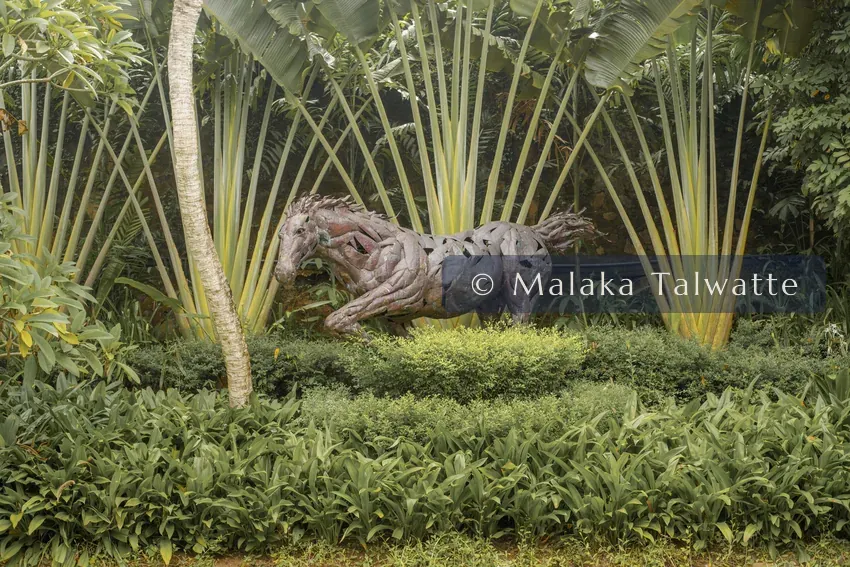
The idea that binds it together is the Japanese principle of wabi-sabi, the willingness to see worth in the flawed and the worn and to make peace with a world that is forever coming into being and passing away, and Prageeth builds that acceptance into the objects themselves. He lets the brass darken and the iron rust, so the surface goes on changing after the piece leaves the studio, and time becomes a collaborator rather than a threat. His answer to the fate of discarded things is to make things that stay honest about their own weathering: the same hand that models the scrap in the round also works in charcoal on paper, and the 2018 exhibition ‘Wanantharaya’ at Saskia Fernando Gallery turned from his earlier structured chaos towards smaller brass creatures drawn from his own jungle, set beside quiet acrylic studies of unusual fauna.
Saskia Fernando Gallery represents him and has shown his sculpture across more than a decade, from ‘Kaputa’ and ‘Gods of Metal’ in 2012 to ‘Wanantharaya’ in 2018, while his public commissions carry the practice well beyond the gallery: a large peacock at Mattala Rajapaksa International Airport, a horse at Panchikawatte Junction in Colombo, and works sited in Singapore and in Malaysia; by his own account he has made more than five thousand pieces of sculpture and assemblage.
He puts the whole undertaking in the plainest terms, taking life to be a forest and himself to be one more tree standing in it, aware of his position and his responsibilities. The creatures welded from the metal others discarded read best in that register, salvaged, patient, and left open to the weather, each one carrying its second life on a surface that has agreed to keep changing.
Sources
- Ocula. Artist profile.
How to cite this profile
Malaka Talwatte, “Prageeth Manohansa,” Malaka Talwatte: Sri Lankan Art and Ceylon Antiquaria, https://malakatalwatte.pages.dev/artists/prageeth-manohansa/.
Quote and cite freely with attribution; please do not republish a whole essay, or a photograph, without permission.