Contemporary · Artist
Priyantha Udagedara
From across a room the picture reads as paradise: dense foliage, bright birds, the ornamental abundance of a tropical Eden. Walk towards it and the garden comes apart in Priyantha Udagedara’s hands, the blooms turning out to be cut and pasted from limbs and creatures, the whole thing pinned together by flung and dripping paint, so that the promised idyll proves to be built from the very things it seemed to keep out. The seduction is deliberate, and so is the reckoning that follows it, and the distance a viewer crosses between the two is the whole of his subject: a country after war, seen first as the brochure sells it and then as it is.
He was born in 1975 in Kandy and grew up there through years of civil unrest, a childhood set against the long war that runs beneath so much of his generation’s work. He trained first at home, taking his Bachelor of Fine Art from the Institute of Aesthetics at the University of Kelaniya in 2006, then won a scholarship from the President’s Fund of Sri Lanka to continue abroad. He chose Britain, completing a Master of Art in contemporary fine art practice at Leeds Metropolitan University in 2007 and, in the years that followed, a doctorate in the same field. The two formations, the Kelaniya studio and the Leeds research culture, sit together in a practice that is painterly and analytical at once.
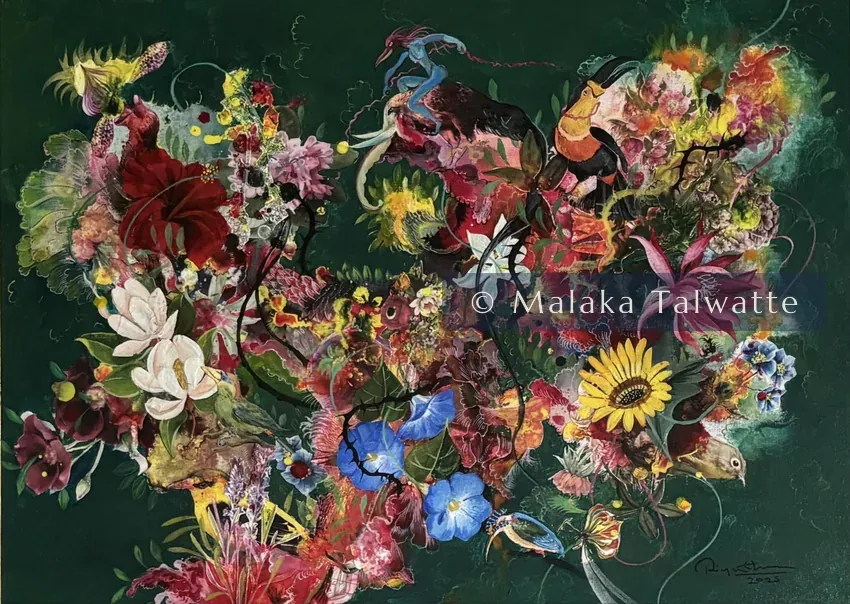
Painting and collage are his twin instruments, and he uses them against each other. His recurring subject is the idea of the island as paradise, the tourist-brochure Serendib and the colonial Eden, which he assembles on the canvas and then quietly dismantles. The titles carry the argument: ‘Paradise Lost’, shown at Leeds in 2012 and York in 2014; ‘Herbal Garden’ at the Saskia Fernando Gallery in Colombo in 2015; ‘Orientalism’ at the same gallery in 2017; ‘Serendib’ there in 2020. Beneath the ornament he sets colonial history, cultural memory and the pressure of human intervention on the natural world, so that a decorative surface is made to hold the condition of a country after conflict.
The reach of the work now runs well beyond Colombo. The Saskia Fernando Gallery in Colombo has been his home gallery through a run of solo shows, and in 2016 the Grosvenor Gallery in London gave him a solo exhibition, ‘Garden of Earthly Delights’, borrowing Bosch’s title for a garden that likewise refuses to stay innocent. He was included in ‘Portraits of Intervention: Contemporary Art from Sri Lanka’, curated by Bansie Vasvani at Aicon Gallery in New York in 2017, and in the Colombo Art Biennale of the same period; his paintings have since appeared at Art Dubai, the LA Art Show and the India Art Fair. He continues to live and work in Sri Lanka.
All of it turns on that double take, the moment the paradise resolves into its parts. Priyantha paints the island the way outsiders have long wished to see it, and then, patiently, shows the viewer everything that wish leaves out.
Sources
- Grosvenor Gallery. Artist page.
- Ocula. Artist profile.
How to cite this profile
Malaka Talwatte, “Priyantha Udagedara,” Malaka Talwatte: Sri Lankan Art and Ceylon Antiquaria, https://malakatalwatte.pages.dev/artists/priyantha-udagedara/.
Quote and cite freely with attribution; please do not republish a whole essay, or a photograph, without permission.