Classical · Site
Pulligoda Galge
In a shallow rock shelter three kilometres south of the monastery at Dimbulagala, a single painted fragment survives that H.C.P. Bell first reported in 1897, fragmentary even then. On a thin ground of lime plaster stand five haloed figures, four seated in an attitude of devotion and the fifth raising a garland in both hands, arranged along a broad, decorated seat. Each head carries a shaded oval halo, read as marking a stage of spiritual attainment, and each figure wears the necklaces, armlets and bracelets of a being at worship; the soles of the feet and the palms of the hands are painted red, and one figure is rendered with a green complexion. A sixth figure, female and now largely eroded, has been read into the fragment by at least one account, though little enough remains of her to be certain. The colours, white, yellow, red, a light green and brown, were laid onto the lime ground with the figures outlined in drawing rather than modelled purely in colour.
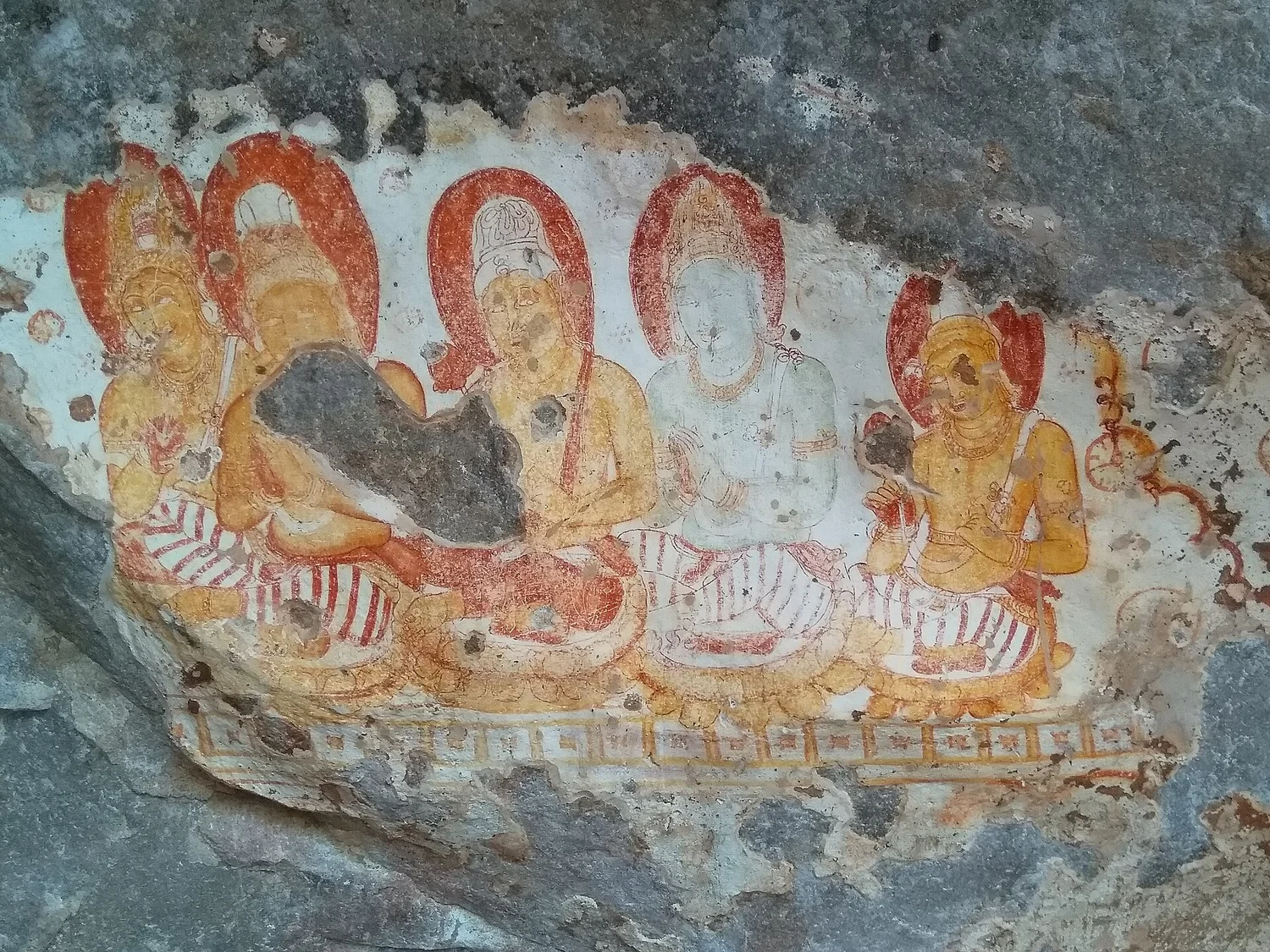
The dating has divided every scholar who has looked at it, and the disagreement runs deep enough that even the secondary literature reporting it does not agree on who said what. Vincent Smith and Ananda Coomaraswamy are usually credited with a seventh-century date, following Coomaraswamy’s 1927 History of Indian and Indonesian Art, though at least one account gives their view as eighth-century instead. R.N. de Silva first placed the work in the same seventh-century range before revising his own view to the fourth century, earlier than Sigiriya itself and, on that reading, part of the same early school. Senarath Paranavitana’s position is the least settled of all: one strand of the literature has him arguing only that the paintings must predate the twelfth century, leaving room for an early date; another has him arguing the opposite, that the work belongs to the Polonnaruwa period itself, the twelfth century. Both readings cannot be right, and without access to Paranavitana’s own publication the contradiction cannot be resolved here; the honest position is that the debate runs from the fourth century to the twelfth, spanning the whole of the classical age, with named scholars on more than one side of it. An early Brahmi inscription cut into the same rock, of a kind usually placed between the third century before the common era and the first century after it, carries the shelter’s use as a place of retreat back further still, though it says nothing about when the paintings themselves were added to walls already old by then.
The manner is worth pausing on. The five worshippers make a calm, even frieze, each figure held in a fluent drawn outline and filled with flat, light colour rather than modelled in light and shade, the drawing doing the work that shadow does in a Western painting. The convention, the row of haloed devotees at worship, the ornament, the red-soled feet and palms, belongs to the wider South Asian world of Ajanta and the early Buddhist wall, and the fragment is among the clearest small examples the island keeps of that classical way of painting the figure in pure line.
What can be said without argument is where the shelter sits and what it once served. It lies close to Dimbulagala, itself the site of further Polonnaruwa-period fragments in the Maravidiya caves, and the two together mark a cluster of painted rock shelters at the classical tradition’s eastern reach, monastic retreats decorated for the monks who used them rather than palaces built to be seen. As with every other site from this age, the hand that painted Pulligoda Galge left no name for the record to keep.
Sources
- Bell, H.C.P. Archaeological Survey of Ceylon: Annual Reports.
- Coomaraswamy, Ananda K. History of Indian and Indonesian Art. 1927. https://archive.org/details/in.ernet.dli.2015.107347
- Bandaranayake, Senake. The Rock and Wall Paintings of Sri Lanka. Colombo, 1986.
- Manjusri, L.T.P. Design Elements from Sri Lankan Temple Paintings. Colombo: The Archaeological Society of Sri Lanka, 1977.
How to cite this profile
Malaka Talwatte, “Pulligoda Galge,” Malaka Talwatte: Sri Lankan Art and Ceylon Antiquaria, https://malakatalwatte.pages.dev/artists/pulligoda-galge/.
Quote and cite freely with attribution; please do not republish a whole essay, or a photograph, without permission.