Kandyan · Site
Ridi Vihara
The rock temple of Ridi Vihara, in the Kurunegala country, holds among the finest of the Kandyan murals. Tradition traces its founding far earlier than the paintings themselves: the temple’s name means ‘silver temple,’ and it is said that King Dutugamunu, having discovered silver ore here in the second century before Christ, used it to help fund the great stupa he was raising at Anuradhapura and consecrated the site in gratitude, a legend the temple carries rather than a documented fact, though it places Ridi Vihara among the island’s very old religious sites, its Kandyan-era murals laid, as at Dambulla, over many centuries of continuous use.
Its upper shrine, the Uda Viharaya, was decorated under Kirti Sri Rajasinha in the eighteenth century, and the earliest of its paintings are given to the hand of Devaragampola Silvattenne Unnanse, the master of Degaldoruwa, among the four temples the king is said to have entrusted to him from 1755 onwards. The remainder of the shrine’s murals are attributed to painters of the Nilagama generation who followed him.
Among the great mural temples of the Kandyan school, later commentary places Ridi Vihara just after Dambulla and Degaldoruwa in the standing of its painting, a ranking that reflects the number and condition of its surviving scenes rather than any real difference in style: Ridi Vihara’s murals share the same outline-led drawing, the same narrow palette of red, yellow and black, with blue and green kept rare, and the same continuous-narrative registers that carry a story along a wall for the devotee to read by walking rather than by standing still.
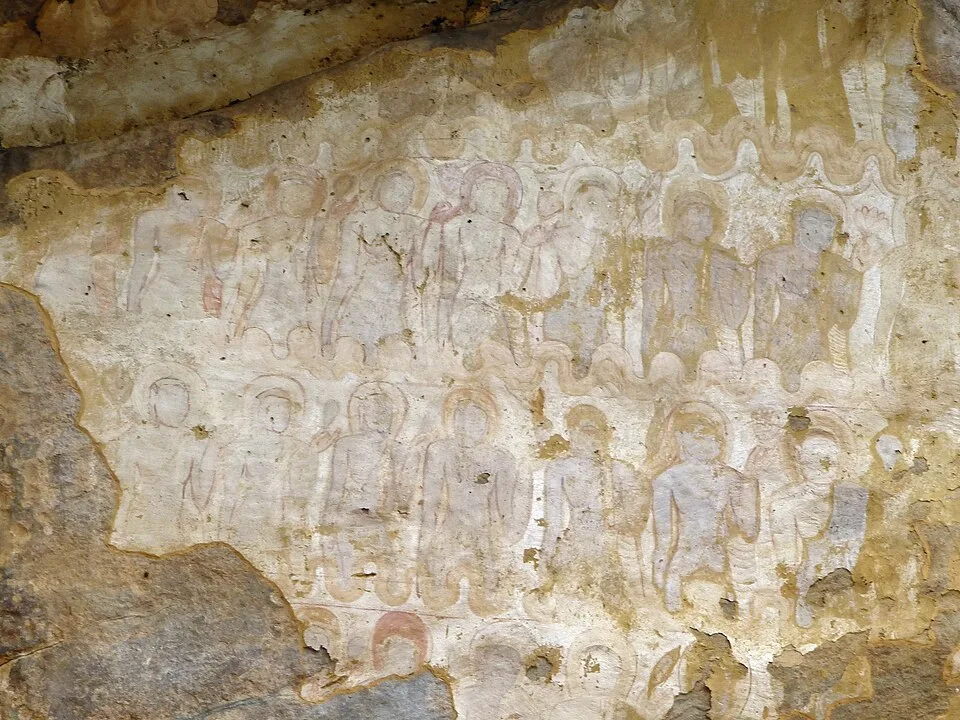
As at Degaldoruwa, the Jataka stories run along Ridi Vihara’s walls in the crowded, exact manner of the age, and the temple gathers painting into a wider display of Kandyan craft: sculpture, a carved makara torana, the ornamental dragon-arched gateway that recurs across the tradition’s finest doorways, and a celebrated ivory-inlaid door frame said, in one account, to be the largest single piece of worked ivory to survive from the island’s craft record, though that particular claim rests on a single source and is offered here with that caution rather than as settled fact. The makara, a mythical crocodile-like sea creature, is one of the most persistent motifs of Kandyan decorative art, carved here into the gateway arch and echoed in metalwork, ivory and textile design elsewhere in the tradition, evidence that Kandyan painters, carvers and ivory workers drew on one shared court vocabulary rather than working as separate, unconnected crafts.
Together the painting, the carving and the ivory work make Ridi Vihara one of the richest single interiors the hill-country tradition left behind, and its double history, an ancient foundation carried forward by an eighteenth-century workshop, places it beside Dambulla as a reminder that a Kandyan-painted temple and an ancient temple are very often the same building at two different moments in its life.
Sources
- Bandaranayake, Senake. The Rock and Wall Paintings of Sri Lanka. Colombo, 1986.
- Gatellier, Marie. Peintures murales du Sri Lanka: école kandyenne, XVIIIe–XIXe siècles. 2 vols. Paris: École française d’Extrême-Orient, 1991.
- de Zoysa, Asoka, Vajira Nalinda Jayathilaka, and Ganga Rajinee Dissanayaka. Evolving Traditions of the Buddhist Image House, Part I.
How to cite this profile
Malaka Talwatte, “Ridi Vihara,” Malaka Talwatte: Sri Lankan Art and Ceylon Antiquaria, https://malakatalwatte.pages.dev/artists/ridi-vihara/.
Quote and cite freely with attribution; please do not republish a whole essay, or a photograph, without permission.