Classical · Site
Ruwanwelisaya
A stupa was a form before it was a building, and the great dagaba that Dutugamunu raised at Anuradhapura about 140 before Christ is the type-specimen of the shape the Sinhalese held most beautiful, the bubble. Tradition says the king asked his builders for a model, and one of them dashed water into a golden bowl and showed him the half-globe a bubble makes on the surface; the Ruwanwelisaya was raised to that profile, a dome swelling from three round terraces to a squared railing and a spire, white against the dry-zone sky.
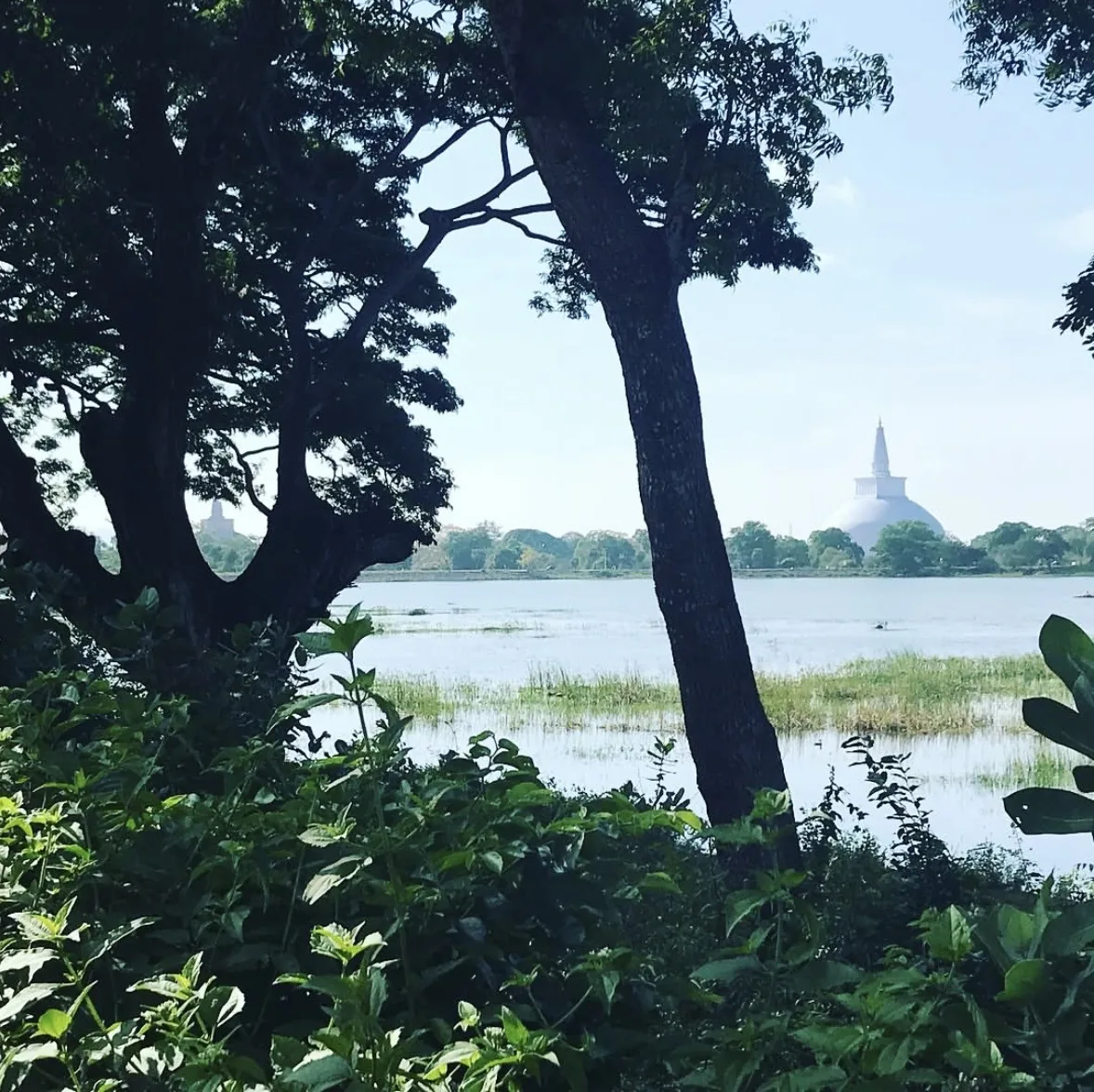
The Sinhalese classified their dagabas by the line of the dome, the bubble and the bell, the heap of paddy, the pot and the lotus, and it is the bubble that is reckoned the noblest and the Ruwanwelisaya its finest example. The form is the art. A pure hemisphere is a heavy, earthbound thing, but the slight swell the bubble profile carries above the hemisphere lifts the whole mass, so the dome seems to rise rather than to sit. It is built to a great scale, the dome some ninety metres high on a base of near the same across and a circumference of about two hundred and ninety. Around the base runs the Elephant Wall, the retaining wall of the terrace faced with a continuous rank of elephant foreparts standing shoulder to shoulder, as though the platform and all it holds were borne on their backs; the elephants there now are largely renewed, but the conceit is ancient, some four hundred of them by tradition.
Dutugamunu, the king who united the island after driving out the south Indian occupier Elara, did not live to see it finished; his brother Saddhatissa completed it, and the chronicle records that the dying king was carried out to look on the dome swathed in white cloth as though done. It is held to enshrine a great measure of the Buddha’s bodily relics, a claim of tradition rather than of the spade. The four vahalkada, the altar-frontispieces at the cardinal points, once carried the kind of relief that is the earliest Sinhalese sculpture, though what stands on the Ruwanwelisaya now is restoration; for that frontispiece carving as it was first cut one must go to the small Kantaka stupa at Mihintale, where it survives.
The richest art of the stupa is the part no one can see. The Mahavamsa, in its account of the making of the Great Stupa, describes the relic chamber sealed within the dome in great detail: a jewelled Bodhi tree with a silver stem and golden fruit, a seated Buddha of gold, and around them the events of the Buddha’s life and the Jataka stories, the enlightenment, the first sermon and the final passing, with the ranks of the gods above. It is among the earliest accounts the island’s literature gives of narrative art, figures set out to be read, though the chronicle names gold rather than paint as the medium, and the chamber itself has never been opened, so the description is a text and not a surviving thing.
That the relic chambers of stupas were in fact painted is known from elsewhere. At Mahiyangana, when the dagaba was restored in the middle of the twentieth century, the relic chamber was opened and its walls found to carry paintings, the Buddha assailed by Mara and enthroned beneath the Bodhi tree among the great gods, most of it fallen in fragments from the plaster and dated, by a coin of the Chola king Rajendra sealed within, to about the eleventh century. It is rare physical proof that the sealed hearts of these domes held pictures as well as relics, some of the oldest painting the island keeps outside the line that runs down from Sigiriya.
The making beneath the plaster was a feat in itself. The Mahavamsa’s account of the foundation, read past its marvels, describes a genuine piece of engineering: the ground dug to bedrock, crushed stone trodden firm and bound with a clay-and-wood-apple slurry, and courses of stone, crystal and metal sheeting laid to seal it, so that the great dome rose on what amounts to a waterproofed raft. The chronicle sets that labour inside an ideal of righteous kingship, recording that Dutugamunu would levy no extra tax and force no man to the work, and paid his builders in full, at a cost it reckons at six and a half million coins. Whitewashed with a lime paint thickened with sago, the finished mound gleamed white above the plain.
The dome we see is itself a modern raising. Ruined and overgrown after the fall of Anuradhapura, the Ruwanwelisaya was rebuilt through the twentieth century by a restoration society formed in 1902, its pinnacle crowned in 1940 and the work carried on to a final crowning in 2019, so that the oldest of the great dome-forms wears, in its white plaster, among the newest surfaces at Anuradhapura. The builders who first shaped the bubble are unknown, as the makers always are; only the king who wished it is remembered.
Sources
- Paranavitana, Senarath. The Stupa in Ceylon (Memoirs of the Archaeological Survey of Ceylon, Vol. V). 1946.
- The Mahavamsa.
- Bandaranayake, Senake. Sinhalese Monastic Architecture. Leiden: Brill, 1974.
- UNESCO World Heritage Centre. ‘Sacred City of Anuradhapura’ (inscribed 1982).
- Ponnamperuma, Senani. The Story of Anuradhapura.
How to cite this profile
Malaka Talwatte, “Ruwanwelisaya,” Malaka Talwatte: Sri Lankan Art and Ceylon Antiquaria, https://malakatalwatte.pages.dev/artists/ruwanwelisaya/.
Quote and cite freely with attribution; please do not republish a whole essay, or a photograph, without permission.