Classical · Site
The Sacred Quadrangle
Within one walled terrace at the heart of Polonnaruwa, the Dalada Maluwa, the kings of the city gathered their holiest buildings: the shrine of the Tooth Relic, the great vatadage, the stone book, and a stepped tower unlike anything else on the island. The quadrangle is the densest gathering of the age’s building in one place, and three of its monuments, beside the Vatadage and the Gal Potha that keep their own account here, are set down below.
The Hatadage
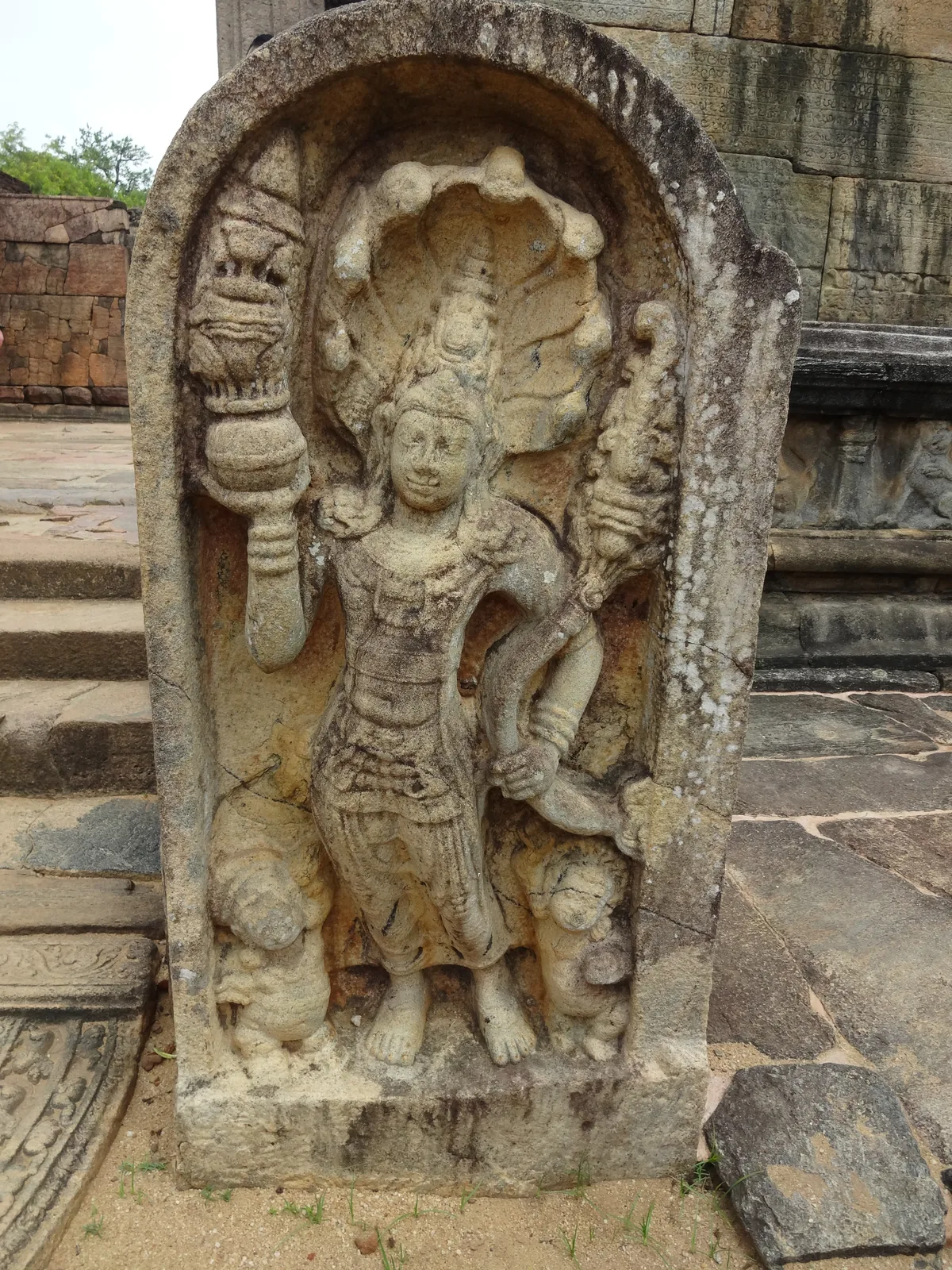
Nissanka Malla raised the Hatadage as a house for the Tooth Relic, and its name, the sixty relic-house, is read either as built in sixty hours, the boast his own stone book and the chronicles repeat, or as the house of sixty relics. It stood two storeys high, the upper chamber that held the relic long gone, and on the ground floor three standing granite Buddhas remain, the middle one the tallest, before a carved doorway with its moonstone and its naga guardstones.
The Atadage
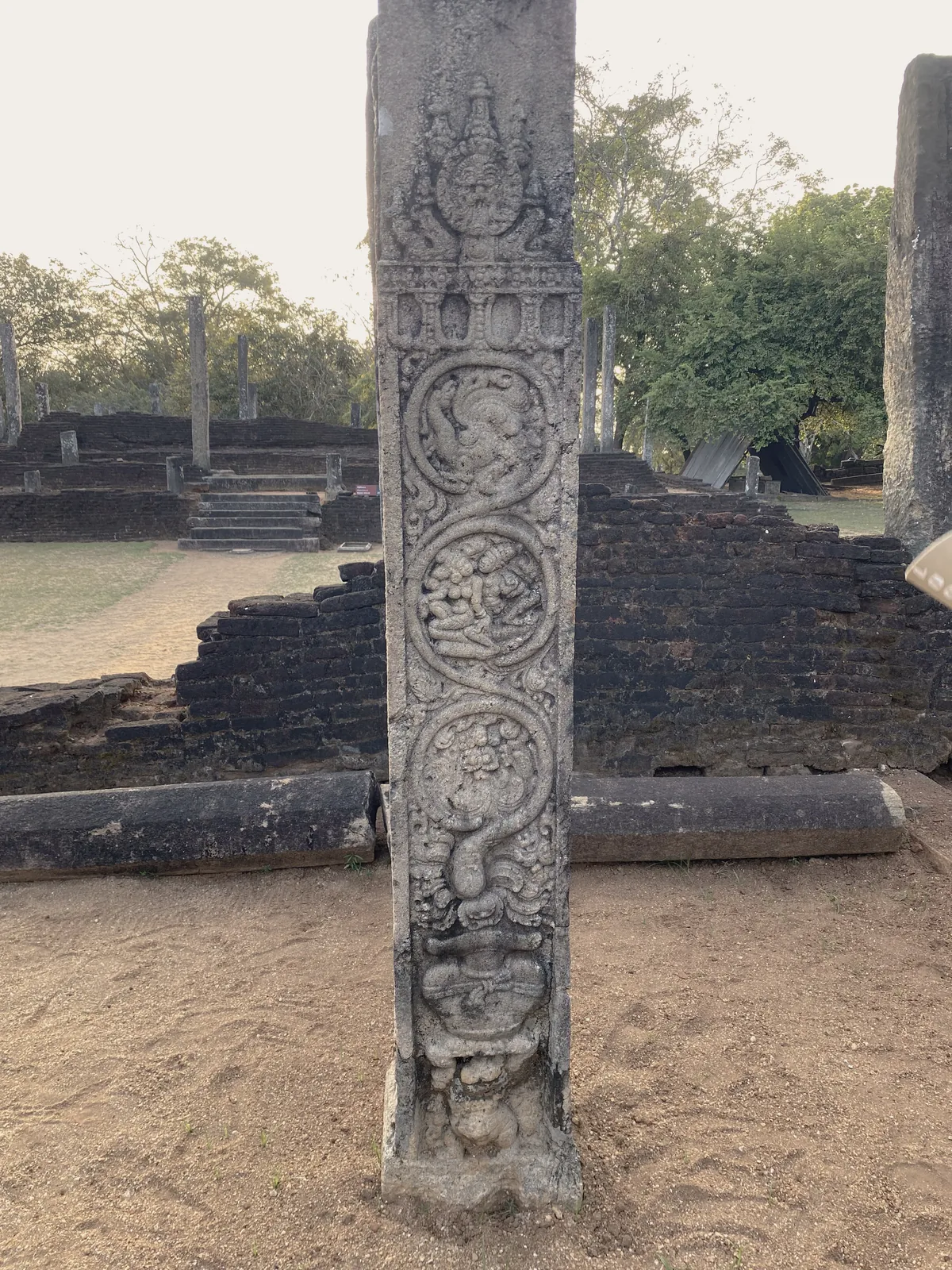
Older than the Hatadage, and the oldest thing in the quadrangle, is the Atadage, the house of eight relics, built by Vijayabahu I in the eleventh century after he drove the Cholas from the city and brought the Tooth Relic back to a Sinhalese capital. Its upper storey of timber, which held the relics, has perished; the stone hall below keeps fifty-four carved pillars. On one of its slabs is cut a Tamil inscription recording that the guarding of the Tooth Relic was given to the Velaikkara, the south Indian mercenary corps then in the king’s service, a telling sign of how mixed the Polonnaruwa court had become.
The Sat Mahal Prasada
In a corner of the quadrangle stands the strangest building in Sri Lanka. The Sat Mahal Prasada, the seven-storey palace, is a stepped pyramid of brick rising in receding tiers, a stucco figure set in a niche at the centre of each face, and nothing else on the island looks like it.
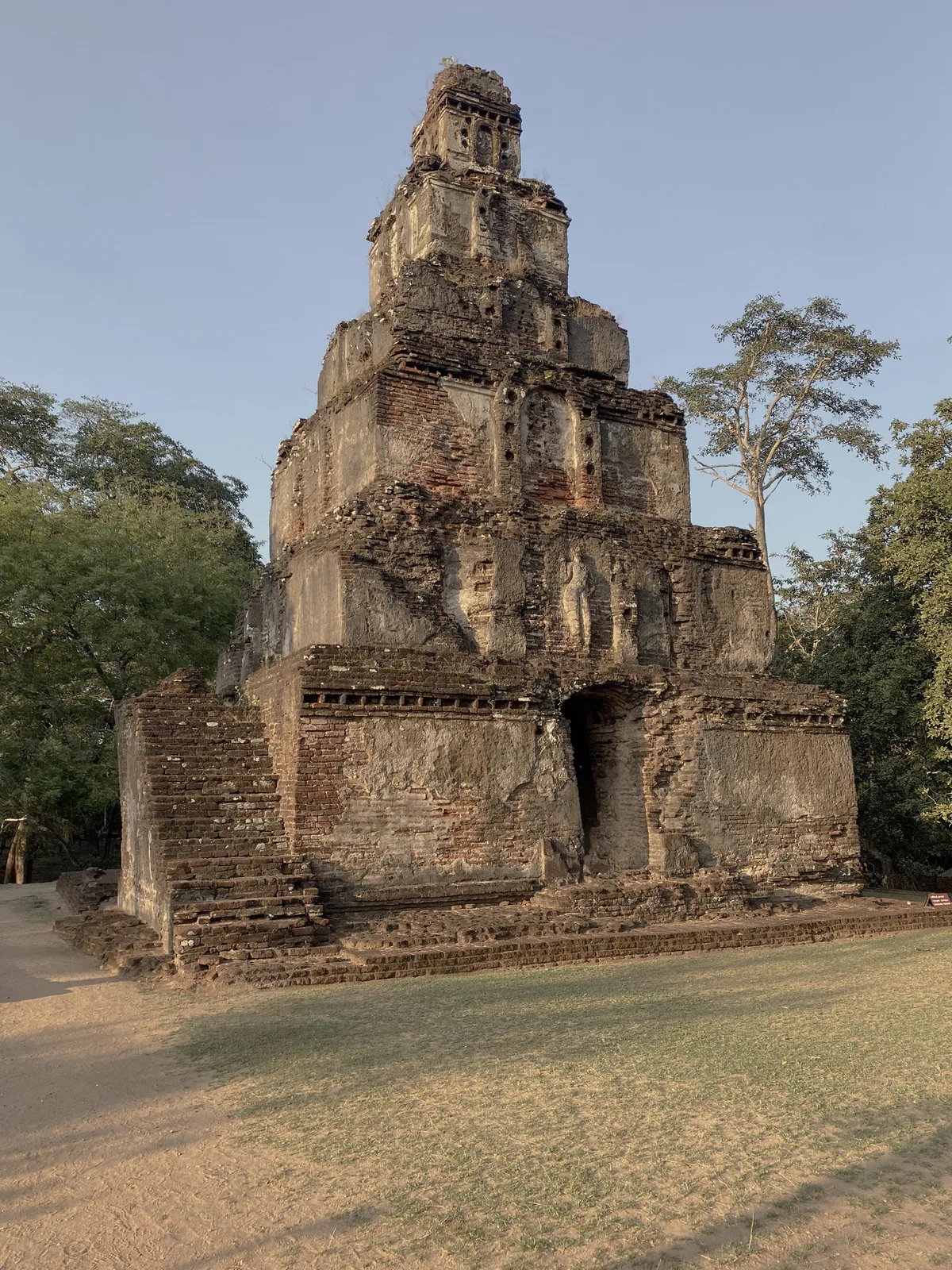
Its form belongs elsewhere, to the stepped towers of South-East Asia, and it is set beside the stupa at Wat Kukut in northern Thailand and the Buddhist building of the Khmer; some read it as the work of Cambodian soldiers in Sinhalese pay, though the link is a guess and the tower’s date and builder are alike unfixed. It stands as the plainest proof in stone of how far the island’s traffic reached in the twelfth century.
Who built and carved these kept no name, as everywhere; the kings who raised them are named in their own inscriptions, and the quadrangle holds their rivalry, Vijayabahu’s relic-house and Nissanka Malla’s beside it, in a single square of ground.
Sources
- Epigraphia Zeylanica. Vol. II.
- Bandaranayake, Senake. Sinhalese Monastic Architecture. Leiden: Brill, 1974.
- Paranavitana, Senarath. Art of the Ancient Sinhalese. Colombo: Lake House, 1971.
- UNESCO World Heritage Centre. ‘Ancient City of Polonnaruwa’ (inscribed 1982).
How to cite this profile
Malaka Talwatte, “The Sacred Quadrangle,” Malaka Talwatte: Sri Lankan Art and Ceylon Antiquaria, https://malakatalwatte.pages.dev/artists/sacred-quadrangle/.
Quote and cite freely with attribution; please do not republish a whole essay, or a photograph, without permission.