Classical · Sculpture
The Samadhi Buddha
The eyes of the seated Buddha at Anuradhapura are hollow, cut to hold the crystal or gem that is thought to have caught the light in them once and is long gone, and what remains is the stillness the sculptor gave the face, a composure so entire that a photograph of it kept Jawaharlal Nehru company through his years in a British jail. He had seen the statue at Anuradhapura, and while he was held at Dehra Dun a friend in Ceylon sent him the photograph, which he set on the table in his cell; the strong, calm features, he wrote, ‘soothed me and gave me strength’. The image he drew that from is a little over two metres of dolomite, a Buddha seated in the posture of meditation, and it is counted among the finest things the island has carved.
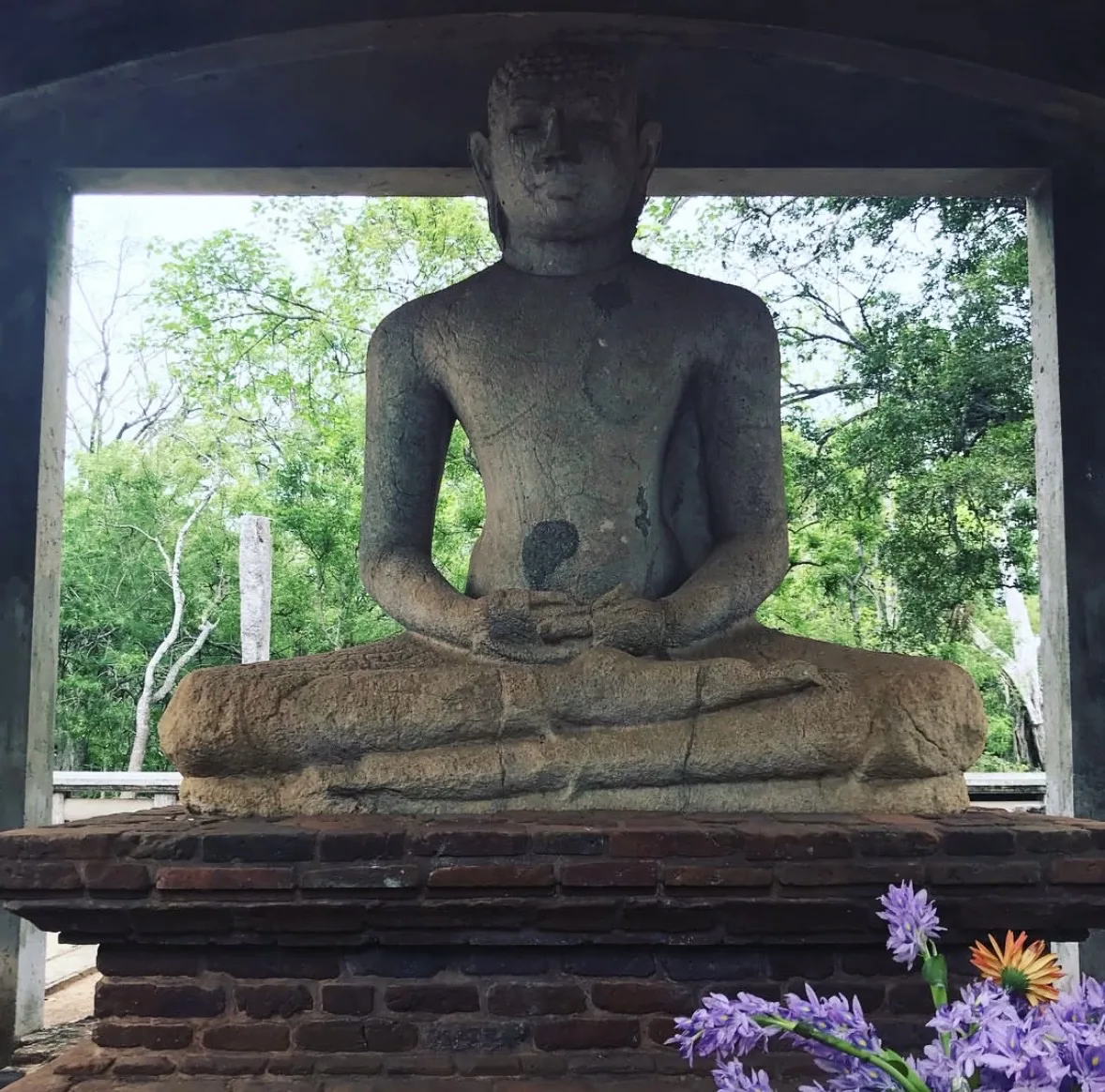
The Buddha sits in the dhyana mudra, the hands laid one upon the other in the lap, the legs folded in the virasana with the soles turned up, the thin robe drawn over the left shoulder and the right left bare, the hair worked in tight snail-shell curls. The power of the image lies in its restraint: the face is composed to the edge of expression and no further, the eyes lowered to a meditation turned wholly inward, and the sculptor has held the whole figure to that single note of absorption without a gesture to break it. In its calm, and in the soft modelling of the body beneath the clinging robe, the statue carries the mark of the Amaravati and Gupta schools of India, the current from which the island’s early Buddha images grew, and it is dated by that resemblance rather than by any inscription to about the third or fourth century, though some would bring it later; the record fixes nothing.
To meet it now in bare grey stone is to meet a fragment of what once stood here. The hollow eyes were made to be filled, with crystal or a precious stone that would have given the gaze its light, and the image is thought to have been gilded in the manner of its Gupta kin, so that the meditating Buddha the pilgrim came to was a gleaming, bright-eyed presence rather than the weathered stone we now admire for its austerity. Colour and inlay are the first things such an image loses, and the loss has, if anything, sharpened the very stillness the sculptor was after.
The statue has come down to us hard used. It was found in 1886 lying fallen on the ground, the nose broken away, and the repair it was given has never sat easily with the original face; treasure-hunters damaged it again in 1914, and a second restoration followed, so that one side of the face reads more worn than the other. It is thought to have been one of four seated Buddhas set about a Bodhi-tree shrine, of which this north-facing image alone survives whole, though that reconstruction rests on slender evidence and is best held lightly. It sits today in the Mahamevnawa park, between the great Abhayagiri stupa and the Kuttam Pokuna, the twin bathing ponds.
Of the sculptor the record keeps nothing, as it keeps nothing of any of them. The classical image-maker of the island worked unnamed, within a fixed canon handed down in the hereditary craft communities that served the monasteries and the crown, so that the achievement here is the tradition’s as much as a single hand’s: the distillation of a whole school’s idea of the meditating Buddha into one seated figure, so sure in its quiet that a picture of it could steady a man in a prison cell, and steadies the pilgrims who still come to sit before it.
Sources
- Coomaraswamy, Ananda K. Mediaeval Sinhalese Art. Broad Campden: Essex House Press, 1908.
- von Schroeder, Ulrich. Buddhist Sculptures of Sri Lanka. Hong Kong: Visual Dharma, 1990.
- Paranavitana, Senarath. Art of the Ancient Sinhalese. Colombo: Lake House, 1971.
- Nehru, Jawaharlal. An Autobiography. London: John Lane, The Bodley Head, 1936.
- Seneviratna, Anuradha. Ancient Anuradhapura: The Monastic City. 1994.
How to cite this profile
Malaka Talwatte, “The Samadhi Buddha,” Malaka Talwatte: Sri Lankan Art and Ceylon Antiquaria, https://malakatalwatte.pages.dev/artists/samadhi-buddha/.
Quote and cite freely with attribution; please do not republish a whole essay, or a photograph, without permission.