Start typing to search the essays, the artists and the collection.
Pre-modern · Artist
Samuel Daniell
Samuel Daniell (1775–1811) came of the most distinguished family of topographical painters in Britain. His uncle Thomas Daniell and his brother William, both Royal Academicians, had between them produced Oriental Scenery, the greatest illustrated work upon India of the period, and Samuel was accounted by many the most gifted of the three. He arrived in Ceylon on 14 August 1805 aboard HMS Greyhound, landing at Galle, and was shortly appointed Assistant Secretary to the Board of Revenue and Commerce, and subsequently Ranger of the Woods and Forests, offices affording him an access to the interior, to its jungles, its fauna and its inhabitants, that no other artist of the period could match.
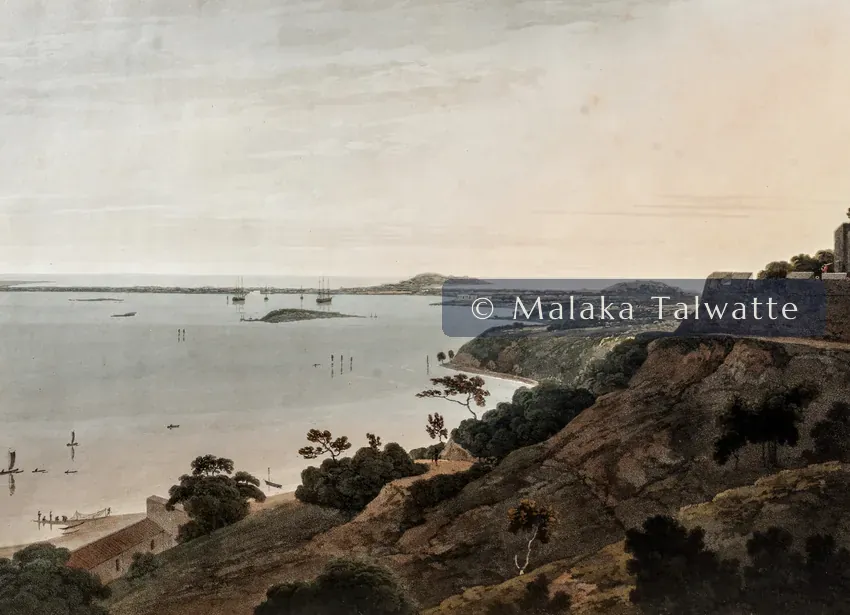
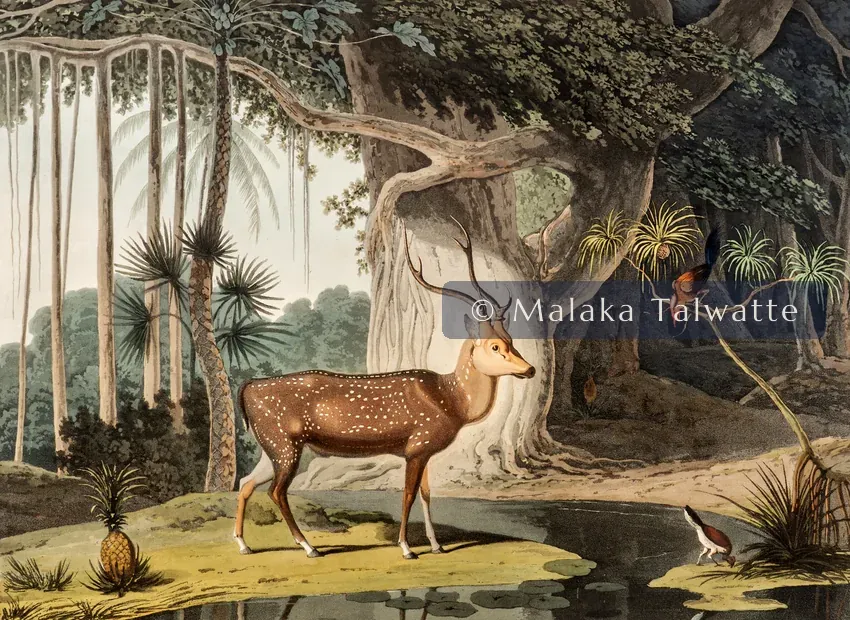
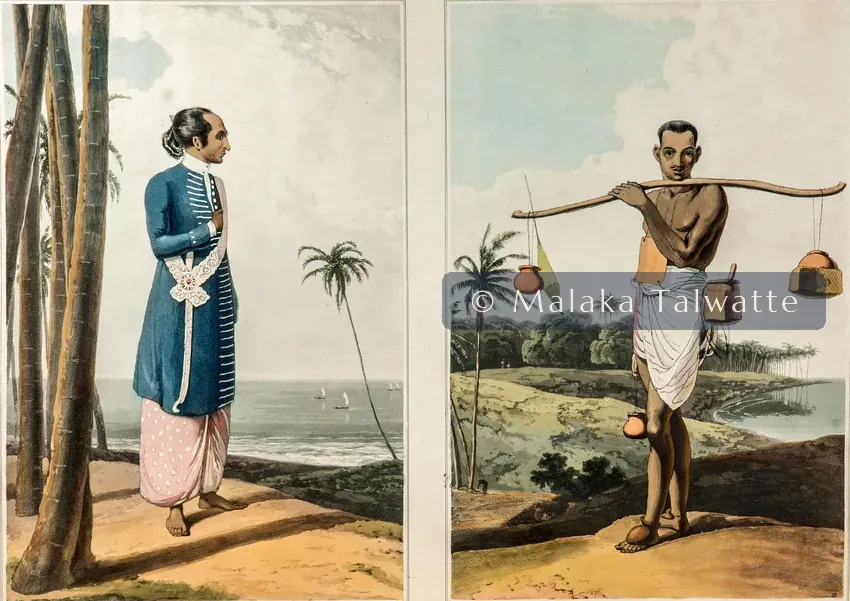
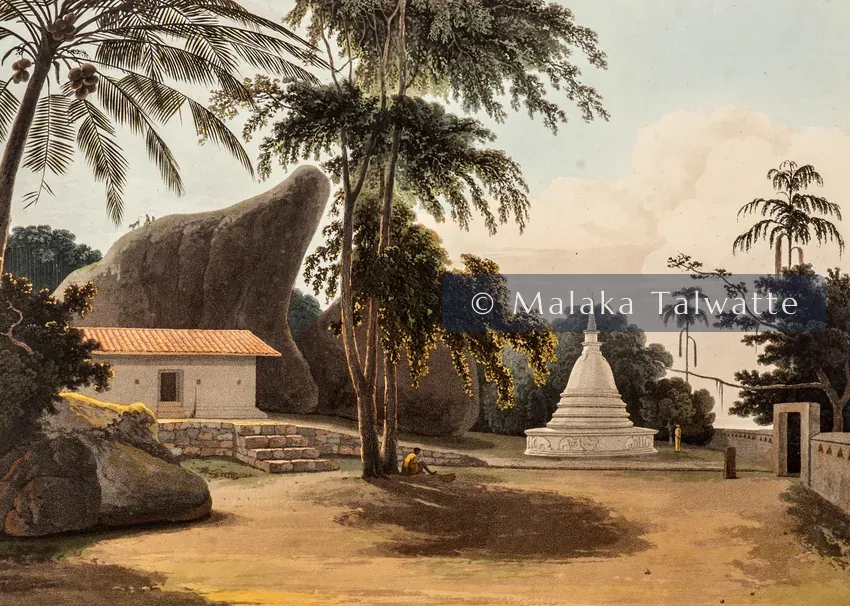
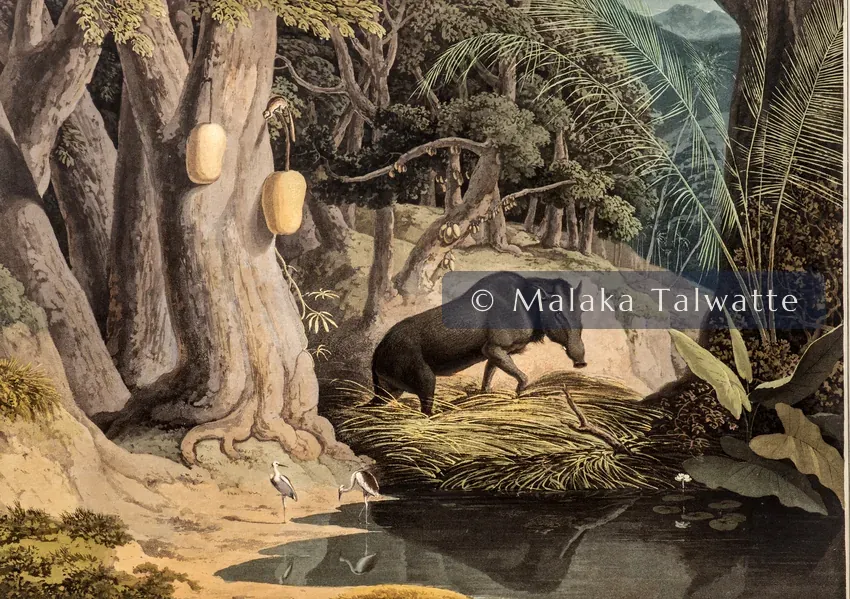
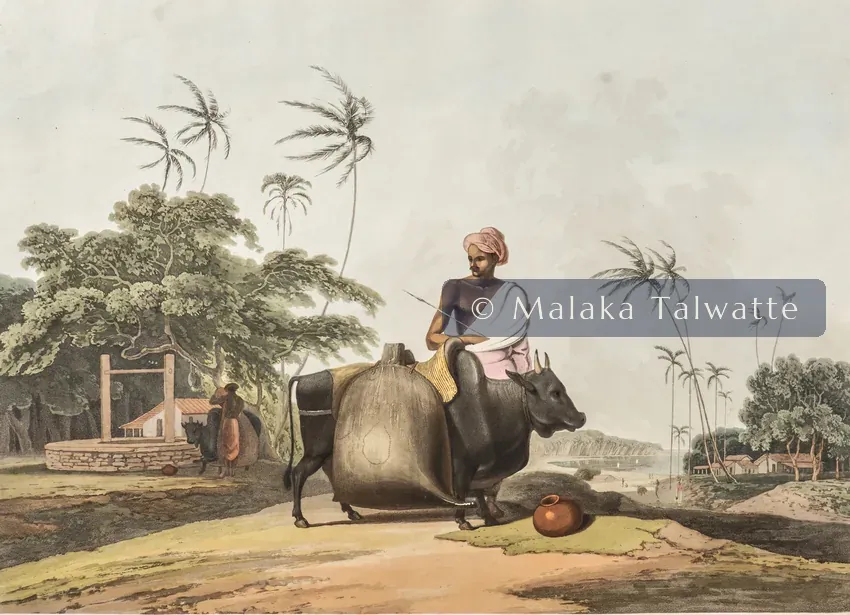
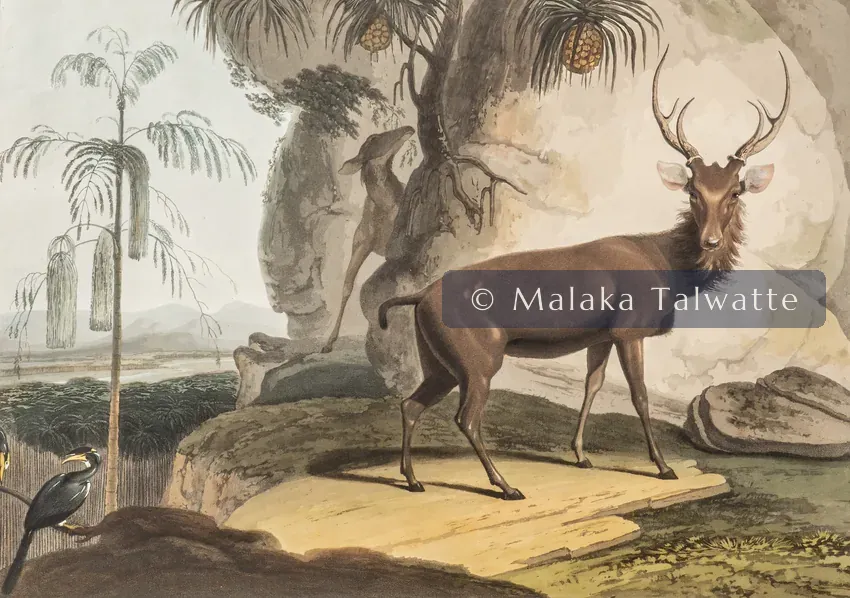
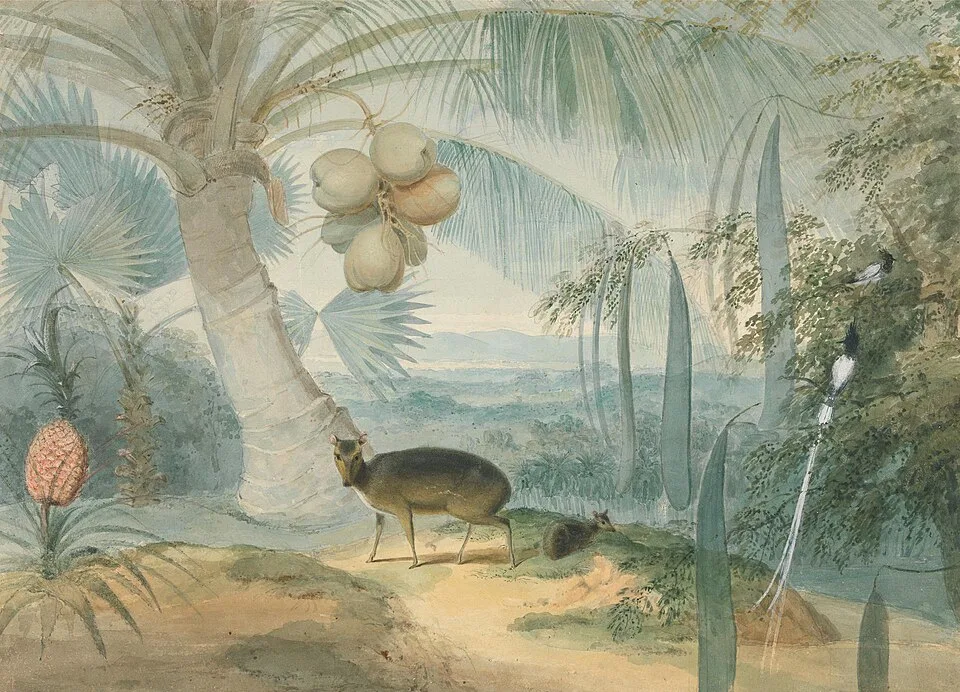
Samuel Daniell, View of the Harbour of Trincomalee, 1808. Hand-coloured Aquatint, 48.5 × 61.5 cm, private collection. The scenery about this noble bay and harbour is bold and romantic. It is surrounded with hills and studded with lands, all of them covered with the most luxuriant shrubbery, the verdure of which is perpetual. The whole surrounding country may almost, indeed, be considered as in a state of nature there being very little cultivation carried on in the neighbourhood of the bay. A few cottages interspersed about the hay coppices tend to render the scenery more exquisitely beautiful. This situation however, is considered as the most unhealthy spot on the island, a circumstance which may be attributed solely to the uncultivated state of the surrounding country. (De Silva, Rajpal Kumar, 1985, Early Prints of Ceylon (Sri Lanka), 1800 to 1900.)Samuel Daniell, The Spotted Stag, 1808. Aquatint, partially printed in colour and hand-coloured, 48.5 × 61.5 cm, private collection. This beautiful animal of the Cervine or deer tribe, is called by the native Cingalese, Muwa. This species abounds in many parts of Ceylon in the vicinity of Close Jungles. Its height is in general, from three to three and a half feet, the colour a chocolate brown; the body marked all over with small round white spots. The male only has horns. The two birds introduced into this print are the male and female of the Jungle Fowl: the former, in the Cingalese language called Wali Keekula, and latter Wali Kikili. The plant on which the male bird is perched, is a species of the Bromelia, or wild pine-apple, which as well as the Ananas, or cultivated pineapple, is very common in all of the Eastern islands. The Cingalese name is Waitakéyiya. The large trunk in the background is the Ficus Indica, or sacred Banyan Tree of India. (De Silva, Rajpal Kumar, 1985, Early Prints of Ceylon (Sri Lanka), 1800 to 1900.)Samuel Daniell, A Mahamodliar and Toddy Gatherer, 1808. Aquatint, partially printed in colour and hand-coloured, 48.5 × 61.5 cm, private collection. The Cingalese are divided into castes of which there are no fewer than nineteen distinct tribes, who can only intermarry with persons of their own rank or profession. The portrait on the right is one of the highest classes of magistrates, known by the name of Modelear. The Maha Modelear at Colombo, is the chief of all the Cingalese, who live under the right of the British government. The other portrait is taken from one of the fourth class, a Durawa, or gatherer of Toddy, or the juice of the cocoa-nut and the palmyra tree, from which the ardent spirit arrack is distilled. (De Silva, Rajpal Kumar, 1985, Early Prints of Ceylon (Sri Lanka), 1800 to 1900.)Samuel Daniell, View Between Galle and Mattura, 1808. Hand-coloured aquatint, 48.5 × 61.5 cm, private collection. The space which this scene occupies is sacred ground, and is situated the distance of about six miles from the southernmost part of the island of Ceylon, called Point de Galle. The humble shed erected near the south rock is named Gal gé, or house of stone. The pyramidal building on the right is a mausoleum, which is supposed to contain the bones of no less a personage than Buddha, the principal and most ancient deity, worshipped by the Cingalese: its name is Véhėra. On one side of the rock there is a figure of Buddha, hewn out of solid stone, in a recumbent posture, which measures in length, eight paces. (De Silva, Rajpal Kumar, 1985, Early Prints of Ceylon (Sri Lanka), 1800 to 1900.)Samuel Daniell, The Wild Hog, 1808. Hand-coloured aquatint, 48.5 × 61.5 cm, private collection. The only remarkable feature about this animal is its snout, which nature seems to have particularly adapted to the employment designed by it, which is that of ploughing up the ground, in search of roots. The Cingalese name of the wild hog is the Wal-uru. The tree in the left hand corner of the print, with the fruit appending to it, is a species of the Artocarpus, or bread-fruit tree, commonly known in the oriental world by the name of Jaca, or the jack-fruit tree: and the species of crane, near the water, distinguished by the Europeans by the name of Paddy Bird, from its visiting the swampy rice grounds, is called by the Cingalese, the Koka. (De Silva, Rajpal Kumar, 1985, Early Prints of Ceylon (Sri Lanka), 1800 to 1900.)Samuel Daniell, The Water Carrier, 1808. Hand-coloured aquatint, 48.5 × 61.5 cm, private collection. The usual mode of carrying water in India from the wells, or tanks, is in bags of leather, either on men's shoulders or across the backs of animals, as in the annexed print. The cattle of Ceylon generally used for this purpose, are of a very diminutive size, with short horns, and a large hump across the shoulders. The most predominant colour is black. They are in fact, the common horned cattle of the continent of India, from whence they are frequently imported into the island, especially after an epidemic of distemper, peculiar to them, has thinned their numbers. They are used to draw in carts and to drag the plough, but the most common manner of employing them, as beasts of burthen, is that represented in the painting. (De Silva, Rajpal Kumar, 1985, Early Prints of Ceylon (Sri Lanka), 1800 to 1900.)
The twelve plates published in 1808 as A Picturesque Illustration of the Scenery, Animals and Native Inhabitants of the Island of Ceylon are among the finest natural-history prints of the Regency. The animal plates are the most striking: a spotted antelope against brilliant tropical foliage, elephants at a watering hole, a leopard within dense jungle, each drawn with a luminous precision rarely equalled in the medium, the antelope having been judged by Thomas Sutton, the Daniells’ biographer, one of the most beautiful ever published. Daniell enjoyed the patronage of Sir Thomas Maitland, Governor of Ceylon; the island he recorded across six years remained very largely unknown to British observers at the time of his death, of malarial fever, at Colombo on 16 December 1811, aged thirty-six. He was buried in an unmarked grave in the Pettah burial ground.
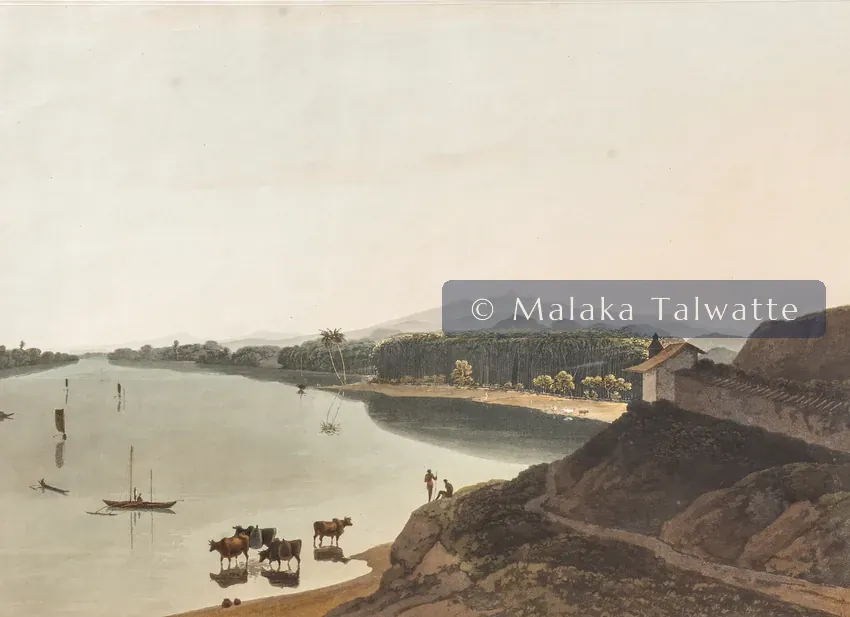
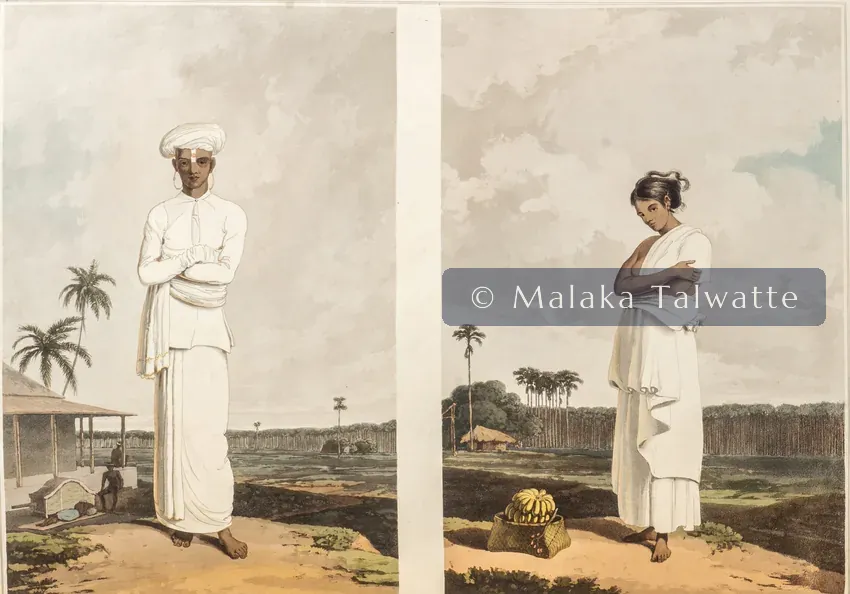
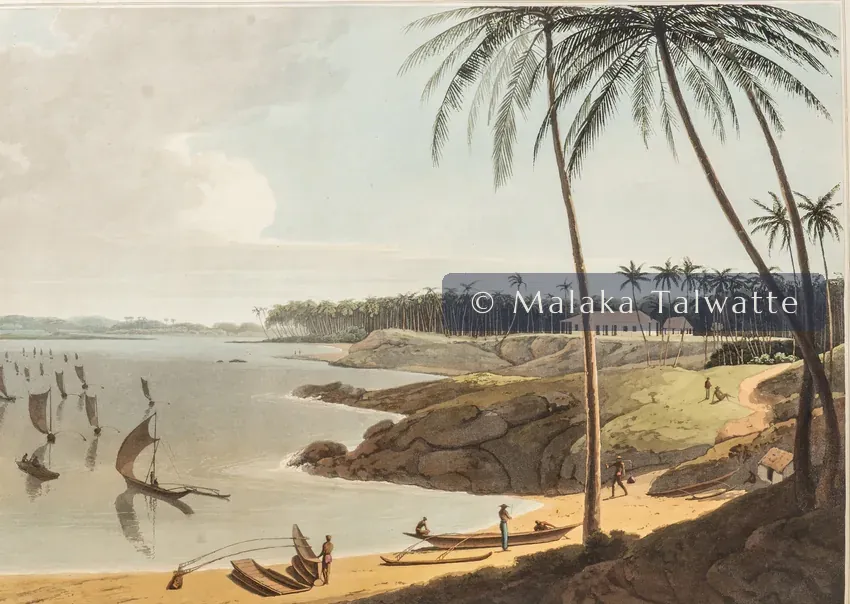
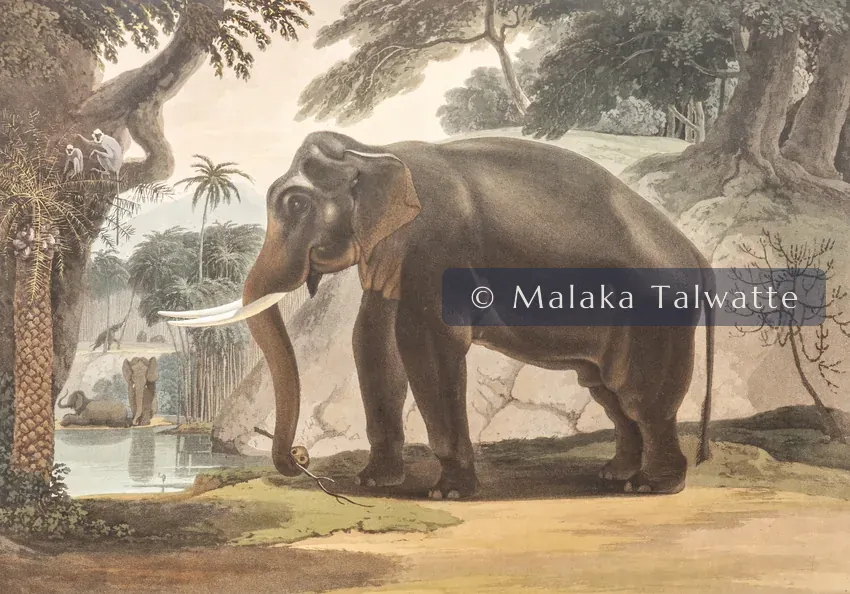
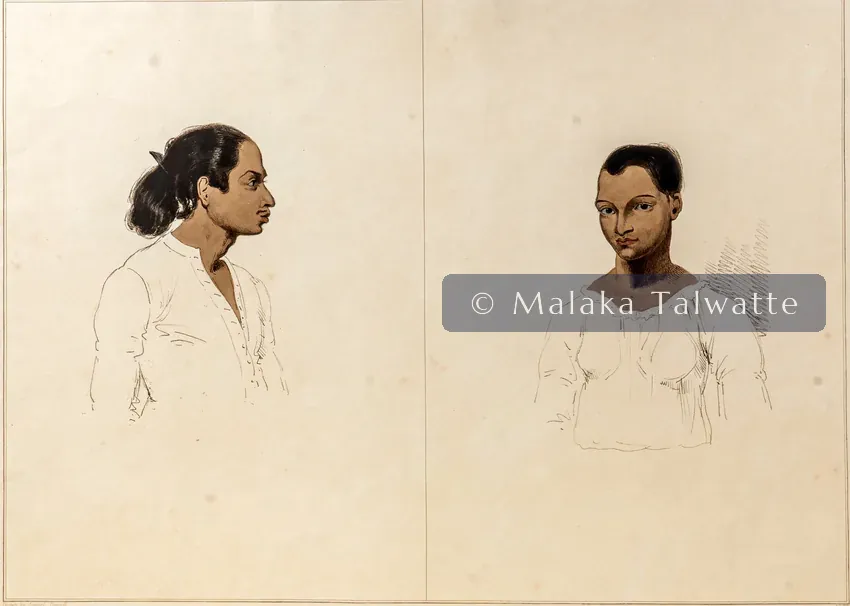
Samuel Daniell, View of Caltura, 1808. Hand-coloured aquatint, 48.5 × 61.5 cm, private collection. The village of Caltura is situated on the banks of a beautiful river, at the distance of about twenty-eight miles from Colombo, with which it communicates by means of inland navigation, partly on rivers and partly artificial canals. The annexed view is taken at the ferry across the river, near which is a small fortification, built upon an eminence, commanding the river. From this delightful situation, the mountain known by the name of Adam's Peak is distinctly visible. The banks of the river and the neighbourhood of the village of Caltura are finely clothed with the Teak tree, and the Cocoa and the Palmyra also abound. The inhabitants of the village are chiefly Cingalese. (De Silva, Rajpal Kumar, 1985, Early Prints of Ceylon (Sri Lanka), 1800 to 1900.)Samuel Daniell, The Elk, 1808. Aquatint, partially printed in colour and hand-coloured, 48.5 × 61.5 cm, private collection. This animal which, except for his short mane on the neck and throat, partakes very much of the stag kind, is found in great plenty near all the woods and thickets of the island. The individual from which the annexed representation was taken was a young male; it measured in height from the top of the shoulder to the fore hoof, four feet. The name of the Elk in the Cingalese language is Gona. The tree on the right hand is singular in its appearance. It is a species of that genus of the palm-tribe, which botanists call Caryota (frondibus bipinnatis). The Cingalese is Kitool. The fruit above the animal is the Bromelia, or wild pineapple; and the bird in the right hand corner of the print, is a species of the Rhinoceros bird or Hornbill. (De Silva, Rajpal Kumar, 1985, Early Prints of Ceylon (Sri Lanka), 1800 to 1900.)Samuel Daniell, Portraits of a Gentoo Man and Woman, 1808. Aquatint, partially printed in colour and hand-coloured, 48.5 × 61.5 cm, private collection. Towards the northern coast of the island, are great numbers of inhabitants who are descendants of the Malabars. The annexed portraits are representations of a Gentoo Chitty man and woman of Jaffnapatnam, of Gentoos professing Christianity. These are in every respect a much superior race to the Cingalese. If, however, they are more active, more intelligent and more enterprising, they are at the same time, more addicted to vicious pursuits. Their dress like that of the Malabars on the coast of India, is generally composed of one single piece of calico, or white muslin, tastefully wrapped round the body; the men wear turbans, but the women are always bare headed. The men are remarkably fond of wearing enormously large earrings, which are sometimes set with stones of considerable value. (De Silva, Rajpal Kumar, 1985, Early Prints of Ceylon (Sri Lanka), 1800 to 1900.)Samuel Daniell, A View of the Fishing Cove, Near Colombo, 1808. Hand-coloured aquatint, 48.5 × 61.5 cm, private collection. Daniell's view is taken looking north along the coast, from Colombo. The building shown on the right is almost certainly what started as a whist club soon after the British occupation of Colombo, in 1796. The Kelani river, whose source is on the western slopes of the Adam's Peak range, meanders via Hatton, Yatiyantota, Avissawella and Hanwella and flows into the sea at Mutwal a few miles north of Colombo. (De Silva, Rajpal Kumar, 1985, Early Prints of Ceylon (Sri Lanka), 1800 to 1900.)Samuel Daniell, The Elephant, 1808. Aquatint, partially printed in colour and hand-coloured, 48.5 × 61.5 cm, the Talwatte Collection. There are few animals, on the subject of which more has been written than on the Elephant, and few objects, till of late years, so inaccurately represented by the pencil. In Ceylon, this creature attains to the largest size of which the species seems capable, and is found in numbers in many parts of the island. In the neighbourhood of those places which they inhabit they are a dreadful scourge to the poor peasantry, by their nightly visits to the paddy grounds and plantations of the cocoa-nut. (De Silva, Rajpal Kumar, 1985, Early Prints of Ceylon (Sri Lanka), 1800 to 1900.)Samuel Daniell, Portraits of a Cingalese Man and Woman, 1808. Hand-coloured aquatint, 48.5 × 61.5 cm, private collection. The great mass of the people who inhabit the island of Ceylon may by divided into three distinct classes; the Cingalese, the Candians and the Malabars. The two first, seem to have sprung from the same origin, but have since been divided by local and political circumstances. The annexed portraits are Cingalese, from the Candian territories; they are a mild and inoffensive race of men, living chiefly on the fruits and other spontaneous produce of the earth. (De Silva, Rajpal Kumar, 1985, Early Prints of Ceylon (Sri Lanka), 1800 to 1900.)A landscape in Ceylon, with barking deer (c. 1808), aquatint after his drawing. Source
Sources
Talwatte, Malaka. ‘19th Century Views of Ceylon by British Artists’.
Oriental Scenery.
De Silva, Rajpal Kumar. Early Prints of Ceylon (Sri Lanka), 1800 to 1900. London: Serendib Publications, 1985.
A Picturesque Illustration of the Scenery, Animals and Native Inhabitants of the Island of Ceylon. 1808.
The Talwatte Collection.
How to cite this profile
Source noteExtracted verbatim from Malaka Talwatte, '19th Century Views of Ceylon by British Artists'. Where this page reproduces a previously published essay, cite that original in preference to this page.
Malaka Talwatte, “Samuel Daniell,” Malaka Talwatte: Sri Lankan Art and Ceylon Antiquaria, https://malakatalwatte.pages.dev/artists/samuel-daniell/.
Quote and cite freely with attribution; please do not republish a whole essay, or a photograph, without permission.