Classical · Site
The Shiva Devales
Among the Buddhist monuments of Polonnaruwa stand Hindu temples of cut stone, and they are the best-preserved Dravidian architecture the island holds. The Shiva Devales, the shrines of Shiva, were built during and after the two generations the south Indian Cholas ruled the city, and where the Sinhalese raised their great works in brick, these are built in finely dressed granite laid without mortar, so that they have outlasted the brick monuments around them almost whole.
Siva Devale No. 2
The building reckoned the oldest surviving at Polonnaruwa is a Hindu one. Siva Devale No. 2 was raised under Chola rule in the early eleventh century, and a Tamil inscription on it names it the Vanavan Madevi Isvaram, the temple of Vanavan Mahadevi, a queen of the emperor Rajaraja the Great. It keeps the plan of a south Indian temple, the small dark cell for the god, a vestibule, a porch, and its stone dome survives, a thing no brick shrine of the city can show.
Siva Devale No. 1
Siva Devale No. 1 is the finer of the two in its masonry, its granite blocks cut and fitted so closely that the joints all but vanish, in a manner that argues either stone brought from the south or south Indian masons at the work. Its date is argued: some place it in the Chola century, others, on the style of the stonework, as late as the thirteenth. Around and beneath it H.C.P. Bell, digging in 1907 and 1908, found the hoard of bronze images, the dancing Shiva and his goddesses, that are the finest metal sculpture the island holds, so that the temple and the bronzes tell one story of the Hindu, Chola-descended art that took root at Polonnaruwa.
Who built the devales and cast the bronzes kept no name, and the temples stand for the layer of the city’s life that was not Buddhist, the Saiva worship of its Chola rulers and of the Sinhalese kings who kept the shrines after them.
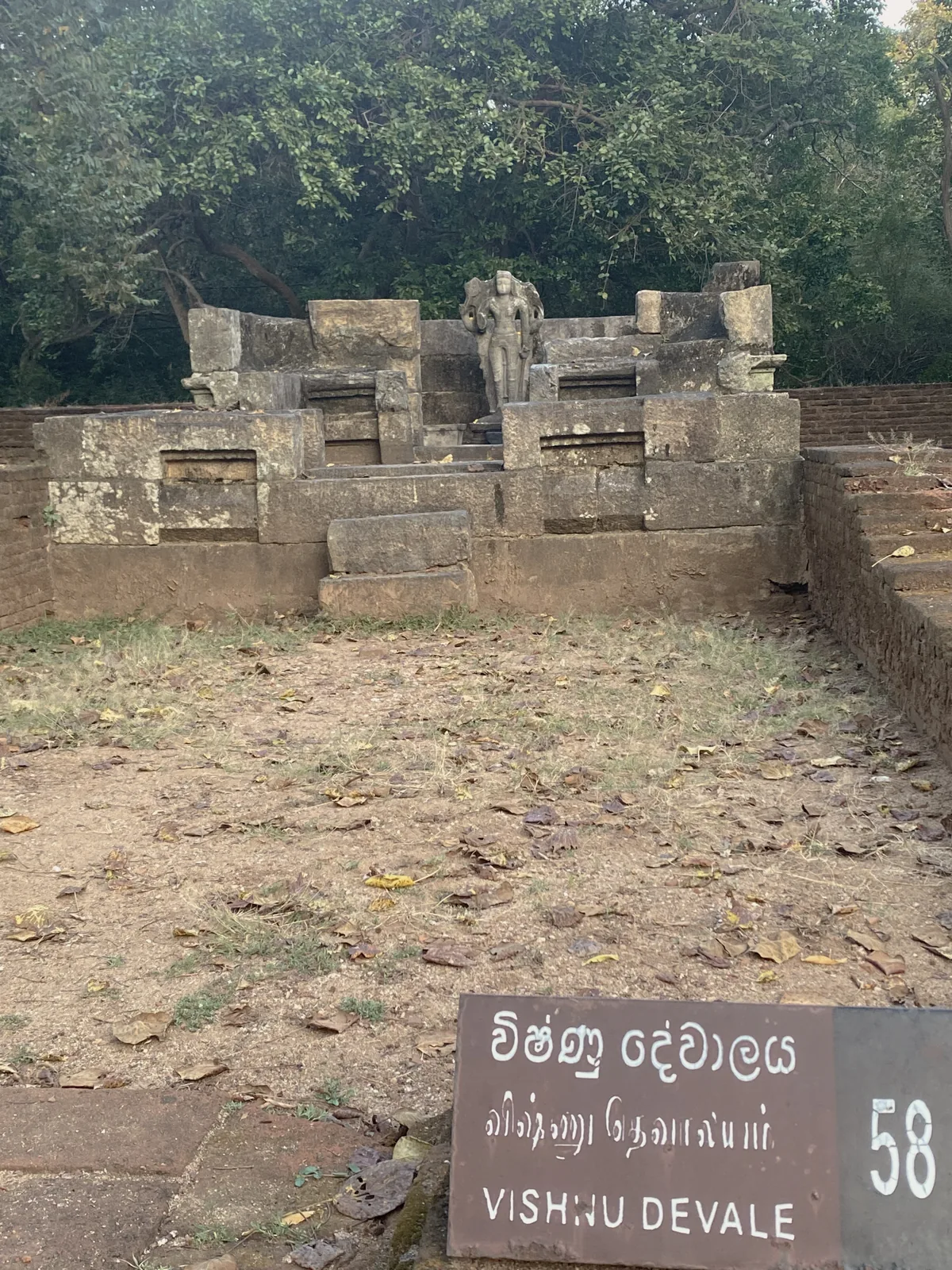
The Saiva shrines were not alone. Hindu temples to Vishnu stood at Polonnaruwa as well, the Vishnu devales, worn now to their brick and the ruin of a standing image, the mark of the same mixed devotion the Chola centuries left in the Buddhist city.
Sources
- Bell, H.C.P. Archaeological Survey of Ceylon: Annual Reports (1907–08).
- von Schroeder, Ulrich. Buddhist Sculptures of Sri Lanka. Hong Kong: Visual Dharma, 1990.
- Bandaranayake, Senake. Sinhalese Monastic Architecture. Leiden: Brill, 1974.
- UNESCO World Heritage Centre. ‘Ancient City of Polonnaruwa’ (inscribed 1982).
How to cite this profile
Malaka Talwatte, “The Shiva Devales,” Malaka Talwatte: Sri Lankan Art and Ceylon Antiquaria, https://malakatalwatte.pages.dev/artists/shiva-devales/.
Quote and cite freely with attribution; please do not republish a whole essay, or a photograph, without permission.