Classical · Site
Sigiriya
High on the western face of the rock at Sigiriya, in the reign of King Kashyapa I between 477 and 495, painters set down the figures that remain the most famous images the island has made. Graffiti scratched into the Mirror Wall below speaks of some five hundred women once ranged across the rock face; today seventeen survive; the twenty-two often quoted was the number D.A.L. Perera copied in 1896, before later losses and the vandalism of 1967. The rest were lost to weather, to the collapse of unsheltered plaster, and to time.
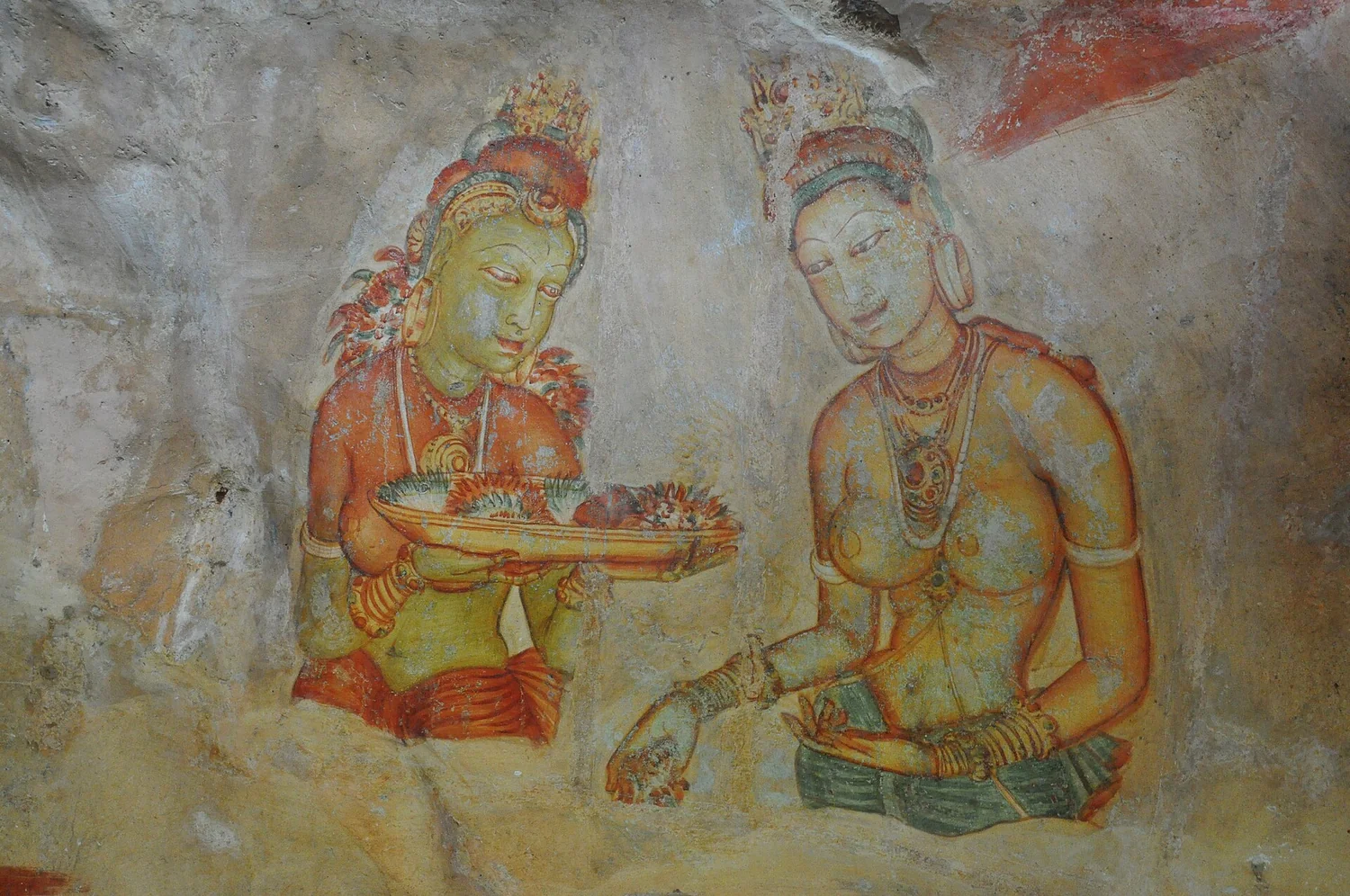
The women, and the argument over them
Who the women are has never been settled, and the debate carries named positions rather than passing guesses. Ananda Coomaraswamy read them as apsaras, celestial nymphs in a long South Asian tradition, and that view remains the popular one. H.C.P. Bell, the pioneering archaeologist who first excavated the site, thought them the ladies of Kashyapa’s court on a devotional procession to the shrine at Pidurangala across the plain, a reading most later scholars have set aside. Senarath Paranavitana proposed instead that the figures were cloud-damsels and lightning-princesses of Alakamanda, the legendary cloud-city of the god Kubera, though his later, more speculative decipherments have drawn scholarly caution, and this reading should be weighed with that in mind. Senake Bandaranayake, who led Sigiriya’s modern conservation project and wrote its standard monograph, took a synthesising view: that the figures may carry more than one meaning at once, apsaras and also evocations of courtly grandeur, their jewellery and dress drawn from the life of Kashyapa’s own court.
A fifth position stands apart, and it is the most sustained single study of the images. Raja de Silva, the Archaeological Commissioner who cleaned the paintings after the vandalism of 1967, argued in a monograph of 2002 that the women are the goddess Tara, the great compassionate deity of the Mahayana, painted over and over across the rock, and that Sigiriya itself was a Buddhist monastery rather than Kashyapa’s palace. His evidence is iconographic and closely looked: the hand-gestures matched to the canonical descriptions of Tara and to Tara bronzes cast on the island, the ranked ornaments, and above all the small line on the brow of several figures, which he read as the urna, the mark that iconography reserves for a Buddha or a great being and withholds from a mere nymph. The identification has not carried the field, and his re-dating of the paintings away from Kashyapa is held with caution; the state heritage authorities and the standard survey keep to the royal city and the celestial women. The looking behind it, though, is unmatched.
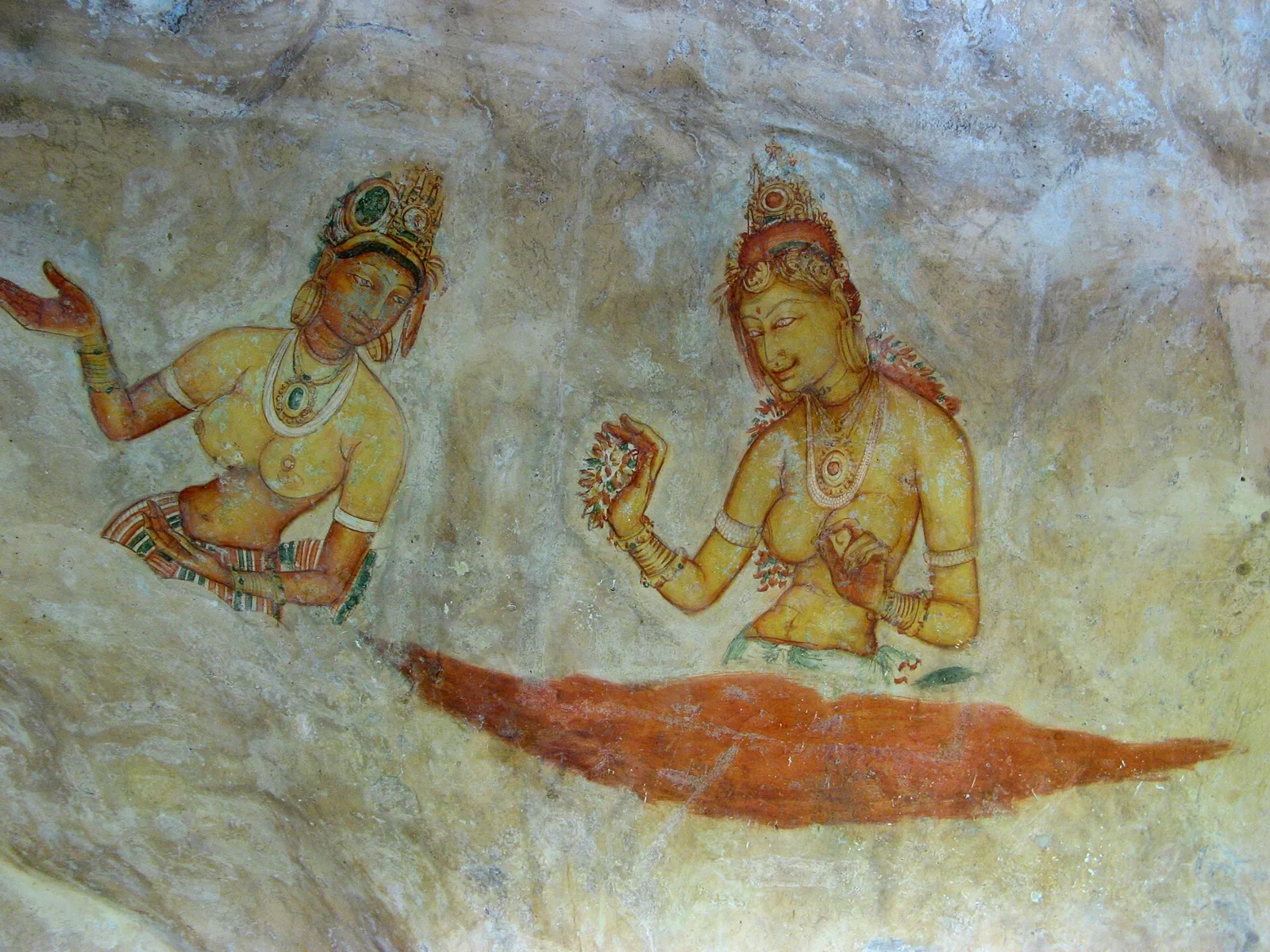
The line, the colour and the technique
What the eye takes first is the drawing. The figures are built with almost no shadow, and their roundness is carried by the contour alone: the celebrated ‘Sigiriya line’, swept on with more pressure to one edge than the other, so that a single stroke deepens in tone as it turns and the figure swells into volume. The painter reached it by stages that remain visible on the plaster, lighter trial lines in red, yellow and black beneath the final dark contour, the corrections that Coomaraswamy identified with the ‘eight limbs’ of the old Indian canon rather than with any fault of hand. The palette is small and warm, the red and yellow of iron-earth ochres, a carbon black, a green earth; and one colour is absent altogether, for there is no blue in the painted pocket. Bell thought the omission remarkable, the more so beside Ajanta in central India, where blue is used freely and to which the Sigiriya work is most often compared, the Sigiriya line being judged the freer and looser of the two hands.
How the colour was fixed is disputed. Some scholars have argued for true fresco, paint laid into wet plaster, or the related fresco lustro; Raja de Silva, whose micro-chemical analysis found both a vegetable gum and a drying oil in the paint film, held there is no evidence of a wet-plaster technique anywhere on the island, and read Sigiriya as an oil-emulsion tempera laid on the dry ground. A recent gas-chromatography analysis, finding wood-apple gum and dorana oil, has tended the same way, so the tempera reading now has the better of the argument, though the older fresco term clings to the pocket by long habit.
The Mirror Wall
Below the frescoes runs the Mirror Wall, a plastered rampart polished to a shine, on which visitors across the centuries scratched verses to the painted women above them. Paranavitana deciphered and published six hundred and eighty-five of them in 1956, in the two-volume Sigiri Graffiti that remains the founding study of the corpus; the wall is thought to carry somewhere between twelve hundred and eighteen hundred verses in total, since later scholars have continued to publish batches he did not reach. The verses date from the eighth to the tenth centuries, several hundred years after the paintings, and are counted among the earliest surviving Sinhala poetry, so the rock preserves both the island’s first great painting and some of its first written verse.
Defacement, rescue and record
The frescoes were first fully copied in 1896 by D.A.L. Perera, the head draughtsman of the Archaeological Survey, who worked nineteen weeks on a platform slung from the cliff; his copies hang today in the Colombo Museum, the oldest full record of the paintings anywhere. In October 1967 a vandal daubed commercial green paint across fourteen of the nineteen figures then surviving, hacking the head from one and the body from another and stabbing a third; de Silva led the emergency cleaning, and the Italian conservator Luciano Maranzi, sent through the international conservation centre at Rome with UNESCO’s help, restored what could be saved by the spring of 1968, setting reconstructions in true fresco where the two ruined figures had stood. Even the original extent is argued rather than fixed: the paintings are thought to have once run far along the western face, of which the sheltered pocket is a small remnant. Sigiriya was inscribed as a UNESCO World Heritage Site in 1982.
Of the painters who did the work, in a reign of eighteen years, nothing at all is recorded.
Sources
- de Silva, Raja. Sigiriya Paintings. Colombo, 2002.
- Bandaranayake, Senake. Sigiriya: City, Palace and Royal Gardens. Colombo, 2005; and The Rock and Wall Paintings of Sri Lanka. Colombo, 1986.
- Paranavitana, Senarath. Sigiri Graffiti: Being Sinhalese Verses of the Eighth, Ninth and Tenth Centuries. Oxford University Press, 1956.
- Coomaraswamy, Ananda K. Mediaeval Sinhalese Art. 1908.
- Bell, H.C.P. Archaeological Survey of Ceylon: Annual Reports.
- The Central Cultural Fund of Sri Lanka; UNESCO World Heritage listing (Ancient City of Sigiriya, inscribed 1982).
- ‘An Analytical Review of Ancient Coating Technology Employed at Sigiriya, Sri Lanka’. npj Heritage Science, 2025.
How to cite this profile
Malaka Talwatte, “Sigiriya,” Malaka Talwatte: Sri Lankan Art and Ceylon Antiquaria, https://malakatalwatte.pages.dev/artists/sigiriya/.
Quote and cite freely with attribution; please do not republish a whole essay, or a photograph, without permission.