Transitional · Artist
Solias Mendis
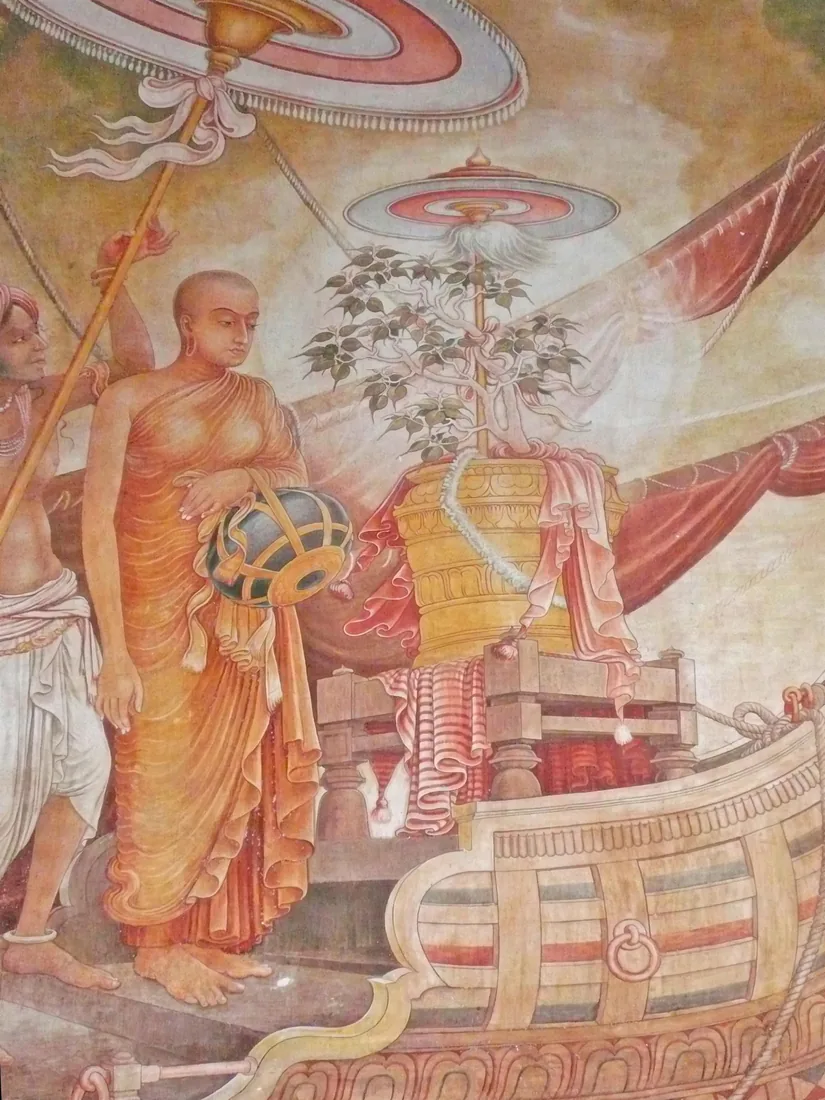
On the inner walls of the Kelaniya Raja Maha Vihara, a few miles from Colombo, the long history of Buddhism on the island unfolds in continuous colour: the Buddha’s visits to Kelaniya and Mahiyangana, the coming of Vijaya, the bearing of the sacred Bo sapling and the tooth relic to Lanka. One painter, Walimuni Solias Mendis, gave some twenty years of his life to those walls, and they stand today as his monument.
He was born on 12 July 1897 at Madampe, near Chilaw, into a family that intended him for Ayurvedic medicine. He was drawn instead to painting, and learned it first from his uncle Memonis Silva, himself a master of the craft. To deepen it he travelled to India, studying the Buddhist cave paintings of Ajanta, Ellora and Bagh and the sculpture of Sarnath, and returned resolved to marry the classical Sinhalese tradition to what he had seen. An early set of mentor-portraits at the Meddepola Raja Maha Vihara, dated to about 1911, shows him working first within the popular idiom he would later leave behind.
The walls at Kelaniya
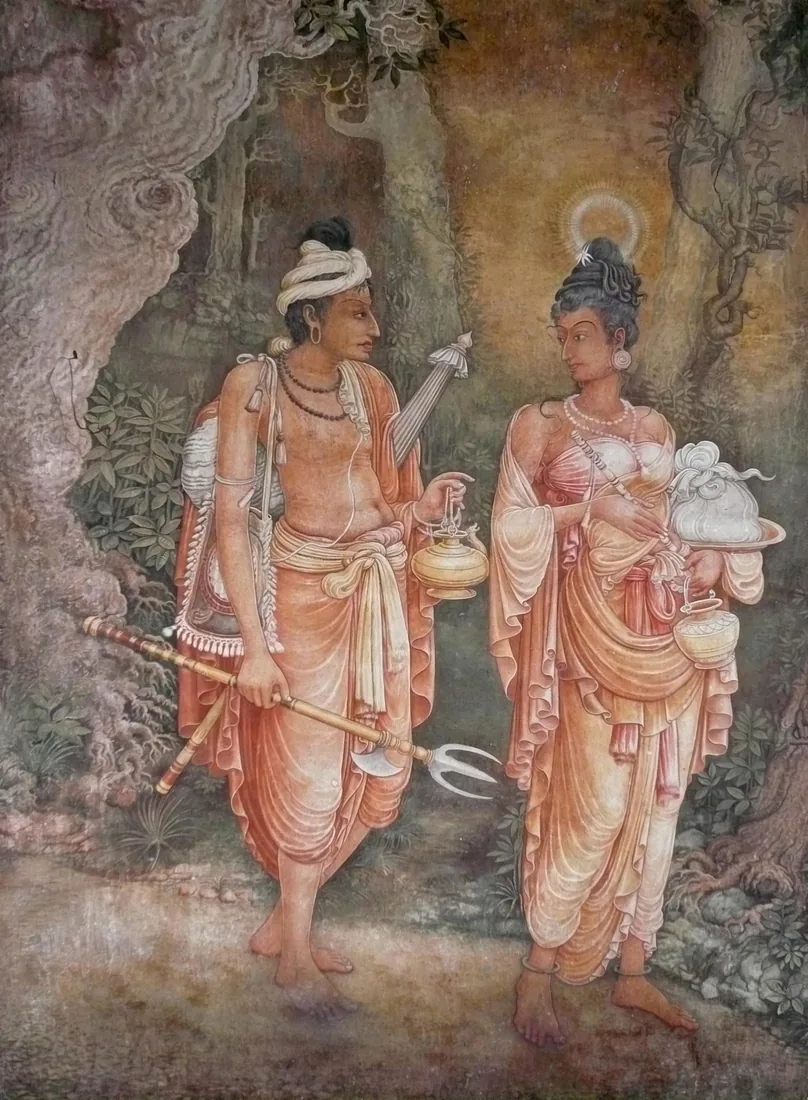
The chance to marry the two came at Kelaniya. Helena Wijewardena, who was rebuilding the ancient temple, engaged Mendis to paint its new image house, a labour that occupied him over the better part of two decades, the main cycle painted through the 1930s and into the 1940s. He broke with the older Kandyan convention of narrow horizontal registers and gave a whole wall to a single subject, modelling his figures with light and shadow so that the scenes carry real depth. The programme drew its episodes from the island’s own chronicles, and in doing so set the terms for the twentieth-century revival of Buddhist temple mural painting.
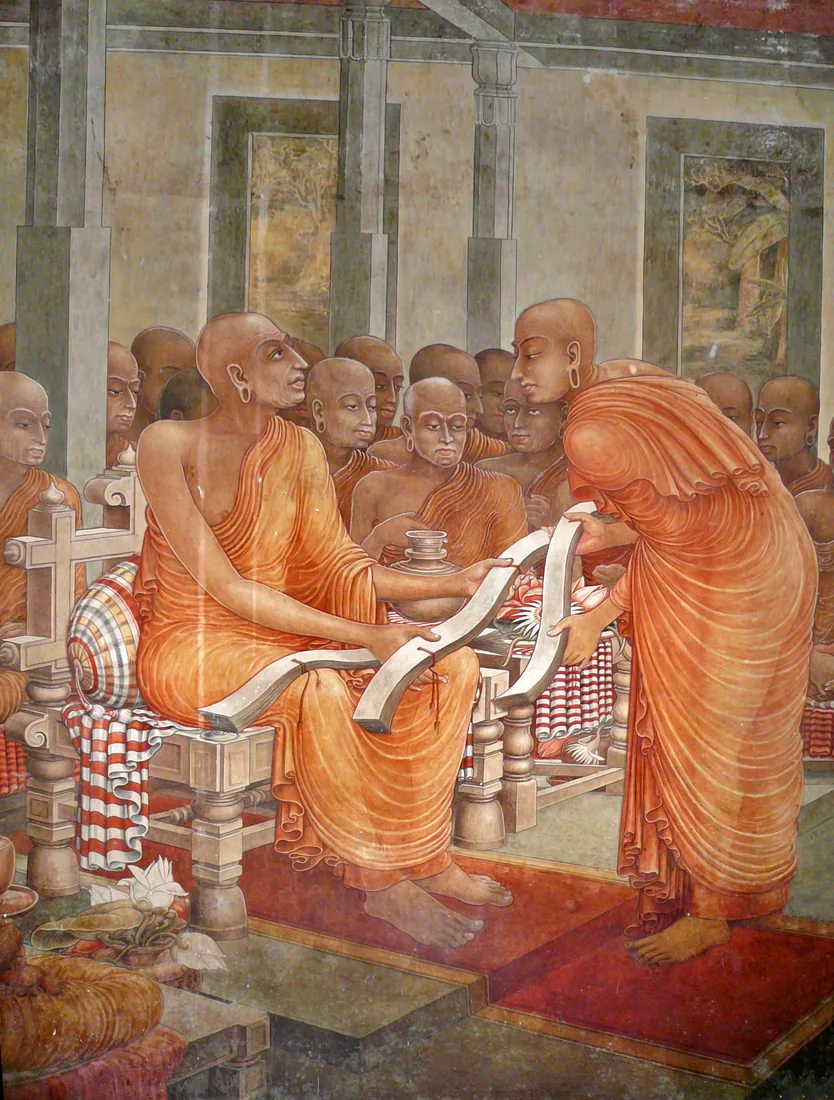
His method at Kelaniya joined the invented to the observed. In the foundation scene, where the patrons and their mentors kneel, the faces alone are individualised: Mendis worked them up from photographs of the living donors and monks and set those true likenesses onto otherwise idealised bodies, so that a real congregation kneels within a timeless one. He is credited with more than the painting, too: with designing the new wings that enclosed the older brick image house, the octagon on their roof echoing the Pattirippuwa of the Temple of the Tooth.
The revival and its road
His work belonged to a wider current. In the decades around independence, painters, writers and patrons looked back towards a pre-colonial Sinhalese and Buddhist past in search of a national art, and Mendis’s murals, with their subjects taken from the Mahavamsa tradition, gave that revival its most complete visual statement. He pursued it in parallel to the salon academics and to the modernists of the ’43 Group, along a wholly different road: the temple wall and the classical line. The Kelaniya cycle has been read as a neo-classic reworking of the island’s classic age, looking back past the Kandyan school to the frescoes of Ajanta and drawing on the revivalist spirit of the Bengal school, and Senake Bandaranayake places it at the head of what he calls the Modern Period of Sri Lankan painting.
The influence ran outward from those walls. Two of the Kelaniya scenes, the coming of the Bo tree and the arrival of the Tooth Relic, became so fixed in the island’s imagination that later temples copied them directly, and Mendis’s whole manner was taken up, a generation on, in the new image house of the Temple of the Tooth at Kandy, painted by Upasena Gunawardana and W. Somasundara. What began as one commission became a source others drew from.
Kalaguru
He was honoured with the title Kalaguru, master of the arts, and the state later placed his name and his Kelaniya work on a commemorative postage stamp. He died on 1 October 1975. At Kelaniya the walls he painted still draw the pilgrim and the visitor into the island’s own telling of its past, one wall and one scene at a time, exactly as he had arranged them.
Sources
- Bandaranayake, Senake, and Albert Dharmasiri. Sri Lankan Painting in the 20th Century. Colombo: National Trust of Sri Lanka, 2009.
- de Zoysa, Asoka, Vajira Nalinda Jayathilaka, and Ganga Rajinee Dissanayaka. Evolving Traditions of the Buddhist Image House, Part I. Samkathana Research Team, University of Kelaniya.
- de Zoysa, Asoka, and Vajira Nalinda Jayathilaka. Buddhist Image Houses. Samkathana Research Team.
- Wikipedia. ‘Solias Mendis.’ https://en.wikipedia.org/wiki/Solias_Mendis
How to cite this profile
Malaka Talwatte, “Solias Mendis,” Malaka Talwatte: Sri Lankan Art and Ceylon Antiquaria, https://malakatalwatte.pages.dev/artists/solias-mendis/.
Quote and cite freely with attribution; please do not republish a whole essay, or a photograph, without permission.