Classical · Site
Sri Maha Bodhi
The oldest thing in the sacred city is alive. The Sri Maha Bodhi is a pipal, a Ficus religiosa, grown from a cutting of the tree at Bodh Gaya under which Prince Siddhartha became the Buddha, and it was planted on a raised terrace in the royal pleasure-garden of Mahameghavana in the third century before Christ, in the first years of the island’s Buddhism. It is the oldest tree in the world whose planting is recorded in history, and it has been kept by an unbroken succession of guardians for more than two thousand years.
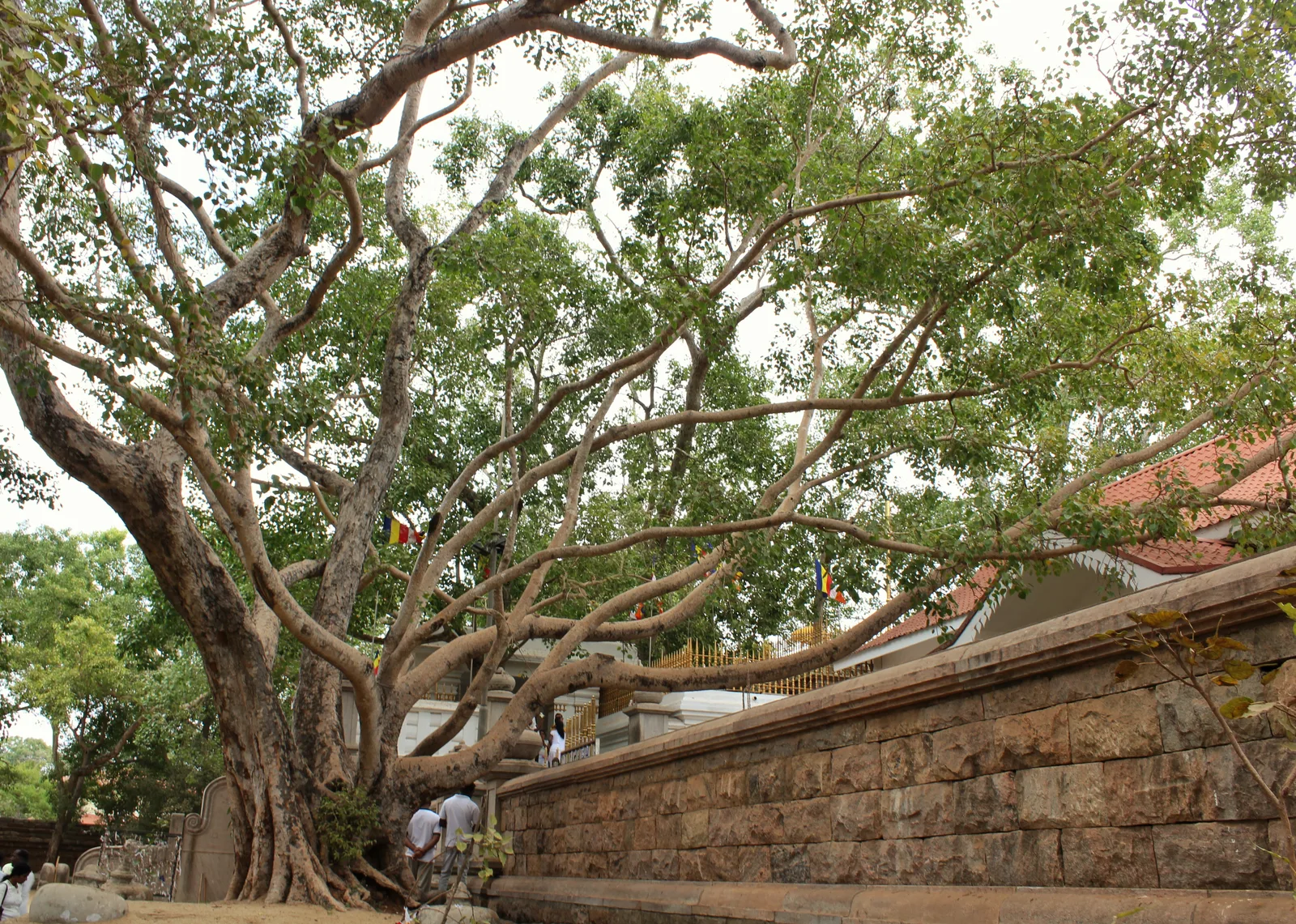
By the tradition set down in the chronicles, the sapling was sent by the Mauryan emperor Asoka, carried to Ceylon by his daughter, the nun Sanghamitta, and received by King Devanampiya Tissa. The parent tree at Bodh Gaya is long gone, cut down in a later age when the faith fell from favour in India, so that the offshoot at Anuradhapura outlived its source. The tree here has not been wholly spared either: storms took branches in 1907 and 1911, and in 1929 a man severed a bough, injuries a shrine so old absorbs and carries on.
Around a living relic the art is the setting and the sign. In the first centuries of Buddhist art the Buddha was shown not as a figure but by emblem, the wheel, the footprint and above all the Bodhi tree, and the shrine grew from that aniconic habit: a bodhigara, a railed and roofed enclosure for the tree, its stone railing cut in the pillar-and-crossbar pattern the island took from the earliest Indian sanctuaries. The tree here stands on a high walled terrace, a shrine without a statue, and the emblem it fixed ran on through the classical centuries in painting and relief, the tree standing for the enlightened one long after his image had first been carved. Its care shaped custom too. To keep wild elephants from the young tree its guardians once lit fires around it each night, and the firewood was brought each year at the August full moon by the villagers whose sacred duty it was, a rite that survives as the Daramitiya, the offering of the bundle of firewood. The present protective wall was built in the eighteenth century under Kirti Sri Rajasinha, and the gilded railing added in 1969. What the visitor venerates is continuity itself, a single line of devotion reaching back to the beginning of the island’s faith.
Sources
- The Mahavamsa and the Dipavamsa.
- Smither, James G., and the Archaeological Survey of Ceylon.
- Bandaranayake, Senake. Sinhalese Monastic Architecture: The Viharas of Anuradhapura. Leiden: Brill, 1974.
- UNESCO World Heritage Centre. ‘Sacred City of Anuradhapura’ (inscribed 1982). https://whc.unesco.org/en/list/200/
- Ponnamperuma, Senani. The Story of Anuradhapura.
How to cite this profile
Malaka Talwatte, “Sri Maha Bodhi,” Malaka Talwatte: Sri Lankan Art and Ceylon Antiquaria, https://malakatalwatte.pages.dev/artists/sri-maha-bodhi/.
Quote and cite freely with attribution; please do not republish a whole essay, or a photograph, without permission.