Classical · Site
Tantirimale
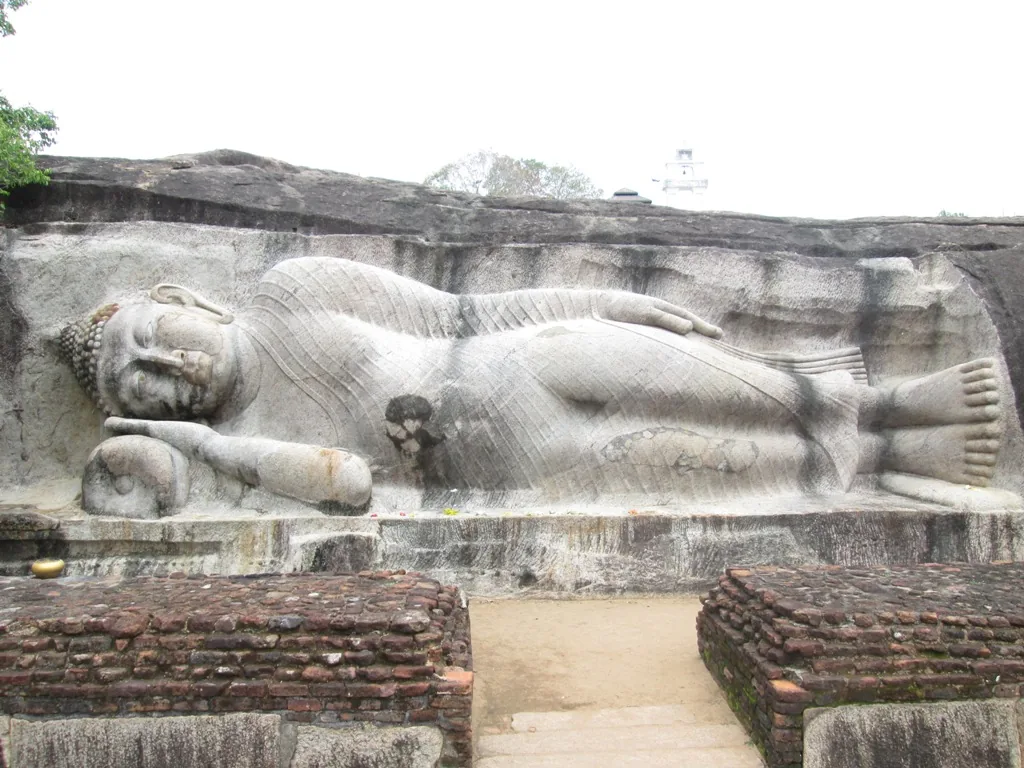
In the dry-zone forest north-west of Anuradhapura a great Buddha lies carved in the living rock, nearly fourteen metres of parinirvana cut straight from the outcrop, and it is the chief work of a provincial rock temple older than almost anything around it. Tantirimale is bound by tradition to the very beginning of the island’s Buddhism: the sapling of the sacred Bo-tree, carried from India to be planted at Anuradhapura in the third century before Christ, is said to have rested here a night on its way, and the place is one of those identified with the village the chronicle names for that halt.
The tradition is contested, and honestly so: the inscription once read to prove the identification has been judged a forgery, and the founding legend cannot be leant on. What is not in doubt is the site’s antiquity, for the drip-ledged caves of the rock carry donors’ names in early Brahmi of the third to the first century before Christ, the plain evidence of a forest monastery here in the earliest centuries. Whatever its beginnings, the monastery endured, and its sculpture was cut in the living rock.
The reclining Buddha is the great figure, laid the length of the rock face on its right side in the attitude of the final passing, the head on the hand, the robe drawn in long folds down the body; its face and hand were broken by treasure-hunters and mended by the Department of Archaeology from the nineteen-seventies. Near the Bodhi tree a seated Buddha is cut on the rock, and beside it, more telling than the finished figures, are the blocked-out outlines of two rows of Buddhas that were never carved, the work broken off and left as the mason set it down, so the rock keeps the record of its own making.
When the figures were cut is not known. There is no dated inscription, and on style alone the estimates run from the late Anuradhapura age to the Polonnaruwa, across four or five centuries, so the honest word is that they are undated and provincial, monumental in scale and plainer in finish than the great sculpture of the capitals. The hands that cut them are unknown, as everywhere; what Tantirimale keeps is a Buddha of the living rock at the edge of the dry zone, and, in its unfinished rows, a rare sight of the classical carver’s work stopped in the middle and never taken up again.
Sources
- Paranavitana, Senarath. Inscriptions of Ceylon. Vol. I.
- von Schroeder, Ulrich. Buddhist Sculptures of Sri Lanka. Hong Kong: Visual Dharma, 1990.
- Department of Archaeology, Sri Lanka.
How to cite this profile
Malaka Talwatte, “Tantirimale,” Malaka Talwatte: Sri Lankan Art and Ceylon Antiquaria, https://malakatalwatte.pages.dev/artists/tantirimale/.
Quote and cite freely with attribution; please do not republish a whole essay, or a photograph, without permission.