Classical · Bronze
The Tara Bronze
A gilded goddess nearly the height of a living woman stands in the British Museum, bare to the waist, one hip swung in a slow flexion, and she is the greatest bronze the ancient island ever cast. The figure is Tara, the Buddhist saviour-goddess and the compassionate counterpart of the bodhisattva Avalokitesvara; the small cavity in her tall matted-hair crown once held a figure of the Buddha Amitabha, the sign by which she is known. Her right hand is lowered in the varada gesture, the giving of a boon; her left is held to form a ring that once, it seems, closed on the stem of a lotus, now lost.
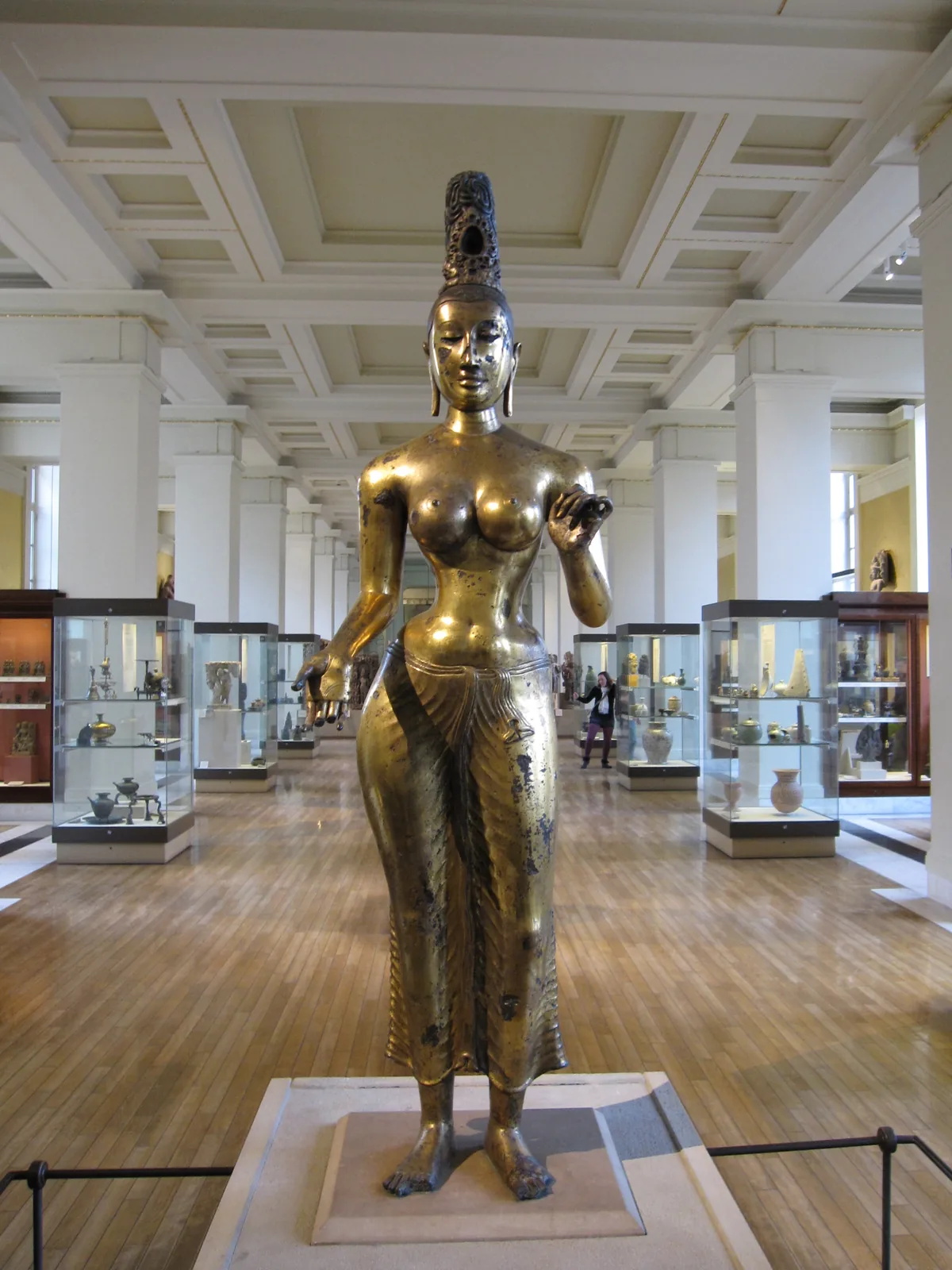
The wonder of the piece is as much in the making as in the modelling. It was cast in one solid pour of bronze by the lost-wax method and then gilded, and to cast a figure of near life size solid, rather than in a thin shell around a clay core, is a feat of metal and of nerve that sets it apart from almost every bronze of its kind; the eyes and the crown-medallion were set with stones, now gone. In the full, sensuous body, bare above a thin clinging cloth, the image carries the Amaravati and Gupta inheritance of India remade in the Anuradhapura manner, and it is dated to about the eighth century, within a span the scholars draw across the seventh to the ninth. It stands, too, as plain evidence, as plain as the Amitabha in her crown, that the Mahayana was practised on the island beside the older Theravada.
She is the greatest of a company, not a work alone. The same Mahayana devotion that set her here left a body of bronze bodhisattvas across the late Anuradhapura centuries, chief among the survivors a gilt figure of Avalokitesvara, the lord of compassion, found at Veheragala in 1968 and now in the Colombo museum, its plaited crown carrying the same niche for a small Amitabha that names the god. Cast by the same lost-wax method, some solid and some hollow, often gilded and set with crystal eyes, these are the finest metal sculpture of the early island, and the Tara is the one that grew to the scale of a standing woman, and the one that was carried away.
How she came to London is its own history, and a live grievance. The statue was carried off from Ceylon about 1820 by Sir Robert Brownrigg, the governor who had annexed the Kandyan kingdom five years before, and given to the British Museum in 1830; the museum records it as found on the east coast, while Sri Lankan accounts hold that it was taken from the treasury of the last king of Kandy, and the two stories have never been reconciled. For decades the museum kept the figure out of sight, judged too sensuous to show, before it took its present place in the Asia gallery. Ceylon asked for its return in 1937 and again around 1980, and Sri Lanka renewed the demand in 2024; a replica stands in the Colombo museum, and the original stays in London.
Of the hand that cast her nothing is known. The finest bronze of the classical age came from the anonymous metal-workshops that served the Anuradhapura monasteries, and it stands now, gilded and gazed at, far from the coast it was made for, the masterpiece of an art whose makers kept no names and whose greatest work is held away from home.
Sources
- British Museum, online collection record, museum no. 1830,0612.4.
- von Schroeder, Ulrich. Buddhist Sculptures of Sri Lanka. Hong Kong: Visual Dharma, 1990.
- Paranavitana, Senarath. ‘Mahayanism in Ceylon’. 1928.
- Smarthistory. ‘Statue of Tara, consort of Avalokiteshvara’.
How to cite this profile
Malaka Talwatte, “The Tara Bronze,” Malaka Talwatte: Sri Lankan Art and Ceylon Antiquaria, https://malakatalwatte.pages.dev/artists/tara-bronze/.
Quote and cite freely with attribution; please do not republish a whole essay, or a photograph, without permission.