Kandyan · Tradition
The Sittara
The painters of the Kandyan kingdom worked as a hereditary craft rather than as lone artists, and it is with them that Sri Lankan painting begins to keep names at all. They were the Sittara (also written Sittaru), one of the ten trades gathered under the royal Kottal-badda, the craftsmen’s department of the Four Korales, alongside the carpenters, turners, arrow-makers, silversmiths and blacksmiths who together supplied the court. Ananda Coomaraswamy, surveying the guild in 1908, counted five Sittaru, or painters, among its number: a small trade, closely held, and passed down through families rather than taught to outsiders.
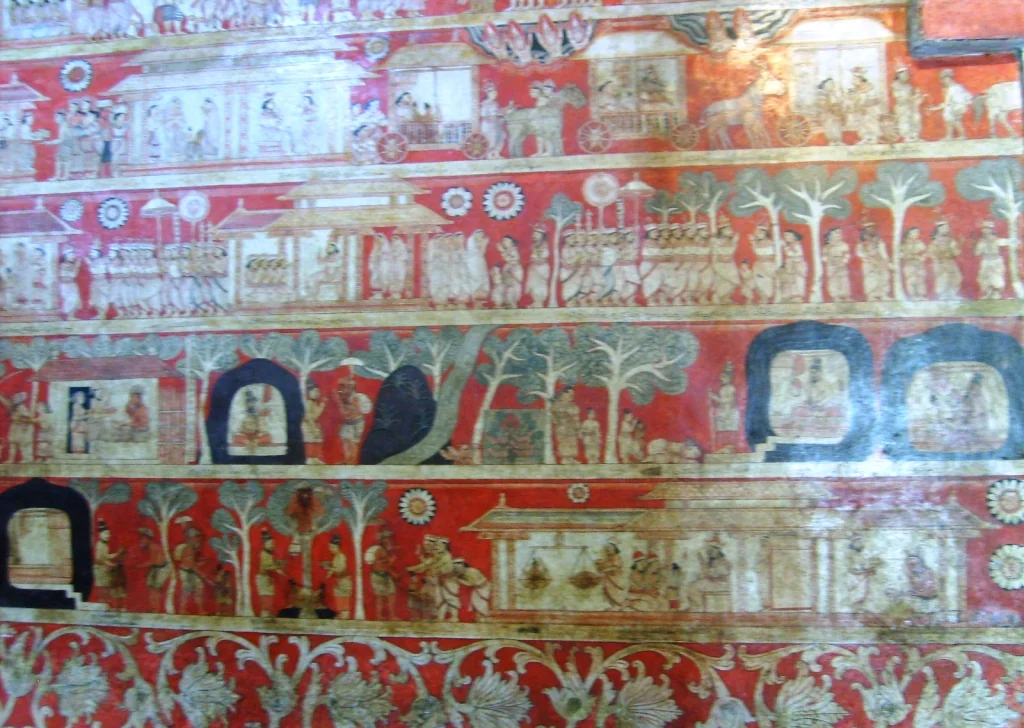
The men of the craft carried the surname Naide, a title recorded plainly in the royal grants of the day: the copper-plate sannasas that name the Degaldoruwa painters include ‘Kosvatte Hitaranayide’ among them, alongside other craft families such as ‘Vaduvavala Dévasimha Mulacari Nayide’ and ‘Kolomba Nayide’. Their women are given, in some accounts, the honorific Etana, ‘Lady’, though the sources divide on the term. The head of a workshop, in turn, held a separate rank rather than a surname: Mulachari, given only to a craftsman judged expert in at least five arts and trades, and under whom several assistants worked. It was, in short, an earned office, not an inherited name, and more than one Sittara workshop in the kingdom’s history was headed by a man who carried it.
A line of painters descending through one family was called a paramparawa, and the most celebrated was the Nilagama paramparawa, the lineage associated with Degaldoruwa and, by a persistent tradition, with the rock temple at Dambulla. The scholar Senake Bandaranayake later set the whole corpus into three working schools for the Kandyan period proper: a Central Kandyan school, formed chiefly under Kirti Sri Rajasinha’s patronage around the capital itself; a Provincial Kandyan school in the country temples beyond it; and a Southern school, which took hold along the wet-zone coast in the nineteenth century, related to the Central Kandyan idiom yet visibly touched by the Western manners reaching the island through the same southern ports. Named hands survive from the south too, among them Dingiran Appu of Ahangama and Welitara Heenappu of the Matara district.
The southern craft ran on different terms from the hill-country trade. The Kandyan Sittara had been of the Navandanna, the smith-and-craftsman caste; the lowcountry ateliers, among them the Kadolgalle, Valitara and Katuvana lineages, drew their painters more widely, and one Katuvana master is remembered for taking pupils across the caste lines the old craft had kept. Their reward differed too: where an upcountry master was repaid in land, rank and honour through a royal sannasa, the southern painter worked for a wage and often struggled to collect it, so that a surviving contract at the Veheragalla Samudragiri temple sets his fee at three hundred and seventy-five rupees. And it was only in the early decades of the twentieth century that a painter was at last permitted to set his own name upon the wall of the image house he had painted.
The craft’s technique was consistent wherever it was practised. The wall was built up with a mud-and-sand core, smoothed with a layer of kaolin clay and finished in white magnesite, and painted dry, not on wet lime as in true fresco, but in tempera, the pigments bound with gum from the wood-apple tree. The palette stayed narrow by design: cinnabar red, always imported and never found on the island; gamboge and orpiment for yellow; magnesite white; a lampblack made by burning oil and resin under an inverted pot; and blue, from indigo, so rare that Coomaraswamy found it absent from most paintings he examined. A picture was drawn first in outline, its figures filled in colour and then closed again with a firm black line that, in his words, at once defined, harmonised and united the whole. A boy born into a Sittara family learned by copying his teacher’s basic forms, over and over, before he was trusted to draw from memory; the brushes themselves were made by hand, from cats’ or squirrels’ hair for fine colouring and from the awns of the teli tana grass for the finest line of all.
Even here the record is thin, and many are known only by clan or school rather than by their own name. Yet the anonymity of the classical centuries is broken, and for the first time particular hands can be set against particular walls.
Sources
- Coomaraswamy, Ananda K. Mediaeval Sinhalese Art. 1908. https://archive.org/details/mediaevalsinhale0000coom
- Bandaranayake, Senake. The Rock and Wall Paintings of Sri Lanka. Colombo, 1986.
- de Zoysa, Asoka, Vajira Nalinda Jayathilaka, and Ganga Rajinee Dissanayaka. Evolving Traditions of the Buddhist Image House, Part I: Understanding Two Centuries of Art and Architecture in Sri Lanka. University of Kelaniya, 2016.
- Gatellier, Marie. Peintures murales du Sri Lanka: école kandyenne, XVIIIe–XIXe siècles. 2 vols. Paris: École française d’Extrême-Orient, 1991.
How to cite this profile
Malaka Talwatte, “The Sittara,” Malaka Talwatte: Sri Lankan Art and Ceylon Antiquaria, https://malakatalwatte.pages.dev/artists/the-sittara/.
Quote and cite freely with attribution; please do not republish a whole essay, or a photograph, without permission.