Classical · Site
Thuparama
The oldest stupa on the island is also the smallest of the great ones, and its fame is as much the ring of stone pillars around it as the dome they once sheltered. Thuparama was raised by Devanampiya Tissa in the third century before Christ, in the first generation of the island’s Buddhism, at the asking of the missionary Mahinda, to enshrine the right collar-bone of the Buddha, and it is the first dagaba the Sinhalese built.
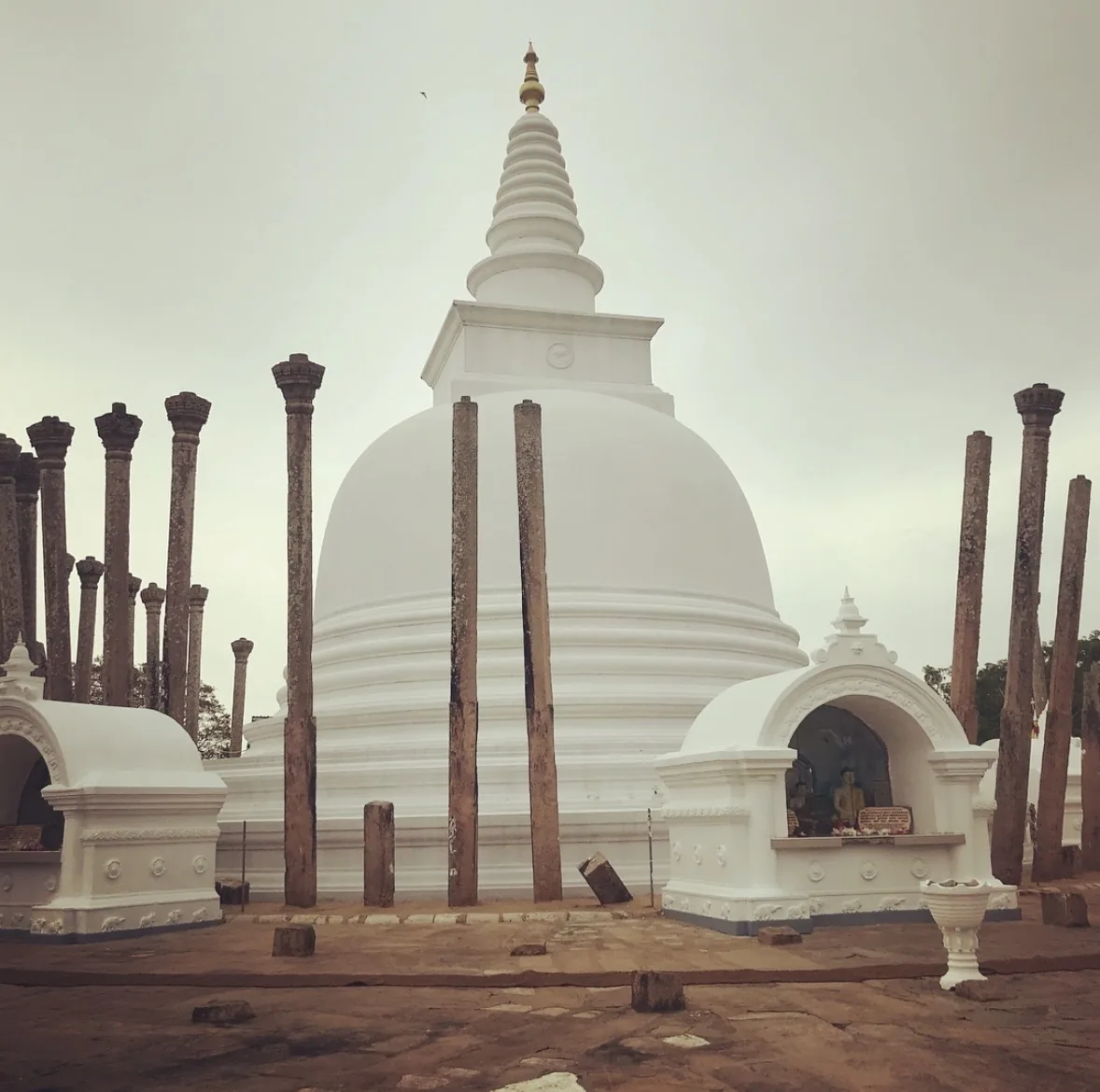
The pillars are the art of the place. Around the little stupa stand tall, slender granite columns, capital-topped and leaning gently inward, the remains of a vatadage, the circular relic-house that once roofed the whole in timber and tile; the roof is centuries gone, but the columns keep the ring, and the inward lean of them still shows how they carried the pitch of the vanished dome. They were set up, tradition holds, under King Vasabha, in four concentric rings of a hundred and seventy-six pillars in all, of which some forty-one still stand, and they make Thuparama, small as it is, the type of the vatadage form the island would later bring to its finish at Polonnaruwa.
The dome itself is not what it was. What stands now is a bell, but that bell is a Victorian raising, rebuilt in the eighteen-sixties; the ancient profile is lost, and the present shape belongs to the nineteenth century rather than the third before Christ. So the visitor meets an old idea in a new surface: the earliest relic-stupa of the island, its dome renewed, inside a colonnade whose leaning pillars are among the genuinely old things on the site.
Devanampiya Tissa, the first Buddhist king, is remembered as its founder; the masons who cut the pillars and the builders who first raised the dome are not. Thuparama holds two firsts between them, the first stupa and, in its ring of pillars, the ancestor of the vatadage, and it keeps them in the plainest compass, a small white dome in a circle of leaning stone.
Sources
- Paranavitana, Senarath. The Stupa in Ceylon (Memoirs of the Archaeological Survey of Ceylon, Vol. V). 1946.
- The Mahavamsa.
- Bandaranayake, Senake. Sinhalese Monastic Architecture. Leiden: Brill, 1974.
- UNESCO World Heritage Centre. ‘Sacred City of Anuradhapura’ (inscribed 1982).
How to cite this profile
Malaka Talwatte, “Thuparama,” Malaka Talwatte: Sri Lankan Art and Ceylon Antiquaria, https://malakatalwatte.pages.dev/artists/thuparama/.
Quote and cite freely with attribution; please do not republish a whole essay, or a photograph, without permission.