Classical · Site
The Tivanka Image House
The Tivanka image house at Polonnaruwa, raised by Parakramabahu the Great between 1153 and 1186 within the Jetavana monastery group, takes its name from the great brick Buddha standing inside it, bent at the shoulder, the waist and the knee in the tivanka, or thrice-bent, pose. Along its inner corridors runs the fullest surviving programme of narrative painting from the classical island, for it is the one image house among Polonnaruwa’s Lankatilaka, Thuparama and Tivanka group to keep the greater part of its original walls; the other two, built to the same monumental brick-vaulted plan and once painted in the same way, have lost almost all of theirs.
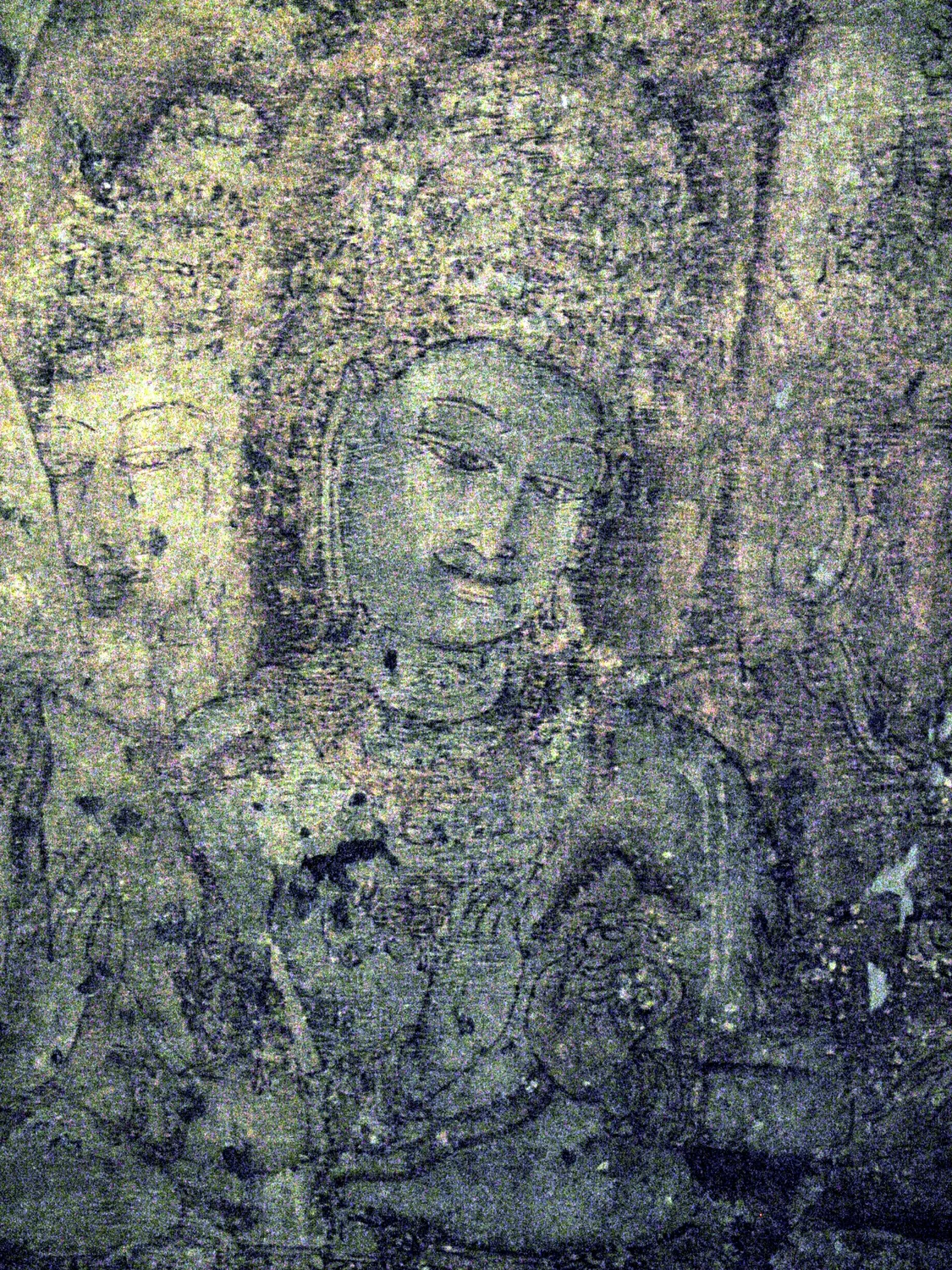
The scenes move through the Jataka tales, the accounts of the Buddha’s former lives, carried in bold outline and warm earth reds and ochres, filling the wall from edge to edge rather than standing as single icons, with ranks of celestial figures above. Named among the narratives are the Sasa, Guttila and Sama Jatakas alongside the long Vessantara cycle, and scenes outside the Jataka proper, among them the gods’ request that the Buddha teach and his descent from the Tavatimsa heaven after preaching there. The paint that survives is not all of one date: while the building itself belongs to Parakramabahu’s twelfth-century campaign, the surviving layer of paint has been dated to the thirteenth century, a hundred years later, which means at least one later repainting was carried out on top of, or soon after, the original scheme, in keeping with a long island tradition of renewing temple murals as they wore rather than leaving them to fade.
Along the corridor the Vessantara Jataka unfolds at greatest length, the story of the prince who gives away everything he owns, down to his children and his wife, and above the narrative registers move ranks of gods and celestial beings, the divine audience of the tale below. The great standing Buddha within, some eight metres of brick and plaster, carries the thrice-bent posture that gives the shrine its name, a pose more usually reserved in South Asian art for royal or courtly figures than for the Buddha, which is itself part of why the image has drawn so much scholarly attention.
The manner of the painting is the classical line brought to its last flowering before the tradition changed. The figures are drawn rather than modelled: a fluent, almost wiry outline carries the whole form, the same descent of the drawn line that runs down from Sigiriya, now put to the service of crowded narrative rather than the single isolated figure, the wall filled edge to edge with incident and the registers stacked one above another. The colour is laid over a lime-plaster ground in the earth palette of the tradition, red and yellow ochre, a white and a black, warm and low in key; the paint went onto a dry or drying surface in the tempera manner rather than into wet plaster, the technique the conservator R.H. de Silva argued was the island’s throughout. Tivanka stands at the hinge of the whole story: the fullest surviving classical narrative painting, and the nearest thing the island keeps to a bridge between the ancient wall-painting and the temple painting of the Kandyan masters five centuries later, who took up the same narrative wall and the same drawn line and carried them on.
The building was cleared from the jungle that had grown over it by S.M. Burrows in 1885, and its wall paintings have been the subject of conservation work since, work UNESCO’s own listing for the Ancient City of Polonnaruwa singles out, alongside Lankatilaka and Thuparama, for their monumentality and delicacy of sculpture. It was declared a protected archaeological monument by gazette notification in 2004, a formal status arriving many centuries after the fact of its making. Faded though the paintings now are, they remain the high point of medieval Sri Lankan narrative painting to survive in place, and their makers, like all who worked before the Kandyan age gave Sri Lankan painting its first recorded names, are unknown to us.
Sources
- Bandaranayake, Senake. The Rock and Wall Paintings of Sri Lanka. Colombo, 1986.
- Coomaraswamy, Ananda K. History of Indian and Indonesian Art. 1927. https://archive.org/details/in.ernet.dli.2015.107347
- Manjusri, L.T.P. Design Elements from Sri Lankan Temple Paintings. Colombo: The Archaeological Society of Sri Lanka, 1977.
- UNESCO World Heritage Centre. ‘Ancient City of Polonnaruwa’ (inscribed 1982). https://whc.unesco.org/en/list/201/
How to cite this profile
Malaka Talwatte, “The Tivanka Image House,” Malaka Talwatte: Sri Lankan Art and Ceylon Antiquaria, https://malakatalwatte.pages.dev/artists/tivanka-image-house/.
Quote and cite freely with attribution; please do not republish a whole essay, or a photograph, without permission.