Pre-modern · Artist
William Daniell
William Daniell (1769–1837), Royal Academician, brother of Samuel and one of the supreme masters of the aquatint, belongs here for a different reason: it was his hand that engraved and coloured Samuel’s 1808 Ceylon plates, with the technical brilliance he had brought to Oriental Scenery, and he too had never seen the island he made so vivid.
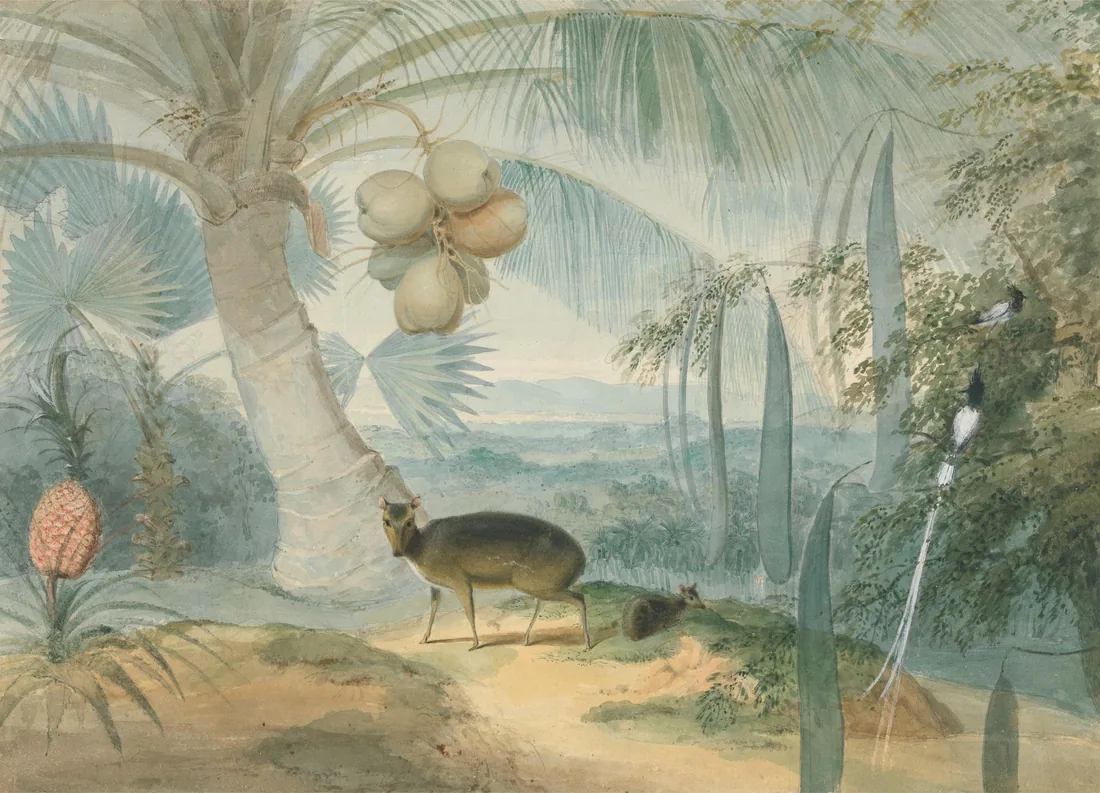
He was born at Kingston upon Thames in 1769, the son of a Chertsey publican, and on his father’s death in 1779 was taken in by his uncle, the landscape painter Thomas Daniell, whom he accompanied to India in 1785 at the age of sixteen. The years the two spent travelling the subcontinent furnished the drawings for Oriental Scenery (1795–1808), the 144 hand-coloured aquatints on which William laboured for the better part of a decade after their return to London, working, by his own account, from six in the morning until midnight to master the medium. That long apprenticeship in the plate made him the natural choice to carry his younger brother’s Ceylon drawings into print.
Samuel Daniell had lived on the island from 1805 and drawn its scenery, its people and its animals from life; it was William, in London, who engraved and hand-coloured the plates of A Picturesque Illustration of the Scenery, Animals, and Native Inhabitants, of the Island of Ceylon, published by Thomas Bensley on 15 January 1808. Among the earliest colour-printed records of the island, the suite owes its clarity as much to the engraver’s discipline as to the draughtsman’s eye.
Daniell’s own standing rose steadily thereafter. He exhibited some 168 works at the Royal Academy between 1795 and 1838, was elected Royal Academician in February 1822, carrying the final vote over John Constable, and undertook his own vast survey in aquatint, A Voyage Round Great Britain (1814–1825), whose several hundred plates recorded the whole coastline of the kingdom. He died at Camden Town on 16 August 1837. The Ceylon plates remain the singular exception in that long career: an exact and luminous body of Sri Lankan imagery made by a man who never once set foot on the island.
Sources
- Talwatte, Malaka. ‘19th Century Views of Ceylon by British Artists’.
- Oriental Scenery. 1795–1808.
- Yale Center for British Art, Paul Mellon Collection (B2006.14.16).
- A Picturesque Illustration of the Scenery, Animals, and Native Inhabitants, of the Island of Ceylon (published by Thomas Bensley on 15 January 1808).
- A Voyage Round Great Britain. 1814–1825.
How to cite this profile
Source noteExtracted verbatim from Malaka Talwatte, '19th Century Views of Ceylon by British Artists'. Where this page reproduces a previously published essay, cite that original in preference to this page.
Malaka Talwatte, “William Daniell,” Malaka Talwatte: Sri Lankan Art and Ceylon Antiquaria, https://malakatalwatte.pages.dev/artists/william-daniell/.
Quote and cite freely with attribution; please do not republish a whole essay, or a photograph, without permission.