Pre-modern · Artist
Lieutenant William Thomas Lyttleton
Lieutenant William Thomas Lyttleton (c.1786–1839) arrived in October 1814 with the 73rd Regiment and remained seven years. From his originals Edward Orme of London published six hand-coloured aquatint views of Kandy and its environs, engraved by M. Dubourg and advertised for sale in the Ceylon Gazette of 2 October 1819; they depict the King’s Palace, the town of Kandy, Balani Mountain and the Ferry of Wattepalogoa. One is held to be the earliest British representation of the Tombs of the Kandyan Kings, which, demolished in 1850, survive in no other record. Two further aquatints after his work appeared in John Davy’s Account of the Interior of Ceylon of 1821. Lyttleton’s plates constitute the visual frontier of British knowledge of the Kandyan kingdom in the years immediately following the conquest of 1815.
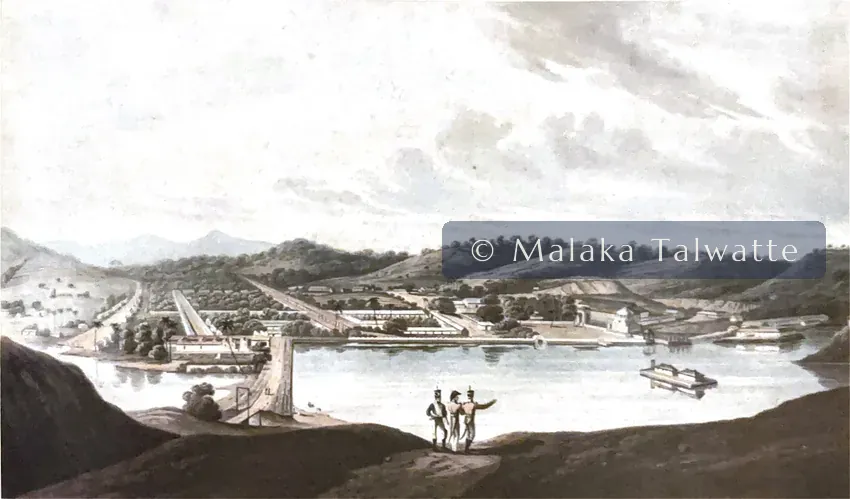
He had entered the 73rd as an ensign in 1809 and served with the regiment in New South Wales before it was ordered north; he reached the island in the Windham on 28 October 1814 and, in the months of the campaign that ended the Kandyan kingdom, was appointed deputy assistant-commissary at Ruanwella on 6 February 1815. It was that commissariat posting in the interior, rather than any errand of the drawing-master, that carried him among the mountain approaches and river crossings his views record. Orme advertised the set at 100 rix-dollars, some seven pounds ten shillings, a price that kept it to a narrow circle of buyers.
The two plates worked up from his drawings for John Davy’s Account of the Interior of Ceylon reached a far wider readership, for Davy was the army physician whose 1821 volume stood as the first full description of the interior in English, and Lyttleton’s images travelled with its authority. He left the island when the 73rd sailed for home in 1821, sold his commission in 1824, and emigrated to Van Diemen’s Land, farming near Launceston and serving there as police magistrate before returning to England, where he died in 1839.
Sources
- Talwatte, Malaka. ‘19th Century Views of Ceylon by British Artists’.
- Davy, John. Account of the Interior of Ceylon. 1821.
- De Silva, Rajpal Kumar. Early Prints of Ceylon (Sri Lanka) 1800-1900. London: Serendib Publications, 1985.
How to cite this profile
Source noteExtracted verbatim from Malaka Talwatte, '19th Century Views of Ceylon by British Artists'. Where this page reproduces a previously published essay, cite that original in preference to this page.
Malaka Talwatte, “Lieutenant William Thomas Lyttleton,” Malaka Talwatte: Sri Lankan Art and Ceylon Antiquaria, https://malakatalwatte.pages.dev/artists/william-thomas-lyttleton/.
Quote and cite freely with attribution; please do not republish a whole essay, or a photograph, without permission.