Classical · Site
Yapahuwa
After Polonnaruwa fell and the kingdom moved south and west, its art did not die with it; at Yapahuwa, for a dozen years in the thirteenth century, the old decorative tradition flowered one last time in stone. Yapahuwa is a rock, a granite mass rising some ninety metres from the plain, and King Bhuvanekabahu I made it his capital and the home of the Tooth Relic between about 1273 and 1284, fortifying it with ramparts as Kashyapa had fortified Sigiriya seven centuries before. What draws the eye at Yapahuwa is not the fortress but the stair.
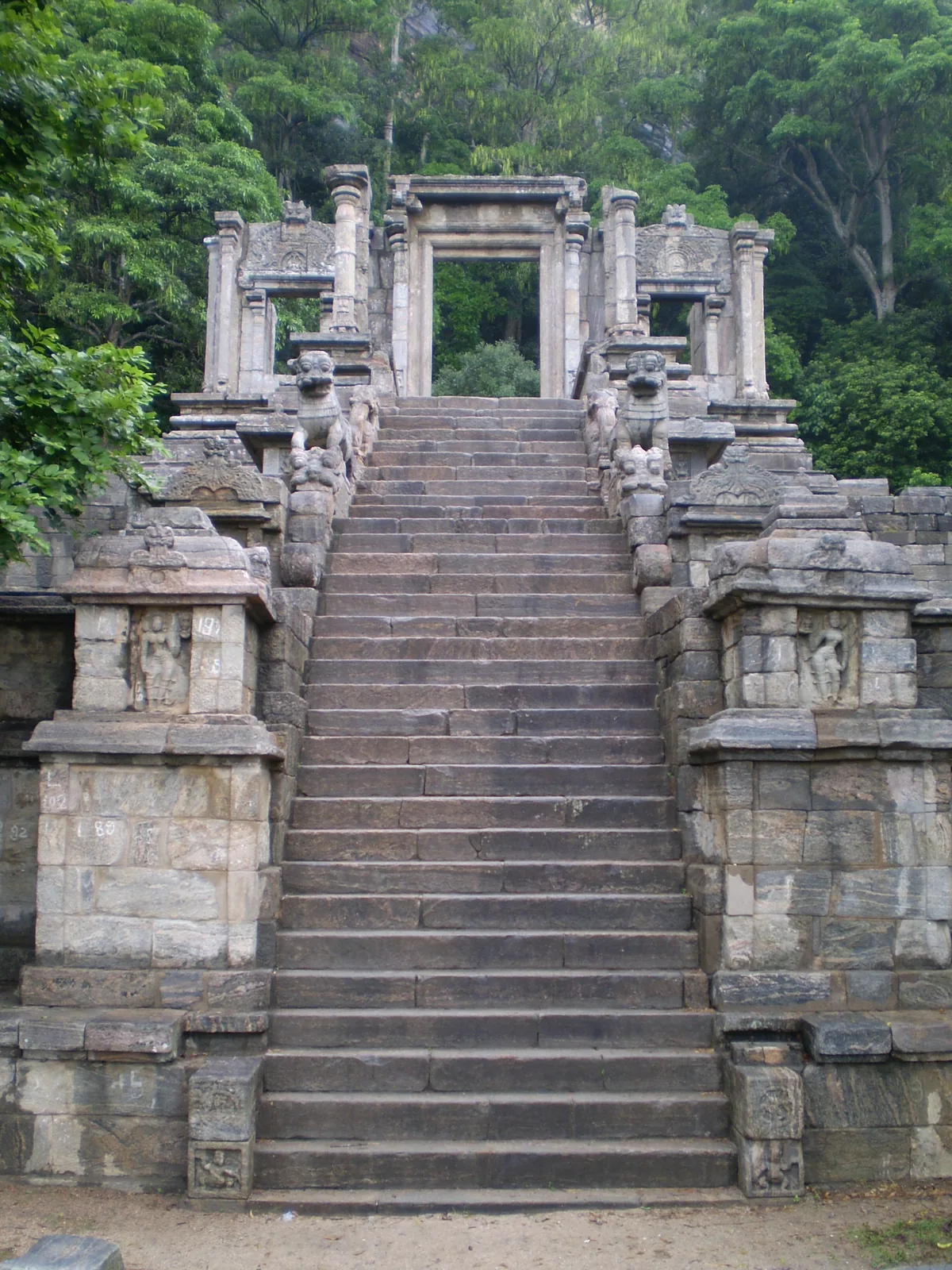
A great ceremonial stairway climbs the rock to the palace and the relic-house, and its last flight, steep and narrow for defence, is worked into one of the finest pieces of decorative sculpture the island made. Two rock-cut lions sit at the head of the steps, guardians of the ascent, and one of them has become among the most familiar images of Sinhalese art, carried for years on the country’s banknotes. Makara balustrades run down the sides, and on the walls and the flanking porches are set panels of dancers, drummers and musicians, and among the ornament the pierced stone windows for which Yapahuwa is best known: slabs of stone cut through with rows of small openings, each holding a carved figure, a dancer, a woman, a beast, a being of the myths. One of these perforated windows was lifted from the ruin in the nineteenth century and is now a treasure of the Colombo museum.
The carving carries a strong south Indian, Dravidian feeling, and it belongs to a moment when the island’s court and its craft were open to the forms of the mainland; it is the classical decorative tradition in its late flowering, after the great age of Anuradhapura and Polonnaruwa, kept here for a few years on a rock in the north-west. There is no date cut into the stair, so the carving is placed by the reign rather than by any inscription, and no carver is named, as none ever is.
The relic did not stay. When Bhuvanekabahu died, a raiding army from the Pandya country in south India carried the Tooth away across the strait, and it was some years before Parakramabahu III won it back and brought it home. Yapahuwa was left almost as soon as it was built, a capital for a dozen years, and it kept its stairway and its lions and its carved windows through the centuries of quiet that followed, the last full flowering of the classical carver’s art before the island’s history turned again.
Sources
- von Schroeder, Ulrich. Buddhist Sculptures of Sri Lanka. Hong Kong: Visual Dharma, 1990.
- Paranavitana, Senarath. Inscriptions of Ceylon. Vol. II.
- Colombo National Museum.
- Department of Archaeology, Sri Lanka.
How to cite this profile
Malaka Talwatte, “Yapahuwa,” Malaka Talwatte: Sri Lankan Art and Ceylon Antiquaria, https://malakatalwatte.pages.dev/artists/yapahuwa/.
Quote and cite freely with attribution; please do not republish a whole essay, or a photograph, without permission.