Start typing to search the essays, the artists and the collection.
19th Century Views of Ceylon by British Artists
The introductory essay to the exhibition of nineteenth-century British views of Ceylon, with notes on the artists, the exhibition wall text and the welcome speech.
By Malaka Talwatte · Exhibition catalogue, The George Keyt Foundation and the British High Commission, Colombo, 2026
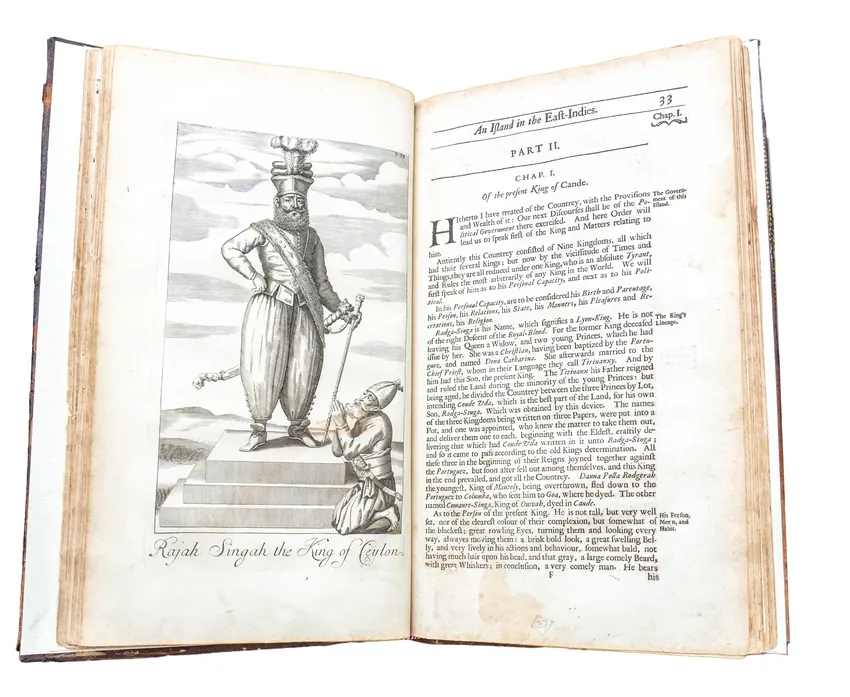
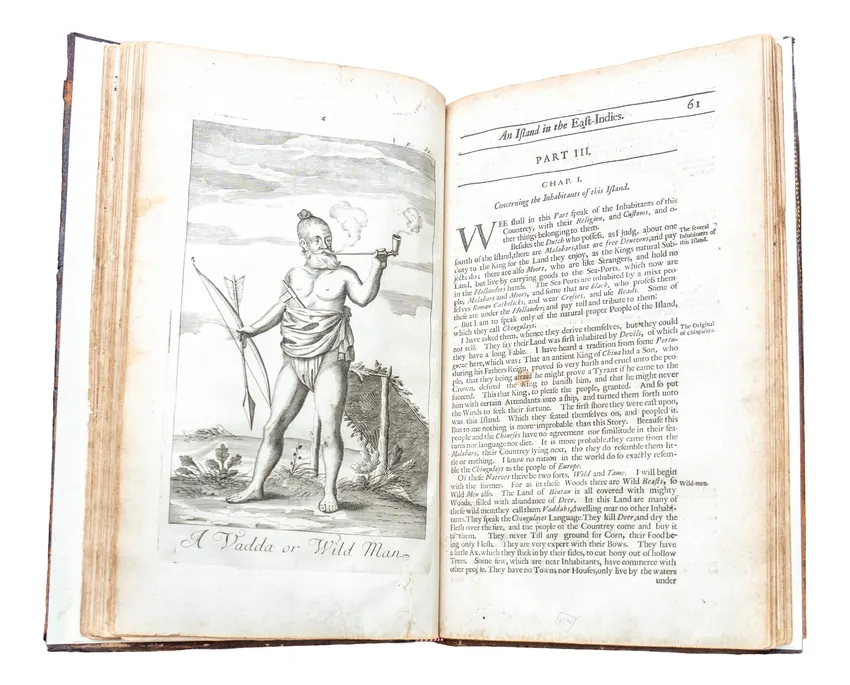
The first Englishman to set down the likeness of Ceylon did so as a captive. Robert Knox, a sea captain who had passed nineteen years in captivity under the king of Kandy, published upon his return to London An Historical Relation of the Island Ceylon, a work illustrated with seventeen engravings of a country his countrymen had scarcely begun to imagine. Crude by the standards of the period that followed, and in certain plates silently indebted to Dutch sources without acknowledgement, these images nevertheless inaugurated a tradition of some two centuries' duration, in the course of which British artists would produce a body of topographical and natural-history work among the finest of the Victorian age.
More than a century separated Knox's book from the first British artist to observe Ceylon at first hand, and the cause was inaccessibility rather than any want of visual interest. From 1640 until 1796 Ceylon was a possession of the Dutch East India Company, whose principal concern was its monopoly of cinnamon, the most lucrative single commodity in the whole of its empire and worth in the region of 2.5 million guilders annually; that interest the Company defended by fortification and by a rigorous pass system which regulated all movement upon the island and excluded every foreign competitor. British shipping traversed Ceylon waters upon the routes to India and China, but no British subject enjoyed liberty of movement ashore. Even after 1796, when Britain assumed the maritime provinces from a Dutch administration weakened by the French occupation of the Netherlands, the Kandyan kingdom of the interior retained its independence and remained effectively closed to Europeans until its conquest in 1815. The prevailing direction of British art, moreover, lay elsewhere: throughout the greater part of the eighteenth century it was oriented towards Italy, towards classical ruins and Roman antiquities and the picturesque conventions of the Grand Tour*, with their preference for the manner of Claude Lorrain**. Only with the closing of the Continent to British travellers by the French Revolutionary Wars after 1793, and the consequent redirection of artistic energy towards the empire, did Ceylon, by then British and accessible, enter the compass of the professional painter. The works that ensued, beginning with the drawings of Henry Salt in 1802 and of Samuel Daniell in 1805, were thus the product of an opening at once sudden and historically determined, rather than of any gradual awakening.
The artists who succeeded Knox were various in kind: soldiers and civil servants, professional painters, women who travelled and worked alone in the interior, and two celebrated artists besides, who depicted Ceylon at second hand, from the drawings and descriptions of others, without ever having visited it. The pages that follow trace that record from its uncertain origins in the seventeenth century to its full development in the late Victorian period, together with the several human connections, some of them unlooked-for, that run through it.
The First British Images: Knox, Cordiner and Salt
Remarkable as they are as historical documents, Knox's engravings are not the work of a trained artist. They were compiled in London from his written descriptions and rough sketches, with additional matter drawn from the account published in 1672 by the Dutch minister Philippus Baldaeus. The frontispiece, a royal portrait, was engraved by Robert White, one of the ablest portrait engravers of Restoration London***; the remaining plates, begun by the author's brother James and left incomplete at his death, were finished by a hand unknown. Seventeen in number, and depicting Kandyan customs and costume, methods of fishing and of agriculture, and an execution by elephant, they represent the earliest British visual record of the island, produced well over a century before the first professional artist observed it.
Robert Knox.Rajasingher, the king of Ceylon, depicted in 'An Historical Relation of the Island Ceylon' by Robert Knox, London, first edition, 1681.Veda or Wild Man of Ceylon, depicted in 'An Historical Relation of the Island Ceylon' by Robert Knox, London, first edition, 1681.
The first draughtsman to record the island after the coming of British rule was not, however, an Englishman at all. Joseph Eudelin de Jonville, a Frenchman who had entered British employ, accompanied Frederick North, the first British Governor of Ceylon, to the island in 1798, and served as its first Surveyor General from 1800 to 1805. Engaged at the outset to survey the cinnamon lands, he was charged by North to inquire also into the natural history, the customs and the languages of the country; and in the seven years he passed upon the island he measured and mapped, and drew and painted, compiling a substantial French manuscript together with a body of natural-history drawings, among them a series of studies of the hornbill; the drawings were dispatched to London and are preserved today in the British Library. The first hand to draw Ceylon for the new British administration, fittingly, belonged to a Frenchman.
The earliest original drawings executed on Ceylon under British rule by a British artist are the work of a clergyman, the Reverend James Cordiner, chaplain to the British garrison, who arrived in 1800 among the first administrators to follow the assumption of the maritime provinces from the Dutch in 1796. His A Description of Ceylon, published in 1807 with twenty-three aquatint plates, was the first British book on Ceylon to be illustrated from drawings made on the island itself. The plates are the production of a skilled amateur rather than a professional, and disclose the attentive eye of a clergyman in place of the hand of a trained artist; they possess nonetheless the value of the first-hand and the immediate, having been made at the very inception of the island's transformation under British rule.
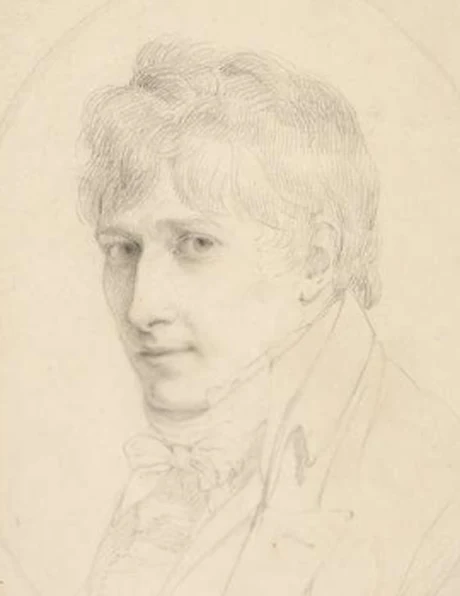
The first professionally trained British artist to draw Ceylon from life arrived two years afterwards. Henry Salt (1780–1827) came out in 1802 as secretary and draughtsman to George, Viscount Valentia, upon a grand tour of the East, having studied under Joseph Farington and John Hoppner, both Royal Academicians, before his departure. Of the twenty-four aquatints he published in London in 1809, printed in colours and engraved by D. Havell, J. Hill and J. Bluck, but a single plate represents Ceylon, a view of Point de Galle; it exhibits, nonetheless, an authority to which Cordiner's drawings do not attain. Salt was afterwards to become one of the foremost Egyptologists in Britain and Consul-General in Egypt, under whose patronage Abu Simbel was first cleared; yet the Ceylon view, made when he was but twenty-two, already displays the precision of eye and the assurance of hand that were to characterise the whole of his subsequent career.
Henry Salt, Br. 1780–1827.Henry Salt, Point de Galle, Ceylon, 1809. Aquatint in colours, 75 × 66 cm, private collection. The view in the vicinity of Point de Galle is taken at the spot where ended a canal, which had been constructed by the Dutch for the purpose of bringing down from the forests of the interior these beautiful woods, which form the chief ornament of the cabinet work of Europe. The groves of cocoa-nut trees which invariably in Ceylon are cultivated in the vicinity of towns add greatly to the beauty of the scene and form a roof of foliage impervious to the rays of the sun. Point de Galle itself is inferior only to Trincomalee as a harbour; it might be rendered more safe by removing several rocks which make the entrance dangerous; but the chief trade is removed to Colombo, and all naval supplies are sent to Trincomalee, as a better harbour. The climate of Point de Galle is, in general, good; Ceylon has not the alternate rainy season like the coast of Malabar and Coromandel; but being situated between them is at all times liable to occasional showers, which cool the air. From its situation on a peninsula, Point de Galle has generally a pleasant breeze from the sea. (De Silva, Rajpal Kumar, 1985, Early Prints of Ceylon (Sri Lanka), 1800 to 1900.)
Samuel Daniell and the Natural History Tradition
The richest legacy left by any artist who visited Ceylon in the early nineteenth century was that of Samuel Daniell (1775–1811), who came of the most distinguished family of topographical painters in Britain. His uncle Thomas Daniell and his brother William, both Royal Academicians, had between them produced Oriental Scenery, the greatest illustrated work upon India of the period, and Samuel was accounted by many the most gifted of the three. He arrived in Ceylon on 14 August 1805 aboard HMS Greyhound, landing at Galle, and was shortly appointed Assistant Secretary to the Board of Revenue and Commerce, and subsequently Ranger of the Woods and Forests, offices affording him an access to the interior, to its jungles, its fauna and its inhabitants, that no other artist of the period could match.
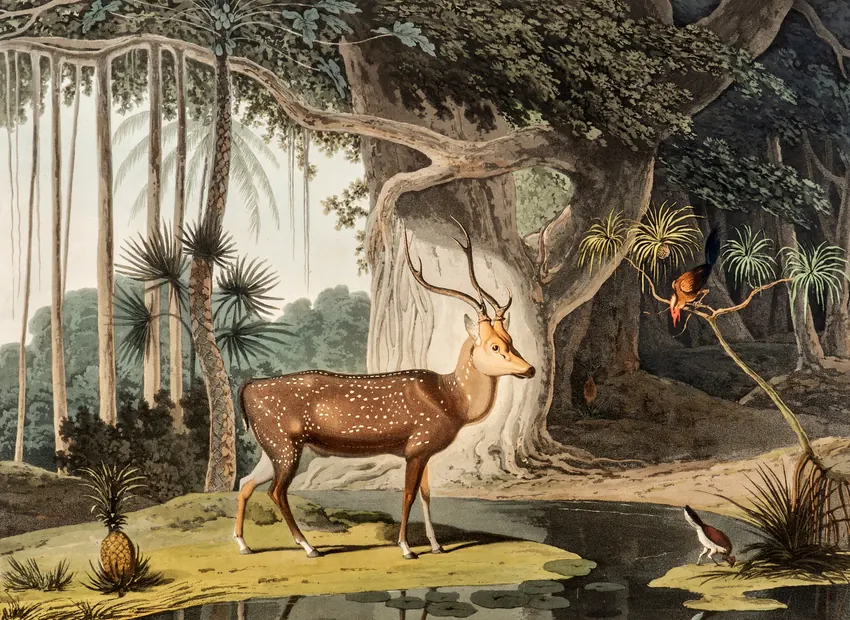
The twelve plates published in 1808 as A Picturesque Illustration of the Scenery, Animals and Native Inhabitants of the Island of Ceylon are among the finest natural-history prints of the Regency****. The animal plates are the most striking: a spotted antelope against brilliant tropical foliage, elephants at a watering hole, a leopard within dense jungle, each drawn with a luminous precision rarely equalled in the medium, the antelope having been judged by Thomas Sutton, the Daniells' biographer, one of the most beautiful ever published. Daniell enjoyed the patronage of Sir Thomas Maitland, Governor of Ceylon; the island he recorded across six years remained very largely unknown to British observers at the time of his death, of malarial fever, at Colombo on 16 December 1811, aged thirty-six. He was buried in an unmarked grave in the Pettah burial ground.
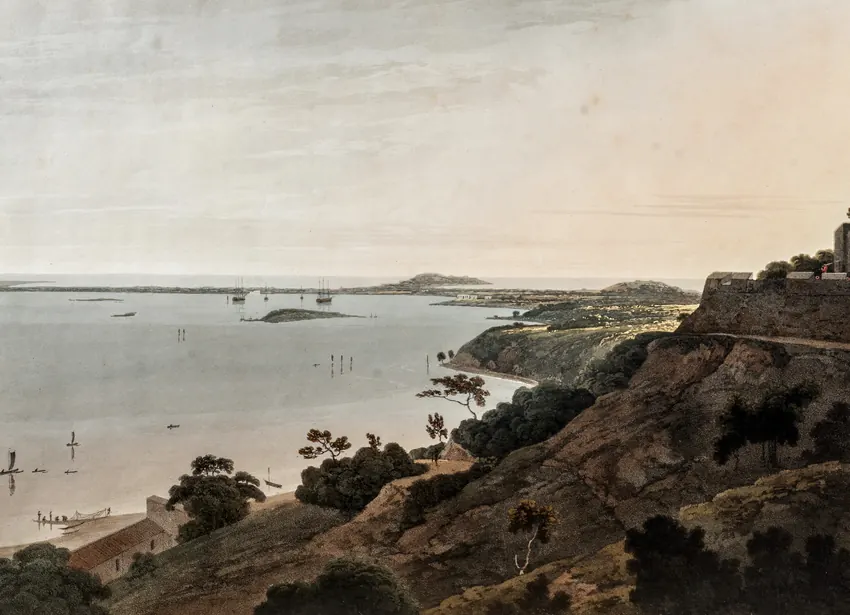
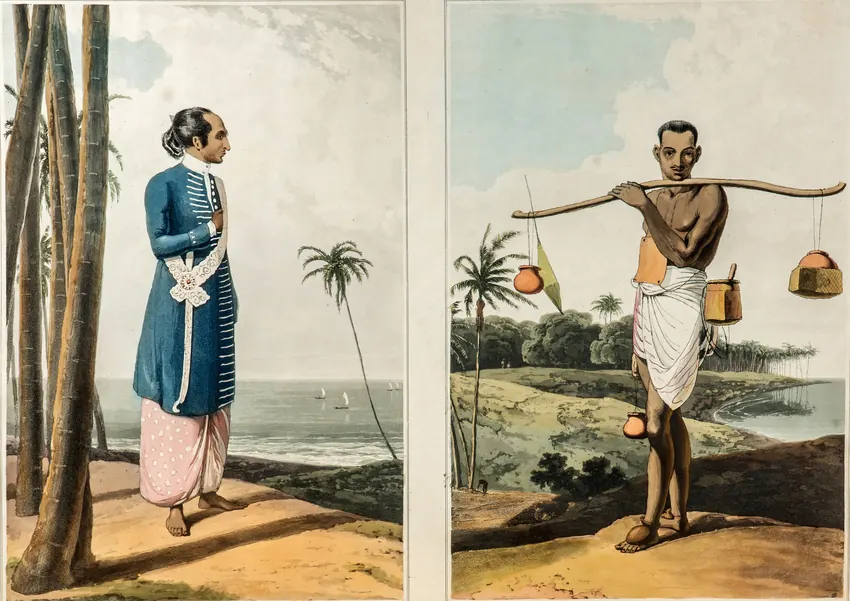
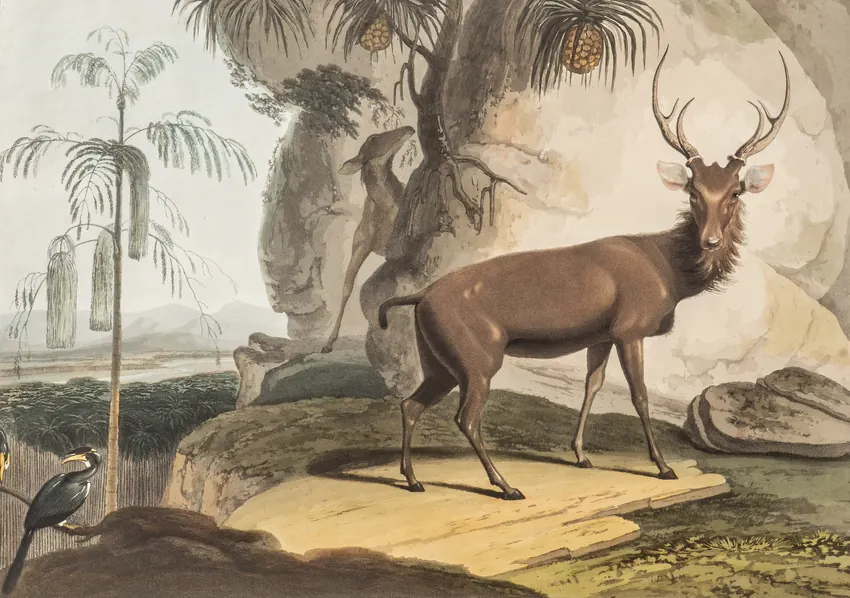
Samuel Daniell, View of the Harbour of Trincomalee, 1808. Hand-coloured Aquatint, 48.5 × 61.5 cm, private collection. The scenery about this noble bay and harbour is bold and romantic. It is surrounded with hills and studded with lands, all of them covered with the most luxuriant shrubbery, the verdure of which is perpetual. The whole surrounding country may almost, indeed, be considered as in a state of nature there being very little cultivation carried on in the neighbourhood of the bay. A few cottages interspersed about the hay coppices tend to render the scenery more exquisitely beautiful. This situation however, is considered as the most unhealthy spot on the island, a circumstance which may be attributed solely to the uncultivated state of the surrounding country. (De Silva, Rajpal Kumar, 1985, Early Prints of Ceylon (Sri Lanka), 1800 to 1900.)Samuel Daniell, The Spotted Stag, 1808. Aquatint, partially printed in colour and hand-coloured, 48.5 × 61.5 cm, private collection. This beautiful animal of the Cervine or deer tribe, is called by the native Cingalese, Muwa. This species abounds in many parts of Ceylon in the vicinity of Close Jungles. Its height is in general, from three to three and a half feet, the colour a chocolate brown; the body marked all over with small round white spots. The male only has horns. The two birds introduced into this print are the male and female of the Jungle Fowl: the former, in the Cingalese language called Wali Keekula, and latter Wali Kikili. The plant on which the male bird is perched, is a species of the Bromelia, or wild pine-apple, which as well as the Ananas, or cultivated pineapple, is very common in all of the Eastern islands. The Cingalese name is Waitakéyiya. The large trunk in the background is the Ficus Indica, or sacred Banyan Tree of India. (De Silva, Rajpal Kumar, 1985, Early Prints of Ceylon (Sri Lanka), 1800 to 1900.)Samuel Daniell, A Mahamodliar and Toddy Gatherer, 1808. Aquatint, partially printed in colour and hand-coloured, 48.5 × 61.5 cm, private collection. The Cingalese are divided into castes of which there are no fewer than nineteen distinct tribes, who can only intermarry with persons of their own rank or profession. The portrait on the right is one of the highest classes of magistrates, known by the name of Modelear. The Maha Modelear at Colombo, is the chief of all the Cingalese, who live under the right of the British government. The other portrait is taken from one of the fourth class, a Durawa, or gatherer of Toddy, or the juice of the cocoa-nut and the palmyra tree, from which the ardent spirit arrack is distilled. (De Silva, Rajpal Kumar, 1985, Early Prints of Ceylon (Sri Lanka), 1800 to 1900.)
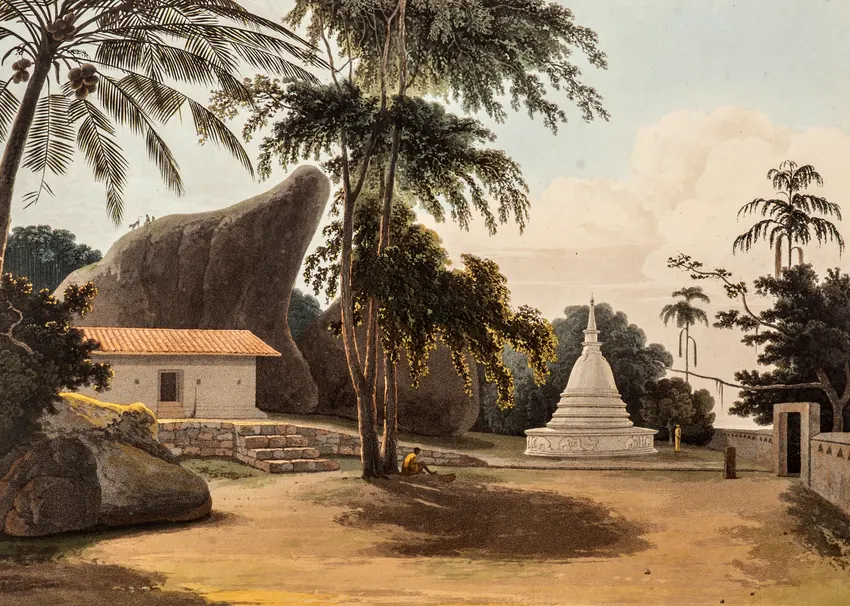
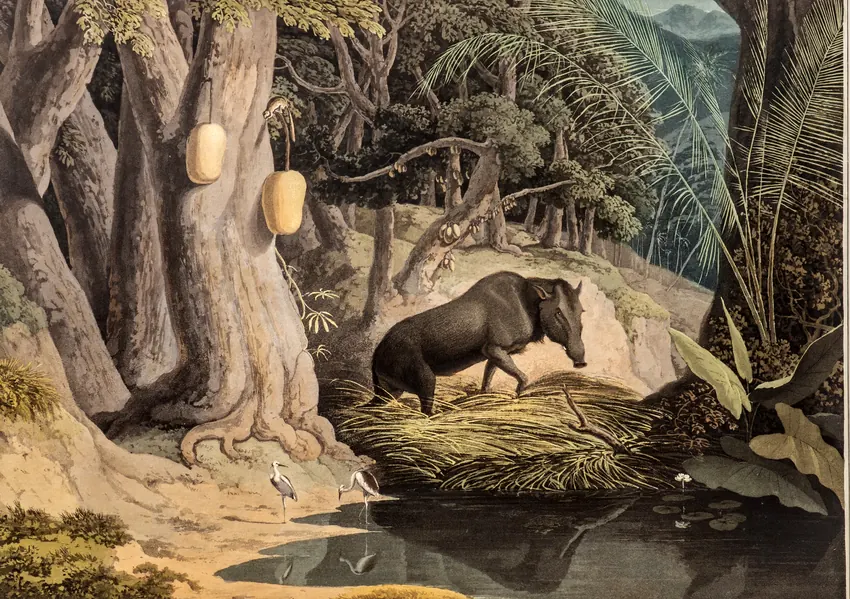
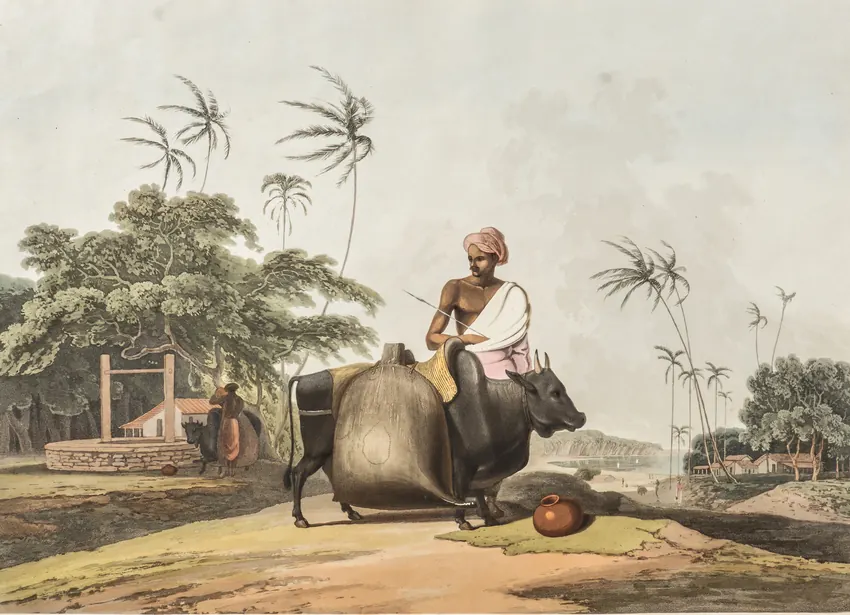
Samuel Daniell, View Between Galle and Mattura, 1808. Hand-coloured aquatint, 48.5 × 61.5 cm, private collection. The space which this scene occupies is sacred ground, and is situated the distance of about six miles from the southernmost part of the island of Ceylon, called Point de Galle. The humble shed erected near the south rock is named Gal gé, or house of stone. The pyramidal building on the right is a mausoleum, which is supposed to contain the bones of no less a personage than Buddha, the principal and most ancient deity, worshipped by the Cingalese: its name is Véhėra. On one side of the rock there is a figure of Buddha, hewn out of solid stone, in a recumbent posture, which measures in length, eight paces. (De Silva, Rajpal Kumar, 1985, Early Prints of Ceylon (Sri Lanka), 1800 to 1900.)Samuel Daniell, The Wild Hog, 1808. Hand-coloured aquatint, 48.5 × 61.5 cm, private collection. The only remarkable feature about this animal is its snout, which nature seems to have particularly adapted to the employment designed by it, which is that of ploughing up the ground, in search of roots. The Cingalese name of the wild hog is the Wal-uru. The tree in the left hand corner of the print, with the fruit appending to it, is a species of the Artocarpus, or bread-fruit tree, commonly known in the oriental world by the name of Jaca, or the jack-fruit tree: and the species of crane, near the water, distinguished by the Europeans by the name of Paddy Bird, from its visiting the swampy rice grounds, is called by the Cingalese, the Koka. (De Silva, Rajpal Kumar, 1985, Early Prints of Ceylon (Sri Lanka), 1800 to 1900.)Samuel Daniell, The Water Carrier, 1808. Hand-coloured aquatint, 48.5 × 61.5 cm, private collection. The usual mode of carrying water in India from the wells, or tanks, is in bags of leather, either on men's shoulders or across the backs of animals, as in the annexed print. The cattle of Ceylon generally used for this purpose, are of a very diminutive size, with short horns, and a large hump across the shoulders. The most predominant colour is black. They are in fact, the common horned cattle of the continent of India, from whence they are frequently imported into the island, especially after an epidemic of distemper, peculiar to them, has thinned their numbers. They are used to draw in carts and to drag the plough, but the most common manner of employing them, as beasts of burthen, is that represented in the painting. (De Silva, Rajpal Kumar, 1985, Early Prints of Ceylon (Sri Lanka), 1800 to 1900.)
The Soldier-Artists: Lyttleton and Deschamps
The British army brought to Ceylon, as well as its soldiers, a number of gifted amateur draughtsmen, whose work preserves scenes no professional artist recorded: the military stations and remote garrisons, the fortifications of Colombo and Trincomalee, and, above all, the newly conquered Kandyan kingdom, whose royal palaces and temples had never before been seen by British eyes.
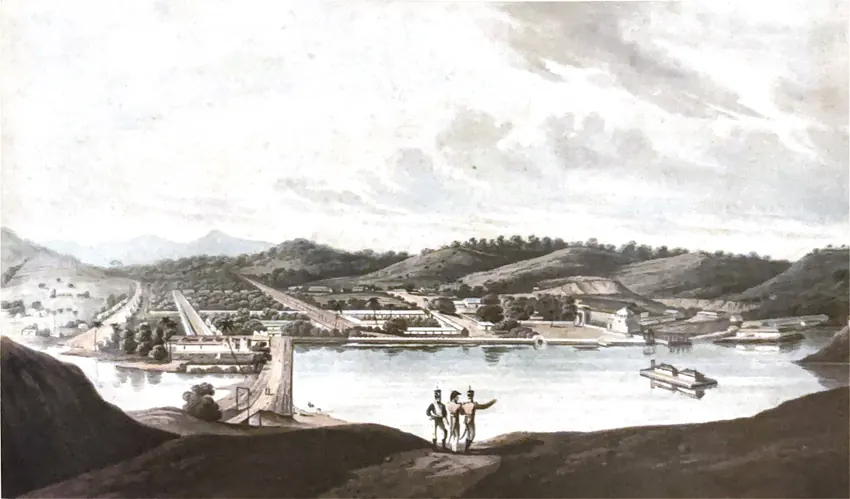
Lieutenant William Thomas Lyttleton (c.1786–1839) arrived in October 1814 with the 73rd Regiment and remained seven years. From his originals Edward Orme of London published six hand-coloured aquatint views of Kandy and its environs, engraved by M. Dubourg and advertised for sale in the Ceylon Gazette of 2 October 1819; they depict the King's Palace, the town of Kandy, Balani Mountain and the Ferry of Wattepalogoa. One is held to be the earliest British representation of the Tombs of the Kandyan Kings, which, demolished in 1850, survive in no other record. Two further aquatints after his work appeared in John Davy's Account of the Interior of Ceylon of 1821. Lyttleton's plates constitute the visual frontier of British knowledge of the Kandyan kingdom in the years immediately following the conquest of 1815.
Lt. William Lyttleton, Town of Kandy, 1819. Coloured aquatint, 56 × 86 cm, private collection. On the summit of this hill stood a royal pleasure-house, mentioned by Knox as the favourite retreat of the Kandyan Monarch, on the site of which a fort is now constructed, which commands the town, and the air is found to be extremely salubrious. The lake, or tank, an extensive sheet of water was formed from Paddy Fields, by order of the late King. In the centre stands a small building, formerly a Hindoo temple, but now converted into a powder magazine. Adjoining this lake is another, into which the unfortunate wife and children of Adikar Eyheylopola were thrown, after suffering a death too horrible for description. The river Maha Villa Ganga, which rises in the mountains of Adam's Peak, nearly surrounds, at the distance of about two miles, the hills in the centre of which Kandy is placed. (De Silva, Rajpal Kumar. 1985. Early Prints of Ceylon (Sri Lanka) 1800-1900.)
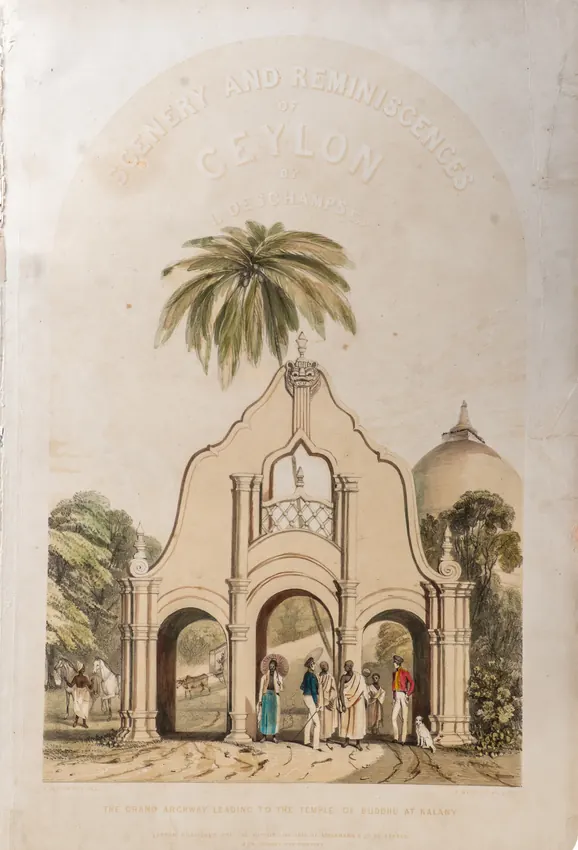
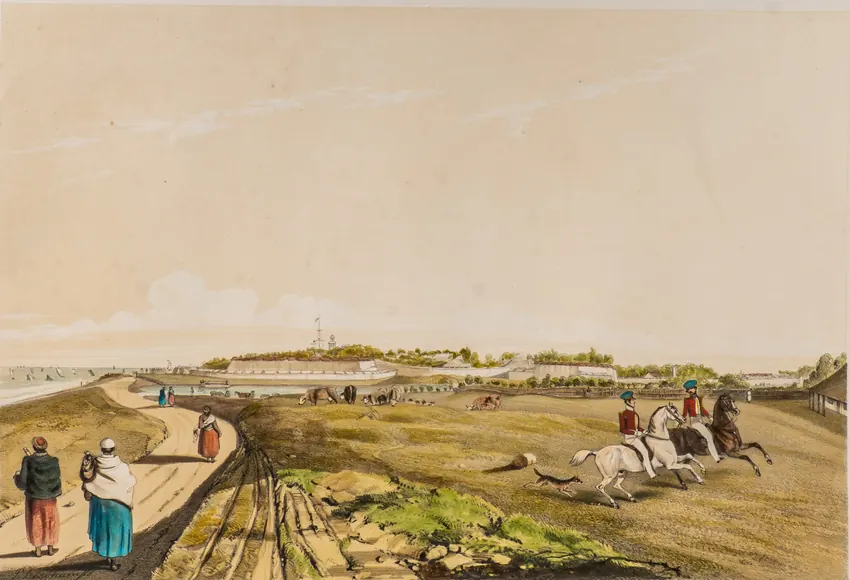
Fourteen years later Captain John Deschamps, an Adjutant in the Royal Artillery, arrived in 1828 and remained in garrison for a decade. His Scenery and Reminiscences of Ceylon, published by Ackermann and Co. in London in 1845, seven years after his departure, comprises twelve hand-coloured lithographs, drawn on stone by J. West Giles and printed by M. and N. Hanhart. He directed his attention to the western coast: to the Fort of Colombo and the Galle Face Esplanade, to Slave Island and the Buddhist temples, to the Ferry at Bentotte and the Rock of Mulkirri. His volume is a soldier's memoir in pictures, exact and affectionate, and everywhere informed by the daily observation of a garrison officer who had spent that decade among the island's people.
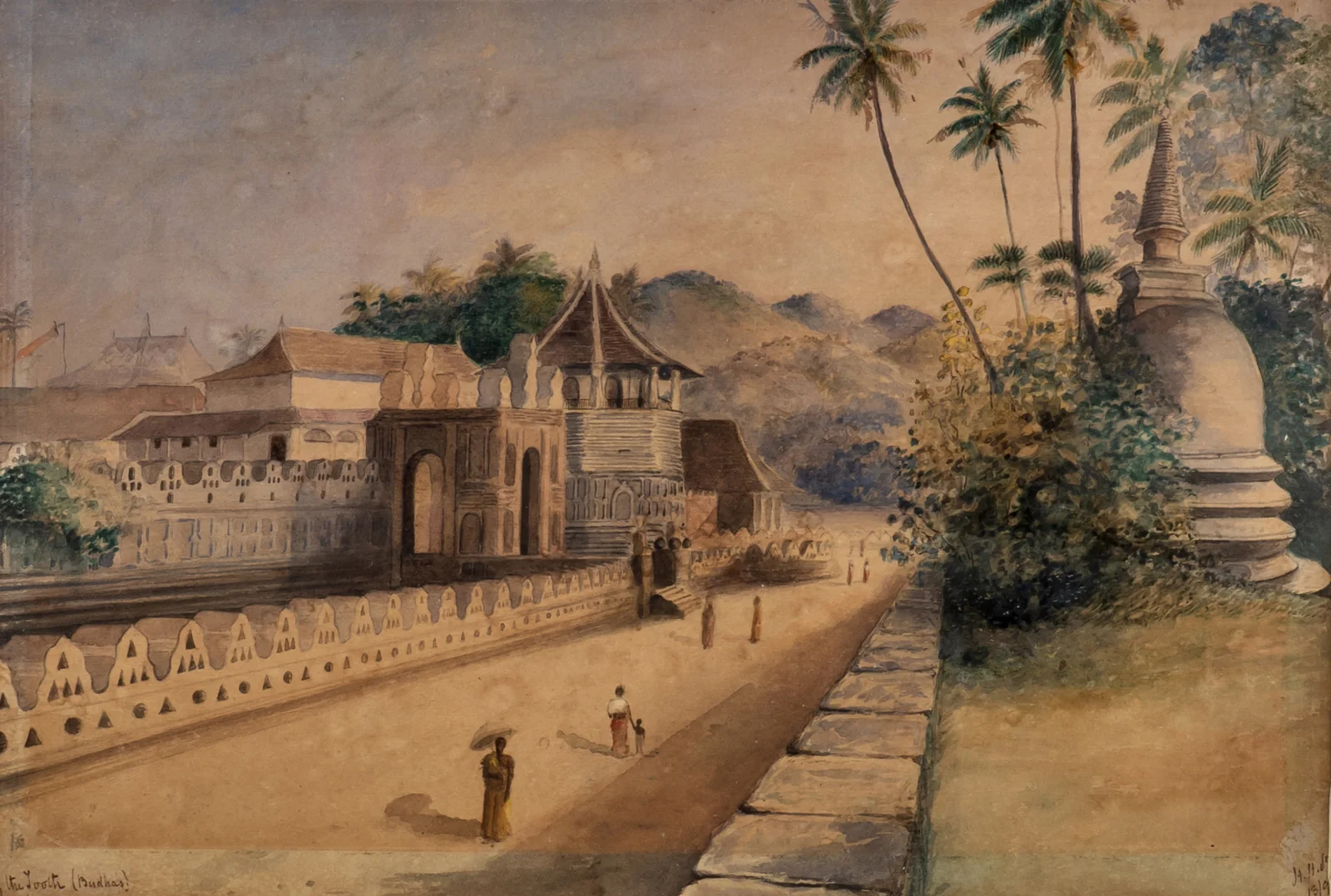
John Deschamps, The Grand Archway Leading to the Temple of Buddhu at Kalany, 1845. Lithographed. Hand coloured and heightened with varnish, 49 × 32 cm, private collection. The Grand Archway still exists as depicted in the painting, with a few additional features including a flight of steps leading up to the arch. It bears examples of the traditional medieval Sinhalese architecture used above doorways and images, and is called a makara thorana. The makara thorana is an ornamental arch springing from the profiles of two makara facing each other and with a kibihi face in the position of the keystone; the intermediate space on either side is treated in several ways. Deschamps has used this plate to depict various costumes, the saffron robes worn by Buddhist priests; a horse keeper (muttu) almost certainly Tamil, is shown with the customary shawl around his head and wearing a cloth (verti); a Sinhalese man wearing a sarong and a comb in his hair; and, two European army officers. (De Silva, Rajpal Kumar. 1985. Early Prints of Ceylon (Sri Lanka) 1800-1900.)John Deschamps, The Fort of Colombo From the Galle-Face Esplanade, 1845. Lithographed. Hand coloured and heightened with varnish, 32 × 49 cm, private collection. The Fort (or, more correctly, the Town and Fort) of Colombo is situated on the west side of the Island, in lat. 7° N., and long. 79° 58'E. of Greenwich. It stands on a rocky point of land, projecting into the sea, from which circumstance it derives many advantages, both in a military and mercantile point of view, and it moreover enjoys the full benefit of the sea-breeze, which renders the air comparatively temperate and salubrious, though so near the equator. The government-house, which commands a fine view of the roadstead, is a long and capacious building of two stories, more commodious than elegant. Adjoining the garden of the government-house is the flagstaff battery, in which stands the lighthouse, one of the most elegant buildings of its kind in the world; the light is also considered by nautical men to be an excellent one. (De Silva, Rajpal Kumar. 1985. Early Prints of Ceylon (Sri Lanka) 1800-1900.)
Andrew Nicholl and the Visual Legacy of Sir James Emerson Tennent
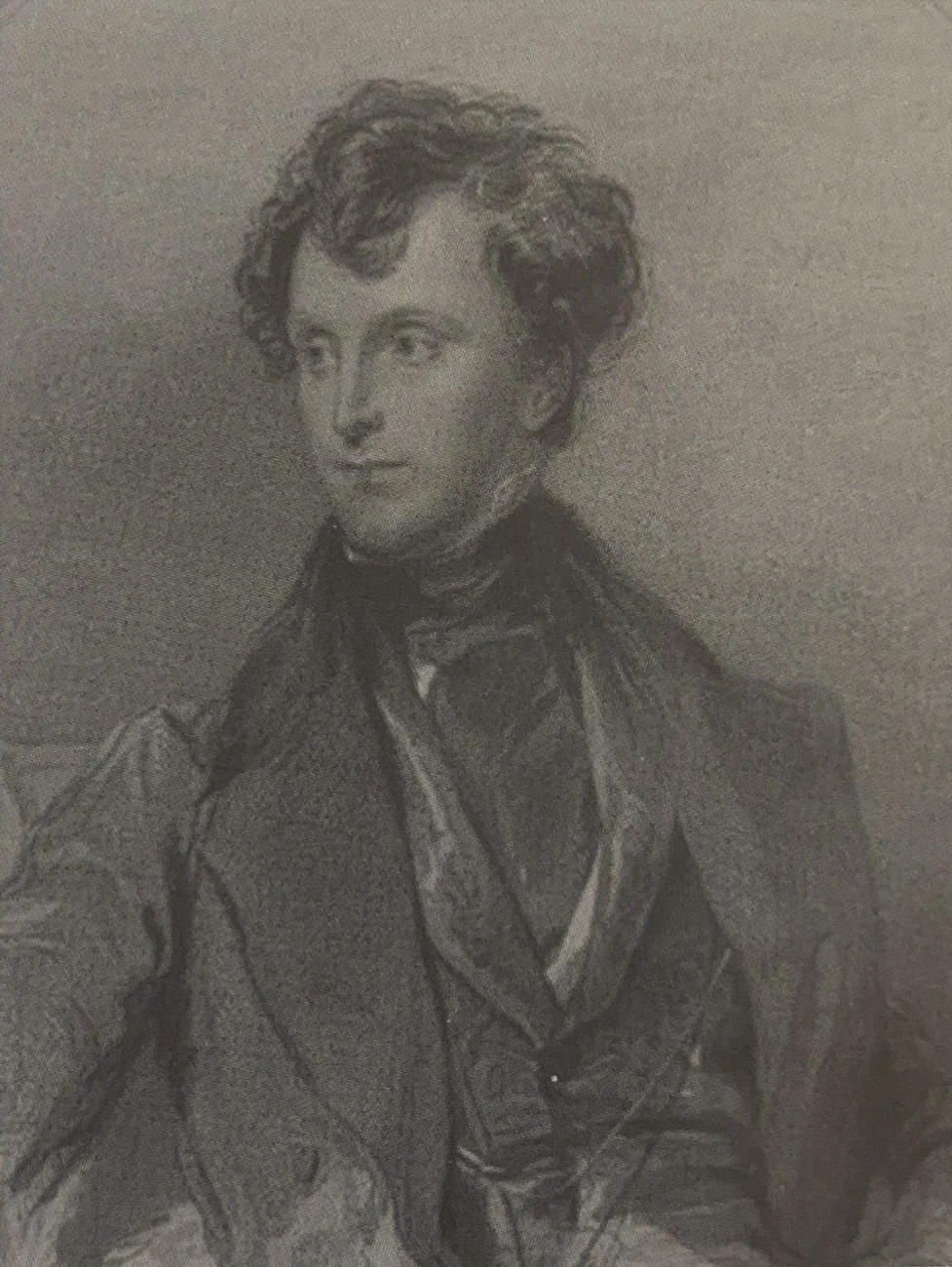
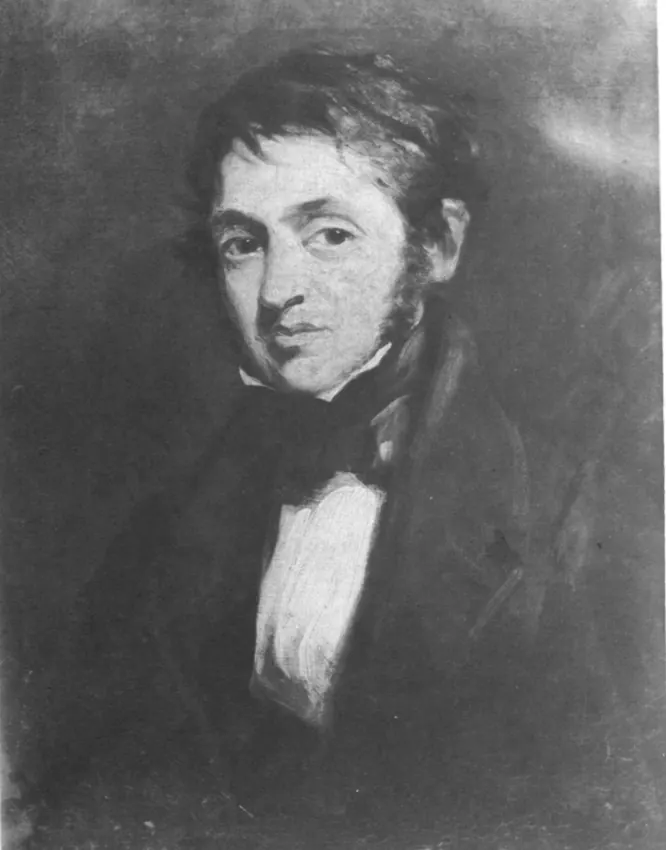
More threads of this history converge upon Sir James Emerson Tennent (1804–1869) than upon any other figure in British Ceylon art. Colonial Secretary to the government of the island from 1845 to 1850, he was the author of Ceylon: An Account of the Island, Physical, Historical and Topographical, published in 1859. The work, which passed through five editions within its first eight months, was the fullest account of the island that had then appeared in English; and Tennent, determined that it should be illustrated as amply as it was written, selected as his principal illustrator a fellow Irishman, Andrew Nicholl (1804–1886).
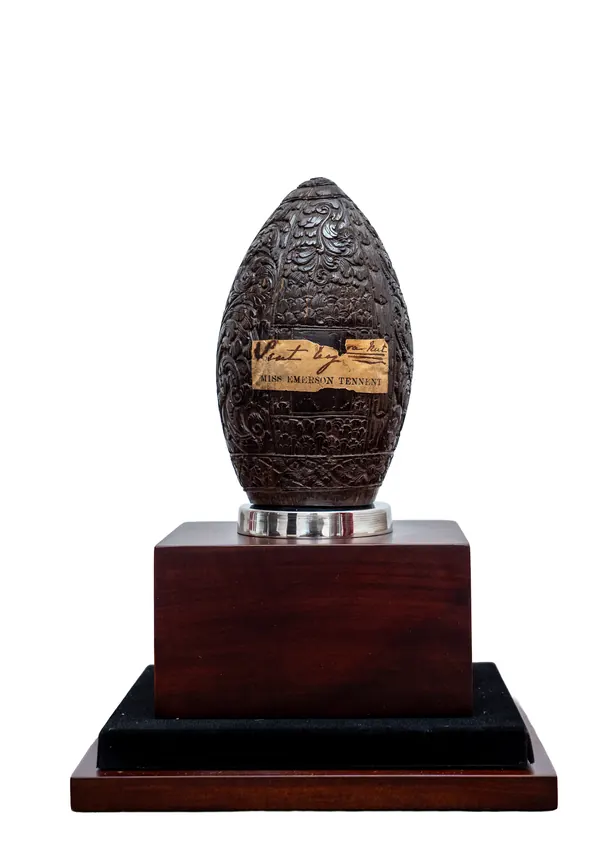
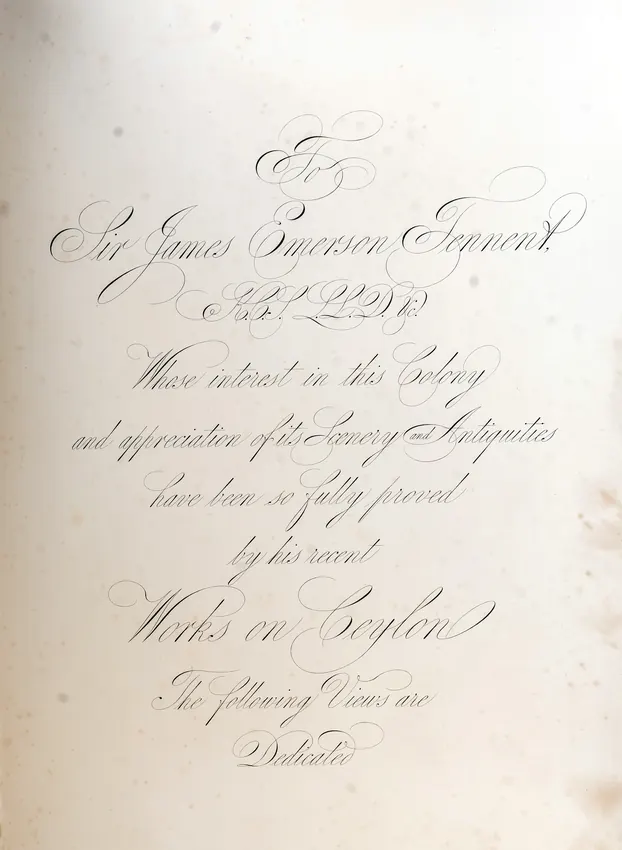
Sir James Emerson Tennent (1804–1869), Nicholl's patron, whose 'Ceylon' (1859) Andrew Nicholl illustrated.Carved coconut shell from Ceylon, originally in the collection of Sir Emerson Tennent. Exhibited at the 'Ceylon Court of the Colonial and Indian Exhibition', London 1886.The dedicatory leaf inscribed to Sir James Emerson Tennent, in recognition of his works on Ceylon.
Nicholl had come out in 1846 as the first teacher of painting and drawing at the Colombo Academy, the island's first government secondary school, later renamed Royal College, having been appointed at a salary of four hundred pounds per annum. Upon Tennent's arrival the two Belfast men, born in the same year, formed a friendship that was to shape the visual record of the island for a generation. At Tennent's instance Nicholl travelled with him throughout Ceylon, making drawings of all that he observed; upwards of eighty of the resulting engravings appeared in the book, and through it his Ceylon views reached a wider public than those of any other artist of the island.
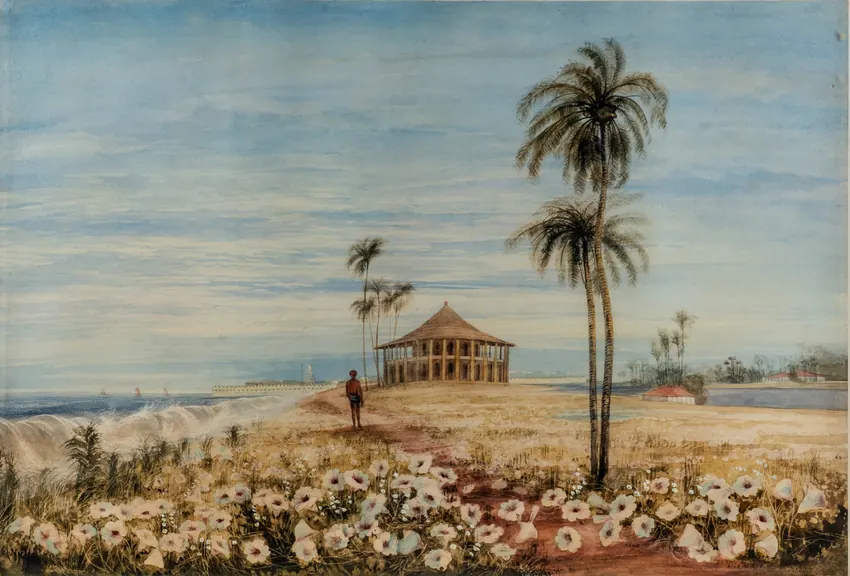
Nicholl's manner is readily recognised. His Ceylon watercolours are suffused with a tropical palette that the island drew from him, greens and blues and reds of an intensity he had not known in Ireland; and he was accustomed to enclose a landscape within a minutely detailed border of wild flowers set in the immediate foreground, so uniting botanical exactitude and topographical breadth within one composition. Queen Victoria acquired two of his Ceylon watercolours in 1870. His influence extended, furthermore, beyond his own production, for J.L.K. Van Dort, whose training at the Colombo Academy owed something to him, was to become the leading Ceylonese draughtsman of the next generation.
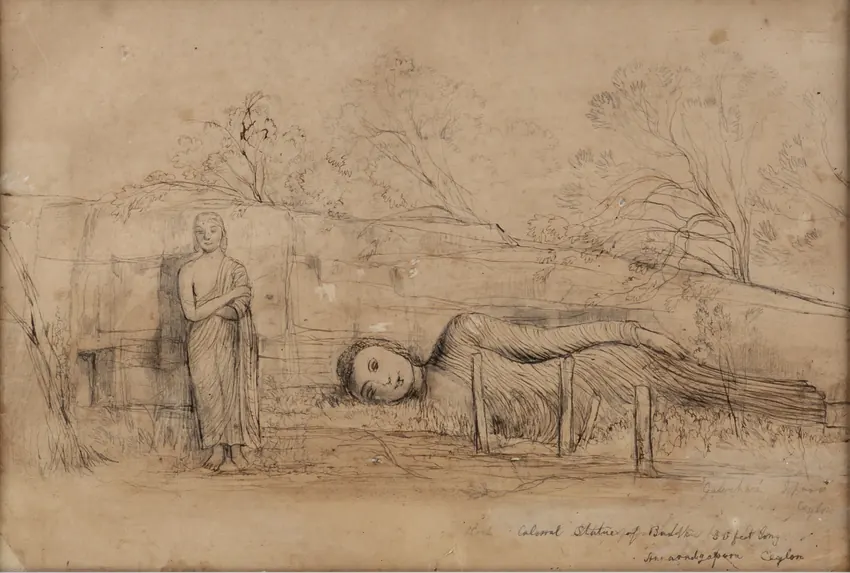
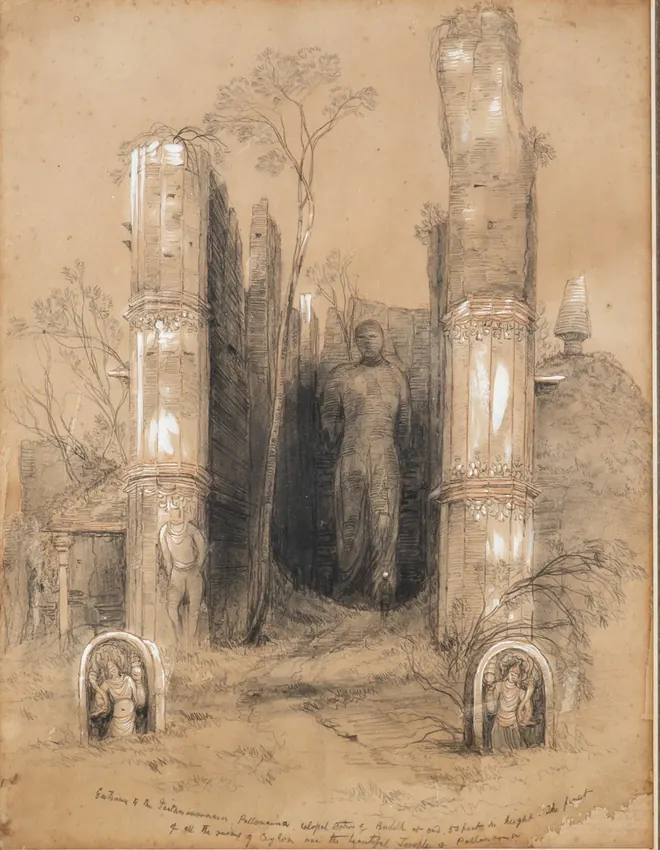
Andrew Nicholl.Andrew Nicholl, Colossal Recumbent Figure of the Buddha and Standing Figure of Ananda, Gal Vihare, Polonnaruwa, Ceylon, Circ. 1846. Pencil, pen and ink, 50.8 × 73.9 cm, the Talwatte Collection. Notes - Originally in the collection of Sir James Emmerson TennentAndrew Nicholl, A Beach in Ceylon, 1846-1849. Watercolour with scratching out, 48.3 × 71.1 cm, private collection. Nicholl used a technique in many paintings called ‘sgraffito’, a term used to describe the action of scraping to highlight certain elements, such as flowers in a landscape. In this particular work he has used it quite effectively to highlight the wave of the ocean. Nicholl’s work was described as ‘totally original compositions, and because the scale of the flowers and building is so irrational, they have a surrealist quality… it is the quality which makes them some of the most haunting paintings of the nineteenth century.’ His work is included in the British Museum, the Victoria and Albert Museum, Ulster Museum and our very own National Museum in Colombo.
Captain O'Brien and the Illustration of Tennent's Ceylon
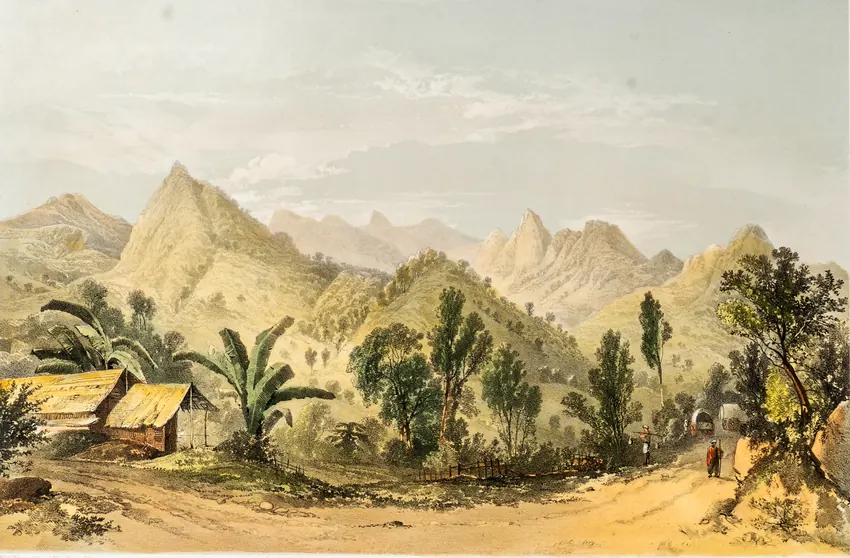
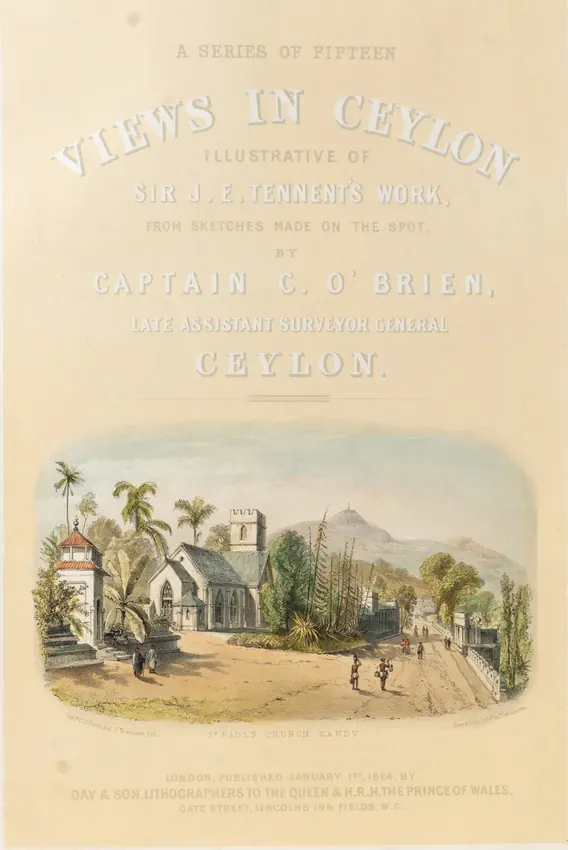
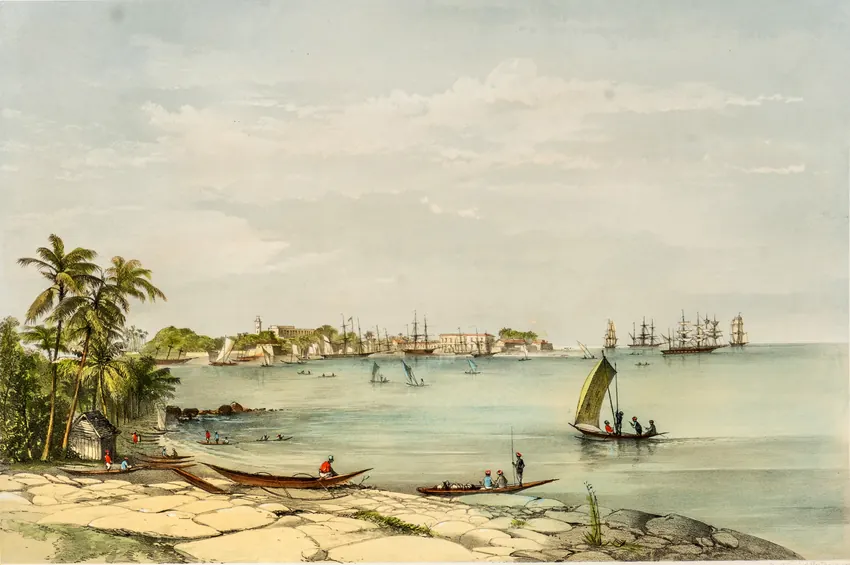
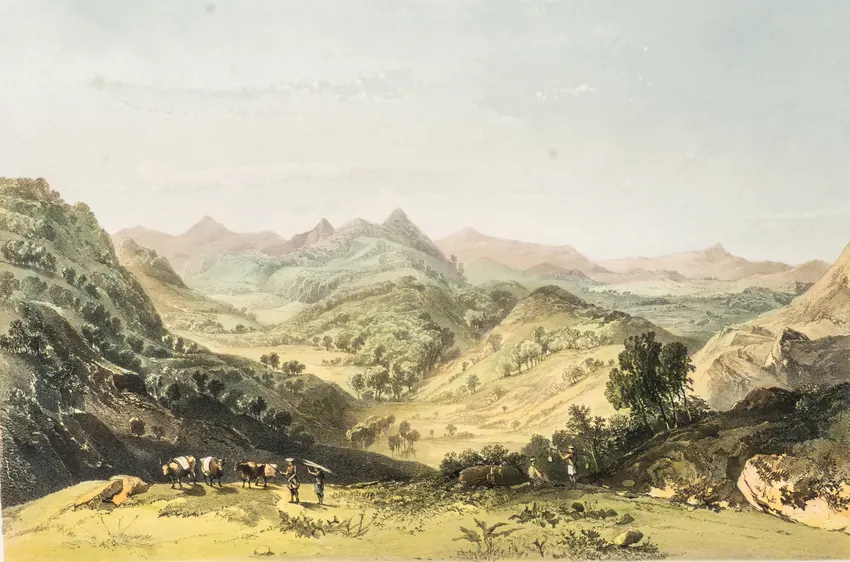
Where Nicholl illustrated Tennent's text from within, Captain Charles O'Brien (d. 1866) supplemented it from outside. As Assistant Surveyor General of Ceylon he possessed the same extensive access to the interior that Tennent had enjoyed as Colonial Secretary; and upon the appearance of the book in 1859, and its considerable success, O'Brien recognised that its descriptions of the hill country, the coffee districts and the remote interior had outrun the illustrations Tennent had been able to provide. In 1864 he published A Series of Fifteen Views of Ceylon Illustrative of Sir J.E. Tennent's Work, with lithographs by Jonathan Needham, a suite of landscape views conceived expressly as a visual companion to Tennent's book. The title declares the relation: O'Brien's art was placed in the service of Tennent's scholarship, and the work of the two men together constitutes the most comprehensive visual and literary record of mid-Victorian Ceylon.
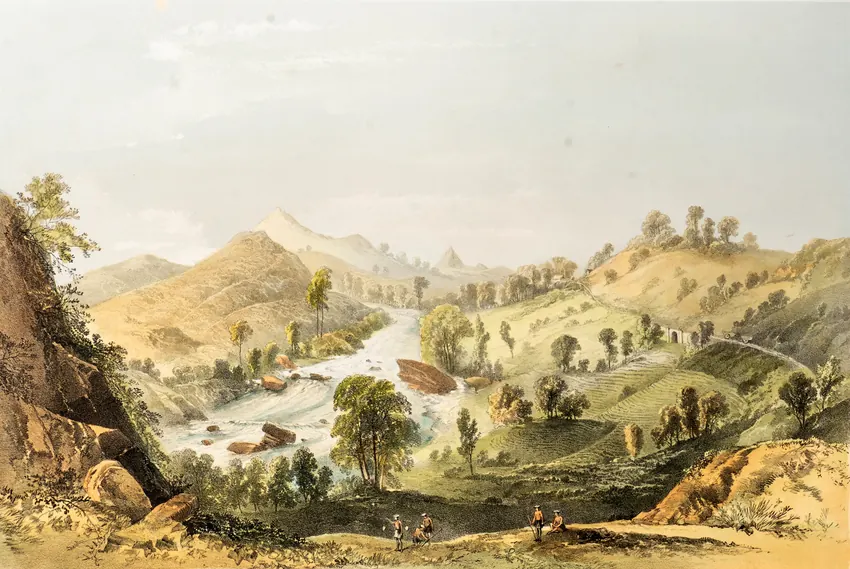
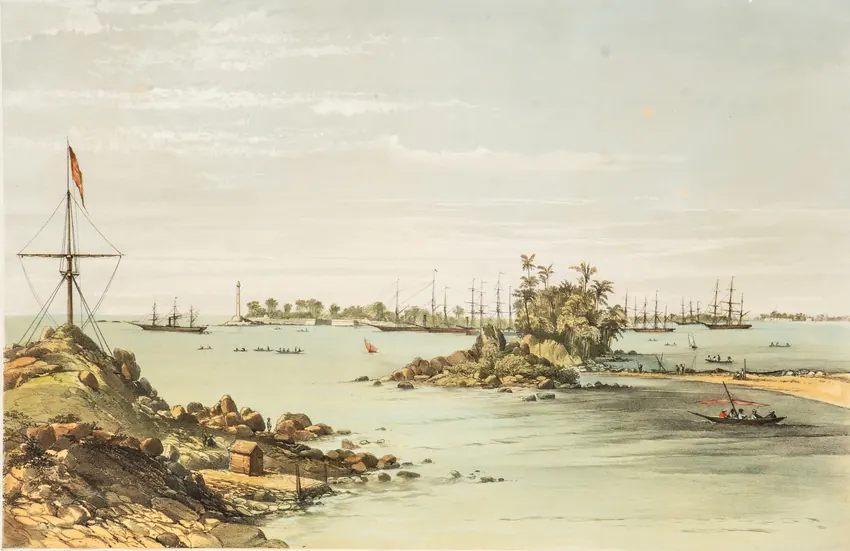
Captain Charles O'Brien, Adam's Peak from the Ambogammoa Road, at Pusbage, 1864. Hand coloured lithograph, 38 × 55 cm, private collection. The lake of Kandy is artificial, formed by damming up a small stream; and the extensive "tanks," which may almost be called lakes, are confined to the low country. On the road from Gampola to Ambogammoa, the Mahavilla Ganga, which passes under a suspension bridge at the former town, here again bursts upon us, foaming down over a rocky bed, whilst "the Peak," in which it has its source, cuts distinctly against the clear morning sky. On the right bank of the river, at this spot, is a flourishing coffee-plantation, called "Mahavilla," the property of Captain Graham, the talented architect of the bridge of Gampola. On the slope below the road are the terraced rice-fields. (De Silva, Rajpal Kumar. 1985. Early Prints of Ceylon (Sri Lanka) 1800-1900.)Captain Charles O'Brien, St. Paul's Church, Kandy, 1864. Hand coloured lithograph, 55 × 38 cm, private collection. This view appears to be orientated looking north, with the entrance to the Natha devale shown on the left and that to the Dalada Maligawa (Temple of the Tooth) on the right. In the centre is Udawattakelle with the eastern redoubt and its flagstaff. At the west end is a monument to officers of the Ceylon Rifle Regiment who served in the Crimean War, and in the south transept there is a window erected by the Ceylon Mounted Infantry in memory of their comrades who fell in South Africa. Regular Anglican services are now conducted both in Sinhalese and English. (De Silva, Rajpal Kumar. 1985. Early Prints of Ceylon (Sri Lanka) 1800-1900.)Captain Charles O'Brien, Colombo, 1864. Hand coloured lithograph, 38 × 55 cm, private collection. Colombo, the capital of the island and seat of government, has an interest as being the port from which nearly all the coffee and cocoa-nut oil is shipped for Europe. The view represents the Fort, with the Custom House, the Roadstead, in which are seen the large ships lading for Europe, and the "Inner Harbour," in which are the coasting vessels and native craft. The view is taken from the suburb of Mootwall, the resort of the fishing-boats; those formed of a single tree, with a washboard, supported by an "outrigger" of light wood, attached to the canoe by two tough but light sticks, have immense speed, and are, I believe, peculiar to Ceylon. (De Silva, Rajpal Kumar. 1985. Early Prints of Ceylon (Sri Lanka) 1800-1900.)
Edward Lear: The Greatest Artist Who Never Published
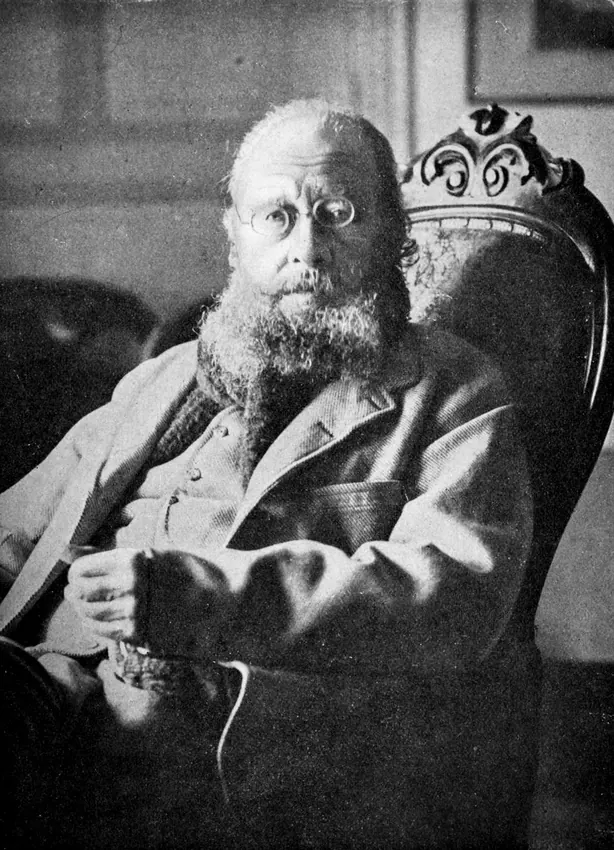
In November 1874 one of the most celebrated figures of Victorian England landed at Colombo. Edward Lear (1812–1888), poet, painter and author of the Book of Nonsense, had come to Ceylon in the course of a fourteen-month journey through India undertaken at the invitation of the Viceroy, Lord Northbrook. He was sixty-two years of age, accompanied by his devoted Albanian attendant Giorgio Kokali, and had long anticipated the island, which he had, as he recorded in his journal, awaited 'for so many years, the end of my landscape painting aspirations'.
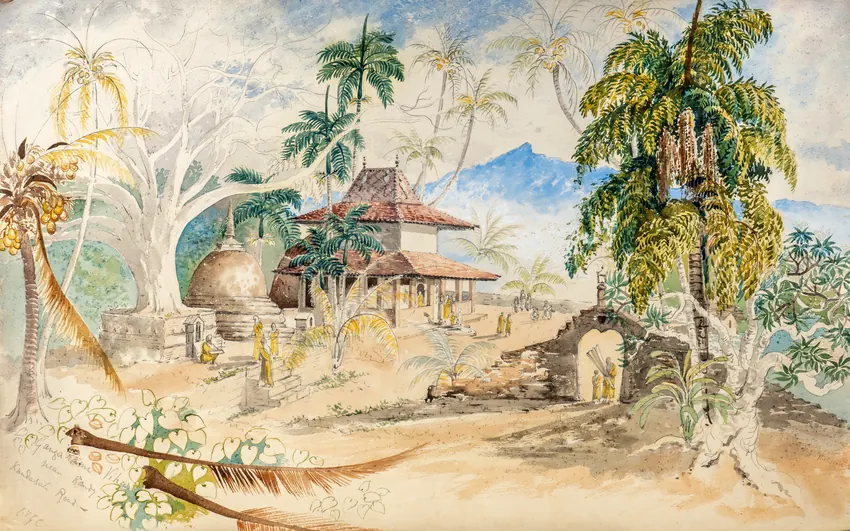
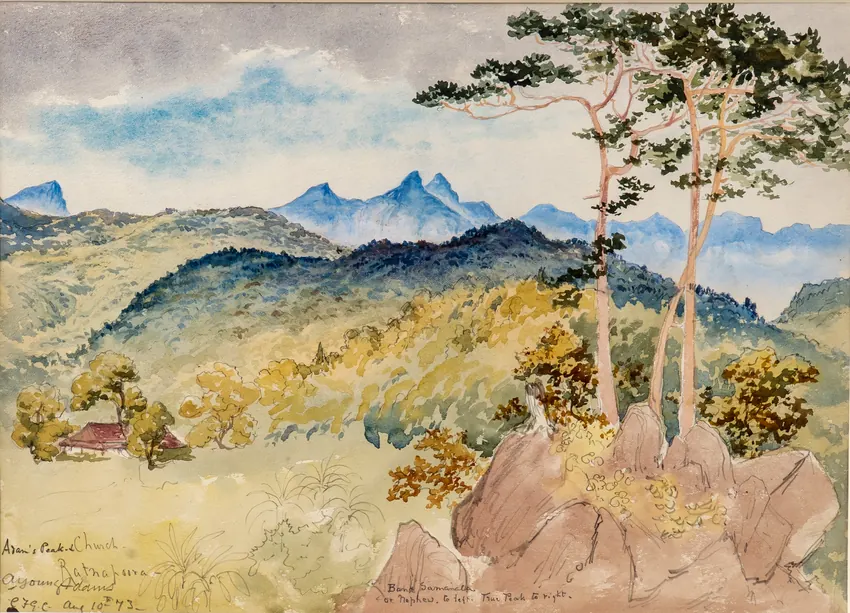
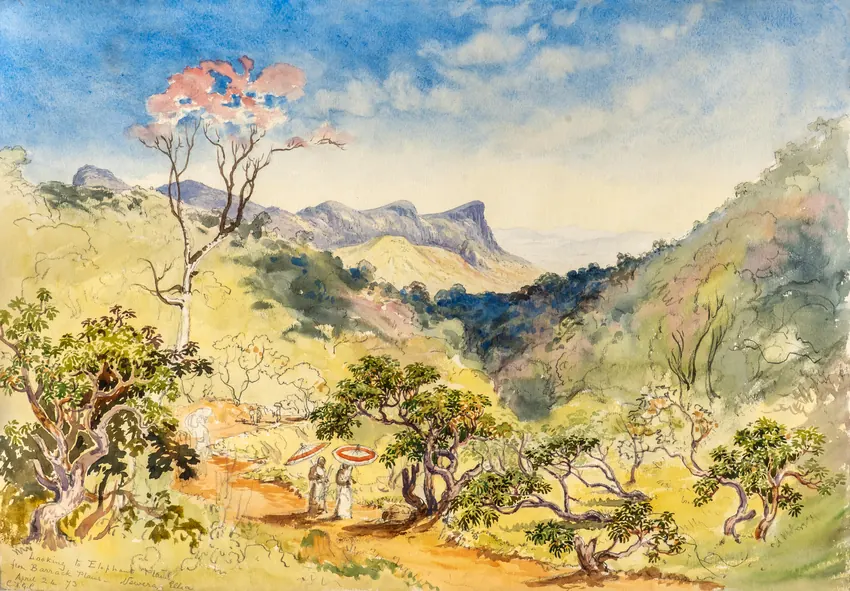
The event answered his expectation only in part. He found the island beautiful but the climate oppressive, the rains persistent, and his companion Giorgio gravely ill with dysentery; yet he sketched with his customary and compulsive industry, travelling by mail coach and one-horse trap to the south and to Ratnapura, and by railway from Colombo to Kandy and back, and producing in less than four weeks over seventy drawings and watercolours. Breadfruit and jak trees, coconut prospects, river scenes near Ratnapura with Adam's Peak in the distance, animated roads near Galle, a landscape with two Buddhist monks: the drawings are vivid, immediate and technically assured, and bear the characteristic pencil annotations of colour and texture from which he was accustomed to elaborate finished watercolours in the studio.
At Ratnapura Lear was the guest of Hugh Nevill of the Ceylon Civil Service, the son of his late friend William Nevill; the visit was, he wrote, 'a duty to the memory of dear William and Mary Nevill'. He can hardly have foreseen whom that duty would set him beside. The younger Nevill was one of the most serious British scholars of Ceylon culture then living: across thirty-two years on the island, through a succession of legal appointments from Colombo to Trincomalee to Batticaloa, he formed the greatest private collection of Sinhala palm-leaf manuscripts in existence, 2,227 of them, now preserved in the British Library, and the largest archive of Sinhala manuscripts anywhere beyond Sri Lanka; he edited The Taprobanian: A Dravidian Journal of Oriental Studies in and around Ceylon from 1885 to 1888. That a simple act of remembrance should have lodged England's greatest nonsense poet beneath the roof of so formidable a scholar, at a remote hill station in the interior, is among the more singular footnotes of the island's colonial history.
Lear's Ceylon works were never published. They remained in private portfolios during his lifetime, and some are now preserved in the Houghton Library of Harvard University. That the most accomplished professional artist to visit Ceylon in the nineteenth century should be at the same time among the least known for his Ceylon work is a paradox that the drawings themselves overturn: seen entire, they are far too fine to have remained so little known.
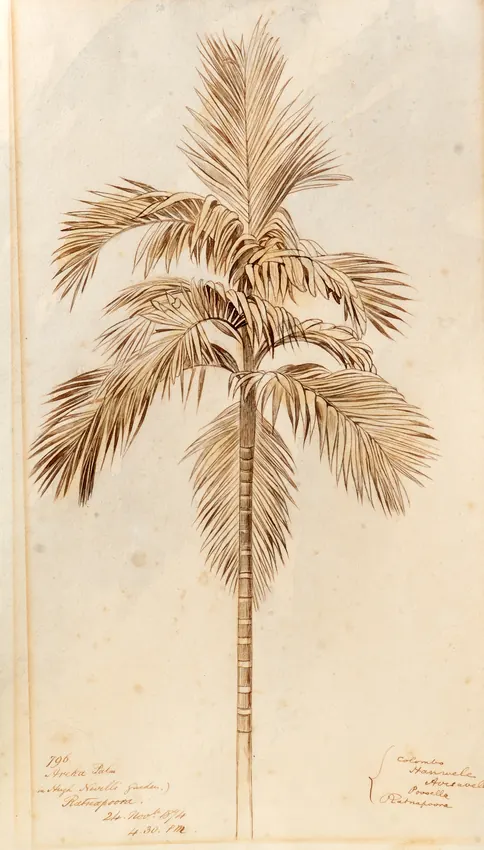
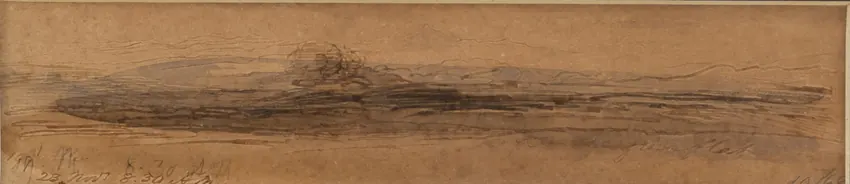
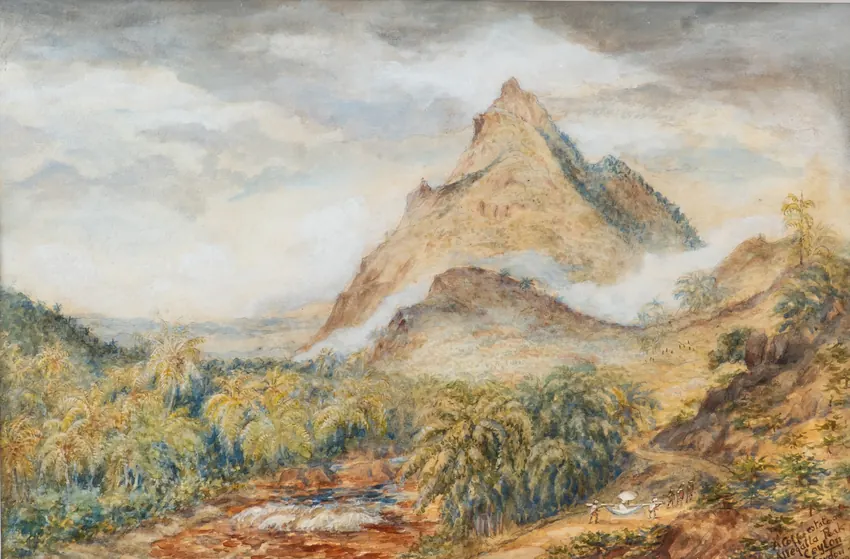
Edward Lear.Edward Lear, 'Areka Palm in Hugh Nevill's Garden, Ratnapoora', 1874. Pen, brown ink and wash, 47.0 × 27.9 cm, the Talwatte Collection. Notes - Inscribed with title and dated 'Novb 1874 4.30pm' Lear has special mention to this drawing in his diary on the 26th of November, 1874, “Read Remarkable Trials and Emerson Tennant at times, and between rains tried to draw a young areka palm in the muddy-miserable back garden. The gloom, and the continual damp here are too wretched! Towards evening what torrents of rain fell!Edward Lear, A View of Adam’s Peak, Ceylon, 1874. Oil on canvas, 22.9 × 43.9 cm, Government Art Collection, UK. The first mention of Adams Peak in Edward Lear’s journal was made on the 23rd of November, 1874. Lear is on en-route to Hugh Nevill’s home in Ratnapura which was situated at the 56th Mile post Ratnapura. On the 24th of November, 1874, whilst at Neville’s home, Lear makes the following journal entry, “ After tea, walk out but a thick mist covers everything beyond what is close to the eye. Drew on the banks of the Kalaganga(Kalu Ganga), beautiful bamboo and palmy scenery but no more.” (Lear, Edward, and Ray Murphy. 1953. Edward Lear’s Indian Journal. Edited by Ray Murphy. Jarrolds, London.)
The Women Artists: Gordon-Cumming, North and Cameron
Three women recorded Ceylon in the 1870s. Each reached the island by a different route and worked in a different medium, yet their three stories are closely intertwined.
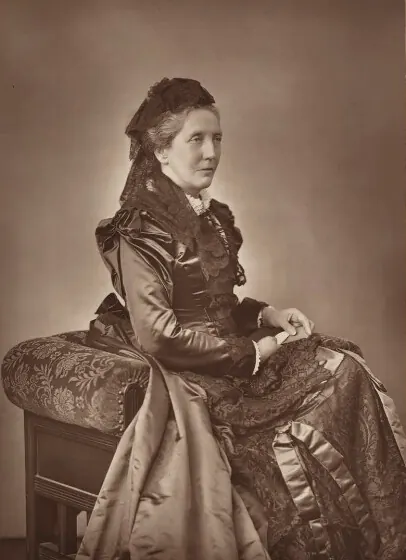
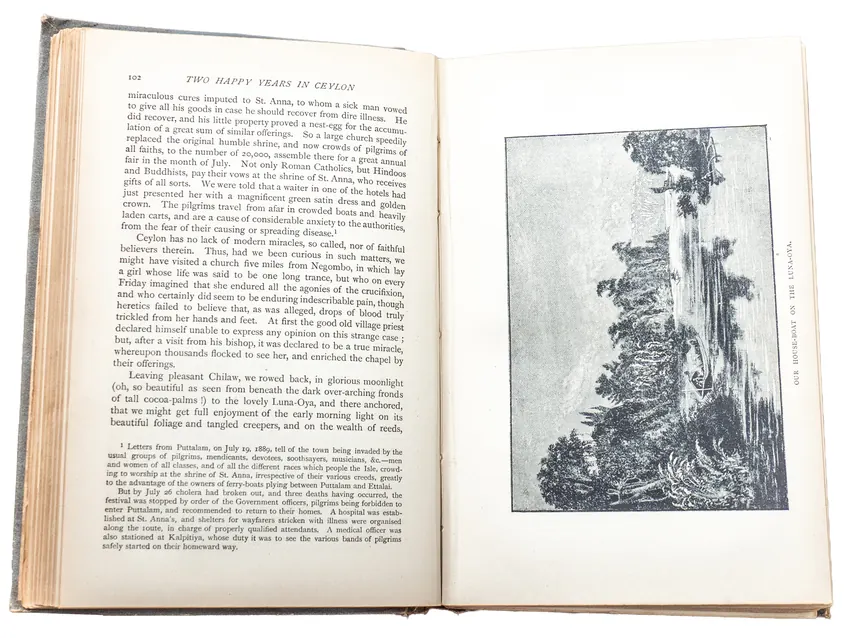
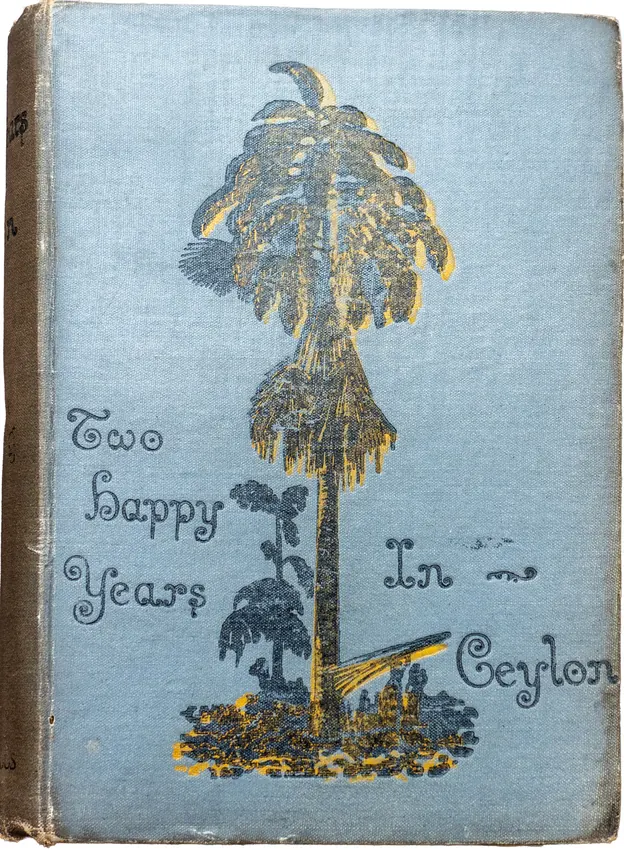
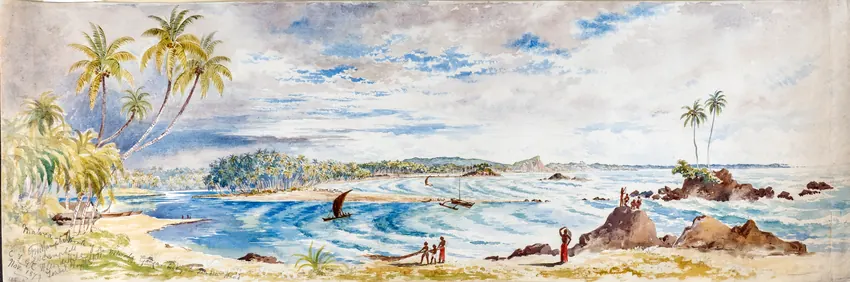
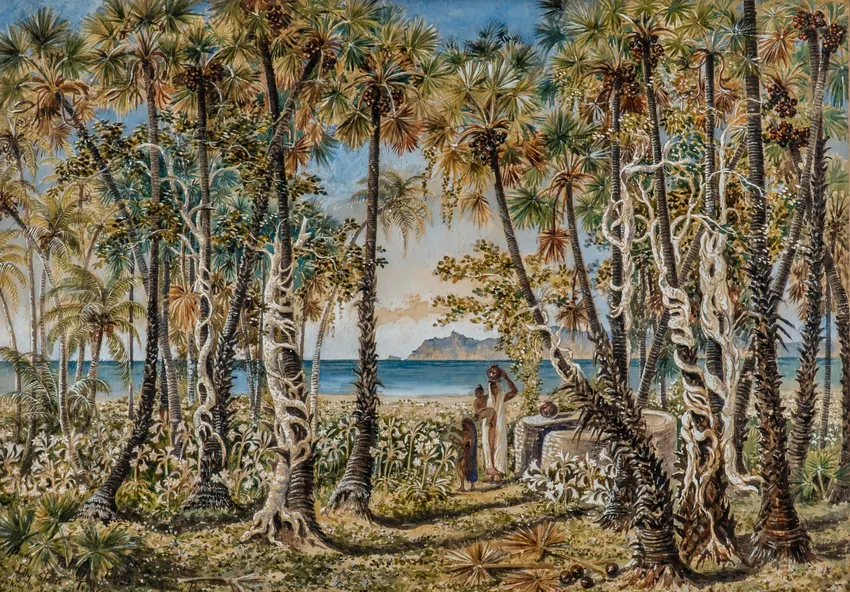
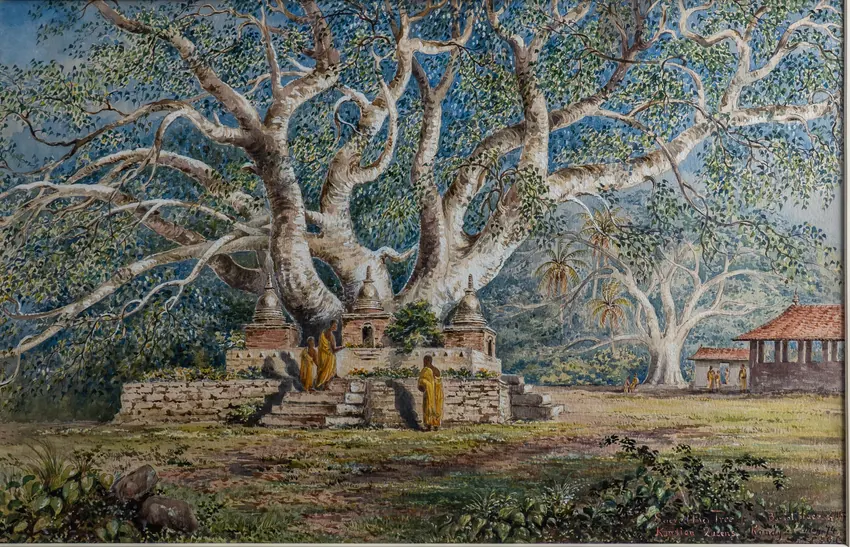
Constance Frederica Gordon-Cumming (1837–1924), known to her intimates as 'Eka', arrived at Colombo in February 1873 at the invitation of the Bishop of Colombo, in whose company she travelled the island. The twelfth child of a Scottish baronet, and largely self-taught, she observed the rule of 'never a day without at least one carefully coloured sketch', commencing her work each morning at five o'clock. Her brother John had managed a coconut plantation at Batticaloa until his death in 1866, and a visit to his grave upon the east coast was among the most personal episodes of her two years upon the island. She returned to Scotland with several hundred works, executed in watercolour and bodycolour heightened with white, a richer and more opaque technique than simple transparent wash; they were exhibited in London, Glasgow and Liverpool to considerable admiration. Her Two Happy Years in Ceylon, published in 1892 with twenty-five plates from her own hand, is at once a travel memoir, a visual record and a reflection upon the human costs of empire. She was a documented friend and influence of Marianne North, whose gallery at Kew she greatly admired.
Constance Frederica Gordon-Cumming (1837–1924).'Two Happy Years in Ceylon' by Constance Gordon-Cumming.'Two Happy Years in Ceylon' by Constance Gordon-Cumming.
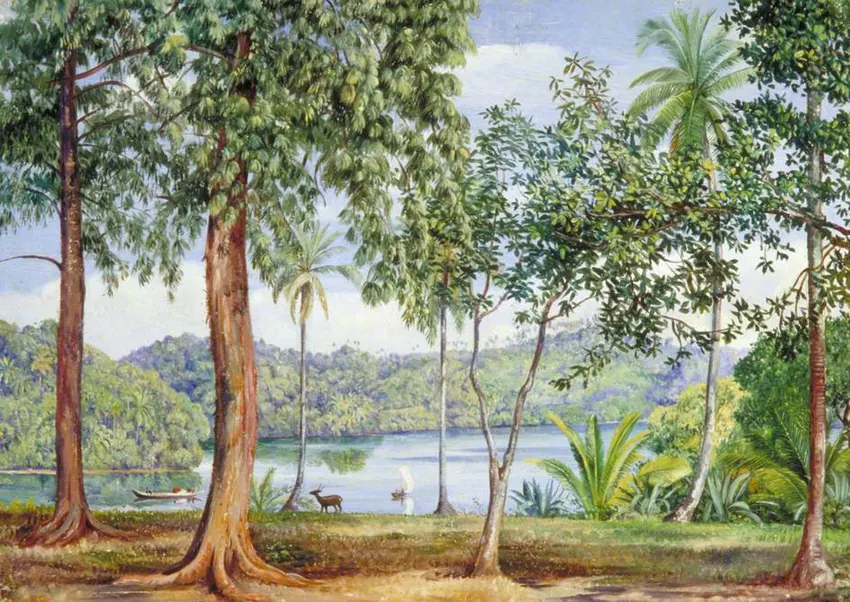
Marianne North (1830–1890) painted in Ceylon in 1877, towards the conclusion of a two-year journey about the world that had commenced in 1875. She was a botanical artist of a novel kind, who painted plants within their natural surroundings rather than as isolated specimens; this gave her work a context that formal botanical illustration had lacked. Her Ceylon paintings, executed in oil upon paper in the direct and vivid manner she preserved throughout her travels, record the island's flora with an immediacy and an accuracy that have made them significant in scientific no less than in artistic terms. They are displayed today in the gallery she herself designed and endowed at Kew, where 832 of her paintings from throughout the world cover the walls from floor to ceiling.
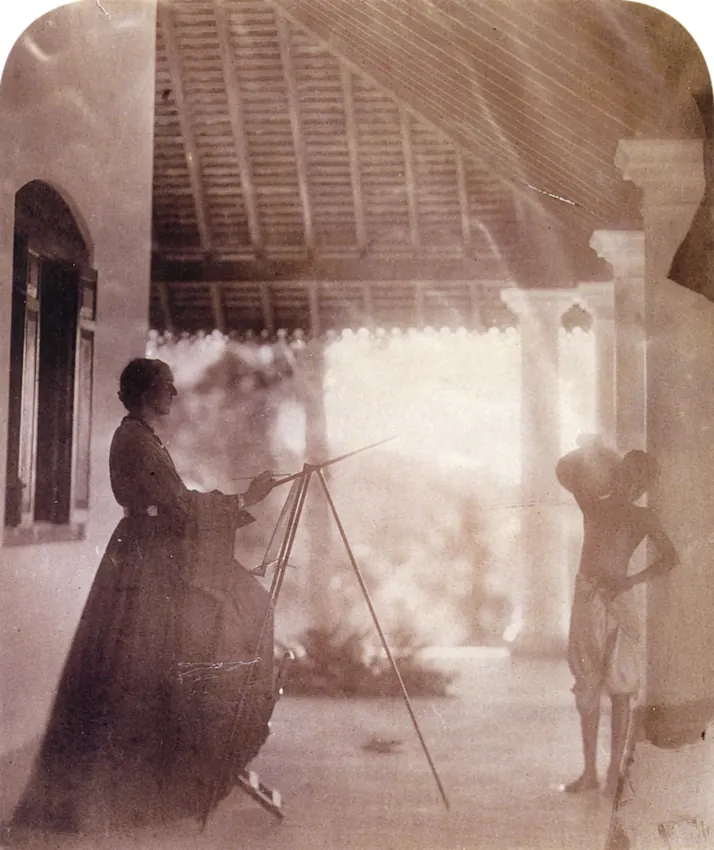
'A View from Kalutara, Ceylon', Marianne North. From the Royal Botanic Gardens, Kew Collection.Marianne North painting in Mrs Cameron's house in Kalutara, Ceylon. Photographed by Julia Margaret Cameron.
Julia Margaret Cameron (1815–1879) arrived in Ceylon singularly provisioned, bringing with her, besides the apparatus of her art, a live cow and two coffins, against the possibility that such things should prove unobtainable in the East. She had come in 1875 in the company of her ailing husband Charles Hay Cameron, whose fortunes were bound to the coffee estates of the island. Born in Calcutta and celebrated throughout Britain as the foremost portrait photographer of the Victorian age, she found the island unkind to her work: fewer than thirty of her Ceylon photographs survive, the humid climate having destroyed the greater part of her glass negatives, and the majority of those remaining are portraits of Tamil servants and estate labourers. When Marianne North came to the Cameron house at Kalutara, upon the south-western coast, Cameron, as North recorded in her memoirs, fell 'into a fever of excitement at having a European subject'.
For three days Cameron photographed her, arraying her in flowing cashmere and posing her against a screen of spiky coconut palms in a temperature of ninety-six degrees Fahrenheit. Cameron, as North recorded with characteristic dryness, 'told me to look perfectly natural'. Four of the photographs survive. The most remarkable represents North at her easel upon the verandah of the Kalutara house, a painter recorded by a photographer, and two of the greatest women artists of Victorian Britain contained within a single frame, upon the western coast of an island at the utmost edge of empire. Cameron died in Ceylon on 26 January 1879; her last word is said to have been 'Beautiful.'
The association of these three women, Gordon-Cumming, North and Cameron, is among the most resonant in the whole history of women's art in the Victorian period. Each defied the conventions of her sex and her time, and each travelled independently; and two of them, in the single year 1892, published the principal illustrated accounts of their travels about the world.
Artists Who Depicted Ceylon Without Visiting
Some of the most significant images of Ceylon were produced by artists who never saw it. The demand for such pictures was so strong that two of the most distinguished British painters of the nineteenth century represented the island without ever setting foot upon it, working from the sketches and descriptions of others.
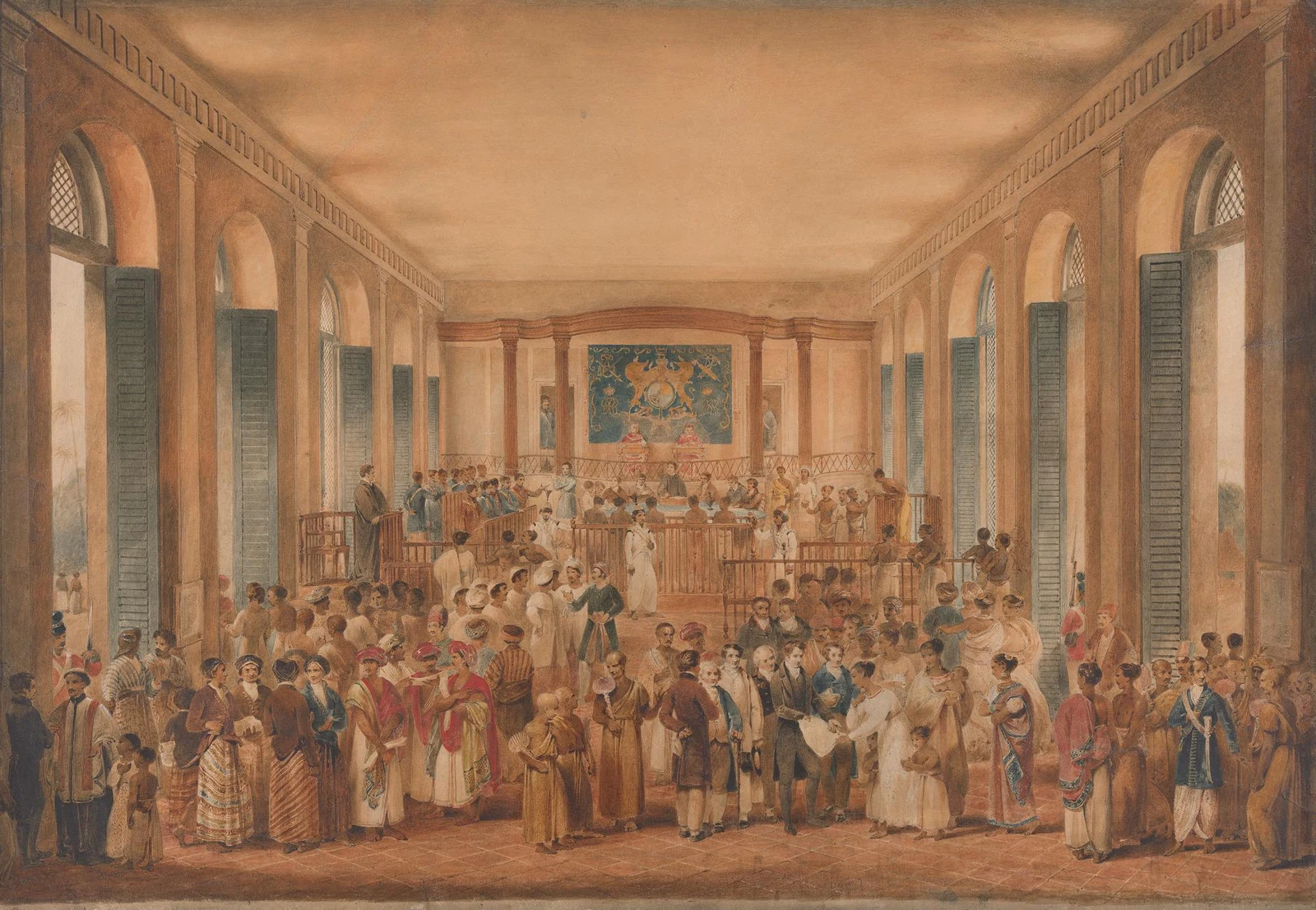
The first was James Stephanoff (c.1787–1874), Historical Painter in Watercolours to King William IV and a contributor to Pyne's History of the Royal Residences. About 1820 he executed an image of rare historical consequence, The Supreme Court of Judicature in the Island of Ceylon, published as a hand-coloured aquatint by Rudolph Ackermann, engraved by J. Bennet, and dedicated to the Chief Justice, Sir Alexander Johnston. Its subject is a moment in the history of law and conscience: the Supreme Court of Judicature at Colombo, where the first native jury in the British empire had sat since 1810, and where the abolition of domestic enslavement was proclaimed in August 1816. Stephanoff had observed none of it, working instead from a sketch dispatched to London by a Sinhalese juror; and the aquatint was afterwards put to a use more extraordinary still, for in the hands of Chief Justice Johnston this depiction of a courtroom the artist had never entered became an instrument in a constitutional contest over the independence of the judiciary, perhaps the most remarkable purpose to which such a print has ever been put. The original is held at the Yale Center for British Art.
James Stephanoff, The Supreme Court of Judicature in the Island of Ceylon, 1820. Grey/dark grey lithograph, 42 × 64 cm, private collection. This engraving is meant to commemorate, first, the grant made by his present Majesty while PRINCE REGENT, to the natives of Ceylon, of the right of sitting upon Juries, the only instance of such a grant being made by any Government to the natives of Asia. Secondly, the abolition of domestic slavery in Ceylon. To SIR ALEXANDER JOHNSTON, late Chief Justice of Ceylon and President of his Majesty's Council on that Island, for the enlightened & benevolent views which he entertains upon these subjects, by whose exertions & according to whose plan of elevating the character of the natives of Ceylon, the above measures were successfully carried into effect, this Plate is dedicated as a mark of respect, by his most obedient humble Servant J. Stephanoff. (De Silva, Rajpal Kumar. 1985. Early Prints of Ceylon (Sri Lanka) 1800-1900.)
The second was Anthony Vandyke Copley Fielding (1787–1855), President of the Society of Painters in Water Colours from 1831 until his death, a gold medallist at the Paris Salon of 1824, and the master of John Ruskin. His views of Ceylon, like his celebrated Benares and the remainder of his foreign subjects, were executed entirely from the sketches and descriptions of others, for he never travelled abroad; his reputation was nonetheless such that his pictures of places he had never seen were eagerly acquired by a British public whose appetite for images of empire far exceeded the capacity of resident artists to satisfy. William Daniell (1769–1837), Royal Academician, brother of Samuel and one of the supreme masters of the aquatint, belongs here for a different reason: it was his hand that engraved and coloured Samuel's 1808 Ceylon plates, with the technical brilliance he had brought to Oriental Scenery, and he too had never seen the island he made so vivid.
Further Witnesses: Simpson, Chevalier, Varley and Van Dort
By the 1870s the artists arriving in Ceylon were reporters and Romantics as much as surveyors. William Simpson (1823–1899), the most widely travelled British watercolourist of the age and special artist to the Illustrated London News, reached the island in the suite of the Prince of Wales, on his tour of India in 1875 and 1876; his rapidly executed field studies, the medium in which he was most fully himself, carried Ceylon to a larger readership than that of any other artist here considered. He was not alone in recording the royal visit: Sydney Prior Hall (1842–1922), special artist to The Graphic, accompanied the same party and depicted the Prince's landing at Colombo and, on 2 December 1875, the elephants and masked dancers of a Perahera rehearsal at Kandy. Nicholas Chevalier (1828–1902), Swiss by descent, Russian by birth and British by adoption, had preceded them, in 1870, with Adam's Peak, Ceylon, in which the sacred mountain ascends from the surrounding jungle and mist in the tradition of European Romantic landscape. The military topographers had measured Ceylon, and the botanists had catalogued it; Chevalier made of it something approaching the sublime.
A decade afterwards John Varley the Younger (1850–1933), grandson of the eminent watercolourist John Varley and heir to a distinguished artistic dynasty, addressed himself to the light upon water rather than to monuments. Throughout the 1880s and into the 1890s he painted the island's lakes and waterways in oil, 'Beire Lake' of 1881 and Early Morning Lake Colombo of about 1891, works soft and atmospheric, aligned with the later Victorian concern for light and mood rather than with topographical record.
The record extends, finally, to the island's own. Any account of the visual record of British Ceylon must include J.L.K. Van Dort (1831–1898), a Ceylonese artist who probably received some tuition from Andrew Nicholl at the Colombo Academy in the 1840s and became the finest indigenous illustrator of the colonial period, serving for nearly three decades as local artistic correspondent to The Graphic, The Daily Graphic and the Illustrated London News. In him something of Nicholl's influence may be traced: the Irish teacher who landed at Colombo in 1846, and the Ceylonese hand that was to produce the most sustained visual chronicle of daily life in British Ceylon that the nineteenth century would yield.
Taken together, the work forms a confluence of overlapping traditions: the natural-history aquatint, the military topographical sketch, the printed plate book, the watercolour field study, the botanical painting and the albumen photograph. It was produced by men whom their duties brought to the island and by women who came of their own accord; by artists of the first rank and by talented amateurs who drew in the intervals of other occupation; by those who passed decades upon the island and by one, Edward Lear, to whom less than four weeks were granted. Two painters, Stephanoff and Copley Fielding, represented Ceylon without ever visiting it; a third, William Daniell, engraved his brother's drawings of a place he had never seen.
What unites a body of work so various is the island itself: its light, its vegetation, its ancient monuments, its people, and the richness it presented to any eye trained to observe. Robert Knox, detained nineteen years within the Kandyan kingdom, was the first British subject to record that richness in words and in images; and the artists who followed him, across two centuries of patronage and colonial ambition, of private obsession and professional duty, raised upon his foundation what no single eye could have achieved: a collective portrait of an island at the moment of its encounter with empire, preserved in watercolour and ink, in aquatint and albumen, and dispersed now among the libraries and galleries of three continents.
* The Grand Tour was the long journey through France and Italy by which a young British gentleman of the eighteenth century completed his education. He set out with a hired tutor, learned French manners in Paris, crossed the Alps to study the classical past and the old masters of Italy, sat for his portrait among the ruins, and came home with pictures and antiquities for the family house.
** Claude Lorrain (c.1600–1682) was the French master of the idealised landscape: harbours and pastoral valleys bathed in the gold of a low sun, framed at either side by tall trees, their small figures dwarfed by the breadth of the scene. His was the serene, luminous manner that set the taste for landscape the Grand Tourist carried home, and that generations of British painters took as the measure of the beautiful.
*** Restoration London was the city of the years after 1660, when Charles II returned from exile and the monarchy was restored after the Commonwealth years. It was a capital rebuilding from plague and the Great Fire, its playhouses reopened, its court resplendent once more, and its men of science gathering in the new Royal Society.
**** The Regency was the decade from 1811 to 1820, when the future George IV ruled as Prince Regent while his father, George III, lay incurably ill. It lent its name to an age of elegance and display: John Nash's terraces, the Brighton Pavilion, the beau monde of St James's, the last war against Napoleon, and a distinctive style in the arts of those years.
The sources consulted for this essay are listed under Sources (page 00).
Notes on the Artists
Henry Salt (1780–1827)
Henry Salt was the first professionally trained British artist to draw Ceylon from life, arriving in 1802 as secretary and draughtsman to Viscount Valentia on a grand tour of the East. He had trained under the Royal Academicians Joseph Farington and John Hoppner, and the discipline shows. Of the twenty-four aquatints he published in 1809, a single plate is of Ceylon, a view of Point de Galle, made when he was but twenty-two, with an authority Cordiner's drawings could not attain. Salt would later become one of the foremost Egyptologists in Britain and Consul-General in Egypt, under whose patronage Abu Simbel was first cleared.
Samuel Daniell (1775–1811)
Samuel Daniell came of the most distinguished family of topographical painters in Britain. His uncle Thomas and his brother William, both Royal Academicians, had produced Oriental Scenery, the greatest illustrated work on India of the period, and many accounted Samuel the most gifted of the three. He reached Ceylon on 14 August 1805 and, as Ranger of the Woods and Forests, gained a freedom of the interior unmatched in his day. His twelve plates of 1808 are among the finest natural-history prints of the Regency: a spotted antelope against brilliant foliage, elephants at a watering hole, a leopard within dense jungle, each drawn with luminous precision.
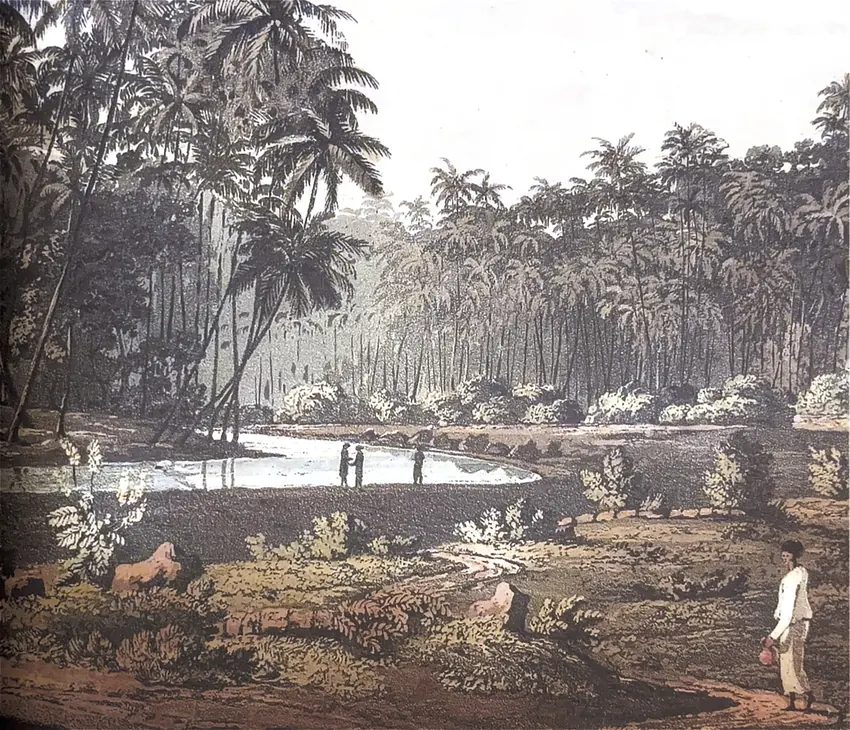
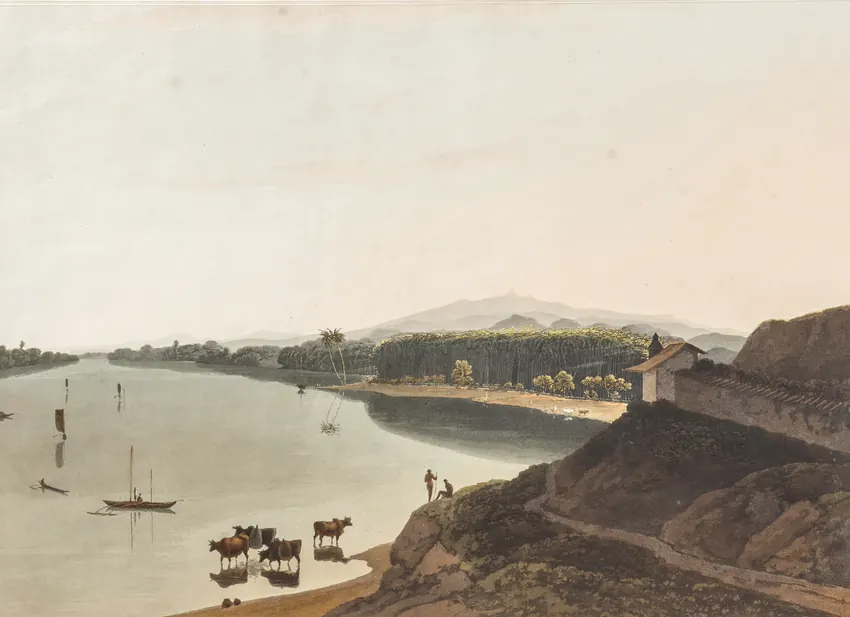
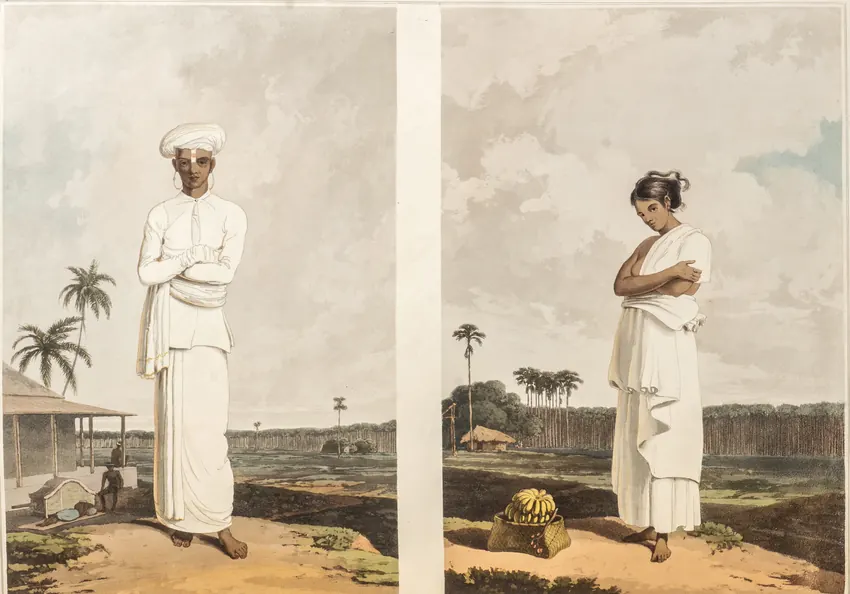
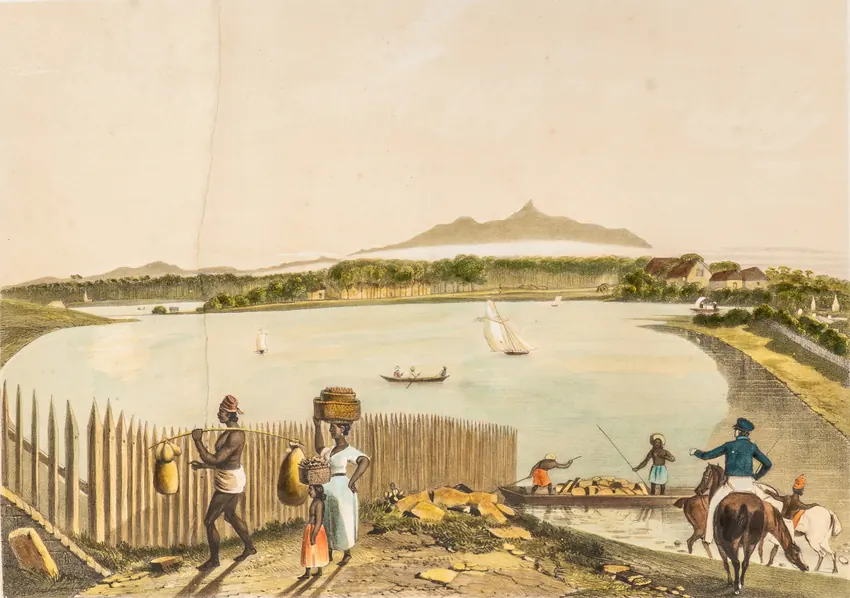
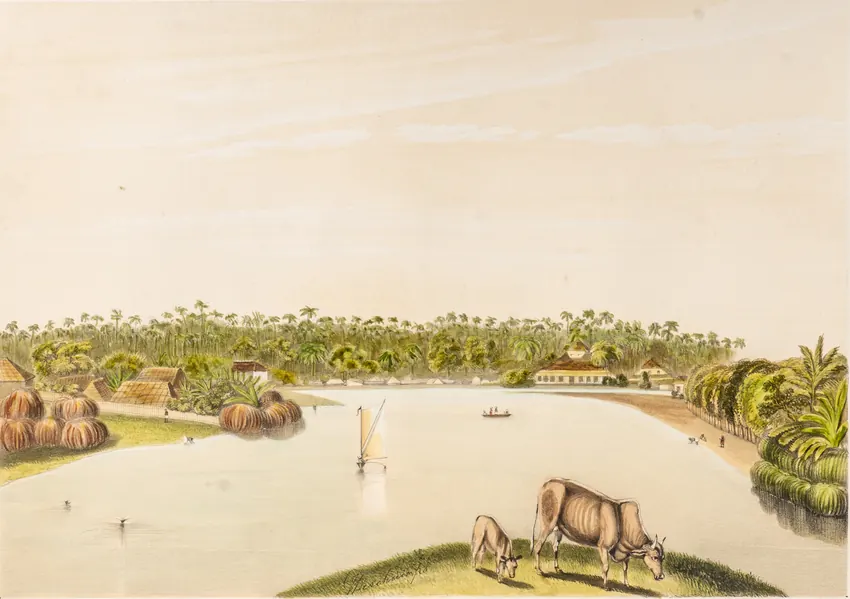
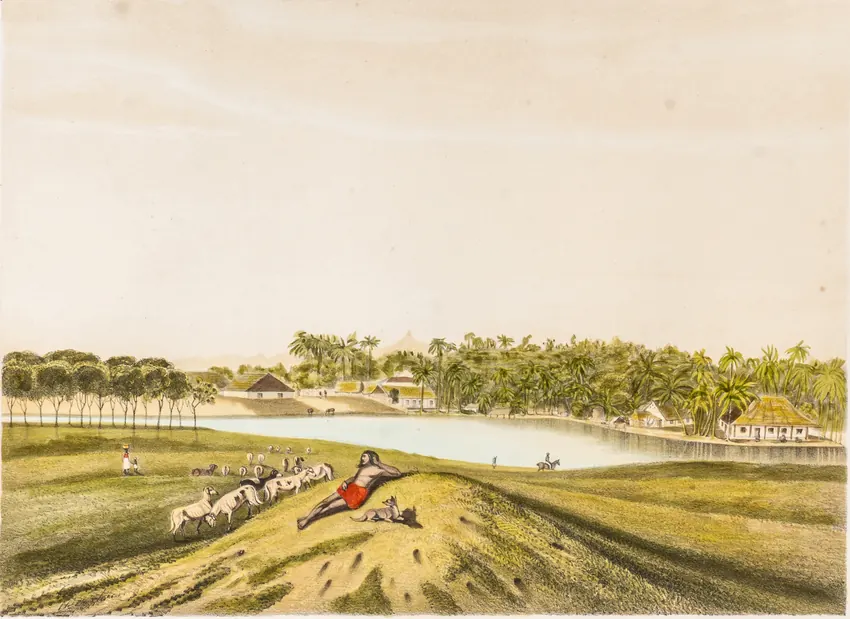
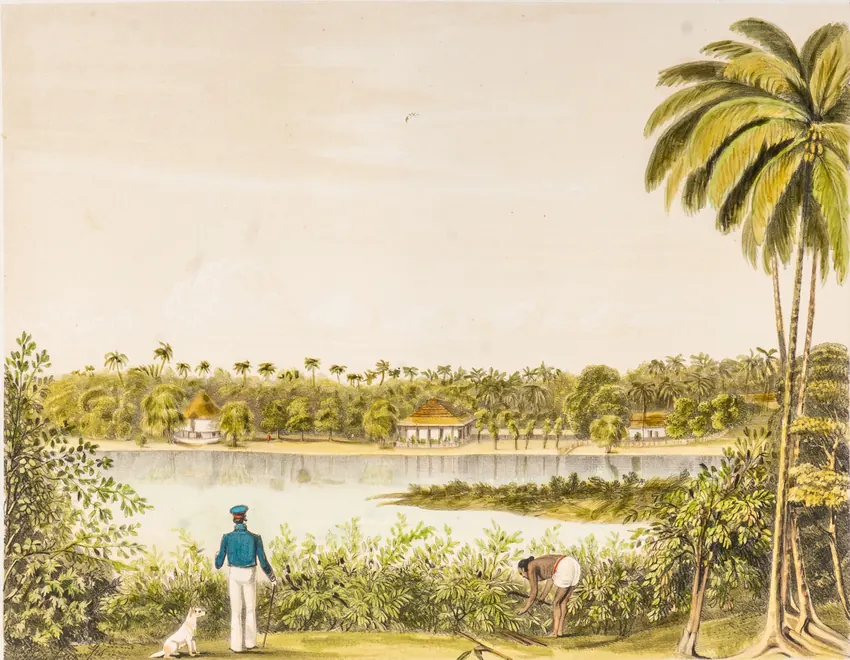
Samuel Daniell, View of Caltura, 1808. Hand-coloured aquatint, 48.5 × 61.5 cm, private collection. The village of Caltura is situated on the banks of a beautiful river, at the distance of about twenty-eight miles from Colombo, with which it communicates by means of inland navigation, partly on rivers and partly artificial canals. The annexed view is taken at the ferry across the river, near which is a small fortification, built upon an eminence, commanding the river. From this delightful situation, the mountain known by the name of Adam's Peak is distinctly visible. The banks of the river and the neighbourhood of the village of Caltura are finely clothed with the Teak tree, and the Cocoa and the Palmyra also abound. The inhabitants of the village are chiefly Cingalese. (De Silva, Rajpal Kumar, 1985, Early Prints of Ceylon (Sri Lanka), 1800 to 1900.)Samuel Daniell, The Elk, 1808. Aquatint, partially printed in colour and hand-coloured, 48.5 × 61.5 cm, private collection. This animal which, except for his short mane on the neck and throat, partakes very much of the stag kind, is found in great plenty near all the woods and thickets of the island. The individual from which the annexed representation was taken was a young male; it measured in height from the top of the shoulder to the fore hoof, four feet. The name of the Elk in the Cingalese language is Gona. The tree on the right hand is singular in its appearance. It is a species of that genus of the palm-tribe, which botanists call Caryota (frondibus bipinnatis). The Cingalese is Kitool. The fruit above the animal is the Bromelia, or wild pineapple; and the bird in the right hand corner of the print, is a species of the Rhinoceros bird or Hornbill. (De Silva, Rajpal Kumar, 1985, Early Prints of Ceylon (Sri Lanka), 1800 to 1900.)Samuel Daniell, Portraits of a Gentoo Man and Woman, 1808. Aquatint, partially printed in colour and hand-coloured, 48.5 × 61.5 cm, private collection. Towards the northern coast of the island, are great numbers of inhabitants who are descendants of the Malabars. The annexed portraits are representations of a Gentoo Chitty man and woman of Jaffnapatnam, of Gentoos professing Christianity. These are in every respect a much superior race to the Cingalese. If, however, they are more active, more intelligent and more enterprising, they are at the same time, more addicted to vicious pursuits. Their dress like that of the Malabars on the coast of India, is generally composed of one single piece of calico, or white muslin, tastefully wrapped round the body; the men wear turbans, but the women are always bare headed. The men are remarkably fond of wearing enormously large earrings, which are sometimes set with stones of considerable value. (De Silva, Rajpal Kumar, 1985, Early Prints of Ceylon (Sri Lanka), 1800 to 1900.)
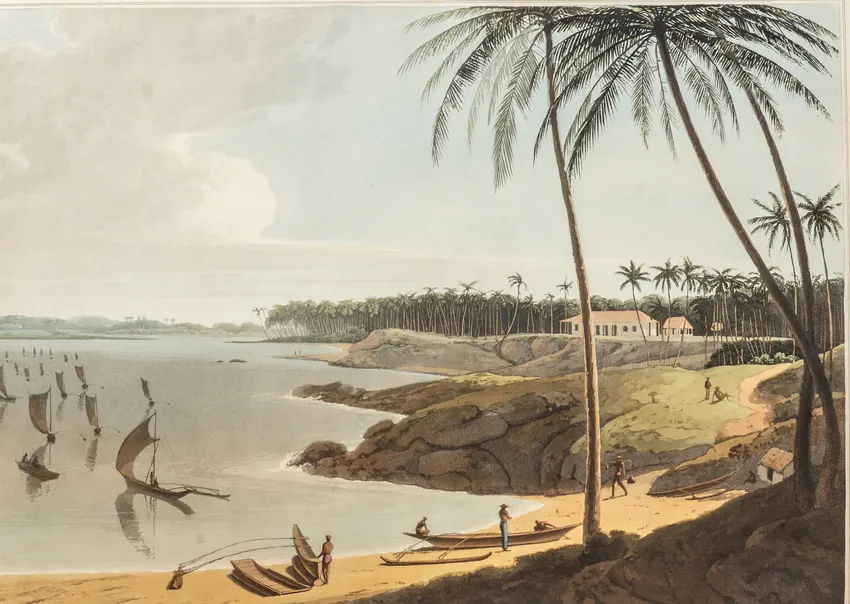
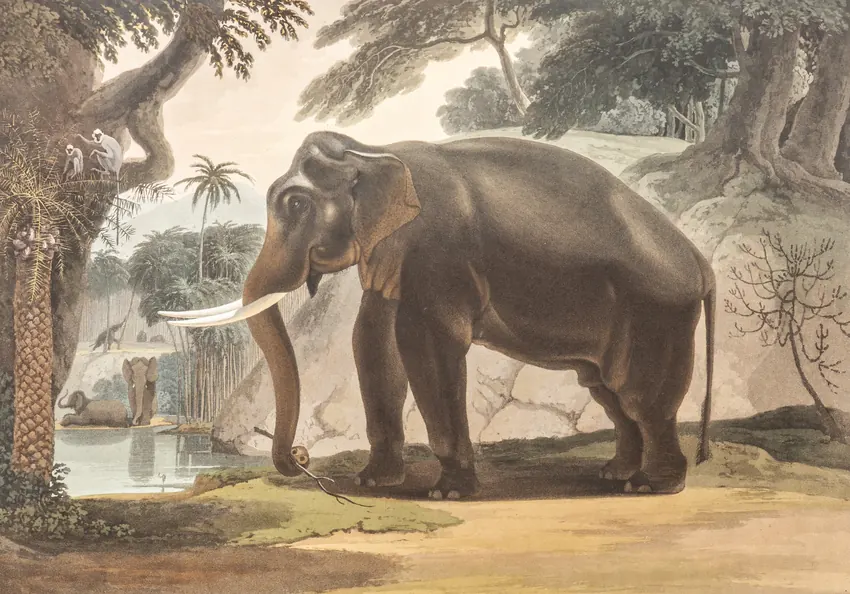
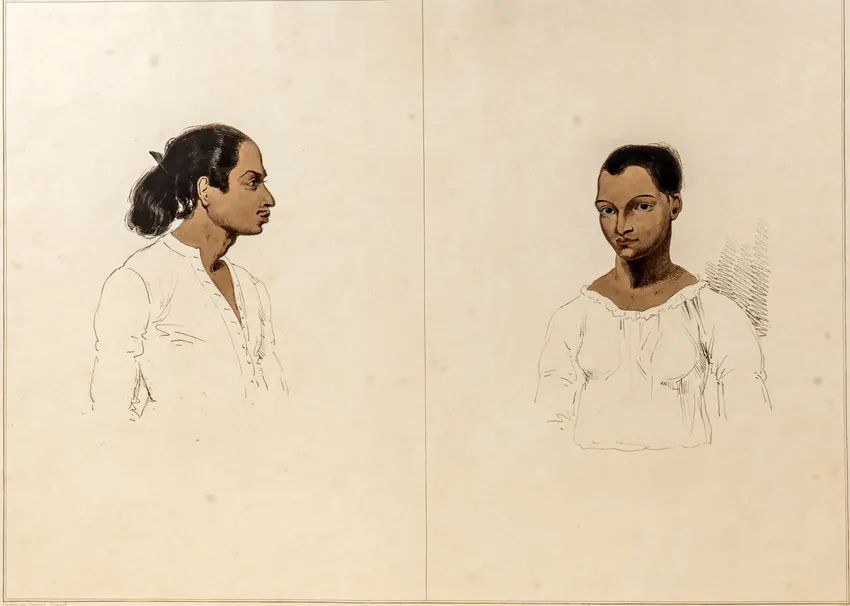
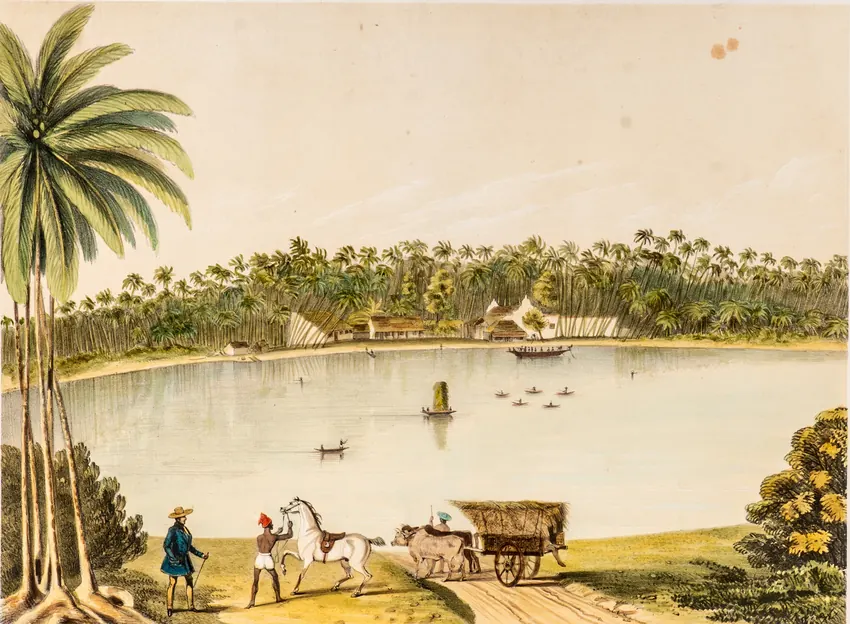
Samuel Daniell, A View of the Fishing Cove, Near Colombo, 1808. Hand-coloured aquatint, 48.5 × 61.5 cm, private collection. Daniell's view is taken looking north along the coast, from Colombo. The building shown on the right is almost certainly what started as a whist club soon after the British occupation of Colombo, in 1796. The Kelani river, whose source is on the western slopes of the Adam's Peak range, meanders via Hatton, Yatiyantota, Avissawella and Hanwella and flows into the sea at Mutwal a few miles north of Colombo. (De Silva, Rajpal Kumar, 1985, Early Prints of Ceylon (Sri Lanka), 1800 to 1900.)Samuel Daniell, The Elephant, 1808. Aquatint, partially printed in colour and hand-coloured, 48.5 × 61.5 cm, the Talwatte Collection. There are few animals, on the subject of which more has been written than on the Elephant, and few objects, till of late years, so inaccurately represented by the pencil. In Ceylon, this creature attains to the largest size of which the species seems capable, and is found in numbers in many parts of the island. In the neighbourhood of those places which they inhabit they are a dreadful scourge to the poor peasantry, by their nightly visits to the paddy grounds and plantations of the cocoa-nut. (De Silva, Rajpal Kumar, 1985, Early Prints of Ceylon (Sri Lanka), 1800 to 1900.)Samuel Daniell, Portraits of a Cingalese Man and Woman, 1808. Hand-coloured aquatint, 48.5 × 61.5 cm, private collection. The great mass of the people who inhabit the island of Ceylon may by divided into three distinct classes; the Cingalese, the Candians and the Malabars. The two first, seem to have sprung from the same origin, but have since been divided by local and political circumstances. The annexed portraits are Cingalese, from the Candian territories; they are a mild and inoffensive race of men, living chiefly on the fruits and other spontaneous produce of the earth. (De Silva, Rajpal Kumar, 1985, Early Prints of Ceylon (Sri Lanka), 1800 to 1900.)
Lieutenant William Thomas Lyttleton (c.1786–1839)
With the 73rd Regiment, Lieutenant William Thomas Lyttleton reached Ceylon in October 1814, the year before the Kandyan kingdom fell, and remained seven years. From his drawings Edward Orme of London published six hand-coloured aquatints of Kandy and its environs: the King's Palace, the town, Balani Mountain, the Ferry of Wattepalogoa. One is held to be the earliest British image of the Tombs of the Kandyan Kings, which, demolished in 1850, survive in no other record. His plates are the visual frontier of British knowledge of the Kandyan interior in the years immediately after the conquest of 1815.
Captain John Deschamps (fl. 1828–1845)
Where Lyttleton had drawn the royal interior, Captain John Deschamps kept to the western coast. An Adjutant in the Royal Artillery, he arrived in 1828 and served a decade in garrison, and his Scenery and Reminiscences of Ceylon, published in London in 1845, gathers twelve hand-coloured lithographs drawn on stone by J. West Giles: the Fort of Colombo and the Galle Face Esplanade, Slave Island and the Buddhist temples, the Ferry at Bentotte and the Rock of Mulkirri. His is a soldier's memoir in pictures, exact and affectionate: he drew what a garrison officer saw daily among the island's people.
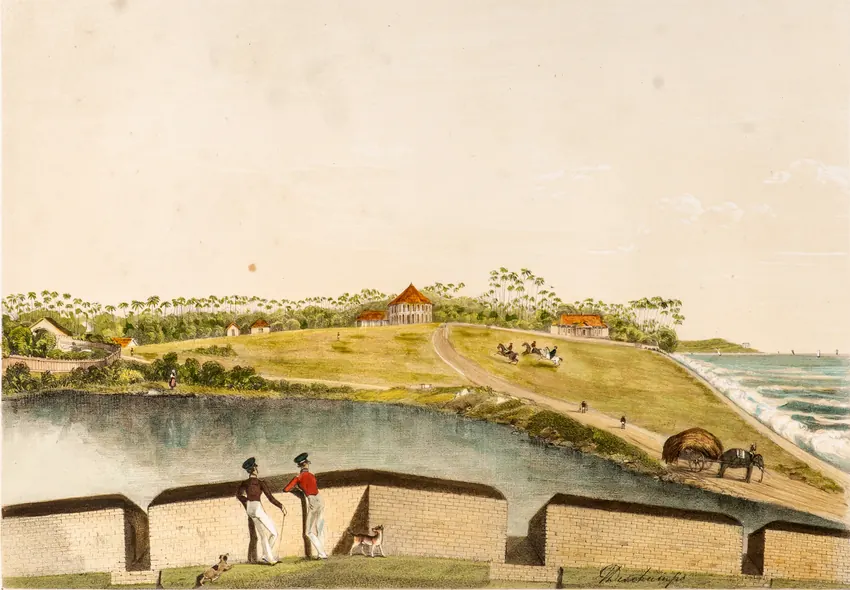
John Deschamps, The Galle-Face Esplanade, From Middleburg Counterguard, 1845. Lithographed. Hand coloured and heightened with varnish, 32 × 49 cm, private collection. Thís esplanade, or open space, on the side of the Fort towards Point de Galle (the high road to which runs through the centre of it), forms not only the principal exercising ground of the garrison, but also the general promenade of the inhabitants of Colombo and its vicinity, who repair thither morning and evening, on foot, on horseback, or in carriages, to inhale the delicious breeze which is almost always to be found by the sea-side of this part of the Island. (De Silva, Rajpal Kumar. 1985. Early Prints of Ceylon (Sri Lanka) 1800-1900.)John Deschamps, Adam's Peak and the Lake of Colombo From the Galle Barrier, 1845. Lithographed. Hand coloured and heightened with varnish, 32 × 49 cm, private collection. This view is taken just outside the barrier, on the road leading to Point de Galle and the Esplanade (one of the points already mentioned, where the lake is barely separated from the sea), a little before the setting in of the south-west monsoon - indications of which be perceived in the threatening appearance of the sky. The Peak, however, called in Cinghalese Hamalella, is the most prominent object in the Island, and is visible many leagues off at sea, in the north-east monsoon. (De Silva, Rajpal Kumar. 1985. Early Prints of Ceylon (Sri Lanka) 1800-1900.)John Deschamps, The Lake and Slave Island, From the Glacis, 1845. Lithographed. Hand coloured and heightened with varnish, 32 × 49 cm, private collection. The Lake of Colombo is a fine piece of water, supplied by several small tributary streams, and extending, as has already been said, from the glacis of the Fort, four or five miles in a north easterly direction. A native canoe being introduced, a description of these peculiar boats may here be given. Their construction is very simple, but has been allowed by scientific nautical men to be that best adapted to give the greatest swiftness to a sailing machine. In the midst of the lake stands ‘Slave Island,' so called by the Dutch from their keeping their sick and refractory slaves there. (De Silva, Rajpal Kumar. 1985. Early Prints of Ceylon (Sri Lanka) 1800-1900.)
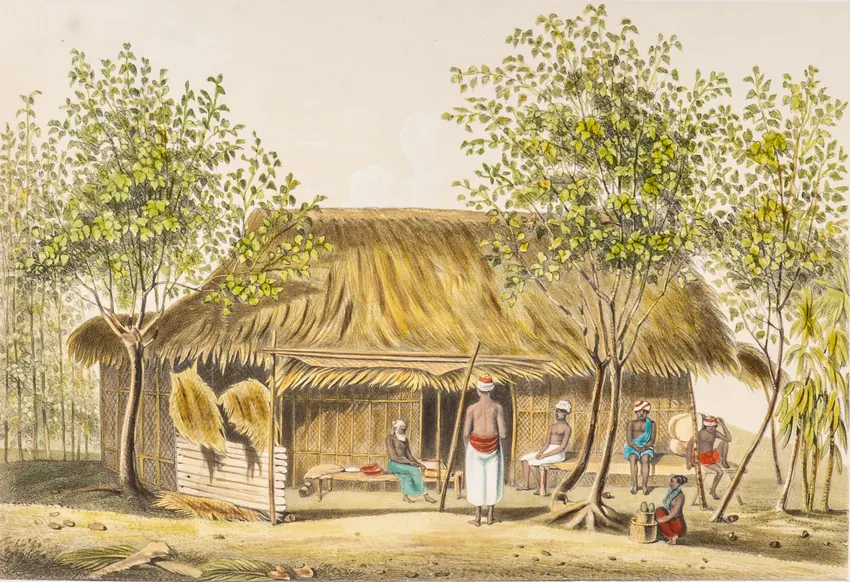
John Deschamps, Adam's Peak and Slave Island, From the Galle-Face Esplanade, 1845. Lithographed. Hand coloured and heightened with varnish, 32 × 49 cm, private collection. This view of the Peak is taken from the upper part of the Esplanade, looking across the western arm of the Lake and Slave Island, all of which having been already described, no further notice of them is necessary here. Some sheep have been introduced in the foreground to shew the character of these animals in Ceylon, and the opposite coast, from whence they are generally imported, by way of Jaffna. (De Silva, Rajpal Kumar. 1985. Early Prints of Ceylon (Sri Lanka) 1800-1900.)John Deschamps, Colpitty, from the Cinnamon Gardens, 1845. Lithographed. Hand coloured and heightened with varnish, 32 × 49 cm, private collection. This is a back view of the residence built and formerly occupied by Robert Boyd, Esq; one of the senior members of the Ceylon civil service, who about nine years since retired on a pension, after a long and honourable service on the island. In the foreground a man is represented in the act of cutting cinnamon for peeling, (De Silva, Rajpal Kumar. 1985. Early Prints of Ceylon (Sri Lanka) 1800-1900.)John Deschamps, The Ferry House at Pantura, 1845. Lithographed. Hand coloured and heightened with varnish, 32 × 49 cm, private collection. The village of Pantura is sixteen miles from Colombo, on the road to Point de Galle, and here is the first ferry over what is commonly called the Pantura river, but which is, in fact, an estuary of the sea. The ferry-house is a good specimen of a Cinghalese hut, being built entirely of kejhans and the wattling hereafter described. The trees afford a specimen of the hibiscus populneus, mentioned in the description of the Fort. Under the verandah sits the old ferryman counting his receipts, and on the other bench are a travelling Moorman and his cooley, with a large bale of cloth, waiting for a return of the ferryboat. In front of the hut stands a native servant, or appoo, and near him is a woman with cocoa-nuts for sale, sitting on her heels in the manner peculiar to Asiatics. (De Silva, Rajpal Kumar. 1985. Early Prints of Ceylon (Sri Lanka) 1800-1900.)
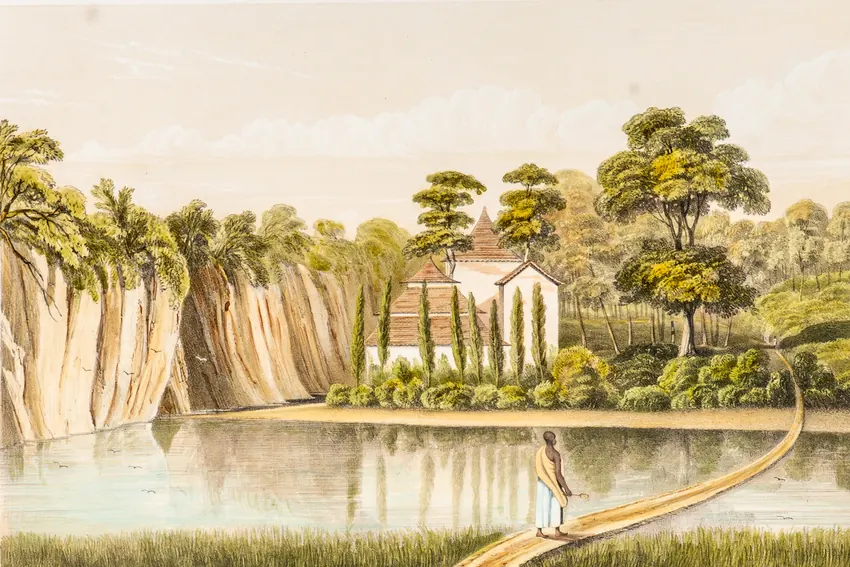
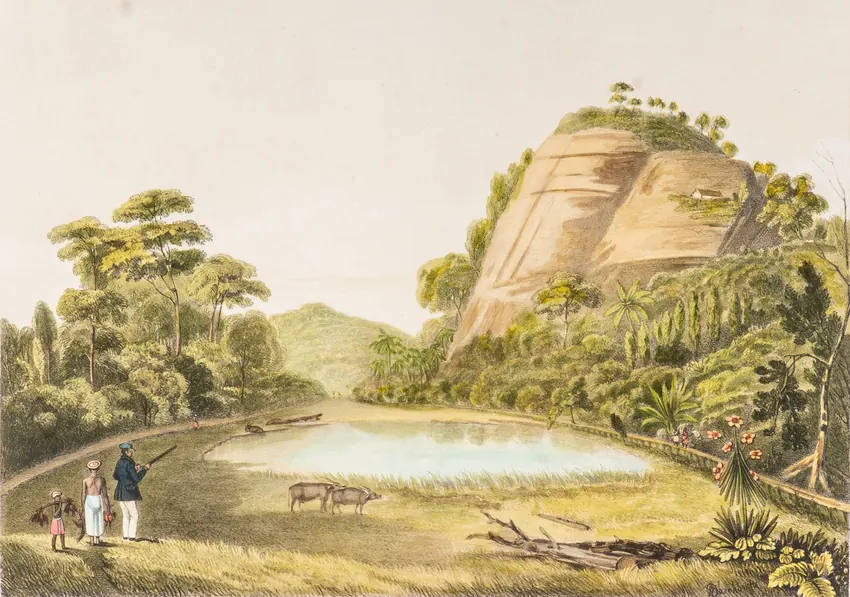
John Deschamps, Buddhist Temples Near Bolgodde, 1845. Lithographed. Hand coloured and heightened with varnish, 32 × 49 cm, private collection. These Temples are distant about three miles from Pantura, on the other side of the ferry, the road winding through beautiful lanes, shaded with a variety of trees, being studded continually with cottages and gardens, and skirted by a thick jungle. The Temple, properly so called, in Cinghalese Dewalé, is situated (as the author has generally observed these structures to be) on the side of a hill, near the top; and below it are the preaching-house, built pagoda-like, and the dwellings of the priests, all beautifully shaded by noble trees, their dark green foliage contrasting finely with the whitewashed walls and red-tiled roofs. The top of the hill affords a splendid view of the Lake of Bolgoddé, which washes its base, the shores of which are covered with forests as far as the eye can reach. (De Silva, Rajpal Kumar. 1985. Early Prints of Ceylon (Sri Lanka) 1800-1900.)John Deschamps, The Ferry and Rest-House at Bentotte, 1845. Lithographed. Hand coloured and heightened with varnish, 32 × 49 cm, private collection. Bentotte is twelve miles beyond Caltura, twenty-two beyond Pantura, and thirty-eight from Colombo, on the road to Point de Galle. The road is, in most parts, good, running close to the sea-shore, which is generally low, and of a sandy soil fruitful in the production of cocoa-nut trees. The river at Bentotte is a fine stream, nearly 500 yards broad at the ferry, but shallow, except for about 150 yards in the middle, as may be conjectured from the way in which the natives are represented, fishing, in the Plate. On one of the boats may be observed a very primitive sail, formed of a single cocoa-nut leaf. On the south, or Galle side of the river, as at the other two places, is a capital rest-house, the picturesque gables of which testify that it was built by the Dutch. (De Silva, Rajpal Kumar. 1985. Early Prints of Ceylon (Sri Lanka) 1800-1900.)John Deschamps, The Rock of Mulkirrigalle, 1845. Lithographed. Hand coloured and heightened with varnish, 32 × 49 cm, private collection. This extraordinary mountain of rock, called by the Dutch Adam's Brecht, or Adam's Berg, is about twelve miles from Tangalle (which is 120 from Colombo), by a wretched cross-road, through narrow lanes, overgrown in places with jungle, and continually up and down hill. At Kattawatta there is a stream, about twenty yards broad, with a bridge over it. The country at the foot of the beholder is richly wooded and verdant, and watered by winding streams; this splendid view being bounded to the southward and eastward by the sea and Tangalle, and, in the opposite direction, by a fine chain of mountains, some of the Kandyan ones being just visible in the distance. On the summit of the rock is one of the white bell-shaped monuments called, in Cinghalese, Dagobah, whích are attached to almost every Buddhist temple, and are said to cover some precious relíc of that god. (De Silva, Rajpal Kumar. 1985. Early Prints of Ceylon (Sri Lanka) 1800-1900.)
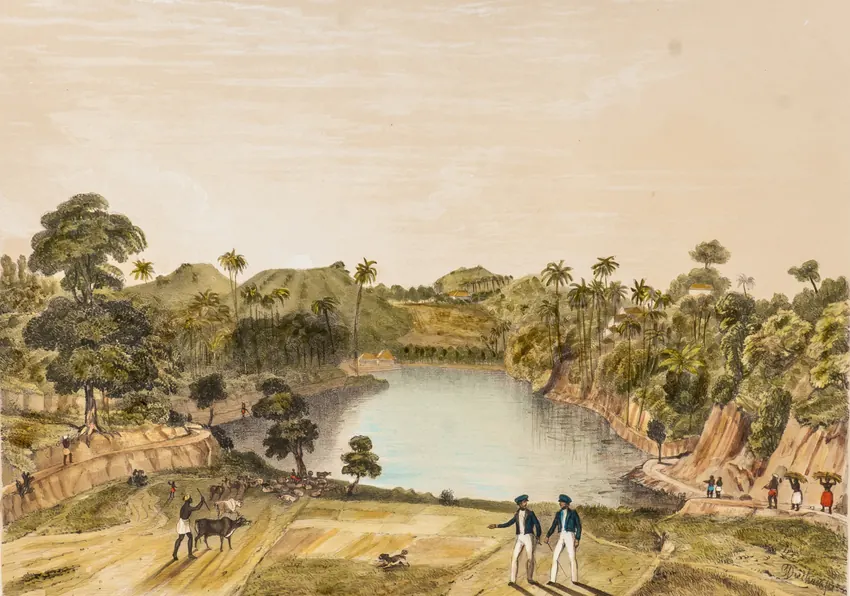
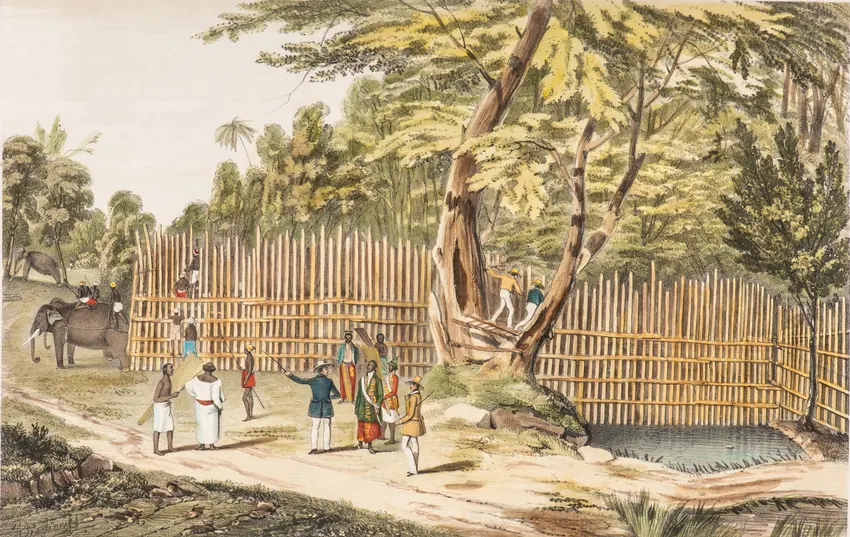
John Deschamps, The Lake of Kandy, 1845. Lithographed. Hand coloured and heightened with varnish, 32 × 49 cm, private collection. Kandy is seventy-two miles from Colombo, by the new and splendid road made under the direction of the royal engineer department, during the government of Sir Edward Barnes. The Lake, which lies nearly east and west, is one of the most attractive features of Kandy, being embosomed in hills which, in some parts, rise abruptly from its margin, their bases having been scarped to make the road, which runs all round it (a distance of about two miles), and forms one of the most favourite walks and drives of the European inhabitants, as well as a bathing and washing place for the natives. (De Silva, Rajpal Kumar. 1985. Early Prints of Ceylon (Sri Lanka) 1800-1900.)John Deschamps, The Great Elephant Kraal at Cottawya, 1845. Lithographed. Hand coloured and heightened with varnish, 49 × 32 cm, private collection. Cottawya is about eight miles from Tangalle, by a wretched cross-road, chiefly through paddy fields, the country, where not cleared, being covered with a low bush or jungle, abounding peacocks, jungle-fowl, deer, wild hog, and other game, from the jack-snipe to the elephant. The kraal is of triangular shape, and vast dimensions, and may be compared to a funnel, the extremity, or pipe, specially called the funnel, being just wide enough to admit one elephant, which, when once in, cannot turn, and is goaded on by the hunters through the posts. Branches of trees are heaped up on the outside to mask the inclosure, and two long lines of fires are formed on the prolongation of the wings, between which the elephants are driven to the immediate vicinity of the kraal, by a host of natives employed by the government, and, formerly, pressed for the service. (De Silva, Rajpal Kumar. 1985. Early Prints of Ceylon (Sri Lanka) 1800-1900.)
Andrew Nicholl (1804–1886)
Andrew Nicholl of Belfast came out in 1846 as the first teacher of painting at the Colombo Academy, and in Emerson Tennent, a fellow Belfast man born the same year, found the patron who would shape his Ceylon work. Travelling the island at Tennent's side, he supplied upwards of eighty engravings for Tennent's book, and his Ceylon views reached a wider public than those of any other artist of the island. His manner is unmistakable: a tropical palette of greens, blues and reds, and landscapes framed within a minute border of wild flowers, where close botanical detail meets a wide prospect. Queen Victoria acquired two of his watercolours in 1870.
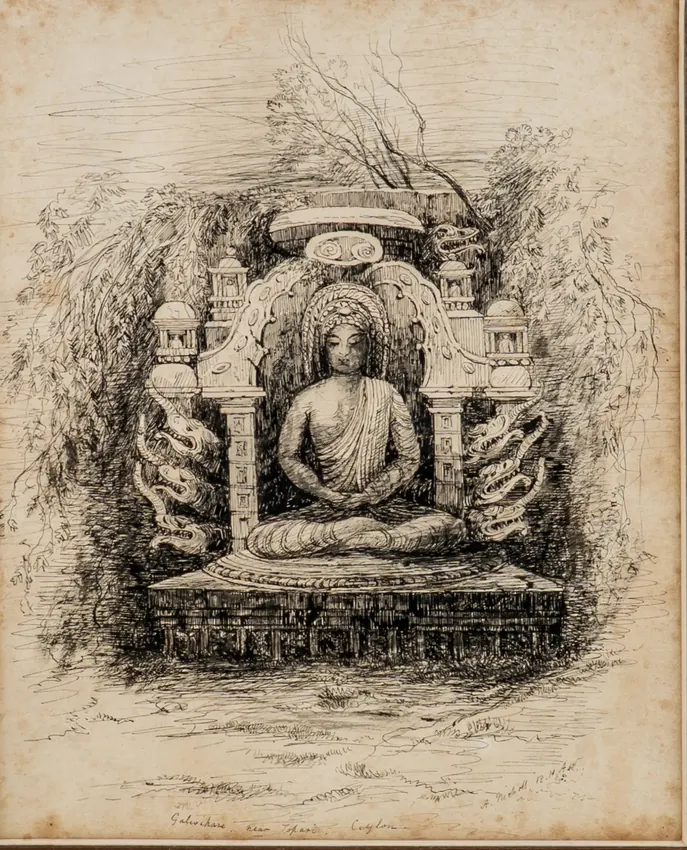
Andrew Nicholl, A Banyan Tree on the Galle Road near Colombo, Ceylon, 1847. Watercolour over traces of pencil, 33 × 47 cm, private collection. This depiction of the Banyan Tree could well be the famous tree in Galle road in Kalutara that Nicholl might have well passed during his travel to or from Colombo. This tree in question has been illustrated and photographed many times and was cut down to enable container trucks carrying cargo to use this road.Andrew Nicholl, The Jatta-wana rama, Circ. 1846. Pencil on Paper, 34.3 × 22.9 cm, the Talwatte Collection. “Still advancing along the main street, we come next to an immense edifice of brick, in the highest style of ornamental southern Indian architecture. This is the Jayta-wana-rama, a temple of great dimensions, built by Parakrama Bahu the 1st., after the model, it is said, of one created by Buddha himself at Kapili-vastu, the place of his birth. The exterior is profusely decorated with architectural devices in chunam, and the character of the island, it is corroborative of the statement in the Mahavanso, that Parakrama the Great, brought artists from the opposite coast of India to construct the buildings at Polonnaruwa, and repair those at Anarajapoora. The style seems to belong to the Sarascenic period, and the grand entrance to the temple at the eastern end is flanked by two polygonal turrets, which forcibly recall the outline of the Kotub Minnar at Delhi. The porch was originally guarded on either side by two figures in alto-relivo, only one of which remains, and at extremity of the main aisle, is reared a gigantic statue of Buddha, formed of brickwork coated over with chunam. It is partially concealed by the debris of the fallen roof, but the portion uncovered measures fifty-eight feet in height from the knees to the crown of the head” (Tennent, Sir James Emmerson Ceylon. 1859. An Account of the Island, Physical, Historical, and Topographical with Notice of its Natural History, Antiquities and Productions. Longman, London)Andrew Nicholl, Gal Viharaya, Circ. 1846. Ink on Paper, 50.8 × 34.3 cm, the Talwatte Collection. The most remarkable of all the antiquities at Toparé, is the Gal-wihara, a rock-temple hollowed in the face of a cliff of granitic stone which overhangs the level plain at the north of the city. So far as I am aware, it is the only example in Ceylon of an attempt to fashion an architectural design out of the rock after the manner of the cave temples of Ajunta and Ellora. The temple itself is a little cell, with entrances between columns; and an altar at the rear on which is a sedent statue of Buddha, admirably carved, all forming undetached parts of the living rock. Outside, to the left, is a second sedent figure, of more colossal dimensions, and still more richly decorated; and to the right, are two statues likewise of Buddha, in the usual attitudes of exhortation and repose. The length of the reclining figure to the right is forty-five feet, the upright one is twenty-three, and the sitting statue to the left sixteen feet from the pedestal to the crown of the head. Between the little temple and the upright statue the face of the rock has been sloped and levelled to receive a verbose inscription, no doubt commemorative of the virtues and munificence of the founder. The Maha-wanso records the formation of this rock temple by Prakrama Bahu, at the close of the twelfth century, and describes the attitude of the statues "in a sitting and a lying posture, which he caused to be hewn in the same stone." With the date thus authenticated, one cannot avoid being struck by the fact that the art exhibited in the execution of these singular monuments of Ceylon was far in advance of that which was prevalent in Europe at the period when they were erected.” (Tennent, Sir James Emmerson Ceylon. 1859. An Account of the Island, Physical, Historical, and Topographical with Notice of its Natural History, Antiquities and Productions. Longman, London)
Captain Charles O'Brien (d. 1866)
When Emerson Tennent's Ceylon appeared in 1859 to considerable success, its descriptions of the hill country, the coffee districts and the remote interior outran the illustrations the book could provide. Captain Charles O'Brien, Assistant Surveyor General, had the same wide access to that interior Tennent had enjoyed as Colonial Secretary, and in 1864 he answered the gap: A Series of Fifteen Views of Ceylon Illustrative of Sir J.E. Tennent's Work, with lithographs by Jonathan Needham, a suite of landscapes conceived expressly as a visual companion to Tennent's scholarship. His art was placed in the service of another's book.
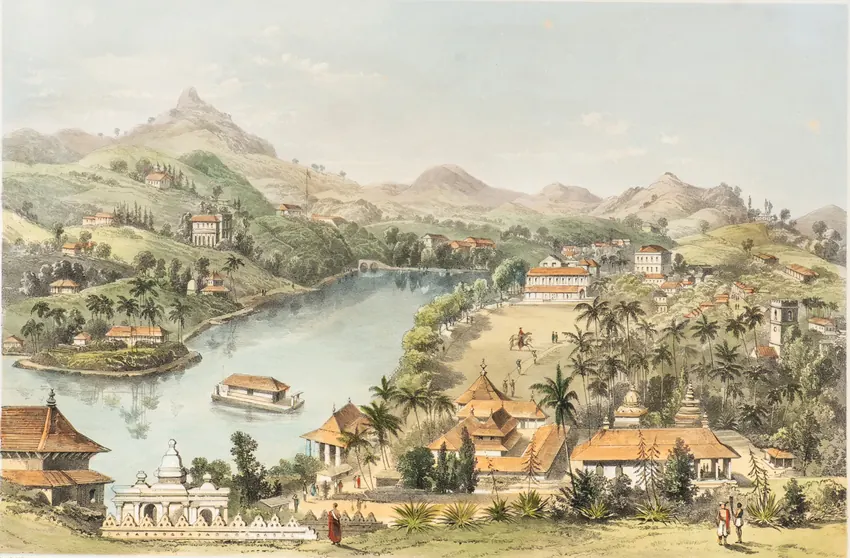
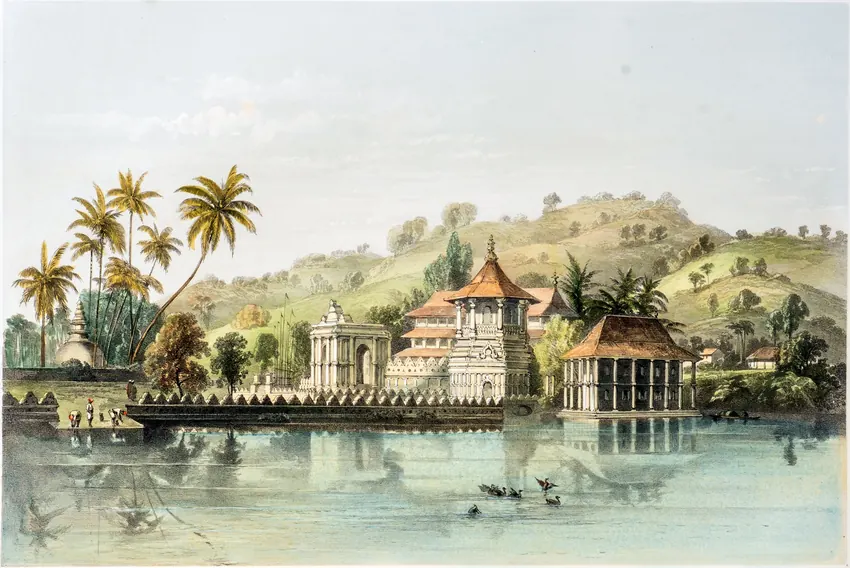
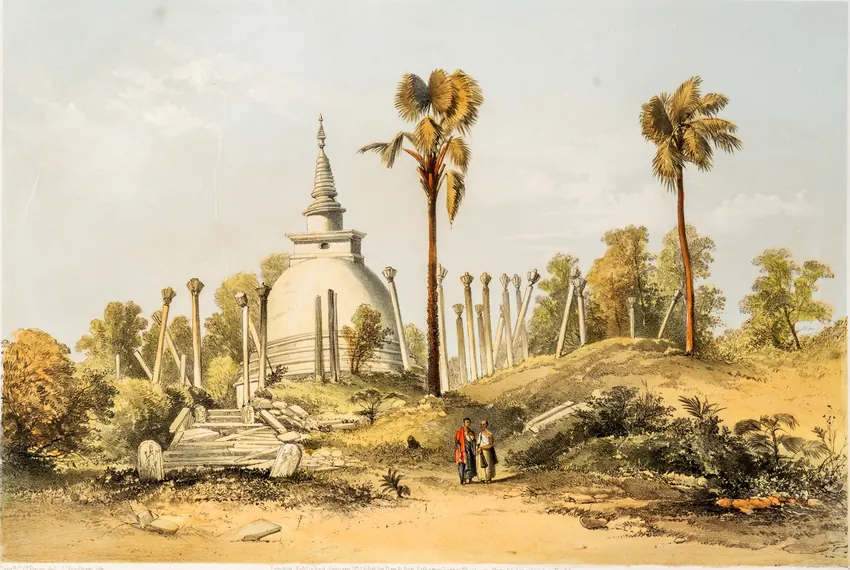
Captain Charles O'Brien, Kandy, 1864. Hand coloured lithograph, 38 × 55 cm, private collection. Our view is taken from the hill, a little below Lady Horton's Walk, looking down on the lake, the Malagawa Temple, the Audience Hall, above which, surmounted by lofty cocoa-nuts, appear the tombs of the kings of Kandy. In the immediate foreground, is a terrace which leads to that part of the Palace now the residence of the principal civil officer of the province. On the opposite side from the town are the monasteries of the priests, and, above them, the residence of the principal civilians and merchants. Near the centre is a redoubt, called "Castle Hill," with a barrack for a company of Malay soldiers, below which are the barracks of the Ceylon Rifle Regiment. The most prominent building on the Esplanade is a very respectable hotel; the large two-story building is the Oriental Bank; and to the extreme right is the parade-ground and barracks of the European regiment. A part of the tower of St. Paul's Church is seen. (De Silva, Rajpal Kumar. 1985. Early Prints of Ceylon (Sri Lanka) 1800-1900.)Captain Charles O'Brien, The Malagawa Temple, Kandy, 1864. Hand coloured lithograph, 38 × 55 cm, private collection. Our view is taken from an island in the lake. On the left is a dagoba, the tomb of one of the kings of Kandy. On the hills behind the Temple winds the beautiful road called “Lady Horton's Walk." The building projecting into the lake, to the right of the Temple, is a modern structure, used as a library and assembly rooms. (De Silva, Rajpal Kumar. 1985. Early Prints of Ceylon (Sri Lanka) 1800-1900.)Captain Charles O'Brien, Thuparamaya Dagoba, 1864. Hand coloured lithograph, 38 × 55 cm, private collection. "Near the intersection of the two great streets of the city stands the ‘Thuparama,' the most venerated of all the dagobas in Ceylon, having been constructed by King Devenipiatissa, three centuries before the Christian era, to enshrine the collar-bone of Buddha. Its outline is peculiar, being flattened at the top, and so hollowed at the sides as to give it the configuration of a bell. Its height is about seventy feet from the ground: and the terrace on which it is placed is surrounded by rows of monolithic pillars, each twenty-six feet high, with richly-decorated capitals." -SIR J. EMERSON TENNENT'S Ceylon, &C., Vol. I1., page 622. (De Silva, Rajpal Kumar. 1985. Early Prints of Ceylon (Sri Lanka) 1800-1900.)
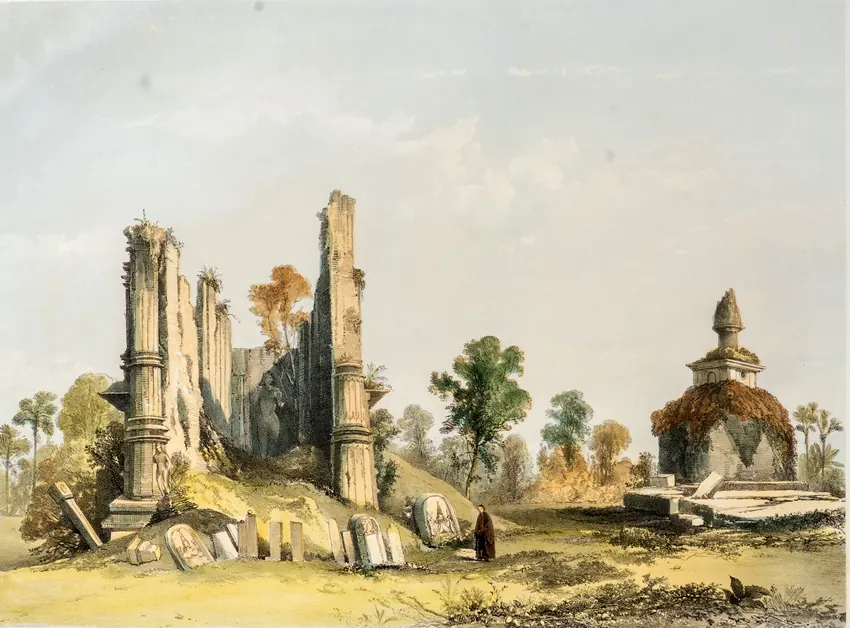
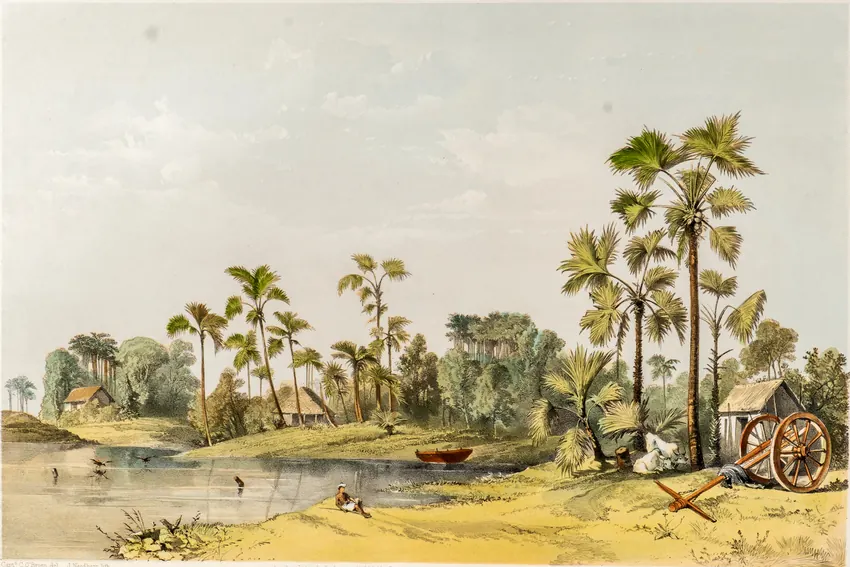
Captain Charles O'Brien, Ruins at Pallanarrua, 1864. Hand coloured lithograph, 38 × 55 cm, private collection. "Still advancing along the main street, we come next to an immense edifice of brick, in the highest style of ornamented Southern India architecture. This is the Jayta-wana-Rama, a temple of great dimensions, built by Parakrama Bahu I after the model, it is said, of one erected by Buddha himself at Kapili-vastu, the place of his birth. The exterior is profusely decorated with architectural devices in chunam. The style seems to belong to the Saracenic period; and the grand entrance to the temple, at the eastern end, is flanked by two polygonal turrets, which forcibly recall the outline of the Kotub Minar at Delhi” SIR J. EMERSON TENNENT'S Ceylon, &C., Vol. II., page 592. (De Silva, Rajpal Kumar. 1985. Early Prints of Ceylon (Sri Lanka) 1800-1900.)Captain Charles O'Brien, Adam's Peak from the Yatteantotte Road, 1864. Hand coloured lithograph, 38 × 55 cm, private collection. Adam's Peak, whether, to our delight, we recognise it rising above its peers on the distant horizon, or, as in the ascent from Ratnapoora, "the majestic cone is discerned towering in unsurpassed sublimity," forms the most striking object in every view from which it is visible. Here it soars over a range of wild and almost inaccessible country, singularly in keeping with its cone-like form. The river Calany is seen glittering in its fall, as it leaps its barrier, and, plunging into the gorge, foams along a rocky course till it reaches the village of Yatteantotte, when it becomes navigable for boats laden with rice from Colombo. The numerous coffee estates in Ambogammoa are connected with Yatteantotte by a splendid cart-road, of twenty-six miles, from the top of the pass. (De Silva, Rajpal Kumar. 1985. Early Prints of Ceylon (Sri Lanka) 1800-1900.)Captain Charles O'Brien, Ferry on the Road from Manaar to Colombo, 1864. Hand coloured lithograph, 38 × 55 cm, private collection. Though the scenery on the coast-road along the western shore, from Manaar to Colombo, is Some-what tame, from the absence of mountains, and monotonous from the constantly recurring Palmyra "topes," or groves, still there are many spots of quiet beauty, particularly on the banks of the rivers. The Palmyras in the view before us are exact portraits, but they have been despoiled of much of their majestic beauty by the custom which prevails amongst the natives of lopping off each leaf as it comes to maturity, as substitutes for thatch with which to cover their huts, convert into fans, and for many other uses. (De Silva, Rajpal Kumar. 1985. Early Prints of Ceylon (Sri Lanka) 1800-1900.)
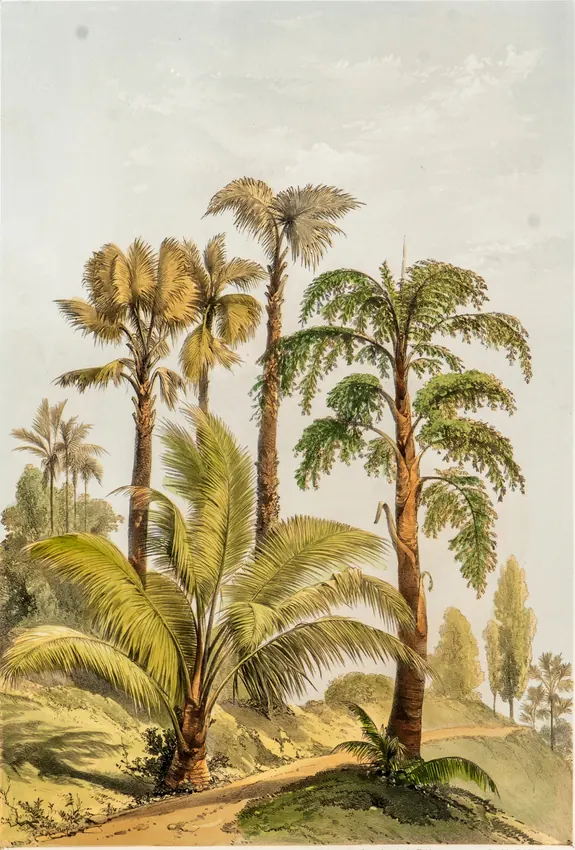
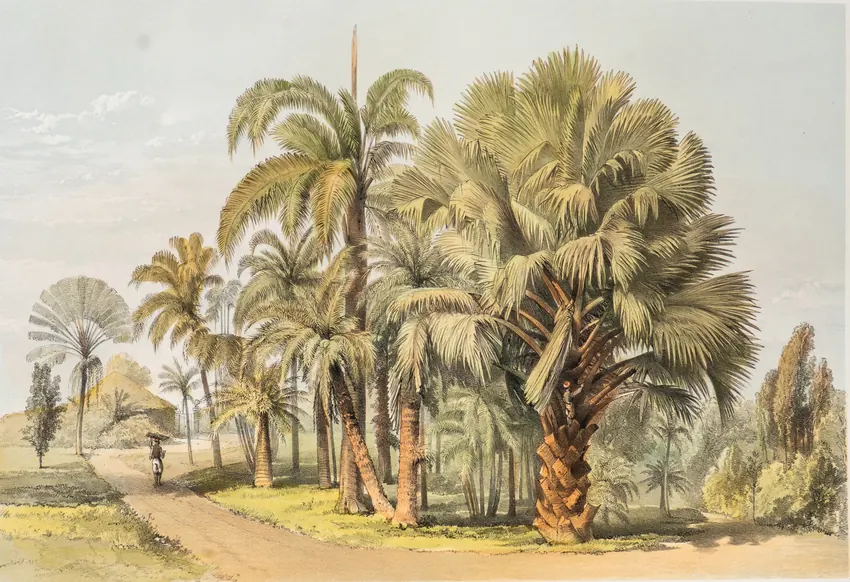
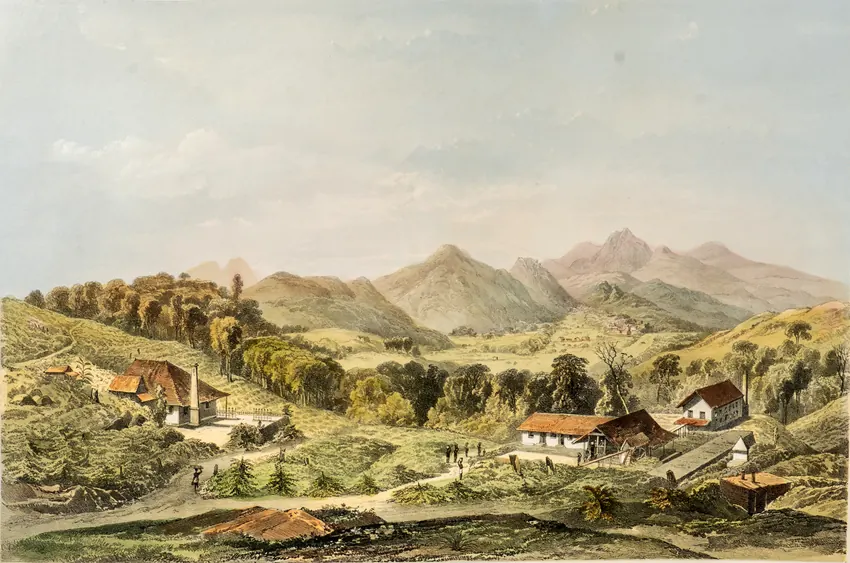
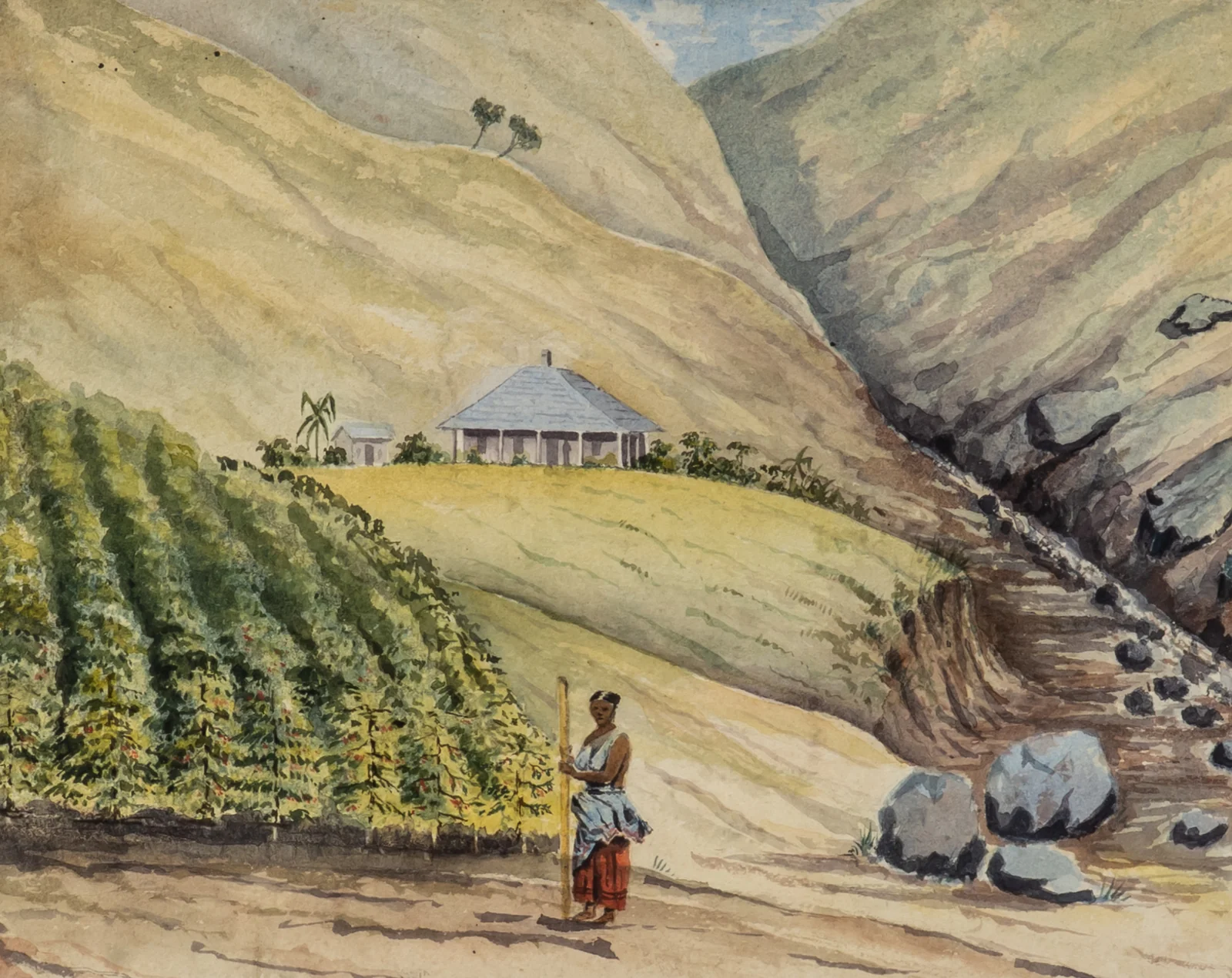
Captain Charles O'Brien, The Talipat in Flower, 1864. Hand coloured lithograph, 38 × 55 cm, private collection. "The most majestic and wonderful of the palm tribe is the talpat, or talipat (Corupho umbraculifera), the stem of which sometimes attains the height of one hundred feet, and each of its enormous fan-like leaves, when laid upon the ground, will form a semicircle of sixteen feet in diameter, and cover an area of nearly two hundred superficial feet. The tree flowers but once and dies; and the natives assert that the bursting of the spadix is accompanied by a loud explosion." -SIR J. EMERSON TENNENT'S Ceylon, &c., Vol. I., page 109. (De Silva, Rajpal Kumar. 1985. Early Prints of Ceylon (Sri Lanka) 1800-1900.)Captain Charles O'Brien, Paradinia Garden, 1864. Hand coloured lithograph, 38 × 55 cm, private collection. "The entrance to Paradinia Garden* is through a noble avenue of India-rubber trees (Ficus elastica), and the first object that arrests the admiration of a stranger on entering is a group of palms, which is, I apprehend, unsurpassed both in variety and grandeur. It includes nearly all those indigenous to the island-the towering talipat, the palmyra, the slender areca, and the kitrol, with its formidable thorny congener, the Caryota horrida, and numerous others less remarkable”. - SIR J. EMERSON TENNENT'S Ceylon,&c., Vol. I, page 208. (De Silva, Rajpal Kumar. 1985. Early Prints of Ceylon (Sri Lanka) 1800-1900.)Captain Charles O'Brien, Coffee Estate, 1864. Hand coloured lithograph, 38 × 55 cm, private collection. Our view is taken in the "Peacock Hill" estate, the property of Messrs. Baring Brothers, near Pusilawa. On the left is the superintendent's bungalow; through the coffee are seen the stumps of the larger trees of the felled forest. In front of the store are the drying grounds, on which the "parchment" coffee is spread. The coolies are seen carrying their loads up the steps of the "pulping-house," in which is the machinery turned by a water-wheel; a little removed is the "Clarihew" stove. In the right foreground is a dam, by which the water of a small stream may accumulate at night to work the machinery during the day. Over a belt of the standing forest is seen the town of Gampola, with the "Mahavilla Ganga" flowing past it, which is here spanned by a splendid suspension bridge. (De Silva, Rajpal Kumar. 1985. Early Prints of Ceylon (Sri Lanka) 1800-1900.)
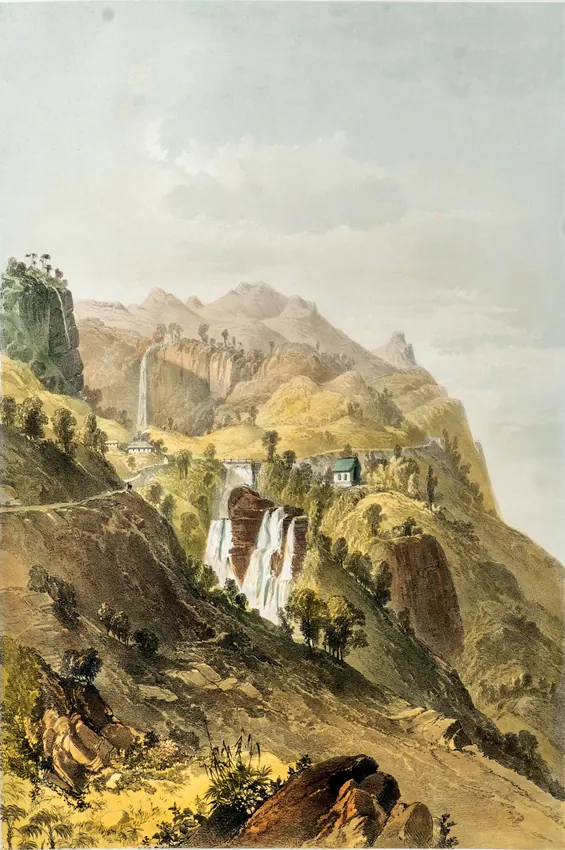
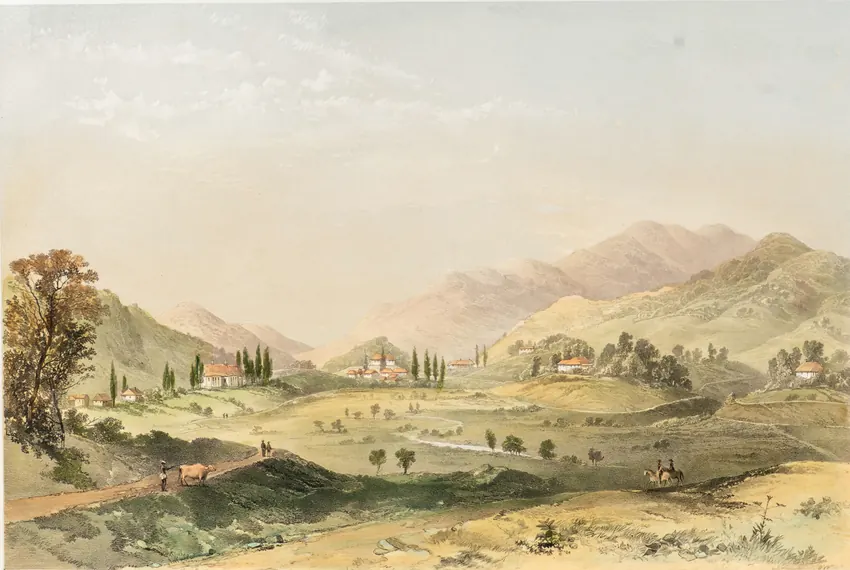
Captain Charles O'Brien, Rangbodde Falls, 1864. Hand colored lithograph, 38 × 55 cm, private collection. "Still ascending towards Nuera Ellia, the road from Pusilawa winds through the valley skirting the bases of the hills, till it reaches an apparently insurmountable barrier of mountains in the glen of Rangbodde. Here the acclivities that bound the ravine are overcome by a series of terraced windings, cut out of the almost precipitous hill; and so narrow is the gorge that the road enters between two cataracts that descend on either side of the pass."-SIR J. EMERSON TENNENT'S Ceylon, &c., page 257, 5th edit. A small church has been erected on a bold projection of the rock overhanging the cataract. There is a hamlet, or bazaar, and a "Rest-House'" for the accommodation of travellers. Some of the finest coffee in the island is produced at Rangbodde. Our sketch is taken from "Wavendon" estate, the valuable property of J. Lewis Gordon, Esq. (De Silva, Rajpal Kumar. 1985. Early Prints of Ceylon (Sri Lanka) 1800-1900.)Captain Charles O'Brien, Nuera Ellia, 1864. Hand coloured lithograph, 38 × 55 cm, private collection. Our view is taken from the road round the plain, that part of it leading to Badulla. We face the pass which leads into it from Rangbodde and Kandy. On the extreme left are the small but neat cottages occupied by visitors from Colombo, during the fine months from January to May. Next is a large and commodious house, built by Sir Edward Barnes, on the first establishment of the Sanitarium. A little further on, where a few low trees mark the top of a knoll, is the burial- ground of Europeans. Over the bazaar, in the centre, is the Club House, and other accommodation for visitors and public officers. There is a very pretty church, concealed by the woods above "Rosebank,” the residence of our late lamented Governor, Sir Henry Ward; passing which the road winds up to the "Barrack Plains," and on the extreme right is the Parsonage. Over Rosebank are the rises of Peduru-talla-galla. (De Silva, Rajpal Kumar. 1985. Early Prints of Ceylon (Sri Lanka) 1800-1900.)Captain Charles O'Brien, Oovah Country and Happotella, 1864. Hand coloured lithograph, 38 × 55 cm, private collection. "Badulla, the capital of the principality, lies in a valley, on one side of which rises the mountain of Namoone-koole, whose summit is nearly 7000 feet high." -SIR J. EMERSON TENNENTS Ceylon, &c., Vol. I., pages 265, 266. The view is taken from one of the minor roads leading from the coffee district of Oodoo Pusilawa to Alampettia and Badulla. At the extremity of the valley, to the left, rises the mountain of Namoone-koole; the distant range to the right is Happotella, and we overlook the plains of Fort McDowall and the main road from Nuera Ellia to Badula. (De Silva, Rajpal Kumar. 1985. Early Prints of Ceylon (Sri Lanka) 1800-1900.)
Captain Charles O'Brien, Galle, 1864. Hand coloured lithograph, 38 × 55 cm, private collection. "No traveller fresh from Europe will ever part with the impression left by the first gaze upon tropical scenery, as it is developed in the bay and the wooded hills that encircle it; for although Galle is surpassed, both in grandeur and beauty, by places afterwards seen in the island, still the feeling of admiration and wonder called forth by its loveliness remains vivid and unimpaired" -SIR J. EMERSON TENNENTS Ceylon, &c., Vol. I., page 99. Galle is now the resort of the Peninsular and Oriental Company's steamers, bi-monthly from England and Calcutta. These are met by their steamers from China, Australia, and Bombay which together with numerous ships laden with coal for their use, give the harbour a lively appearance, adding much to its natural beauty. (De Silva, Rajpal Kumar. 1985. Early Prints of Ceylon (Sri Lanka) 1800-1900.)
Edward Lear (1812–1888)
Poet, painter and author of the Book of Nonsense, Edward Lear landed at Colombo in November 1874, aged sixty-two, during a fourteen-month journey through India at the Viceroy's invitation. He found the island beautiful but the climate oppressive, yet sketched with compulsive industry, producing in under four weeks over seventy drawings and watercolours: breadfruit and jak trees, river scenes near Ratnapura with Adam's Peak beyond, animated roads near Galle. Immediate and technically assured, and bearing his characteristic pencilled notes of colour and texture, his Ceylon works were never published in his lifetime, and rank with the best any artist made of the island.
Constance Frederica Gordon-Cumming (1837–1924)
Known to her intimates as 'Eka', Constance Frederica Gordon-Cumming was the twelfth child of a Scottish baronet and largely self-taught. She arrived at Colombo in February 1873 at the Bishop of Colombo's invitation, and kept a rule of never a day without at least one carefully coloured sketch, beginning at five each morning. She returned to Scotland with several hundred works in watercolour and bodycolour heightened with white, a richer and more opaque technique than simple wash, and exhibited them in London, Glasgow and Liverpool to considerable admiration. Her Two Happy Years in Ceylon (1892) is at once a travel memoir and a reflection upon empire.
Constance Gordon-Cumming, A Coffee estate at Allegalla Peak, Ceylon, 1873-1874. Watercolour, 27.2 × 41.9 cm, private collection. Returning by rail from Gampola to Kaduganawa station, I was there met by very kind friends, who had brought a chair fastened to bamboos, and a party of luggage-coolies to carry me and my goods to their delightful bungalow (Oolanakanda), perched far up the steep face of Allegalla Peak. The many pleasant days which on several occasions I spent in that sweet home, with its music and flowers and sunny faces, are among my happiest memories of Ceylon. I only wish it were possible for words to convey something of the charm of such surroundings, of majestic crags, clear streams, and fruit-bearing trees, with varied cultivation, chiefly coffee, on the most impossible-looking ground--so steep and rocky ; and all this at such a height that, looking up from the railway far below, one could only imagine an eagle's eerie perched at such a height. One day we climbed to the very summit of the Peak (3,394 feet above the sea), there to inspect a large artificial hollow in the rock in imitation of Buddha's footprint on Adam's Peak. This one is well defined, and makes no pretension to being genuine. It is simply representative, and worshippers who cannot make pilgrimage to the true Sri Pada climb up here, to make their simple offerings, while looking towards Adam's Peak, which rises sharp and clear on the horizon (Cumming, C.F. Gordon. 1893. Two Happy Years in Ceylon. Chatto & Windus, Piccadilly.) Editor's Note - The bottom right of the watercolor depicts Cumming on the chair fastened to bamboo described.Constance Gordon-Cumming, Gangarami Vihara Near Kandy, 1873-1874. Watercolour over pencil, 40.1 × 62.2 cm, the Talwatte Collection. This temple is on the outskirts of Kandy, at Lewella in Mahanuwara, and near the Mahaweli Ganga. It was built around 1750, on the orders of King Kirti Sri Rajasinghe. (CONSTANCE FREDERICA GORDON-CUMMING (1837 – 1924) A LADY OF ADVENTUROUS DISPOSITION. KAREN TAYLOR FINE ART, 2025.)Constance Gordon-Cumming, Matura, Mouth of the Milwale Ganga, Looking Towards Dondra Head, 1873. Watercolour over pencil, 25.4 × 73.7 cm, the Talwatte Collection. Before turning northward to Colombo I wished to see something of the southern coast of the Isle, and gladly accepted an invitation from the same kind friends who had made our stay in Negombo so pleasant, to visit them in a new home at Matara, a most lovely place at the mouth of the Nilwalla Ganga (i.e. the river of blue sand), and only four miles from Dondra Head, which is the southernmost point of the island.' (Cumming, C.F. Gordon. 1893. Two Happy Years in Ceylon. Chatto & Windus, Piccadilly.)
Constance Gordon-Cumming, The Lily Shore, Near Trincomalee, 1873-1874. Watercolour, 37.8 × 49.5 cm, the Talwatte Collection. “Within Fort Frederick, beneath the cool shade of large dark trees, there is a most fascinating old well. Two heavy pillars coated with cream-colored chunam, once polished like marble, but now partially stained with orange colored lichen, support a heavy overhanging roof of rounded roof tiles, which are the playground for many squirrels. To a stout rafter is attached a pulley over which passes a long rope; to this is attached the bucket where-with brown men (clothed only in a white waist-cloth and scarlet turban) fill their great red water-pots for domestic use. It is all very pleasant to the artistic sense, though I suppose we must admit that for practical purposes unromantic leaden pipes have their advantages“ (Cumming, C.F. Gordon. 1893. Two Happy Years in Ceylon. Chatto & Windus, Piccadilly.)Constance Gordon-Cumming, Sacred Bo Tree at the Burial Place of the Kandian Queens, Kandy, 1874. Pencil and watercolour heightened with white on paper, 34.3 × 52.1 cm, the Talwatte Collection. Constance Frederica Gordon-Cumming is likely to have arrived in Kandy in late April or early May 1874, having spent a week with Bishop Hugh Jermyn at Pallagolla, before taking a coach to Gampola and onwards by rail. She described Kandy as ‘a beautifully situated little town’ where ‘the vegetation of the hills meets that of the plains, and all the lovely varieties of foliage peculiar to each mingle in rank luxuriance’ (Cumming, C.F. Gordon. 1893. Two Happy Years in Ceylon. Chatto & Windus, Piccadilly.). The Burial Place referenced here is the Asgiri Maha Viharaya, one of two fourteenth-century Buddhist monasteries in Kandy, which contain in their grounds the Sri Dalada Maligawa, or Temple of the Tooth, which houses a sacred relic said to be a tooth of the Buddha. The Asgiri had served as a royal crematorium and burial ground since the late fourteenth century, a tradition that started when Queen Chandravati, mother of the Kandyan King Sena Sammatha Vikramabahu, was cremated and buried there. However, in 1880, the royal burial ground and funerary dagobas were destroyed by the British to make way for a railway line to Matale. (Chris Beetles Summer Show, 2020. Chris Beetles Gallery, London.)Constance Gordon-Cumming, Adam's Peak and Church, Ratnapoora, 1873. Watercolour over pencil, 41.9 × 58.4 cm, the Talwatte Collection. The artist climbed Adam’s Peak ‘a very steep and toilsome expedition’, Memories, p. 212. She refused to be deterred as she had heard of only two European women who had climbed it and made the expedition accompanied by ‘half a dozen stalwart planters’, one of whom was presumably A. Young Adams who signed this work, Memories, p. 212. Her sensitivity to local customs and beliefs is reflected in her account of this view, ‘the [other] great mountain of Ceylon, known to us as “Adam’s Peak” but to the Singhalese as the “Sri Pada’ or Mount of the Holy Foot, because of an impression, six feet in length, on the extreme summit of that lofty peak, which is reverenced by millions of the human race as that of whatever saintly person they most revere. The Buddhists believe it to have been the footprint of Buddha, the Mohammedans of Adam, the Sivites of Siva while the Roman Catholic Christians suppose it to have been that of St Thomas’. (CONSTANCE FREDERICA GORDON-CUMMING (1837 – 1924) A LADY OF ADVENTUROUS DISPOSITION. KAREN TAYLOR FINE ART, 2025.)
Constance Gordon-Cumming, The Brazen Palace, Anuradhapura, 1873. Pencil and watercolour heightened with white on paper, 39.4 × 62.2 cm, the Talwatte Collection. The ‘Brazen Palace’, or Lovamhapaya, was an ancient monastery which stood during the city’s glorious past. It was described as being nine stories high, with each side being 400 feet long. The palace was bedecked in corals and jewels, with a roof covered in copper-bronze plates, which gave it its name. Each storey was said to contain 1,000 rooms, and the whole structure sat upon 40 rows of 40 copper-wrapped stone pillars. Though the palace was destroyed in a fire in the first century BC, it was rebuilt, demolished and rebuilt again multiple times, before its final destruction during the city’s fall. The stone pillars which supported the building and appear in Constance Frederica Gordon-Cumming’s watercolour were raised again in the twelfth century and still stand to this day. The small building seen in the centre was a later construction that served as a chapter house for Maha Vihara Buddhists. Gordon-Cumming’s visit to Anuradhapura in June 1873 was likely to have been linked to early attempts to survey the area, as official British interest in the area had only been registered in 1871. She remains one of the earliest British recorders of Anuradhapura, as planned excavations of the site did not begin until 1890. (Chris Beetles Summer Show, 2020. Chris Beetles Gallery, London.)Constance Gordon-Cumming, Looking to Elephant Plains From Barrack Plains, Newera Ellia, 1873. Watercolour over pencil, 35.6 × 50.8 cm, the Talwatte Collection. ‘Nine miles to the north of Nuwara Eliya, at a somewhat lower level, lie the grassy Elephant Plains’. Nuwara Eliya was the hill station to which planters and others retreated from the heat. (Cumming, C.F. Gordon. 1893. Two Happy Years in Ceylon. Chatto & Windus, Piccadilly.)
James Stephanoff (c.1787–1874)
James Stephanoff, Historical Painter in Watercolours to King William IV, never set foot in Ceylon. About 1820, working from a sketch sent to London by a Sinhalese juror, he executed The Supreme Court of Judicature in the Island of Ceylon, published as an aquatint by Rudolph Ackermann and dedicated to Chief Justice Sir Alexander Johnston. Its subject is the Colombo court where the first native jury in the British empire had sat since 1810, and where the abolition of domestic slavery was proclaimed in 1816. In Johnston's hands, this picture of a courtroom the artist had never entered became an instrument in a constitutional contest over the independence of the judiciary.
Thomas Fraser (1776–1823)
One of Ceylon's great spectacles was the kraal, the driving of wild elephants into a timber stockade, and it reached print through the exact eye of a military engineer. Thomas Fraser, son of a Morpeth portrait painter, served with the Madras Engineers from 1796 to 1819, rising from Lieutenant to Captain and, by 1803, to Superintending Engineer of Public Works for the Madras Presidency; he was present at the siege of Seringapatam. From his sketches made on the spot, James Robert Thompson drew the aquatint shown here, Method of Catching Wild Elephants by the Kraal in the Island of Ceylon (1817), printed in colours.
James Miller Huggins (1807–1870)
Whether James Miller Huggins ever reached Ceylon is not recorded, yet his View in Ceylon with Soldiers and Natives on a Road of 1854 hangs today in the Government Art Collection. A marine painter and etcher, son of William John Huggins, Marine Painter to William IV, he grew up in Leadenhall Street beside the East India Company's headquarters, trained under his father, and made engravings after his work. He exhibited rarely, four times at the Society of British Artists from 1826 and once at the British Institution in 1842; his marine subjects are now in the National Maritime Museum at Greenwich.
Thomas Hampson Jones (1846–1916)
Beneath a great rock face in the hill country of Uva stands the Dhowa Rock Temple, a Buddhist shrine known for a tall standing Buddha cut in low relief into the living rock. Thomas Hampson Jones painted it during a tour of the East in 1895 that took in India, Ceylon and Burma, and signed and dated the sheet '98 at the lower right. The picture here, The Rock Temple, near Bandarawella, belongs to the late-Victorian taste for the picturesque corners of empire, in the fluent, atmospheric watercolour of the travelling painter.
Unknown Artists
Not every fine view of nineteenth-century Ceylon carries a signature. Four watercolours here are the work of hands now unrecorded, yet each holds its corner of the island as surely as the named plates around it: a view of Slave Island at Colombo, the British hill fort at Matale, a planter's bungalow above Haputale, and the Temple of the Tooth at Kandy seen from its moat.
Unknown artist, A View of Slave Island, Colombo, 19th century. Watercolour, 10.1 × 24.6 cm, Suresh Dominic Collection.Unknown artist, Fort MacDowall, Matale, c. 1800s. Watercolour, 17.8 × 33 cm, private collection. Fort MacDowall (misspelt in the title as Macdonald by the artist) stood at Matale, a fortified outpost of the Kandyan Wars named after Major General MacDowall, the sixth Commander of British troops in Ceylon. Built by the British, it was completed in 1803. British troops in uniform are shown at the lower left. One of the finest watercolours of the fort, which artists have rarely drawn.
Unknown artist (British School), The House of Reginald Downall at Dambatenne Plantation, Haputale, 1800s. Watercolour, 21 × 28.5 cm, private collection. Reginald Beauchamp Downall (1843–1888) was a plantation owner in Sri Lanka. He owned many plantations, the last being Dambatenne near Haputale, which was purchased by Sir Thomas Lipton. He also purchased Barnes Hall, now The Grand Hotel, in Nuwara Eliya. (Bonhams, British School, 19th Century, 2024.)Unknown artist, Temple of the Tooth, Kandy, 1800s. Watercolour on paper, 9.5 × 13.4 cm, private collection.
Wall Text: Exhibition Entrance
For nearly two hundred years, British artists came to this island and drew what they saw. This is Ceylon through British eyes in the 19th century.
It began with watercolours and drawings, made on the spot. Few in Britain would ever see the island for themselves, and the appetite for images of it was immense. Some of the originals were reproduced for that wider audience as aquatints and lithographs, printed and carefully coloured by hand. Yet some were never published at all, and survive here in the artists' own hand.
Some came here under orders, some out of curiosity or grief. Andrew Nicholl taught at the Colombo Academy, framing his Ceylon views within a fine border of wildflowers; Queen Victoria bought two of them. Edward Lear stayed only a few weeks in 1874, made over seventy drawings with notes on colour, and published not one in his lifetime.
Two artists here never set foot on the island at all, painting Ceylon from sketches sent home by others, a measure of how strong that appetite was.
Together they are a record of the island as it once was: its light, its vegetation, its ancient monuments, some of which no longer stand. These views have long belonged to distant collections, and most have never been shown on the island they portray. Brought together for the first time, they hang here at last.
Welcome Speech
Delivered by the Chairman of the George Keyt Foundation. Westminster House, Residence of the British High Commissioner, Colombo. 30 July 2026.
Your Excellency Andrew Patrick, distinguished guests, good evening.
August 1873. A Scottish woman stands at a graveside in Batticaloa. She has crossed half the world to reach it, not as an official or a missionary, but as a sister. Her brother John came out in 1845, ran a coconut plantation on that coast, and died here in 1866. Years later, she has come to see where he lies.
Her name is Constance Gordon-Cumming. She has brought her sketchbook, as she does everywhere. Even here, to her brother's grave.
She meant to stay a few weeks. She stayed two years. Anuradhapura and Polonnaruwa. The paddy fields of the low country. The faces of people she met on the road. She went home with several hundred watercolours and a book she illustrated herself.
She was not the only one who overstayed. Her friend Marianne North, the finest botanical painter England produced, arrived two years after Gordon-Cumming left. And while she was here she called on Julia Margaret Cameron at Kalutara. Cameron was so thrilled to have a European sitter that she posed North at her easel on the verandah, wrapped her in draperies, stood her in ninety-six degrees of heat, and told her to look perfectly natural.
That photograph survives. So do North's paintings. So do Cameron's Ceylon portraits, and Gordon-Cumming's watercolours. Three women. Three art forms. One island, and none of them in any hurry to leave.
And almost none of it has ever been seen here.
It hangs in London. In Belfast. In a library at Harvard. For two hundred years this country has been the subject of these pictures and almost never the audience for them. That is what tonight changes. That is why the George Keyt Foundation mounted this exhibition, and why we have insisted, from the beginning, that it be genuinely open.
Open to the public, free, for the duration of the show. A dedicated viewing for writers and members of the press. And time set aside for art history students, from the University of the Visual and Performing Arts and from the History Department of the University of Colombo. They come not to file past the walls, but to spend proper time with the work and learn from it. Pictures locked in private collections teach nobody. These will.
And it will outlast the walls. We have produced a book, a history of the significant artists who came to this island, with nearly two hundred illustrations, including every work hanging here tonight. It is offered at a subsidised price for the run of this exhibition, because we would rather it sat open on a desk than closed behind glass. For researchers, for students, for anyone who wants to go further than one evening allows, it is the reference that did not exist until now.
There is more than these three. Samuel Daniell died at Colombo at thirty-six, buried in an unmarked grave in the Pettah, and left twelve plates as good as anything made in Britain that decade. Edward Lear came for three weeks in 1874, made seventy-one drawings, published not one of them. Andrew Nicholl taught at the Colombo Academy, Royal College today, and Queen Victoria thought his Ceylon paintings good enough to buy two for the Royal Collection.
They were looking at your country. Tonight you get to look back.
My thanks to His Excellency Andrew Patrick, who opened this house to us, the first known public art exhibition ever held at Westminster House. A British High Commission and a Sri Lankan foundation, standing together before two centuries of complicated history and choosing to look at it honestly. That is not a small thing.
My thanks, too, to British Airways, our co-sponsor. And to Nations Trust Bank, Lynear Wealth and the Juniper Group, and to MTV News First, our media partner.
Constance Gordon-Cumming came here to bury a brother and stayed two years because she could not stop looking. Everything on these walls was made by someone with the same affliction.
Ladies and gentlemen, the exhibition is open.
Sources
Works consulted for the introductory essay '19th Century Views of Ceylon by British Artists' by Malaka Talwatte.
Baigent, Elizabeth. 'Cumming, Constance Frederica Gordon- (1837–1924).' In Oxford Dictionary of National Biography. Oxford: Oxford University Press, 2004, vol. 14, pp. 631–632.
Chris Beetles Gallery. Chris Beetles Summer Show 2020. London: Chris Beetles Gallery, 2020.
Cordiner, James. A Description of Ceylon, Containing an Account of the Country, Inhabitants, and Natural Productions; with Narratives of a Tour Round the Island in 1800, the Campaign in Candy in 1803, and a Journey to Ramisseram in 1804. 2 vols. London: Longman, Hurst, Rees, and Orme, 1807.
Daniell, Samuel. A Picturesque Illustration of the Scenery, Animals and Native Inhabitants of the Island of Ceylon. Engraved by William Daniell. London: T. Bensley, 1808.
Davy, John. An Account of the Interior of Ceylon, and of its Inhabitants, with Travels in that Island. London: Longman, Hurst, Rees, Orme, and Brown, 1821.
Deschamps, John (Capt.). Scenery and Reminiscences of Ceylon. London: Ackermann and Co., 96 Strand, 1845.
Design and Art Australia Online (DAAO). 'William Thomas Lyttleton: Biography.' Available at: www.daao.org.au/bio/william-thomas-lyttleton/biography/ [Accessed 2026].
De Silva, Rajpal. Early Prints of Ceylon. London: Serendib Publications, 1985.
Estève, Marie-Hélène (ed.). Eudelin de Jonville: Quelques notions sur l'isle de Ceylan. Paris: Ginkgo Éditeur, 2012.
Goonetilleke, H.A.I. 'Edward Lear: Paintings and Drawings in Sri Lanka.' Journal of the Royal Asiatic Society of Sri Lanka, 1996.
Gordon-Cumming, Constance Frederica. Memories. Edinburgh: William Blackwood and Sons, 1904.
Gordon-Cumming, Constance Frederica. Two Happy Years in Ceylon. 2 vols. Edinburgh: William Blackwood and Sons, 1892.
Herbert, Eugenia. 'Julia Margaret Cameron in Ceylon: Idylls of Freshwater vs. Idylls of Rathoongodde.' The Public Domain Review, 2015. Available at: publicdomainreview.org.
Houghton Library, Harvard University, Cambridge MA. Edward Lear, Indian and Ceylon drawings, 1873–74. 71 Ceylon works in pencil, ink wash and watercolour. Unpublished during the artist's lifetime.
Karen Taylor Fine Art. Constance Frederica Gordon-Cumming (1837–1924): Catalogue. London: Karen Taylor Fine Art, 2025.
Karttunen, Klaus (Prof. Dr). 'Nevill, Hugh.' In Persons of Indian Studies. Available at: whowaswho-indology.info/4366/nevill-hugh/ [Accessed 2026].
Knox, Robert. An Historical Relation of the Island Ceylon, in the East-Indies: Together, with an Account of the Detaining in Captivity the Author and Divers Other Englishmen now Living There, and of the Author's Miraculous Escape. London: Printed by Richard Chiswell, Printer to the Royal Society, at the Rose and Crown in St. Paul's Church-yard, 1681.
Lear, Edward. Edward Lear's Indian Journal. Edited by Ray Murphy. London: Jarrolds Publishers, 1953.
Losano, Antonia. 'A Preference for Vegetables: The Travel Writing and Botanical Art of Marianne North.' Women's Studies, 26 (1997), pp. 423–448.
Lyttleton, William Thomas (Lieut.). A Set of Views in the Island of Ceylon. 6 hand-coloured aquatints engraved by M. Dubourg. London: Edward Orme, 1819.
Middleton, Dorothy. Victorian Lady Travellers. London: Routledge and Kegan Paul, 1965.
North, Marianne. Recollections of a Happy Life: Being the Autobiography of Marianne North. Edited by Mrs John Addington Symonds. 2 vols. London: Macmillan and Co., 1892.
O'Brien, Charles (Capt.). A Series of Fifteen Views of Ceylon Illustrative of Sir J.E. Tennent's Work, from Sketches Made on the Spot by Capt. C. O'Brien, Late Assistant Surveyor General, Ceylon. London, 1864.
Peterson, Tom. 'Chaldean Dravida, Diversity, and Pigeon Worship in the Hugh Nevill Collection.' Ceylon Journal, Vol. 3, No. 1 (June 2026), pp. 31–36.
Raheem, Ismeth. 'Capturing Facets of Ceylon.' Sunday Times (Sri Lanka), 25 February 2024.
Raheem, Ismeth. 'JLK Van Dort's Vibrant 19th Century Sketches of British Ceylon.' Thuppahi's Blog, 1 January 2024. Available at: thuppahis.com.
Royal Collection Trust, London. Andrew Nicholl, two Ceylon watercolours purchased by Queen Victoria, 1870. Also: Sydney Prior Hall, drawings from the Prince of Wales's tour of India and Ceylon, 1875–76, including the Prince's landing at Colombo (RCIN 931213) and the Prince watching a Perahera rehearsal at Kandy, 2 December 1875 (RCIN 923318).
Salt, Henry. Twenty-Four Views Taken in St. Helena, the Cape, India, Ceylon, Abyssinia and Egypt. London: W. Miller, 1809.
Saparamadu, Anura. Ceylon: Through the Eyes of Foreign Artists. 2 vols. Dehiwala: W.L.H. Skeen, 2024.
Stambler, Benita. 'Julia Margaret Cameron: Victorian Photographer in Ceylon.' Thuppahi's Blog, 27 November 2015. Available at: thuppahis.com.
Sutton, Thomas. The Daniells: Artists and Travellers. London: The Bodley Head, 1954.
Talwatte, Malaka. 'Belfast's Finest in Ceylon: The Story of Andrew Nicholl.' Ceylon Journal, Vol. 1, No. 1 (July 2024), pp. 34–39.
Tennent, Sir James Emerson. Ceylon: An Account of the Island, Physical, Historical and Topographical, with Notices of its Natural History, Antiquities and Productions. 2 vols. London: Longman, Green, Longman, and Roberts, 1859.
Victoria and Albert Museum, London. Julia Margaret Cameron, Marianne North, photograph, 1877, Ceylon. Albumen print (Museum no. PH.256-1982). Also: watercolours and drawings by Andrew Nicholl.
Yale Center for British Art, New Haven. James Stephanoff, The Supreme Court of Judicature in the Island of Ceylon, c.1820 (B1977.14.13147). Hand-coloured aquatint, engraved by J. Bennet, published by Rudolph Ackermann.
Notes on the Works Cited
Plate counts, dimensions, provenance and artists' itineraries for the works cited above, retained here for record.
Cordiner, A Description of Ceylon (1807). 23 aquatint plates and 2 folding maps.
Daniell, A Picturesque Illustration (1808). 12 plates: 11 aquatints and 1 etching, hand-coloured. Oblong folio, 443 x 595mm.
Davy, An Account of the Interior of Ceylon (1821). 15 plates including 2 hand-coloured and a folding map; plates after W.T. Lyttleton and others.
Deschamps, Scenery and Reminiscences of Ceylon (1845). 12 hand-coloured lithographs, drawn on stone by J. West Giles, printed by M. & N. Hanhart. Large folio, c.50 x 34cm. Deschamps served as Adjutant, Royal Artillery, Ceylon, 1828–1838.
Estève (ed.), Eudelin de Jonville (2012). Edited edition of de Jonville's manuscript, with a biographical essay. De Jonville (1756–1837).
Gordon-Cumming, Two Happy Years in Ceylon (1892). 25 plates from the author's own drawings; folding map. Author was in Ceylon February 1873 – July 1874.
Knox, An Historical Relation of the Island Ceylon (1681). 17 copperplate engravings and a double-page folding map. Large quarto. Frontispiece portrait engraved by Robert White.
O'Brien, A Series of Fifteen Views of Ceylon (1864). 15 lithographs by Jonathan Needham. Published as an explicit visual companion to Tennent (1859).
Salt, Twenty-Four Views (1809). 24 aquatint plates printed in colours by D. Havell, J. Hill and J. Bluck, on thick Whatman paper. Large broadsheet folio. Salt visited Ceylon 1802–06 as draughtsman to Viscount Valentia.
Saparamadu, Ceylon: Through the Eyes of Foreign Artists (2024). Comprehensive survey of 420 foreign artists whose work depicts Ceylon and Sri Lanka, 1500–2000.
Tennent, Ceylon (1859). Illustrated with wood-engraved plates, maps and plans, the majority after drawings by Andrew Nicholl. Five editions within the first eight months.
Yale Center for British Art: Stephanoff, The Supreme Court of Judicature (c.1820). Stephanoff never visited Ceylon; worked from a sketch supplied by a Sinhalese juror.
How to cite this essay
Malaka Talwatte, “19th Century Views of Ceylon by British Artists,” Malaka Talwatte: Sri Lankan Art and Ceylon Antiquaria, https://malakatalwatte.pages.dev/publications/19th-century-views-of-ceylon/.
Quote and cite freely with attribution; please do not republish a whole essay, or a photograph, without permission.