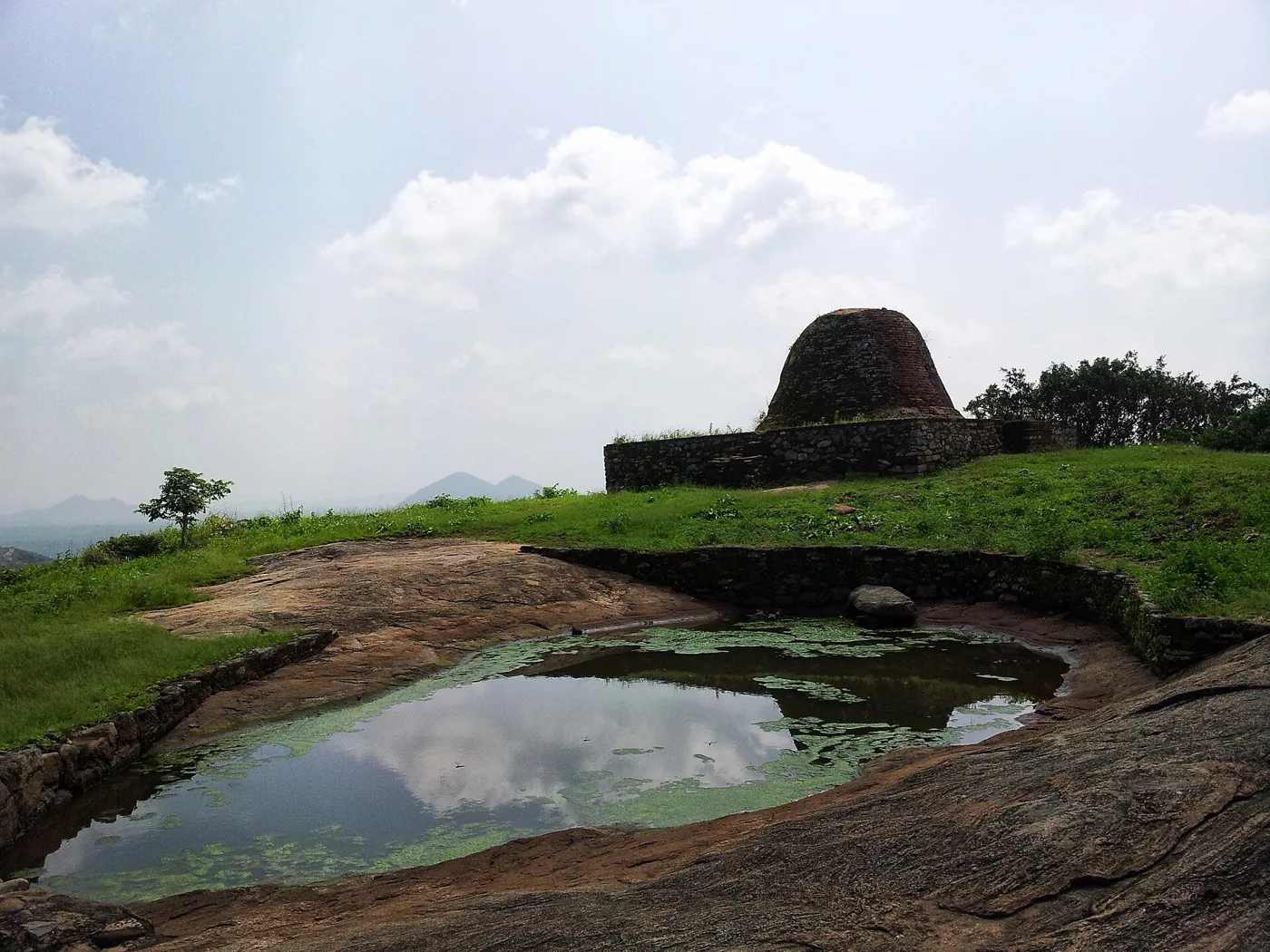
When the Kalinga adventurer Magha stormed Polonnaruwa early in the thirteenth century and broke the second kingdom, the seat of Sinhalese rule did not settle again for three hundred years. It moved south and west, from one defensible hill or well-watered valley to the next, and each move gave the island a short-lived capital: Dambadeniya, then Yapahuwa, then Kurunegala, then Gampola, then Kotte, and at the last Sitawaka. The art of these wandering capitals is a thing apart from the classical age that went before and the Kandyan revival that came after, and it has often been passed over as a time of decline. It was rather a time of change: the Buddhist image and the Hindu shrine drawn together on one platform, the Dravidian temple of the mainland naturalised in the hills, the wood-carver raised to a master, and, in the reign of the last king to hold the whole island, a golden age of Sinhala poetry.
The palladium and the wandering seat
What travelled with the court from capital to capital was the Tooth Relic of the Buddha, the palladium whose possession had become the very warrant of Sinhalese kingship. At Dambadeniya, King Parakramabahu II gathered the kingdom together again, recovered the relic, and called a council of the monastic order, its rulings set down as the Dambadeni Katikavata, a reform in the manner of the great council at Polonnaruwa. His successors carried the relic to the rock citadel of Yapahuwa, from which it was seized and carried off to South India by a Pandyan army before it was won back; and it moved on with the capital to Kurunegala and to Gampola, where the crown created the office of Sangharaja, the chief of the order, to hold the fragmented church together. Buddhism stood at a low ebb in these years, and the kings leaned on the gods of the Hindus, Vishnu, Skanda and Ganesa, as the appointed guardians of the faith and the realm, a dependence that shaped the art of the age as much as the doctrine.
The Dravidian temple in the hills
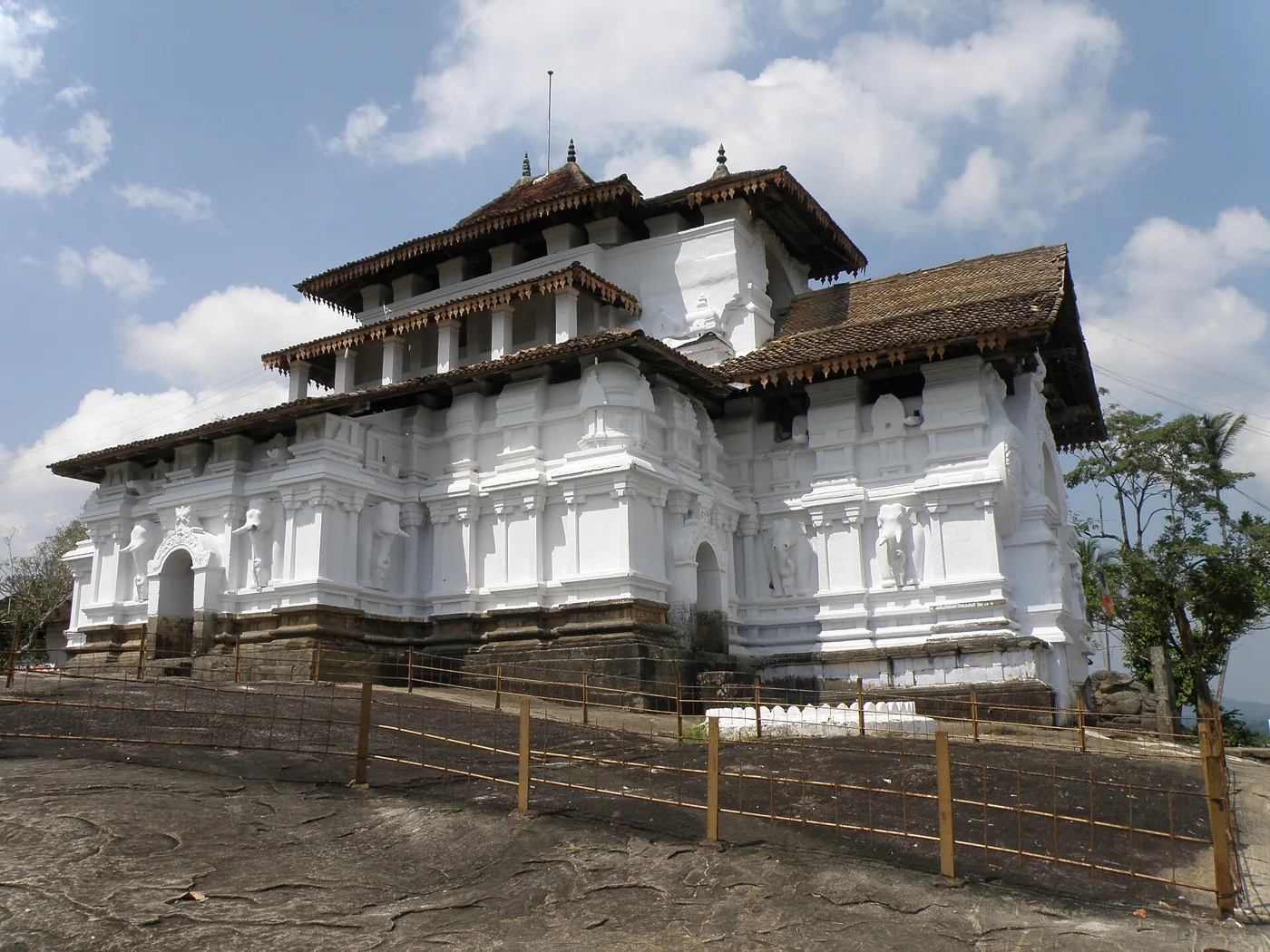
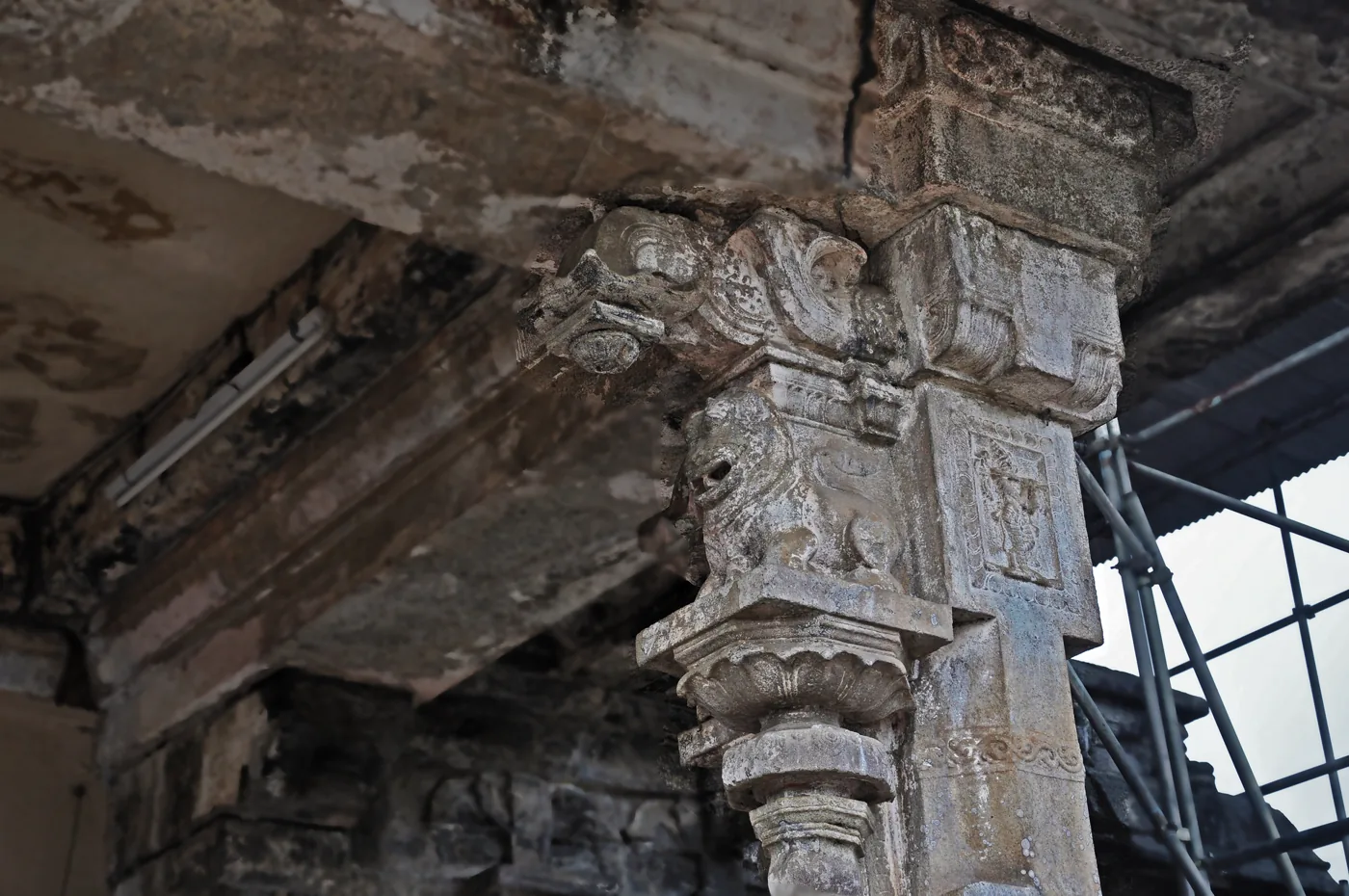
The signature buildings of the age stand in the hills around Gampola, and in them the Buddhist shrine and the Hindu temple are built as one. At Gadaladeniya, on a bare rock, a Buddha-house and a shrine of Vishnu share a single platform; the Buddha sits in samadhi beneath a makara-torana, and the whole is raised in the stone-cut manner of the southern mainland, its pillars carved with Krishna and Siva and Ganesa and its roof crowned by a Dravidian stupika, a miniature spire in place of the island’s usual dome. A short way off stands the Lankatilaka of Gampola, a gedige of the old Polonnaruwa type, its thick brick walls closed by a corbelled vault and topped by a stupika, holding a colossal seated Buddha of clay and plaster beneath a wide makara arch, with the Hindu divinities set in niches along its outer walls. The synthesis is complete: to worship the Buddha here was to pass among the gods who protected him.
The carvers of wood and stone
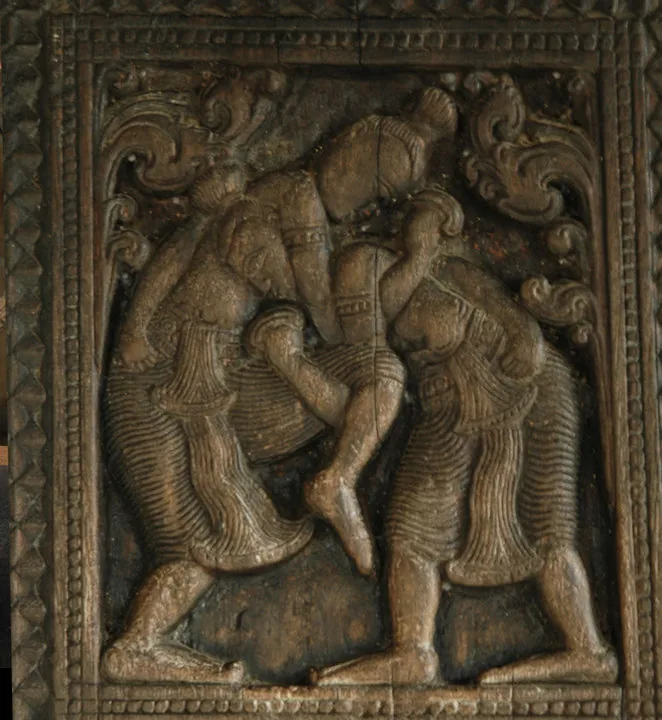
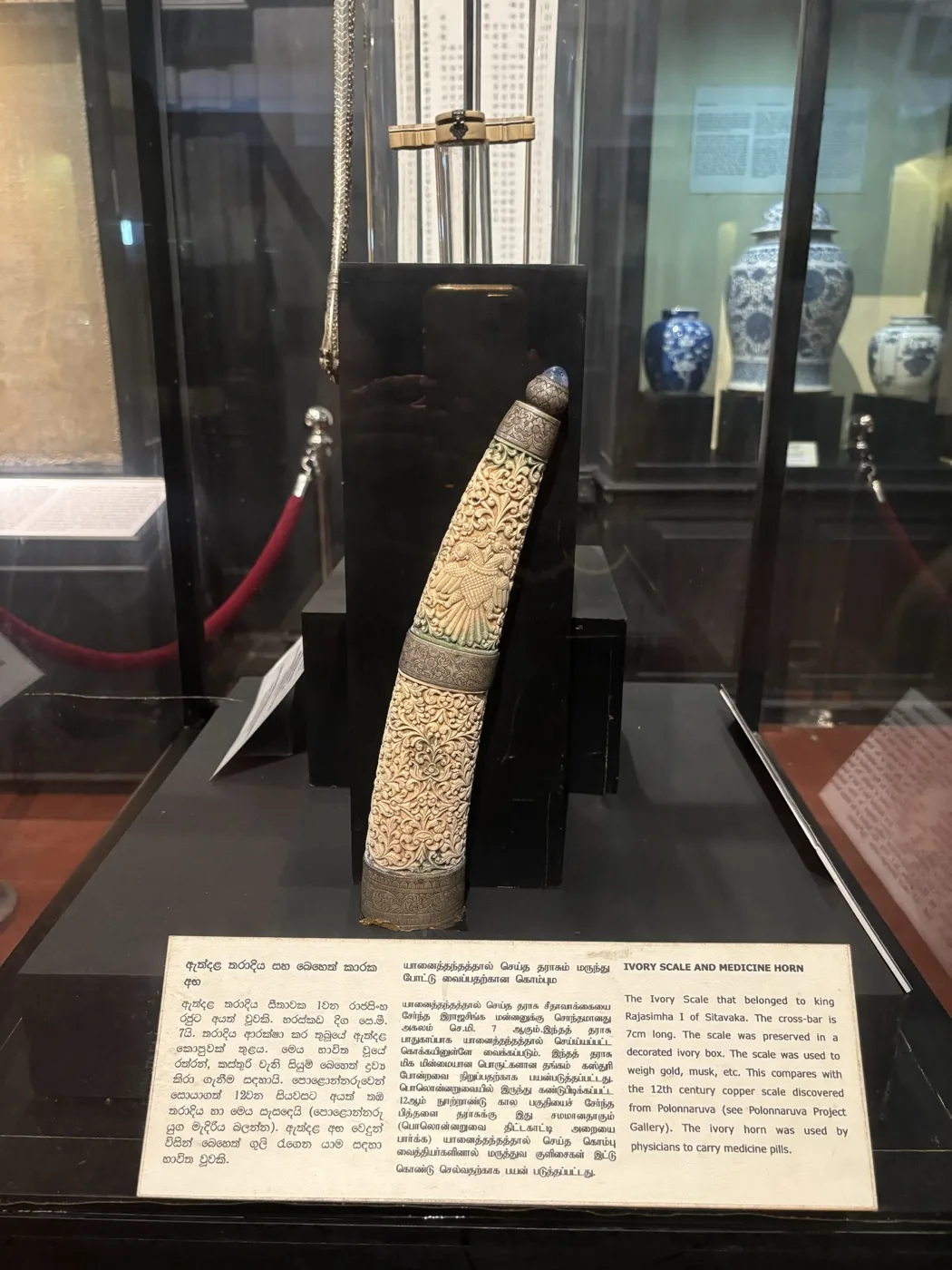
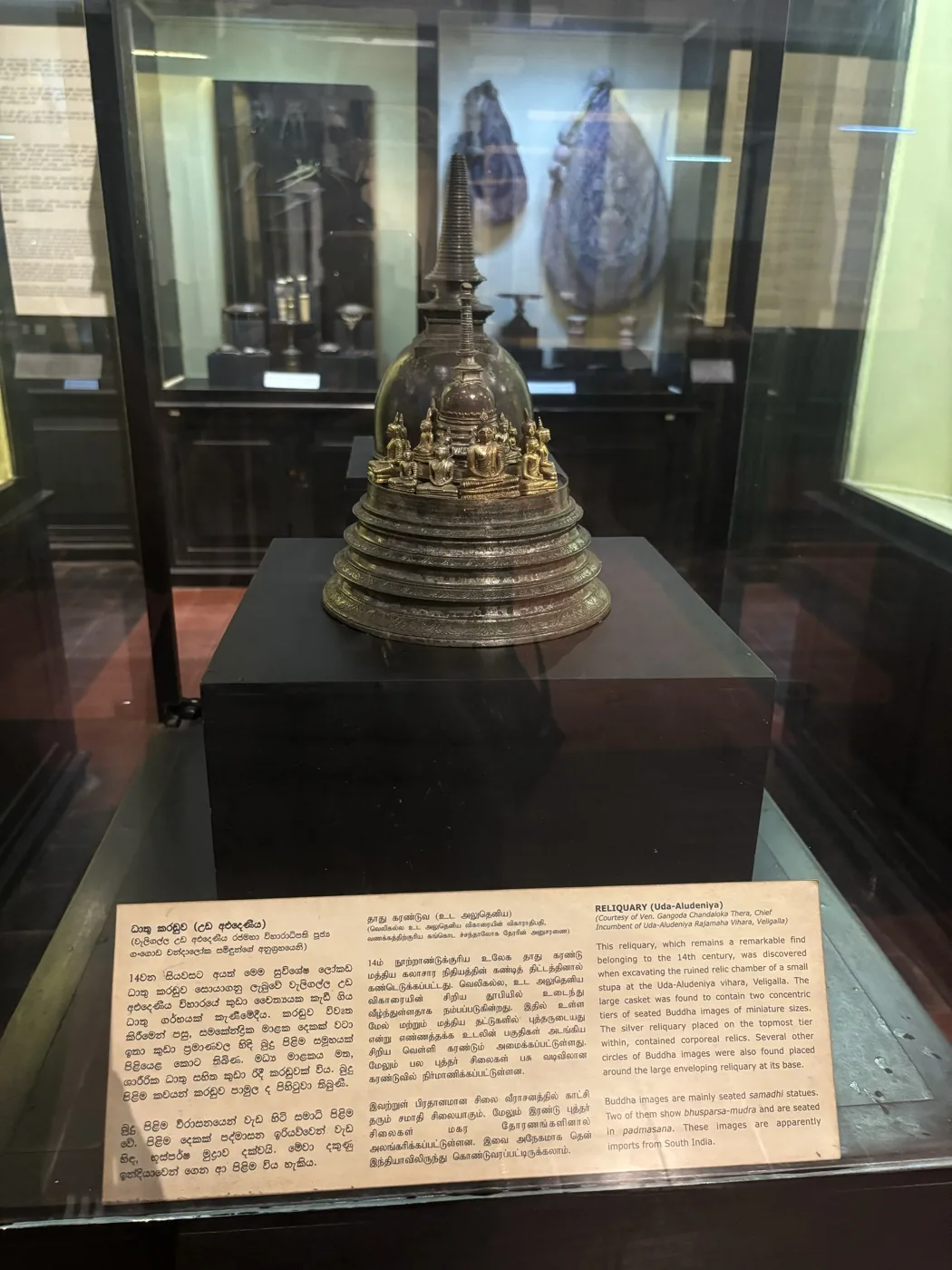
The third of the great Gampola monuments, the Embekke Devale, is the finest work of wooden architecture the island produced. A shrine to Skanda of Kataragama, its hall carries carved timber pillars and pekada capitals worked with a whole world of figures, wrestlers and horse-riders, a nursing mother, swans and kinnari musicians, the double-headed eagle called the bherunda and the composite nari-lata, the woman-creeper, cut with a freedom the stone of the age rarely allowed. In stone the decorative carver reached a late zenith of his own. The makara-torana, the dragon arch, grew richer than it had ever been, crowned now at its crest by the fierce mask of Kala, the face of time; the guardian balustrade, which at Anuradhapura had ended in the makara, gave way to the gajasimha, the winged lion-elephant; and the moonstone at the threshold, once a solemn diagram of the round of birth and death, was reduced to a plain circle of floral ornament. Beside these the bronze-casters went on making the gilded seated Buddhas of the hill shrines, the flame of knowledge, the siraspata, rising tall from the crown, the eyes now opened wide where the classical image had held them half closed.
The painted wall
Of the painting of these centuries little survives, for the walls of Gampola and Dambadeniya were replastered and painted afresh in the great Kandyan renovations of the eighteenth century, and the older work was lost beneath the new. What the excavators have since recovered argues an unbroken tradition rather than a gap: traces of the earlier painting found at the Natha Devale, at the Gadaladeniya and Lankatilaka image-houses, and at the Dalada shrine of the Wijesundararamaya at Dambadeniya tie the mural art of the thirteenth century to that of the early eighteenth in one continuous line. The most telling fragment is a great lion set in a flag, uncovered by the Central Cultural Fund under an inner coat of plaster at the Lankatilaka Vihara, a fourteenth-century painting that shows the hand of the age at a moment the later work had all but erased.
The word
The wandering capitals gave the island not only its temples but its letters, and the age is a golden one for Sinhala writing. At Dambadeniya, Parakramabahu II, a poet as well as a king, composed the Kavsilumina, the crest-gem of poetry, on the story of the Kusa birth; the age produced the Pujavali and the great collection of the Pansiyapanas-jataka, the five hundred and fifty former births of the Buddha, and the chronicles and doctrinal digests of the scholar-monks. Its most loved form was the sandesa, the message-poem, in which a bird is sent as a courier across the island and the poet describes all it passes on the way; the finest of them, the Salalihini-sandesa, was written at Kotte by the monk Sri Rahula of Totagamuwa, after the model of Kalidasa’s cloud-messenger, and sends a myna-bird from the capital to the shrine of Vishnu. It was in these centuries, too, that the Sinhala script settled into the rounded form it keeps today.
The last kingdom
The wandering ended at Kotte, near the western coast, where in the fifteenth century Parakramabahu VI held the whole island under one crown for the last time and made his capital the centre of the literary flowering that Sri Rahula led. It did not hold. Within a generation of his death the kingdom broke, the Portuguese landed on the coast in 1505 and fixed themselves at Kotte itself, and the last Sinhalese resistance gathered inland at Sitawaka under Mayadunne and his son Rajasinha, who turned in the end to the worship of Siva. The island was passing into the age of the European powers, and the seat of a free Sinhalese kingship would make its last move, up into the hills, to Kandy. The art of the wandering capitals, the temple that held Buddha and god together and the carved hall of Embekke, is the bridge between the classical world of Anuradhapura and Polonnaruwa and the hill-country tradition that was to be the island’s last.
Sources
- Paranavitana, Senarath. Art of the Ancient Sinhalese. Colombo: Lake House, 1971.
- Bandaranayake, Senake. The Rock and Wall Paintings of Sri Lanka. Colombo: Lake House, 1986.
- Coomaraswamy, Ananda K. Mediaeval Sinhalese Art. 1908.
- National Museum of Colombo, period galleries (Transitional-period panels, signed L. Prematilleke).
- University of Ceylon, History of Ceylon, on the Dambadeniya, Gampola and Kotte periods.
How to cite this essay
Malaka Talwatte, “The Wandering Capital: Art from Dambadeniya to Kotte,” Malaka Talwatte: Sri Lankan Art and Ceylon Antiquaria, https://malakatalwatte.pages.dev/publications/dambadeniya-kotte/.
Quote and cite freely with attribution; please do not republish a whole essay, or a photograph, without permission.