Among the peoples of the pre-modern world the Sinhalese are unusually well recorded, and they are so because they wrote a great deal and cut much of it in stone. Two bodies of writing carry their history. The first is the epigraphic record, the many thousands of inscriptions cut into rock and stone slab from the third century before Christ down to the fall of the medieval kingdoms; the second is the literary record, the chronicles, poems and doctrinal works written with a stylus on strips of dried palm-leaf. Together they make the island one of the best-documented lands of its age, and the writing they preserve is more than a record: the shaped letter cut in granite, and the verse scratched on a burnished wall, are an art of their own.
The letters in the caves
The oldest writing on the island is found beneath the drip-ledges of its rock shelters. From the third century before Christ, and for some centuries after, the donors who gave a cave to the community of monks had their gift recorded in a line of early Brahmi characters cut along the brow of the rock, just below the ledge chiselled to throw off the rain. A typical one reads simply that the cave is the gift of a named layman and his wife to the Sangha, the community of the four quarters, present and to come. Thousands survive, at Mihintale, at Sigiriya, at hundreds of hermitages across the dry zone, and they are the earliest evidence of the Sinhala Prakrit and of writing itself in the island, set down within a century or two of the coming of Buddhism.
The slabs and the pillars
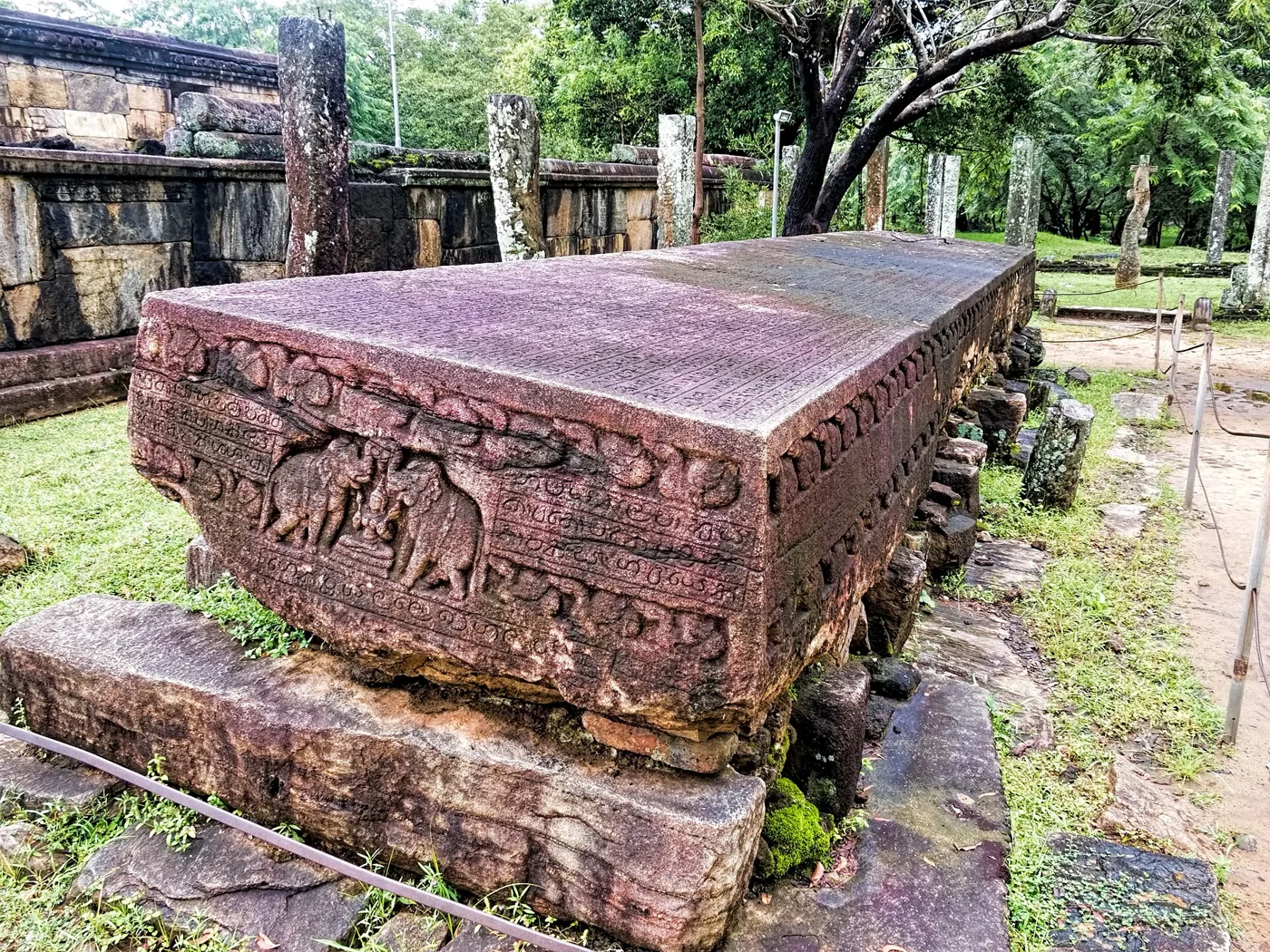
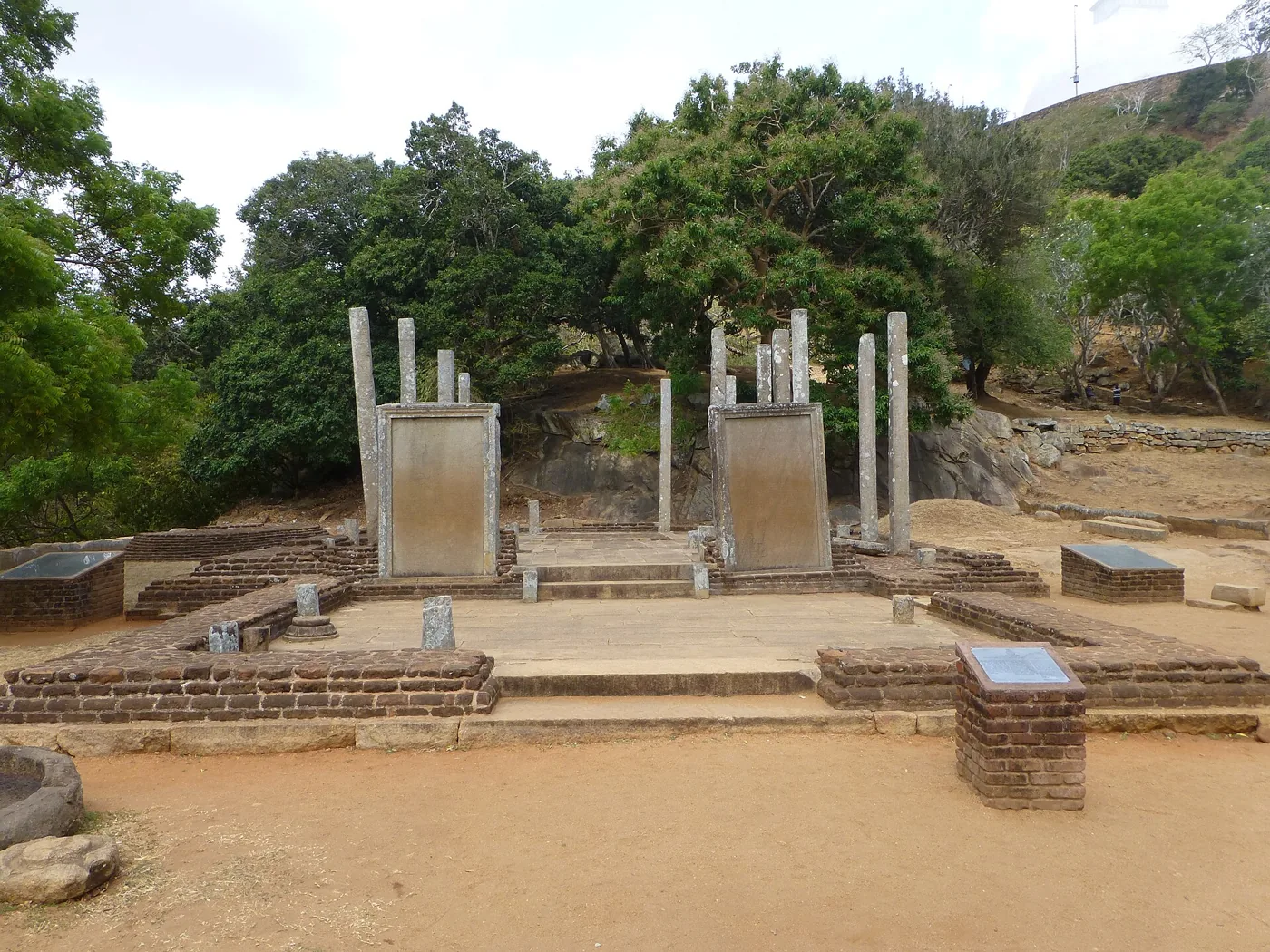
As the kingdom grew, so did the ambition of its inscriptions, until the royal proclamation cut in stone became a public monument in its own right. The tenth-century tablets of King Mahinda IV at Mihintale, two great slabs set at the stairway, lay down in detail the rule of the monastery, the duties of its servants, the shares of its lands. The longest of all is the Galpota, the stone book of Nissankamalla at Polonnaruwa, a single slab lined and shaped like a giant palm-leaf manuscript, recording the king’s descent, his good works and the duties he laid on his subjects across seventy-two lines. Beside these stood the pillar-edicts that guaranteed a grant or an immunity, the copper-plate charters buried with a foundation, and the katikavata, the codes of monastic discipline that a reforming king would have cut in stone at Polonnaruwa, at Dambadeniya and at Gampola. A number of the grandest, at the Abhayagiri and the Jetavana and on the eastern coast, are in Sanskrit rather than Sinhala, the language of the Mahayana Buddhism that flourished for a time beside the older school.
The oldest verse
One body of writing stands apart from the official record, and it is the most human of all. On the burnished plaster of the Mirror Wall at Sigiriya, the visitors of the eighth, ninth and tenth centuries scratched their responses to the painted women on the rock above them, and those scratched lines are the oldest surviving Sinhala verse. They are the private speech of an early public, praise and longing and the occasional dry remark, and they make Sigiriya something rare, a body of painting whose earliest audience left, incised beside it, exactly what it felt. Senarath Paranavitana read and published near seven hundred of them; the whole run past two thousand, and they carry the Sinhala poetic line at its beginning, before a single named poet had set his hand to it.
The shaped letter
Across these centuries the script itself was changing, and its history can be read on the stones. The angular early Brahmi of the cave-gifts gave way, through the medieval hand of the great slabs, to rounder and more fluent forms, until by the fifteenth century the Sinhala letter had settled into the curved shape it keeps today, a script whose loops and rings owe as much to the stylus and the palm-leaf as to the chisel. For the writing surface shaped the letter: a straight stroke drawn with a metal point across a dried leaf would split it along its fibres, so the scribe learned to write in curves, and the roundness of the Sinhala character is the mark of the palm-leaf on which so much of it was set down.
The palm-leaf book
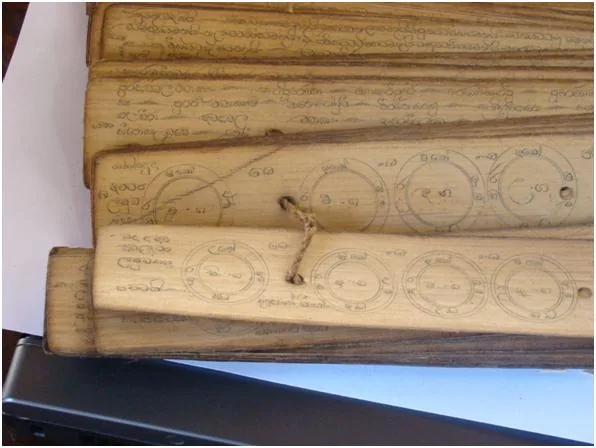
The book of the island was the pota, the manuscript of ola, the prepared leaf of the talipot or the palmyra palm. The leaves were cut to a long narrow strip, boiled and dried and smoothed, and the letters incised into them with an iron stylus; lamp-black rubbed over the surface and wiped away left the writing standing dark in the cut grooves. The leaves were strung on a cord through two holes and pressed between a pair of wooden boards, and the boards themselves were often carved and lacquered, so that the finest of them, like the covers of a Vinaya commentary now in the British Museum, carry the same ornament as the wooden pillars of Embekke. On these leaves was written the whole literature of the island: the Pali chronicles, the Mahavamsa and its continuation, that give the island its unbroken history; the doctrinal digests of the scholar-monks; and the great flowering of Sinhala poetry in the medieval kingdoms, the Kavsilumina of a poet-king and the sandesa or message-poems, in which a bird is sent as a courier across the land.
The reading of the record
Much of this writing had fallen silent by the nineteenth century, its scripts no longer read and its stones lost in the forest, and the recovery of it was the work of the antiquarians and then of the Archaeological Survey. The decipherment of the early Brahmi opened the whole epigraphic record, and from 1904 the inscriptions began to be gathered, read and published in the volumes of Epigraphia Zeylanica, the labour above all of Don Martino de Zilva Wickremasinghe and, after him, of Senarath Paranavitana, who between them made the stones speak again. What they recovered is not only a chronology of kings but a running account of the island in its own words, the gift of a people who wrote their history down and cut a great deal of it where it could not easily be lost.
Sources
- Wickremasinghe, Don Martino de Zilva, and Senarath Paranavitana, eds. Epigraphia Zeylanica. London and Colombo, 1904 onward.
- Paranavitana, Senarath. Sigiri Graffiti: Being Sinhalese Verses of the Eighth, Ninth and Tenth Centuries. Oxford University Press, 1956.
- Paranavitana, Senarath. Inscriptions of Ceylon. Colombo: Department of Archaeology.
- National Museum of Colombo, period galleries (the letters and language panels).
- UNESCO Memory of the World; the ola-leaf manuscript collections of Sri Lanka.
How to cite this essay
Malaka Talwatte, “Stone and Palm-Leaf: The Inscriptions and Letters of the Sinhalese,” Malaka Talwatte: Sri Lankan Art and Ceylon Antiquaria, https://malakatalwatte.pages.dev/publications/inscriptions-and-letters/.
Quote and cite freely with attribution; please do not republish a whole essay, or a photograph, without permission.