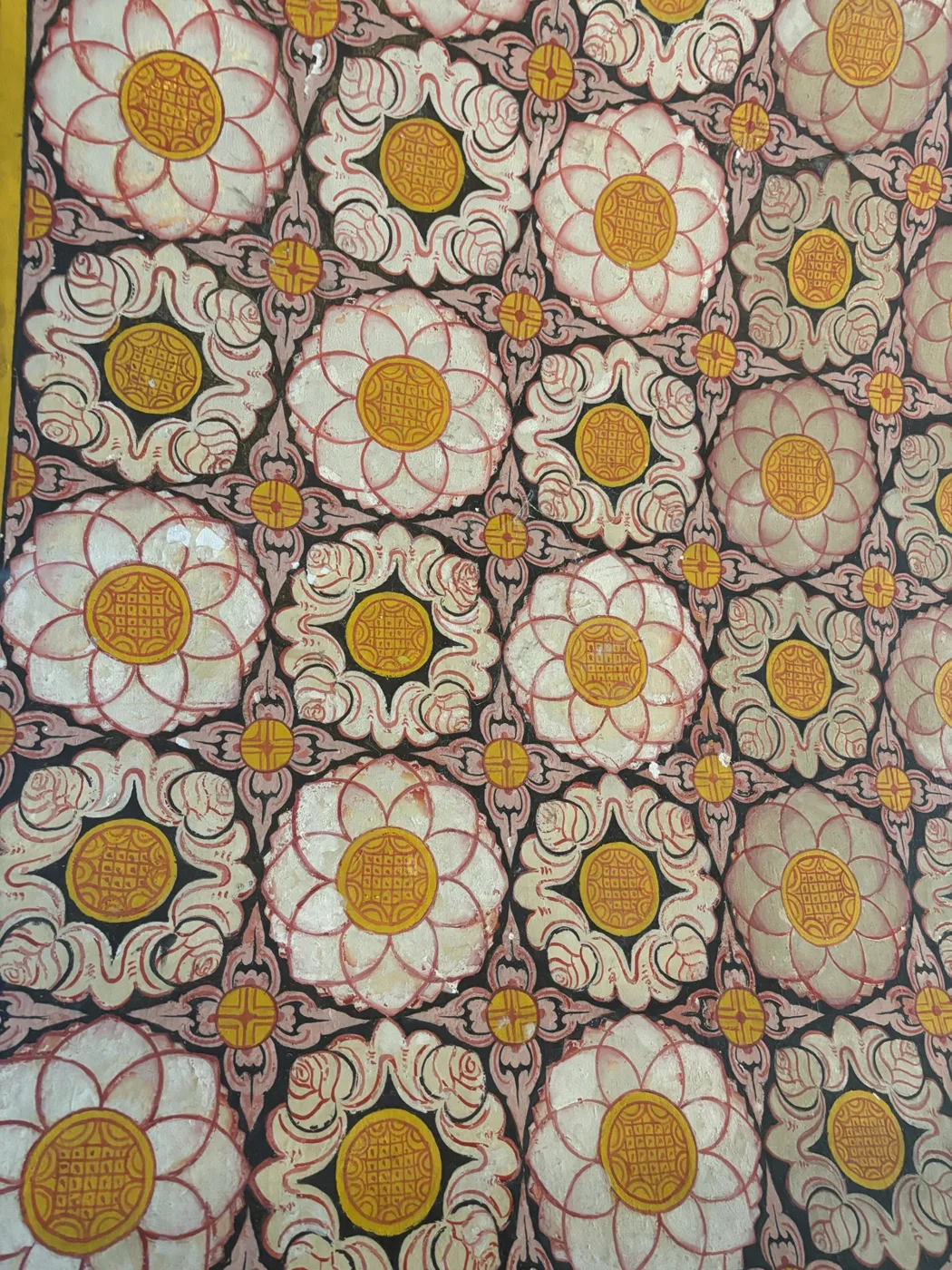
The ceiling of a Kandyan shrine is a whole field of flowers. Row upon row of lotus rosettes, each ringed in white and gold, run to the edges in a grid and gather, here and there, into a larger medallion; a scrolling creeper borders the panels and threads between them, and no surface is left plain. This is the other half of the Kandyan achievement, the half that carries no story. Beside the narrative walls with their Jatakas and their ranks of Buddhas runs a tradition of ornament, and it is worth looking at on its own, for the decoration of a Kandyan temple is not a background to its painting but the same art turned to a different end.

One vocabulary, many crafts
The reason the ornament holds together across a temple, from the painted ceiling to the carved doorpost to the ivory plaque on a casket, is that it was made by one body of craftsmen drawing on one repertory. In the Kandyan kingdom the royal artificers were organised in workshops, and the painters were not set apart from the ivory-carvers: one workshop department held them both. A single tradition of motif therefore passed freely between the media, so that the lotus a painter laid on a ceiling is the lotus a carver cut into a capital and the lotus an ivory-worker pierced into a comb, and to learn the Kandyan ornament in one craft is to know it in all of them.
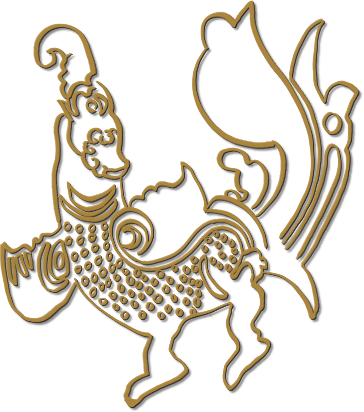
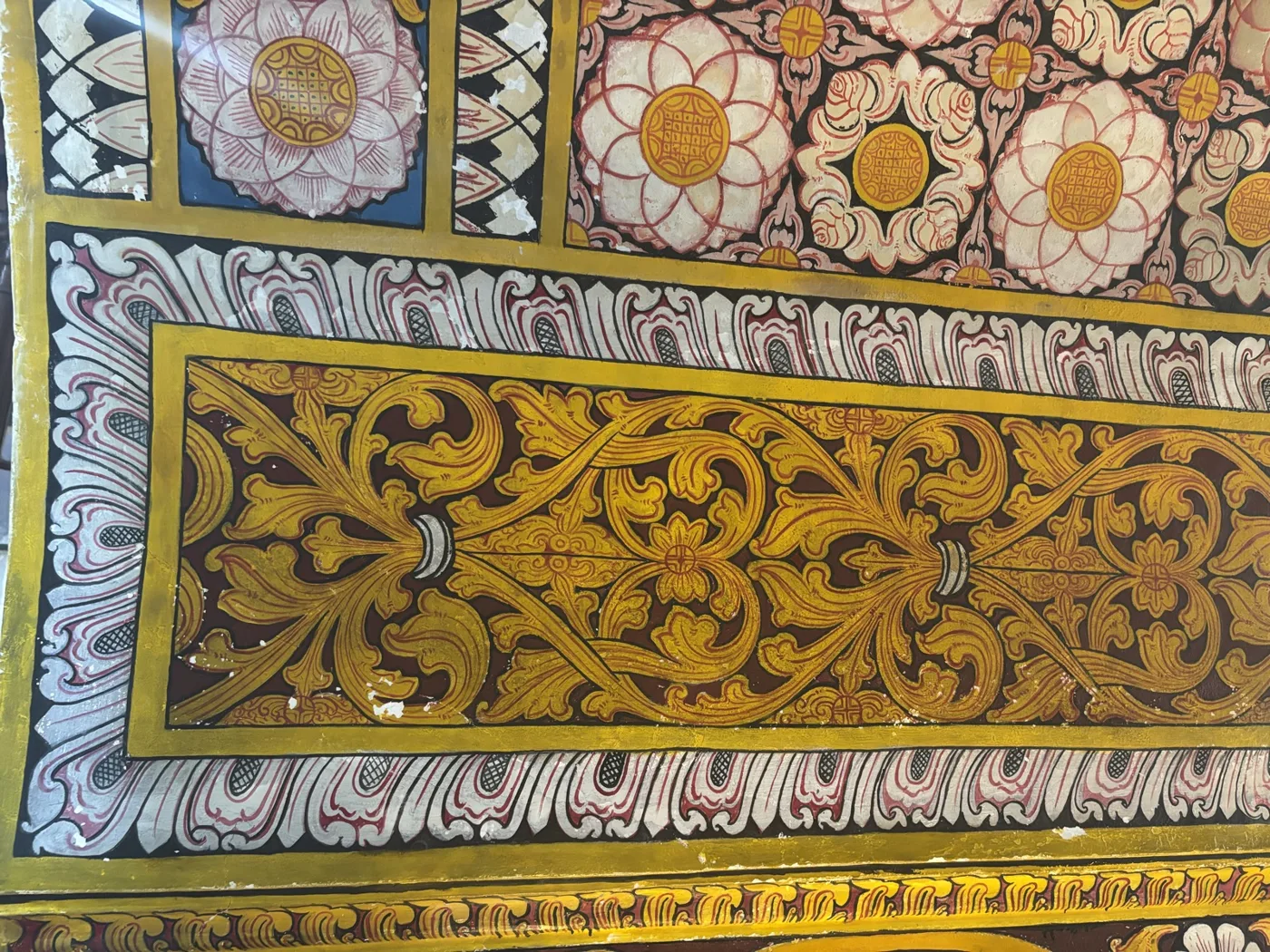
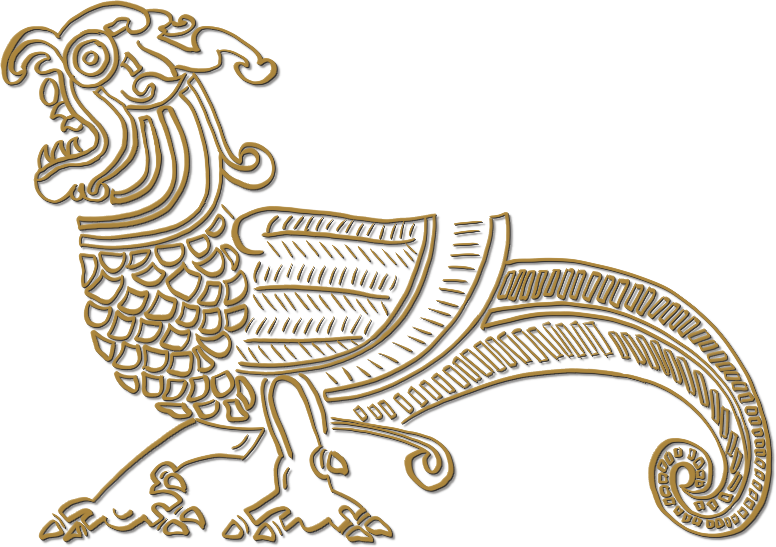
The vocabulary itself is small and endlessly recombined. Its foundation is the liyavala, the undulating scrolling creeper that borders, divides and fills, the single most characteristic line of all Sinhalese ornament; from it branch the named flowers and beasts. There is the nelum, the lotus, in full face as a rosette or reduced to the pala-peti, a running border of petals; the nari-lata, the creeper whose bud opens into the head and torso of a woman; the hansa, the sacred goose, singly or interlaced in the paired knot the craftsmen call the hansa puttuva; the gaja-sinha, the composite elephant-lion; the lion alone; and, at the arch and the roof-end, the makara. Between and around them run the geometric diapers, the interlaced bands and the checker. A Kandyan craftsman held this alphabet in his hand, and ornamented a wall or a beam by combining its letters.

The workshop and the trained hand
The workshop that held this repertory had a name. In the Kandyan kingdom the crafts were gathered into a royal department, the Kottalbadda, set under an officer of the court, the Kottalbadda Nilame, and it is from the ordered world of this department that the temple painter, the ivory-carver and the mason alike came. Coomaraswamy, who first set the Kandyan crafts down in detail, recorded that the Upcountry painters and sculptors were paid in the coin of the old kingdom, in grants of land, in gifts of material and in titles of honour, so that the man who ornamented a shrine held a settled place in the order of things and worked as more than a hired hand.
The training that produced the sure line was as ordered as the department that employed it. A pupil learned the set proportions of the figure and the grinding and laying of the colours, and before either of those he learned to draw, working through a graded set of line exercises with names of their own, the vaka-deka or 'two curves', the katuru mala and the tiringi talaya, each a drill in the turns and returns from which the whole ornament is built. To pass through this curriculum was to make the hand certain, so that the lotus and the creeper came from it already formed, and the confidence a visitor reads in a finished ceiling was laid down years earlier in the repetition of a few strokes.
The painted ceiling
The painted ceiling, the Udu Viyana or raised canopy, is the fullest field the ornament was ever given. The scheme is simple and the effect is not: the surface is divided into a grid, a lotus rosette set in each compartment, the whole bordered in creeper and gathered, where the ceiling permits, to a larger medallion over the shrine below. The palette is the same small one the narrative walls use, the madder red, the yellow and gold, the white, so that the ceiling reads as a continuous flowering canopy stretched above the worshipper, a painted echo of the cloth canopies hung over sacred images on festival days. The great cave temple at Dambulla carries such a ceiling over its Buddhas, and Degaldoruwa and the Ridi Vihara over their shrines; the most sumptuous are in the Temple of the Tooth at Kandy, whose interior, much of it renewed in the traditional manner during the twentieth century, keeps the old scheme alive.

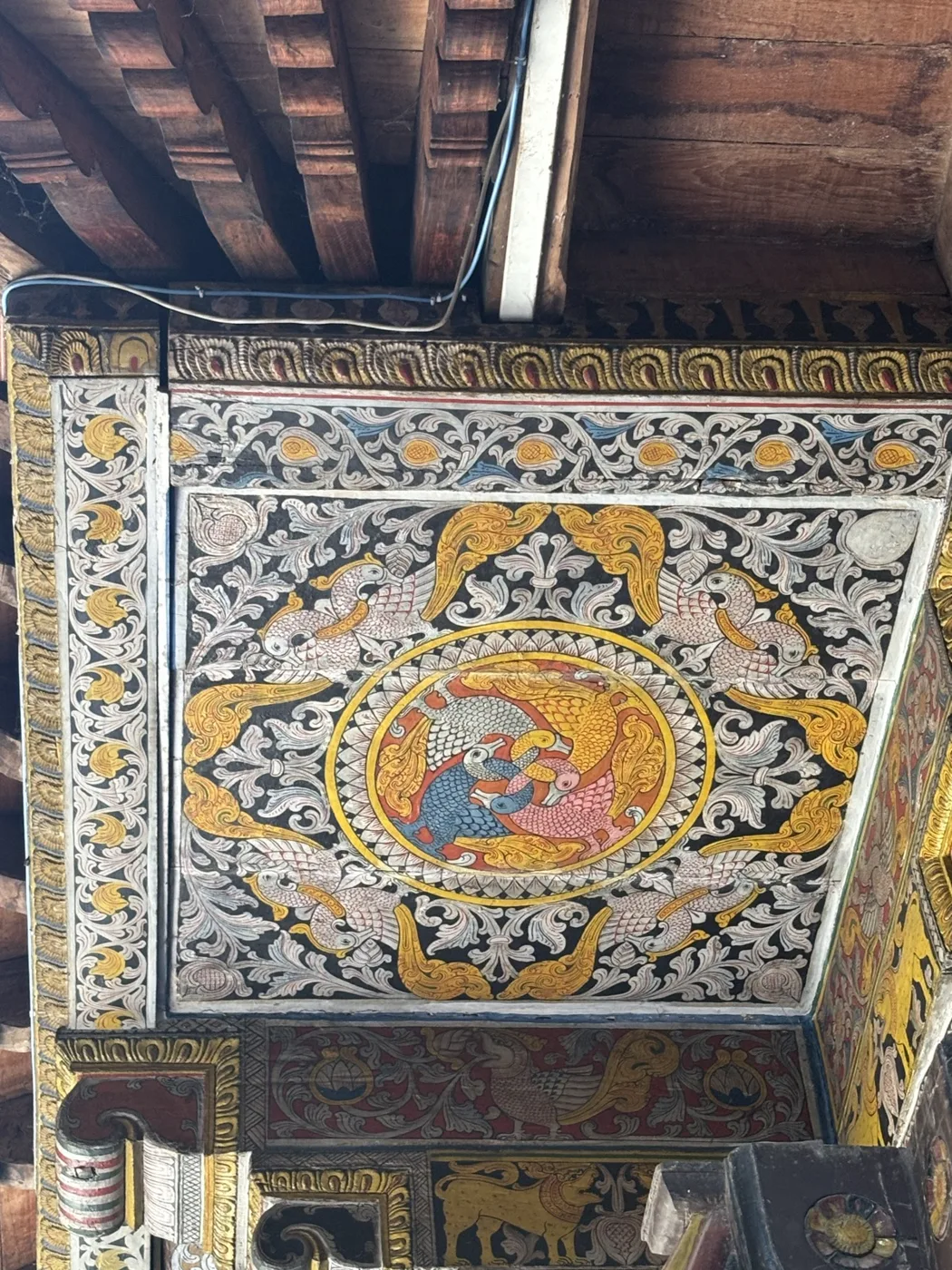
The ceiling is not always pure pattern. At the centre of a panel the craftsman would set a medallion, and into the medallion a figure or a pair of them, ringed by the scrolling ground; the swan of the hansa runs in interlaced rows through the border, and among the flowers move small figures drawn with the same care as any on the walls below. The ornament, in other words, is peopled, and the reader who looks closely finds a whole small world moving through the flowers overhead.
The flowered canopy of the temple on pillars
The great Udu Viyana at Kandy is one scale of the flowering ceiling; the small wooden shrine gives another. Across the Kandyan country stands a class of little image house raised clear of the ground on stone pillars, the tampita vihara, whose single dark room carries its own painted canopy overhead, called the Mal Viyana, the canopy of flowers. In these small ceilings the field is divided into panels set against one another in contrasting pattern, a lotus ringed with petals in the common compartments and, here and there, a star-shaped or purely floral motif, as at Valevela, where a lotus at the centre is surrounded by four of the demon faces the craftsmen call Kirti Mukha with the woman-creeper nari-lata opening at the corners. The leaf forms carried a vocabulary as exact as the flowers, the vihidi kolaya, the vakutu kolaya and the dati kolaya each a named shape a painter was expected to know.
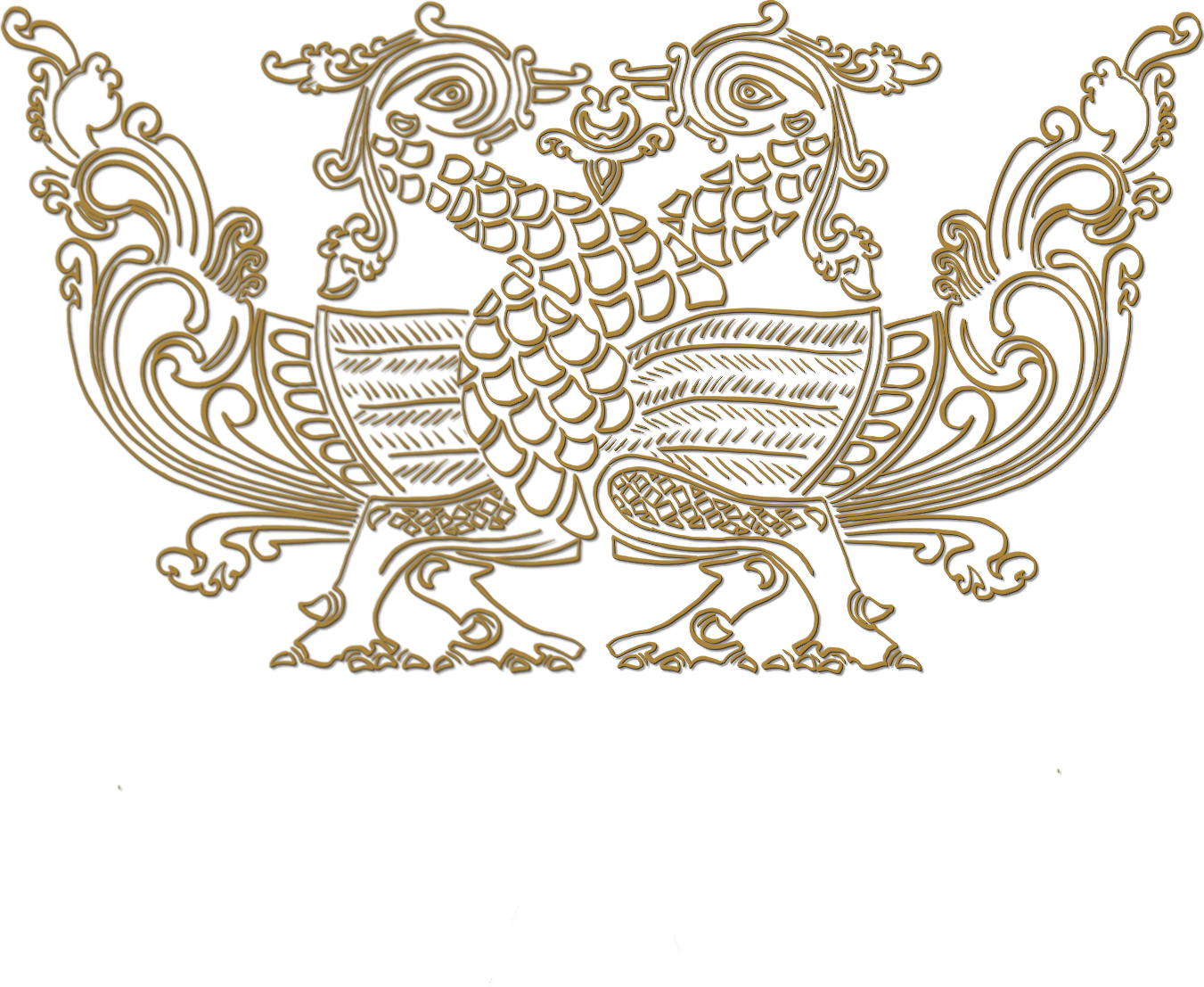
One motif of these canopies deserves its name in full. The interlaced goose the great ceilings show in running rows is known to the craftsmen as the hansa puttuva, and the term carries more than the mechanics of the knot, for it names a pair of geese wound together in courtship, a note of desire worked into the sacred canopy. Rathnayaka finds it most in the ceilings of the Matale and Kandy country and least in Kurunegala, so that a motif can also mark a region, the same interlaced birds telling one district's hand from another's.
The flower-bearer in the pattern
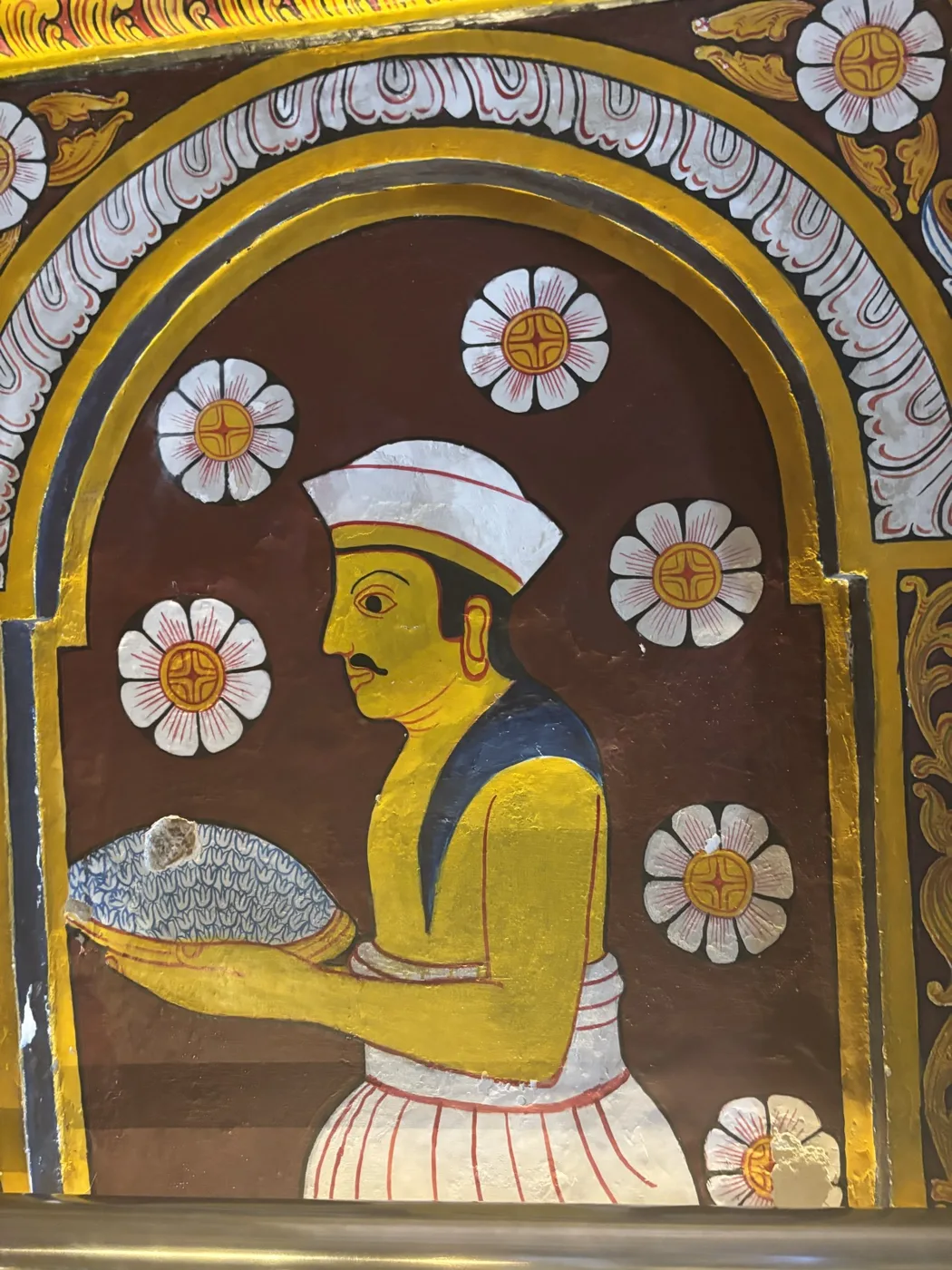
The figures woven into the ornament are not idle decoration; they carry the devotion of the shrine. The most constant of them is the flower-bearer, a figure who holds before him a tray of flowers, the offering the worshipper brings to the Buddha, set within a gilded arch among the rosettes. To ornament the ceiling and the arch with the very act of offering was to make the decoration itself an act of homage, so that the canopy of flowers overhead repeats, in paint, the flowers laid on the altar below. Here the two halves of the Kandyan achievement, the narrative and the ornamental, are seen to be one: the flower-bearer is a painted figure as finished as any on the story-walls, and he is also a unit of pattern, repeated along the arch like a rosette.
The creeper that opens into a woman
Beside the flower-bearer, who belongs wholly to the devotion of the shrine, runs a figure of a very different temper. The nari-lata is the creeper whose bud opens into a woman, and with it go the knotted forms the craftsmen call the nari ghata and the pancanari, the tie of five or eight women wound together, and the rare pancanari palakkiya, read as a palanquin of women, observed on the boards above a doorway at Murutdeniya. These motifs have been read as carrying an intended srngara rasa, the sentiment of the erotic, a frank sensuous note admitted into the ornament of a Buddhist shrine.
Where that note is allowed to sound is the whole point. The woman-creeper and its knots are kept off the walls of the sanctum, the dark inner room where the Buddha sits, and are given instead to the porch, the veranda and above all the wooden door, the threshold a worshipper crosses on the way in. The sensuous belongs to the world left at the door; the sanctum within holds the flower-bearer and the ranked Buddhas. To move from the doorway to the image is to move from one register to the other, and the ornament marks the passage as surely as any wall between them.
The same art in stone and wood
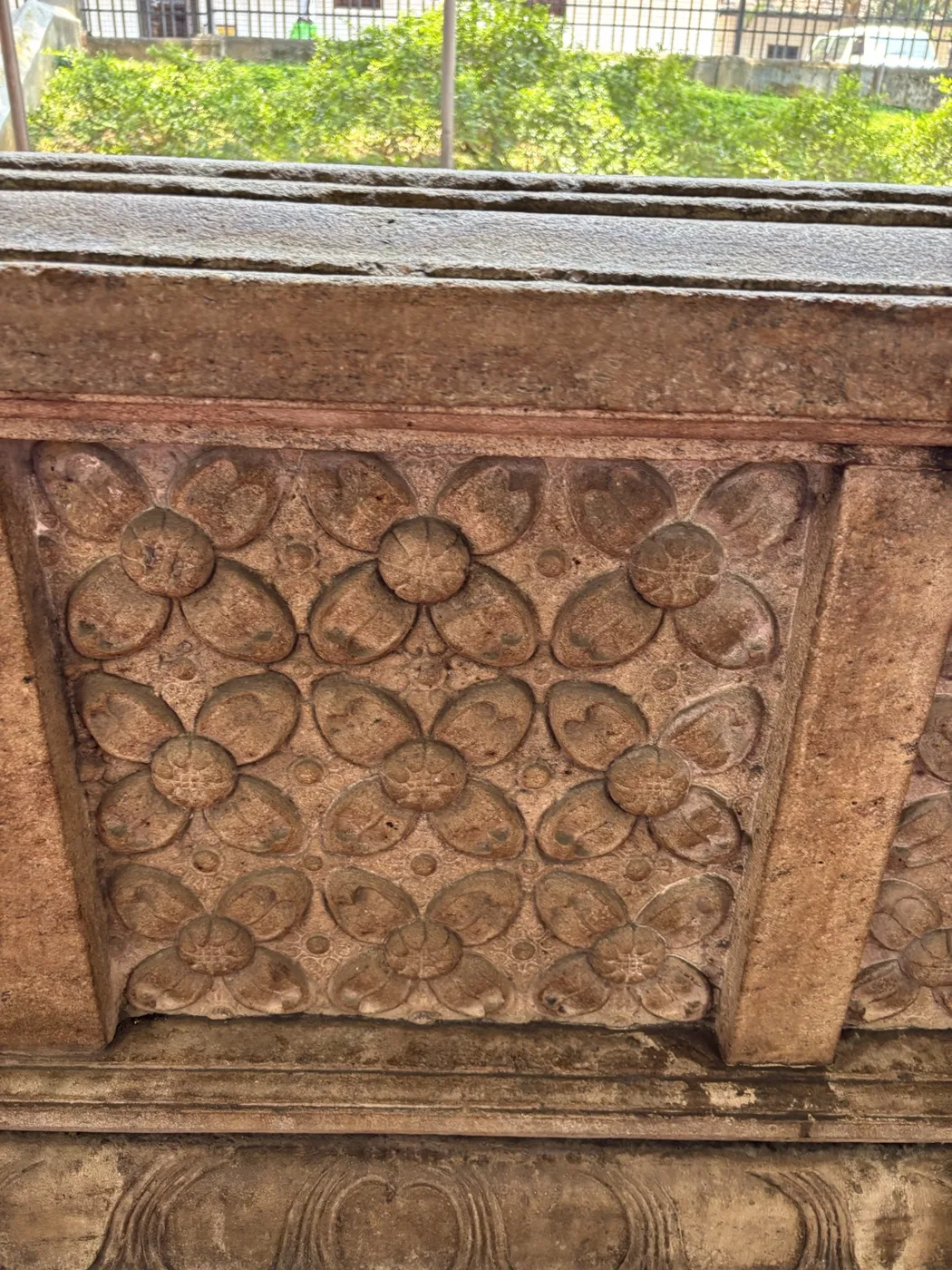
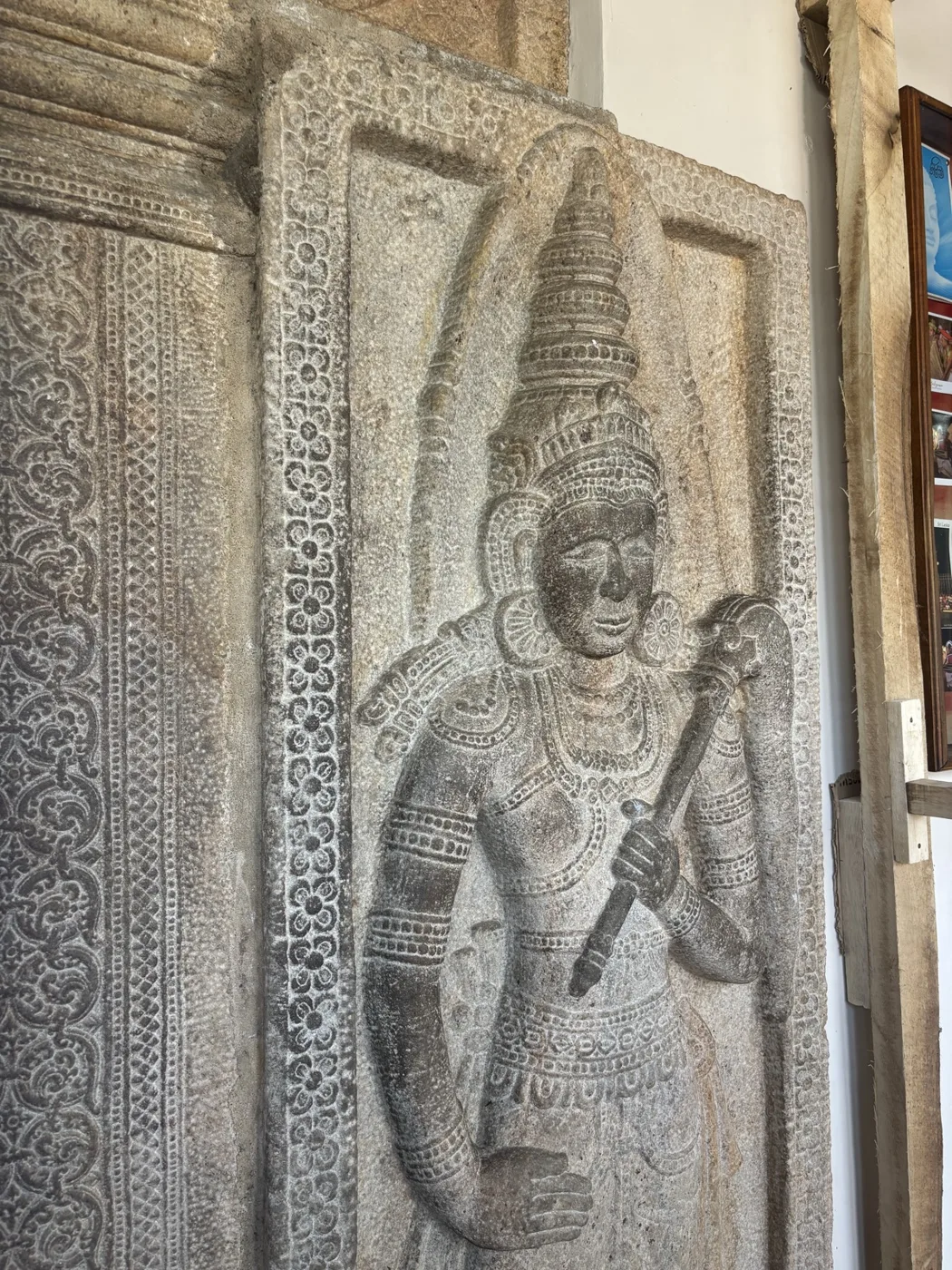
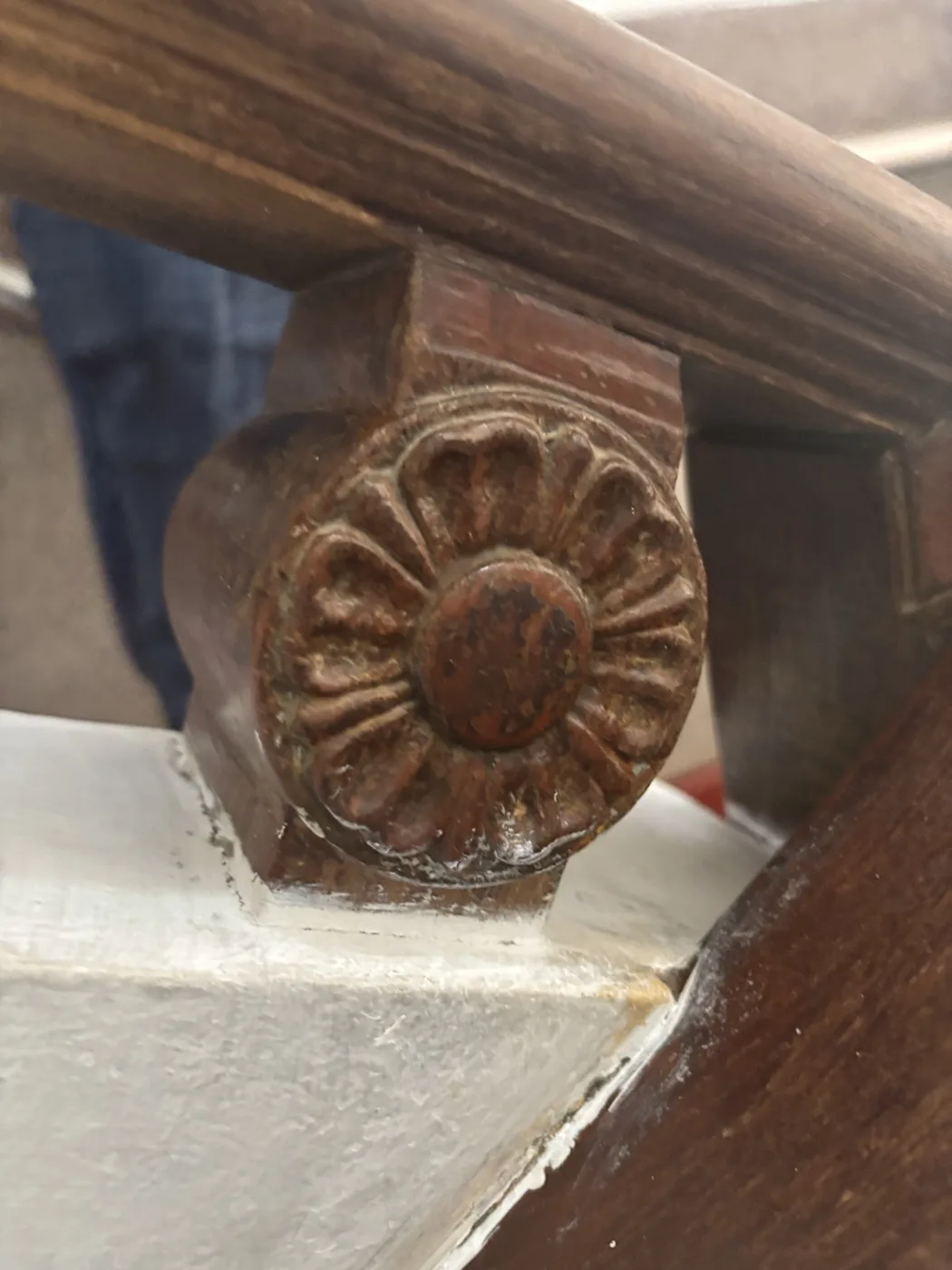
What the brush laid flat, the chisel cut deep, and the lotus of the painted ceiling returns, unchanged in form, in the carved stone of a panel and the turned wood of a bracket. The mason set the same rosette in a grid across a stone slab that the painter set across the ceiling; the carpenter cut the end of a beam or the head of a pillar into ornament, and the pekada, the carved wooden bracket that carries a beam, is the small masterpiece of the tradition, most often a lotus or a lotus-and-creeper. The supreme example of Kandyan woodcarving stands not at Kandy but a little to the west, at the Embekke Devalaya, whose pillars carry a celebrated series of hundreds of carved panels running through the whole repertory of flower, bird, beast and dancer; but the same hand is at work wherever a Kandyan roof is held up. The shrine itself was raised in the fourteenth century under Vikramabahu III of Gampola, the kingdom that held the hill country between the fall of Polonnaruwa and the rise of Kandy.
The guardian of the door shows the unity of the crafts most plainly of all. At the threshold of a Kandyan shrine the visitor is met by a door-guardian, a Doratu Pala, and the same figure may be painted on the jamb, modelled in plaster, or carved in stone in relief; it is one iconography worked in three materials. Coomaraswamy noted that the larger images, whether of stone, brick or clay, were in the end always plastered and painted or gilt, so that painting and carving met on the finished surface, and the modelled and the drawn figure were never so far apart as they seem. The carved door-guardian, worked in low relief, is the sculptural cousin of the painted figure on the jamb.
Ornament that is also writing
One kind of ornament on these walls asks to be read as well as looked at. Through the ranked Buddhas of the sanctum run small painted panels of Sinhala script, the cartouche or label that names each figure, the Buddha of a former age and the seeker who worships him, so that the series can be told apart one from the next. The hand these labels are written in is the hand of the manuscript, the rounded Sinhala of the palm-leaf book of the same century, and the affinity is not accidental, for the men who painted the shrines and the men who copied the texts were shaped by one reform.
The Buddhist revival of the mid eighteenth century, led by the Sangharaja Valivita Sri Saranankara, set out to renew the copying of the scriptures and, with that, to fix a standard Sinhala hand, and the Silvat Samagama he founded taught the letter as well as the doctrine. At Gurubabila in Matale the sand-tray called the Vali Pihilla survives, the surface on which a pupil traced the deep curves of the script until the hand held them, most likely so that liturgical texts brought from Siyam could be carried over into Sinhala. The painted label on a shrine wall and the letter drilled in the sand-tray are two ends of one discipline, and the ornament of the Kandyan temple, at this one point, is also its writing.
The ornament and the anonymous hand
The decorative tradition shares the anonymity of the painting it accompanies. The men who laid a thousand lotuses across a ceiling, wove the flower-bearer into an arch, or cut the guardian into a doorstep, are as unrecorded as the makers of the narrative walls, and for the same reason: this was craft in the service of the shrine, held in families and passed from master to pupil, and it did not occur to it to sign its work. Yet it is in the ornament, as much as in the great Jataka walls, that the character of Kandyan art is most concentrated: the love of the filled surface, the small and constant palette, the confidence of a line that had drawn the same lotus ten thousand times. To look up at a Kandyan ceiling is to see a whole aesthetic in a single glance, and to understand why the painting on the walls beneath it looks as it does.
Sources
- Ananda K. Coomaraswamy, Mediaeval Sinhalese Art, Broad Campden, 1908 (full text, Internet Archive).
- Senake Bandaranayake, The Rock and Wall Paintings of Sri Lanka, Colombo, 1986.
- R.M.T. Rathnayaka, 'Unveiling the Intricacies of Artisanal Mastery: Central Kandyan Temple Mural Paintings', Vidyodaya Journal of Humanities and Social Sciences 10(1), 2025.
- On the Kandyan painted ceiling and its design: the Suriyakantha Centre studies of Kandyan-period decoration.
- Asoka de Zoysa, Vajira Nalinda Jayathilaka and Ganga Rajinee Dissanayaka, Evolving Traditions of the Buddhist Image House, Part I: Understanding Two Centuries of Art and Architecture in Sri Lanka, Colombo.
How to cite this essay
Malaka Talwatte, “Lotus and Creeper: the Kandyan Decorative Tradition,” Malaka Talwatte: Sri Lankan Art and Ceylon Antiquaria, https://malakatalwatte.pages.dev/publications/kandyan-decorative/.
Quote and cite freely with attribution; please do not republish a whole essay, or a photograph, without permission.