The temple painting of the kingdom of Kandy is at once the last great flowering of a Buddhist art two thousand years old, and the first of that art whose makers the record keeps by name. For the thousand years before it, the painters of the island had worked in anonymity: the men who covered the western face of Sigiriya with celestial women in the fifth century, and those who filled the shrine walls of Anuradhapura and Polonnaruwa in the centuries after, are known today by their places alone, their names lost as wholly as those of the masons and image-makers who laboured beside them. It is in the hill country, in the last independent kingdom the island would hold, that the craft at length steps clear of that long silence, and a Sri Lankan painter can first be spoken of by name.
The occasion of that flowering was a revival, and the revival was hard-won. The classical civilisation of Anuradhapura and Polonnaruwa had fallen by the thirteenth century, and through the long unsettlement that followed, as the Sinhala capital moved from one hill refuge to another, the religion decayed with the polity until the higher ordination itself, the upasampada that alone could make a fully professed monk, died out upon the island. Twice the kings of Kandy sent abroad to recover it, bringing monks from Arakan in the 1590s under Vimaladharmasuriya I and again in 1697 under Vimaladharmasuriya II; twice the restoration lapsed. It held only at the third attempt. In 1753 King Kirti Sri Rajasinha (r. 1747–1782), at the urging of the monk Weliwita Saranankara, brought a chapter from the court of Ayutthaya in Siam, and the fraternity they founded, the Siyam Nikaya, took root and endured. The king who restored the ordination rebuilt the temples with it, and across his reign and the two that followed, the old cave shrines were replastered and painted afresh and new image houses raised across the hill country, and the painter-craftsmen who carried out the work entered the most productive age their art would know.
The Sittara and their lineages
The men who painted these walls were the Sittara, the painter-craftsmen who formed one class of the royal craft department, ranked in the old grants beside the carpenters, the turners, the arrow-makers, the silversmiths and the smiths. The craft was a caste and a calling at once, carried in the male line under the surname Naide, the women of the same families bearing the honorific Etana, lady. At the head of a commission stood the Mulachari, the master who took the work and directed the hands beneath him; the word is an office and not a surname, so that a painter remembered as a Mulachari is being named for the rank he held, and a work of any size was given, in the old phrase Coomaraswamy recorded, 'not of one, but of four Mulachari'. Above the single workshop lay the lineage that descended from master to pupil across the generations, of which the painters of Nilagama, in the Matale country to the north, were the most celebrated.
The scholarship on this art rests on two names. Ananda Coomaraswamy, the Ceylonese art historian and philosopher who later shaped the study of Indian art from Boston, was the first to treat these craftsmen as craftsmen: his Mediaeval Sinhalese Art of 1908 set down the working methods, the materials and the caste organisation of the Kandyan artisan while the tradition was still a living practice, and it remains the ground on which every later account has been built. Senake Bandaranayake, writing in 1986, gave the surviving corpus its modern order, distinguishing within it a Central Kandyan school of the highlands, a Provincial Kandyan school in the country about it, and a Southern school along the lowland coast. Whether that Southern school is a late branch of the Kandyan or a tradition of its own has since been argued, Somathilaka reading it as an extension of the hill-country manner, Wijesekara and de Zoysa as something more nearly independent, and Bandaranayake himself allowing that the question could not be easily decided. The divisions were never sealed, for the Sittara travelled, a workshop from one district taking a commission in another and carrying its manner with it, so that a single hand or lineage may be met with far from its home.
The patrons and their reward
The work reached the Sittara through a chain of patronage that ran downward from the throne. The king stood at its head, and the great royal foundations rose and were painted in his name; below him the provincial governors and the Radala chiefs who held office as Adigar, Disava and Nilame, together with the lay custodians drawn from the same families, endowed the temples of their districts, so that a single shrine might bear the marks of a king in one generation and of a local nobleman in the next. A craftsman who completed a vihara was rewarded in kind and in land, and the grant was set down on a copper deed, the sannas, that fixed the gift beyond the life of the giver. Coomaraswamy recorded the practice while its memory was still fresh: the reward for a large undertaking, he wrote, 'consisted usually of rice, cloth, cattle, gold, silver, land', and the deeds he gathered measure the wealth a temple could command, from the paddy, gold, silver and cloth granted at Lankatilaka in 1342 to the fifteen thousand six hundred fanams paid at Medawala, with lesser sums recorded at Asgiriya, Niyamgampaya and Palkumbura. Land was the surest of these rewards, for a holding granted against service passed with the craft from father to son, and the caste that painted the walls was tied to the temple by the same tenure that bound the cultivator to his field.
The making of a wall
The Kandyan painter worked in tempera upon a dry ground, and the distinction from true fresco governs all that follows. Coomaraswamy, setting down the practice while it was still a living craft, was plain about it: the pigments were 'mixed with dul latu', the gum of the wood-apple tree, and water, so that 'the work is thus in no sense fresco, but should be called tempera painting'. The ground was built up, not laid wet. A wall of brick, or of mud on a timber frame, was covered with fine clay and sand bound in rice water, then with a coat of kirimetiya, the white 'milk-clay' or kaolin, and finished with makul, a magnesite brought from a cave at Maturata, until the surface was made pure white; lime plaster, the wet ground of the true fresco, was kept for outer walls that were never meant to carry painting.
The palette laid on this white was small and, but for one imported colour, wholly of the island. Red, which served as the ground of nearly every composition, was cinnabar, a mineral that does not occur on the island and had always to be brought from abroad, though the old accounts that name it do not record from where; yellow was gamboge from the gokatu tree, or orpiment; white was the magnesite of the ground itself; black was a lamp-black gathered as soot from a smouldering mixture of resin and oils. Blue, an indigo drawn from the leaf, was rare, and green, mixed from blue and yellow, rarer still, so that in the older paintings the two are often absent altogether; a little gold, said to have come from Siam, was used on occasion. The colours were ground in a stone mortar for as long as a month before a great undertaking began, the labour of pupils, and the brushes were made by hand and graded to their task, the finest, for the outlines, from the stiff awns of the teli tana grass, the broader from squirrel hair or the frayed aerial root of the screw-pine.
The painting was drawn before it was coloured. The scene was first sketched on the white ground in black; the background was filled with pink and the figures reserved in white; the figures were then laid in with yellow and outlined in red, the ground brought up in pink exactly to that outline, the features and detail added in red, and the whole at last drawn round with a firm black line that, in Coomaraswamy's words, 'at once defines, harmonises and unites the whole composition'. It was the line, and not the modelling, that carried the picture.
The reading of a wall
A Kandyan wall is composed to be read, and it is read in bands. The narrative runs in horizontal registers, one above another, each a continuous strip in which episode gives way to episode without the frame a later age would insist upon; the eye travels along the register as it would along the leaves of a palm-leaf book, and the painted Sinhala captions set beside the scenes, in a hand close to the manuscript letter of the day, confirm the kinship. The telling is continuous in a stricter sense as well: a single figure may be repeated along the register to carry the story through its stages, so that at Degaldoruwa the same royal elephant is painted twice within one field, once ridden by the king and once being given away, and it is the eye of the worshipper, not the picture, that is made to move. Within the register the figures stand frontal or in three-quarter face, the eye elongated and the pose held to a set of inherited attitudes, and their scale answers to their rank rather than to their distance from the viewer, so that a king or a Buddha stands larger than the attendants about him; colour too was made to carry rank, the darker tones given to the lowly and gold reserved for kings and gods. Around and between the scenes runs the liyavala, the undulating scrolling creeper that borders and divides the whole, with a repertory of lotus rosette and floral motif to fill every ground the narrative leaves bare. The result is a system, learned entire and carried from one shrine to the next, in which the individual hand shows less in invention than in the quality of its line and the richness of its finish.


How such a wall should be read has itself drawn scholarly attention. Asoka de Zoysa brings to these shrines the iconological method of Erwin Panofsky, asking of a painted scene not only what it shows but why it was chosen for this wall at this moment, so that the sixteen sacred sites of the Buddha's visits to the island, the Solosmasthanaya set out at Medawala and other shrines of the revival, read as more than a pious inventory once one weighs that they were painted for a Kandyan king whose temporal authority was ebbing even as he covered the walls with the Buddha's dominion over the land.
The threshold: the makara torana
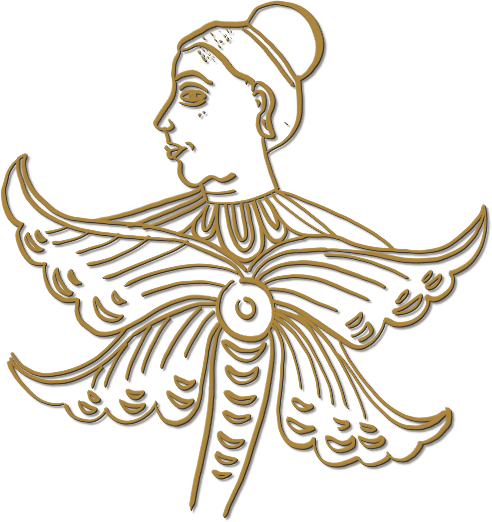
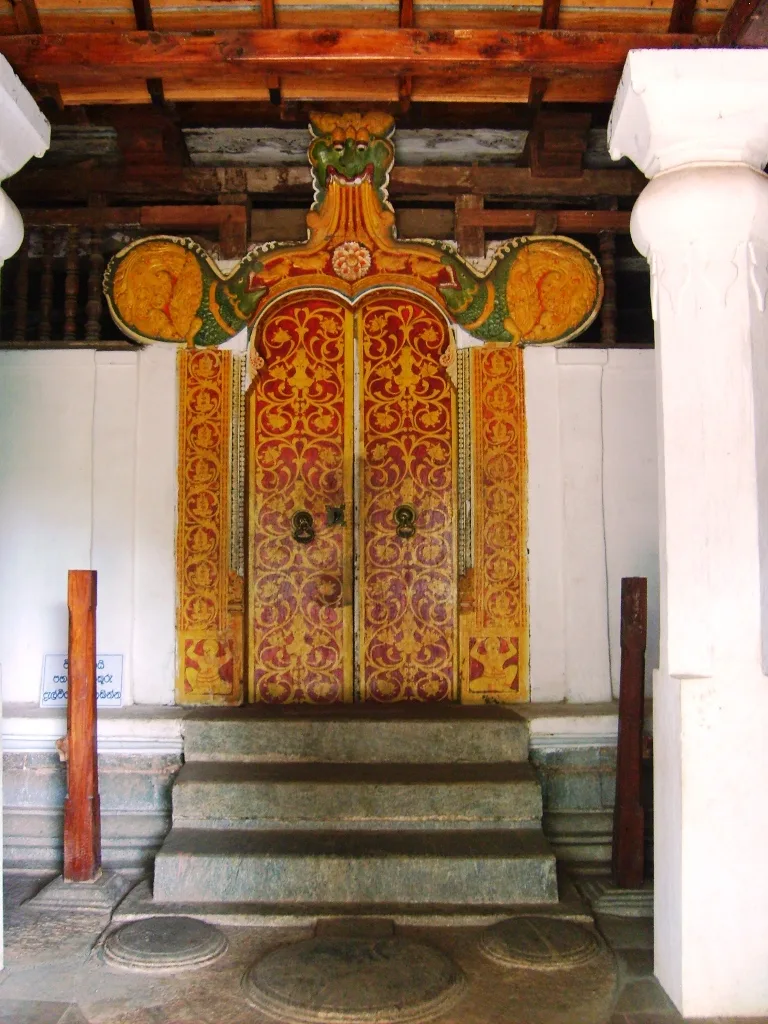
The devotional and visual climax of the image house is its doorway, and over the doorway sits the makara torana, the great arch that frames the way into the sanctum or crowns the seated Buddha within it. A pair of makara rise upon the flanking pillars, composite monsters the tradition assembles from many creatures at once, part elephant, part lion, part fish, part serpent. Their trunks meet and intertwine at the crown of the arch, and there, at the apex, glares the Kirti Mukha, the face of glory, the fanged mask that guards the threshold. Along the jambs below stand the door-guardians, the Doratu Pala, who may be deities, cobra-kings or fanged demons; among them climbs the Nari-lata, the creeper whose blossom opens into a woman, while the half-bird Kinnara pipe and sound their trumpets in the foliage.

The arch is also a record of belief in motion. The upper register of the torana is peopled by the gods of the heavens above it, and the company grew as the Kandyan court drew closer to South Indian practice: Indra and Brahma stand first among them, and the Hindu gods were drawn into the guard by degrees over the eighteenth and nineteenth centuries, each admitted in turn to the keeping of the Buddhist door. To follow the deities gathering above a Kandyan arch is to watch a Hindu pantheon settle, by slow accretion, into the service of a Buddhist shrine.
Rank among these gods was marked in the figures themselves. At the altar at Medawala, where the great gods attend the seated Buddha beneath the arch, Sakra and Mahabrahma, Vishnu and Siva are each given three arms, while the four Guardians of the Directions who stand beyond them are allowed only two, the count of the arms alone fixing the guardians' lower place in the celestial order.
The programme of the shrine
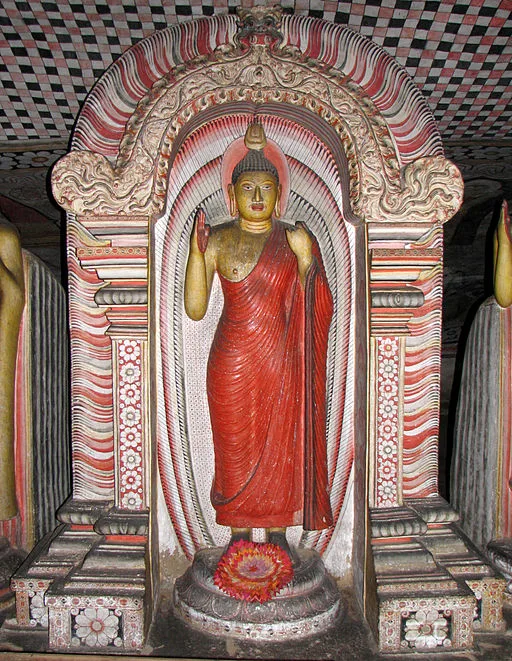
Behind the arch the painting follows an order as fixed as the architecture. The innermost chamber, the sanctum, holds the principal image, a Buddha seated in meditation, standing, or recumbent in the attitude of the final passing, and its walls carry the ranks of those who attend him: the enlightened Arhats in adoration, the protective gods, and the Bodhisattvas who stand facing the central figure. The ambulatory that surrounds the sanctum is the zone of narrative, given to the life and the former lives of the Buddha. The Jataka stories, the accounts of his earlier births in which the future Buddha perfected his virtues, run in their registers, the long Vessantara Jataka most fully of all; the Buddha Carita, the events of the final life, unfolds from the descent from the Tusita heaven to the great passing; and to these are added the standard cycles of the ambulatory, among them the twenty-four former Buddhas of the Suvisi Vivarana, alike to one another and told apart chiefly by their painted labels, and the seven weeks after the Enlightenment, the Sat Satiya. The wall is a doctrine set out in sequence, a scripture the unlettered devotee could walk through and read.
The donor in the shrine
The men who paid for these walls were not always content to remain outside them. Among the Arhats and the attendant gods the Kandyan shrine came to admit the patron himself, the Radala donor who had carried out the royal commission, and it pictured him by a fixed convention. He is shown in profile, turned toward the central Buddha in the posture of worship, a lotus or a sapu blossom held between his fingers, the flower that elsewhere marks the Bodhisattva and the Arhat; the dress is the white cloth and the ornamented upper garment that were the privilege of high rank at court, and the standing of the sitter is told by the size of the figure and the richness of what he wears rather than by any sign of worldly power. Jayathilaka reads the convention plainly: the donor is drawn to declare his devotion and his faith, not his office or his arms. The same holds of the kings, who appear in the shrines they endowed as worshippers and not as rulers, Kirti Sri Rajasinha among them, shown at Dambulla in the gesture of homage before the Buddha. Dunuvila Nilame at Medawala, Migastenne Adigar at Dambadeniya, Levke Nilame at Danakirigala: the named noblemen enter the painted assembly as devotees, ranged in worship among the idealised enlightened.
Asoka de Zoysa presses the point further at Medawala, the small temple raised on pillars near Kandy whose murals a copper deed of King Kirti Sri Rajasinha dates to 1755. There the donor, whom Bandaranayake identifies, though only provisionally, as Dunuvila Nilame, and the two monks who mentored the work, one of them named as Ven. Deniyē Chandaratana, are painted larger than the idealised Arhats ranged along the same walls, and they are rendered with a particularity the Arhats are denied: the donor in the exact costume of the Kandyan court, the Thuppottiya below and the embroidered Hattaya above, finished with the frilled ruff, the Mantaya, and the worked belt, the borders of even his undergarments picked out with care, the stubble left on the cheeks of the monks. De Zoysa reads these figures as portraits in all but name. He sets them early, arguing that this individualised likeness of the donor appears at Medawala well before the donor portrait became a commonplace of the southern temples under British influence at the close of the nineteenth century. The convention the last kingdom began, of giving the patron a face upon the wall, would swell into the crowded donor processions of the coastal shrines in the century that followed.
The masters and their walls
The best-remembered painter of the age is Devaragampola Silvattenne Unnanse, a priest of the craftsman caste who kept the precepts without taking full ordination, the silvat unnanse of his name, and who was still spoken of a century afterward as the finest painter of his day. He worked in the second half of the eighteenth century, at Ridi Vihara and Medawala among other temples, but his name is joined above all to Degaldoruwa, the rock temple in the hills east of Kandy. The Degaldoruwa paintings were the work of four Sittara, and the temple's charter names them: the foreman was Nilagama Patabenda, Silvattenne was the most renowned, Kosvatte Hitaranayide painted the Sutasoma Jataka, and a fourth is left unnamed. They were finished about 1771, or at the latest before the grant of 1786, the work begun under Kirti Sri Rajasinha and carried to completion in the reign of his brother Rajadhi Rajasinha. Their four great walls hold the Vessantara, the Sattubhatta, the Sutasoma and the Mahaseelava Jatakas, and the school has been measured against them ever since.
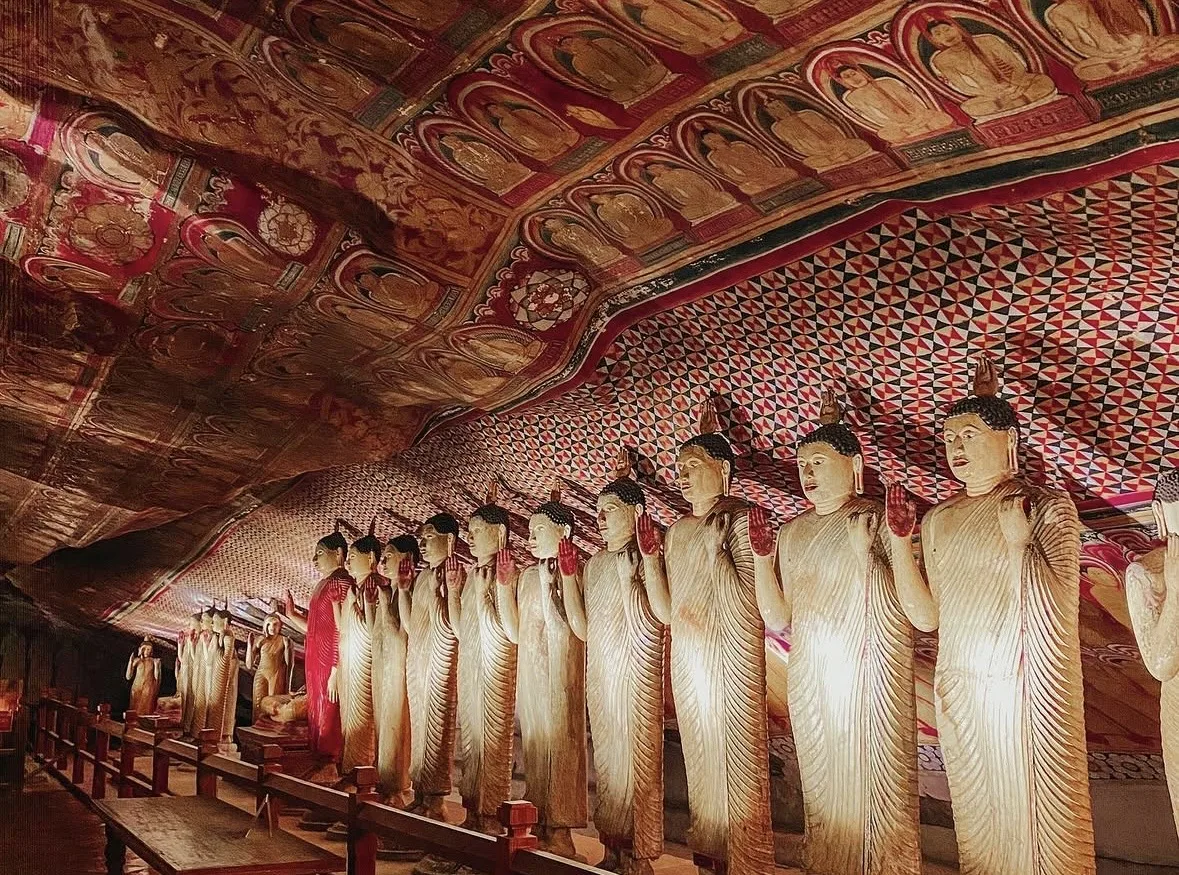
Two further sites carry the school at its height. Dambulla, the range of royal cave temples in the dry lowlands, holds a painted interior of the first rank: a row of gilded Buddha images along the base of the living rock beneath a ceiling worked edge to edge in lotus rosette and register, and the recumbent Buddha of the great passing laid the length of one wall; in a neighbouring cave stands the painted portrait-statue of Kirti Sri Rajasinha himself, one of the very few royal figures the school renders in a form we can name. At Hindagala, in the hills near Kandy, an older layer survives beneath the Kandyan work, a fragment of the classical age that binds the eighteenth-century revival to the ancient tradition it set out to renew.
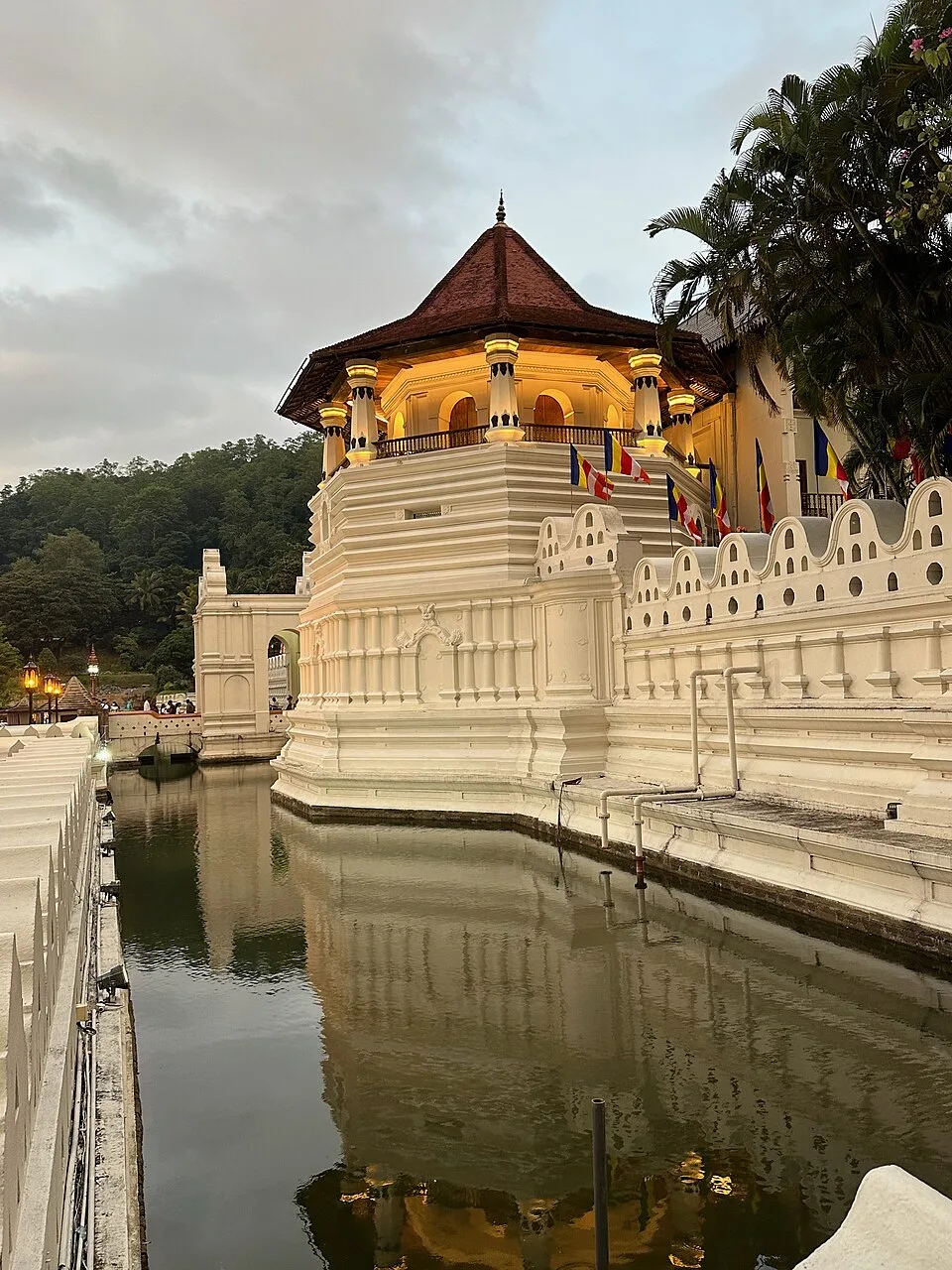
The last of the great names belongs to the end of the kingdom, and it belongs to a builder. Devendra Mulachari served three kings, and for the last of them, Sri Wickrama Rajasinha, he raised the works that still shape the face of Kandy: the Pattirippuwa, the octagon that stands out from the wall of the Temple of the Tooth; the cloud-wall, the Walakulu Bamma, that fronts the ornamental lake; and the audience hall of the palace. A Mulachari, the tradition held, must be master of five crafts at the least, and his monuments are as much built and carved as painted. The manner of his death has passed into legend: falsely accused over the king's timber and threatened with the loss of a finger, he is said to have drowned himself in the lake he had made, and to have been given a royal funeral once the truth was known.
The eve of the rupture
The school stood at the summit of its powers when the kingdom fell. In 1815 the British took the hill capital and deposed Sri Wickrama Rajasinha, the last king, of the South Indian Nayakkar line, carried off under the Kandyan Convention of 2 March that year to imprisonment at Vellore in southern India, where he died in 1832. With the court went the settled patronage that had sustained the Sittara for three generations; the collapse of the feudal landholding that followed the risings of 1818 and 1848 completed what the conquest had begun. The tradition itself endured. It moved, carried south to the harbour towns of the maritime provinces where a new commercial patronage was rising, and there it entered the long transformation, under Indian and European pressure at once, that remade it across the century that followed. The walls of the last kingdom remain the point from which that later art is measured, and the point at which the island's painting first learned to keep the names of those who made it.
Sources
- Ananda K. Coomaraswamy, Mediaeval Sinhalese Art, Broad Campden: Essex House Press, 1908 (full text, Internet Archive).
- Senake Bandaranayake, The Rock and Wall Paintings of Sri Lanka, Colombo, 1986 (revised edn with Gamini Jayasinghe, 2006).
- R.M.T. Rathnayaka, 'Unveiling the Intricacies of Artisanal Mastery: Central Kandyan Temple Mural Paintings', Vidyodaya Journal of Humanities and Social Sciences 10(1), 2025.
- D.S. Wijerathne, S.A. Ariadurai and N. De Silva, 'Drawing Composition Techniques Practiced in Kandyan and Southern School Art Murals', Open University of Sri Lanka.
- Asoka de Zoysa and Vajira Nalinda Jayathilaka, Buddhist Image Houses, Samkathana Research Team.
- Marie Gatellier, Peintures murales du Sri Lanka: école kandyenne, XVIIIe–XIXe siècles, Paris, 1991.
- Asoka de Zoysa, Vajira Nalinda Jayathilaka and Ganga Rajinee Dissanayaka, Evolving Traditions of the Buddhist Image House, Part I: Understanding Two Centuries of Art and Architecture in Sri Lanka, Samkathana Research Team, University of Kelaniya.
How to cite this essay
Malaka Talwatte, “The Kandyan School: Painting in the Last Sinhala Kingdom,” Malaka Talwatte: Sri Lankan Art and Ceylon Antiquaria, https://malakatalwatte.pages.dev/publications/kandyan-school/.
Quote and cite freely with attribution; please do not republish a whole essay, or a photograph, without permission.