Born in Kandy, Sri Lanka, in April 1901, George Perceivel Sproule Keyt (1901-1993) is one of Sri Lanka’s most distinguished and renowned modernist painters, as well as a poet and writer. His work encapsulates a fluid synthesis of Eastern and Western, Buddhist and Hindu, art and iconography. Keyt endures as Sri Lanka’s most celebrated visual artist and among the greatest Asian painters of the twentieth century. His extraordinary artistic creations have played a central role in the cultural life of Sri Lanka for over half a century and continue to do so to this day.
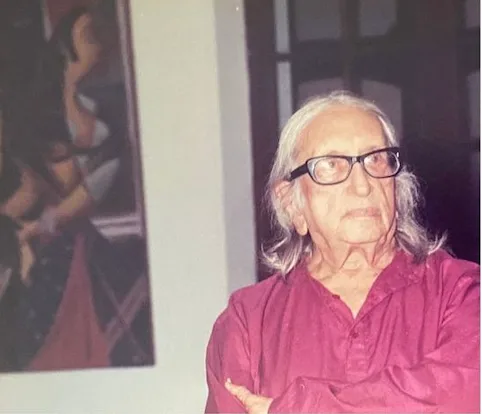
George Keyt’s earliest paintings belong to the mid-1920s, and it is estimated that he has in his lifetime produced over 12,000 paintings, drawings and sketches, as well as the murals of significant cultural and historical value at the Gothami Viharaya temple in Borella.
In June 1988, a group of his ardent admirers and close friends decided to establish the foundation in his name, headed by Cedric and Sita de Silva, to perpetuate Keyt’s legacy and preserve his work as part of Sri Lanka’s heritage. The foundation aimed to foster the development of Sri Lankan art and artists, promoting art, and to establish a gallery of Modern Sri Lankan Art. The George Keyt Foundation was subsequently incorporated on 13 June 1990 as a legal entity and a charitable trust, and Keyt himself witnessed its early years and significant contribution to the arts in Sri Lanka.
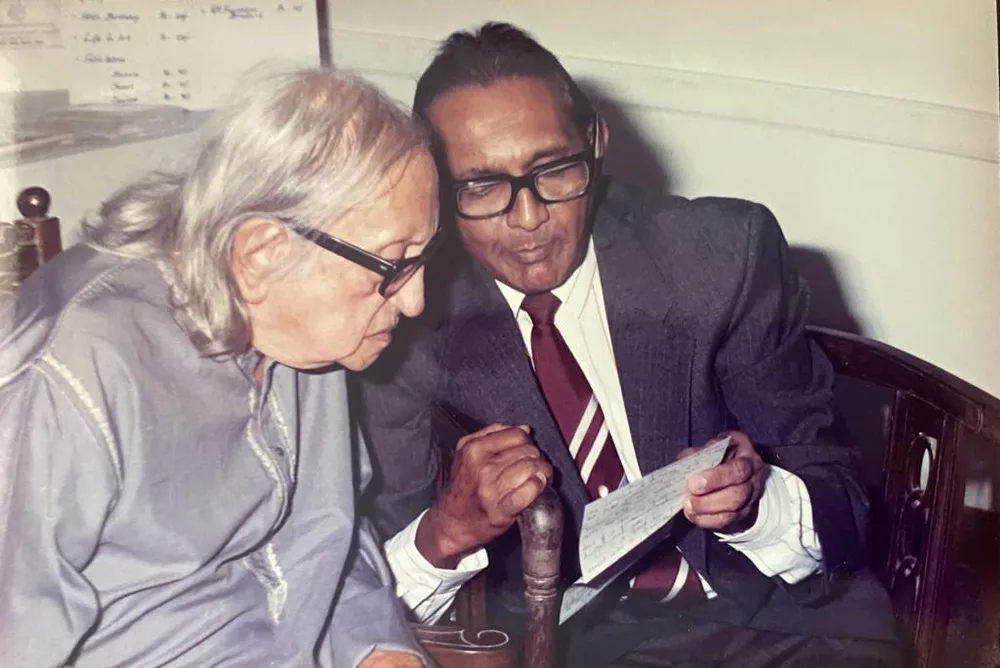
The George Keyt Foundation has engaged in advancing the arts and strengthening its revival since the 1980s by organising exhibitions and presentations of Sri Lankan paintings and sculptures, as well as individual exhibitions of Sri Lankan and overseas painters and exhibitions by SAARC painters. These opportunities supported the emergence of many artists over the years and provided opportunities for collaboration with global cultural bodies, giving emerging artists the opportunity to develop and present their work to a broader audience and the opportunity to be discovered. Along with the promotion of the arts, there have been several publications, including an anthology to commemorate George Keyt’s centennial in 2001, as well as writings translated into Sinhala and Tamil, catalogues of exhibitions, and facsimile reproductions to provide more exposure for artists.
Over the years, the foundation has led many initiatives such as Young Contemporaries from 1991, for artists below forty years of age. Sculpture and Painting, now named Sri Lankan Art to include senior artists by invitation, has been held annually since 1991. Kala Pola, an open-air art fair, was presented initially in 1993 and annually thereafter other than in 2001 and 2007. Nawa Kalakaruwo, which commenced in 1994, is an annual exhibition presenting new and emerging art from both established and emerging artists.
A further achievement of the George Keyt Foundation was the rehabilitation of the Gotami Vihara Shrine Room, the walls of which have George Keyt’s murals of over 70 years titled ‘The Life of Lord Buddha’. The George Keyt Foundation has been generously assisted in these achievements by the several sponsors and institutions who have supported the foundation over the years, some who continue to do so year after year, and who have made it possible to achieve all of the above, and have earned the very sincere gratitude of Sri Lankan painters and sculptors.
A vast number of Keyt’s paintings of the period 1926 to 1952 were taken to New Delhi in 1953 for an exhibition organised by the All India Fine Arts and Crafts Society in association with the renowned Sri Lankan art collective ’43 Group. The exhibitions were thereafter transferred to Bombay, where an incalculable misfortune befell these paintings at the Victoria Warehouse where they were being stored. Most of the paintings were destroyed and damaged in a fire. The exhibition in Bombay did not take place as planned. The artwork that remained was then transported to London for the next exhibition by the Institute of Contemporary Art in London in January 1954. The exhibition was supplemented by a number of artworks from collections in London. Apart from a brief stop in Holland for an exhibition held in the same year by the Art Institute of Rotterdam, these valuable paintings remained in London under Keyt’s much-devoted and beloved friend Martin Russell’s care.
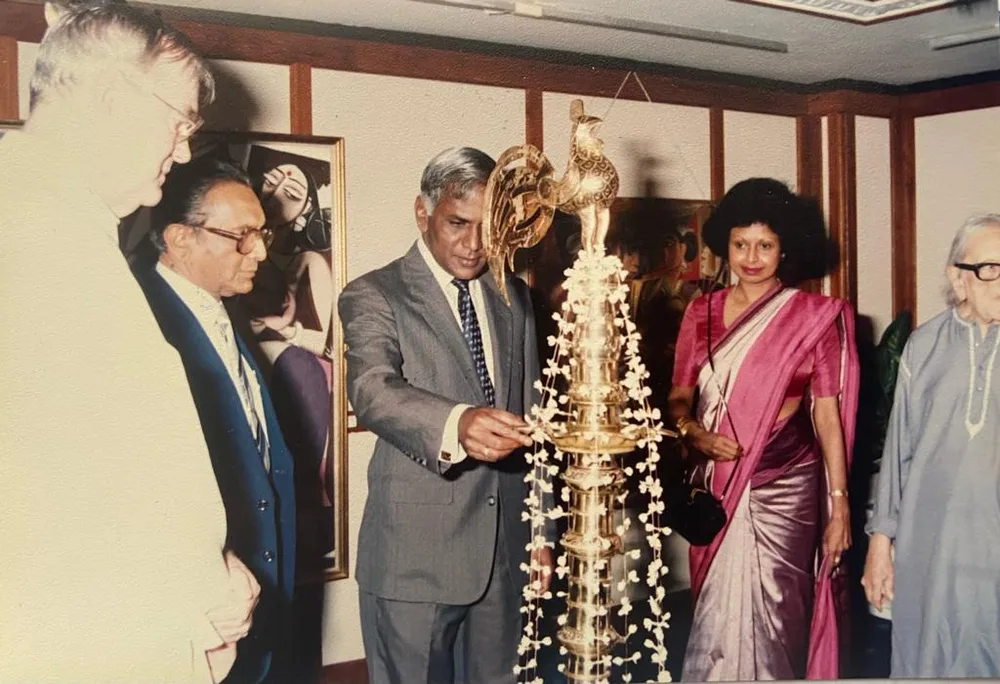
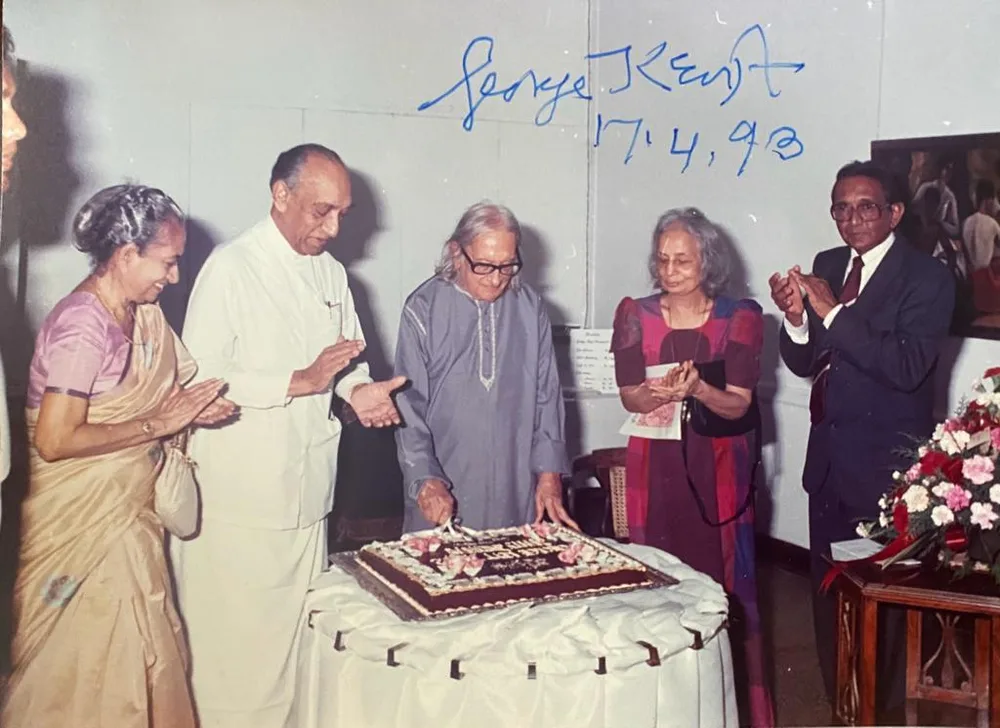
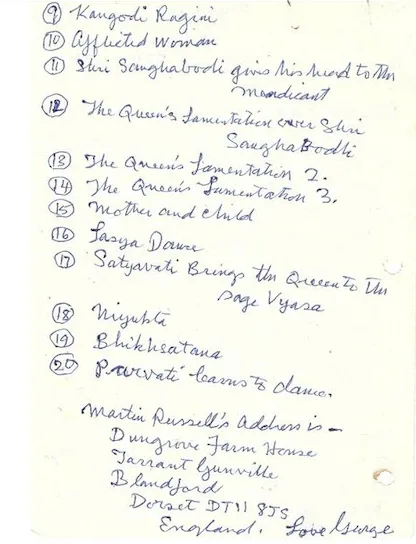
In July 1988, as soon as the George Keyt Foundation was established, George Keyt decided to donate 21 of these paintings to the foundation as a nucleus for a proposed George Keyt Gallery. He requested Russell to send all the paintings he had entrusted with him to the foundation. After an extensive process of negotiations for the release of these paintings from storage, packing and transport freight to Sri Lanka, these paintings took nearly 40 years to return to the country, in time for an exhibition celebrating George Keyt’s 90th birthday. The exhibition of Keyt’s paintings was held at the Lionel Wendt Gallery in Colombo, with support from the John Keells Group, and inaugurated by the then President of Sri Lanka, J.R. Jayewardene.
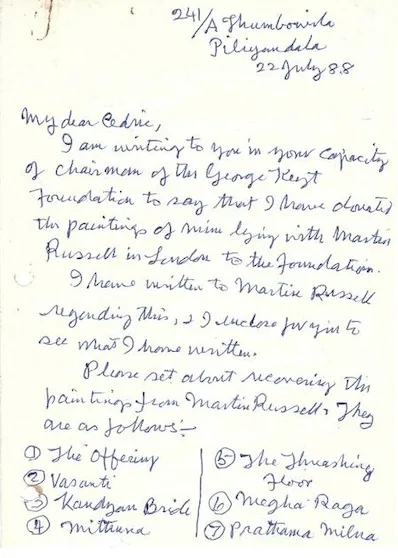
In a letter to Russell from Piliyandala in December 1988, as referenced in Buddha to Krishna: Life and Times of George Keyt by Yashodhara Dalmia (2016), George Keyt wrote,
As I had donated my pictures to the foundation since they are making a gallery and you have with you some of the best of my work and since I now have no pictures in what was my own collection, and since very few people will be willing to donate from their collection; I naturally want you to send to Cedric de Silva … the pictures of mine with you.
With regard to the request made by George Keyt, the chairman Cedric de Silva circulated copies of two letters addressed to Martin Russell and to Sri Lanka’s High Commissioner in the UK in August 1989. The foundation had then informed Martin Russell to arrange for the 21 paintings donated to the foundation by George Keyt to be handed over to Sri Lanka’s High Commissioner in London. With the assistance of the trustees of the George Keyt Foundation at the time, namely Cedric de Silva (chairman), Justice Percy Colin-Thome (vice-chairman), Srimani Athulathmudali, Sam Elapata, Professor Ashley Halpe, Professor Cyril Ponnamperuma and Gilbert Sheinbaum, a public appeal was initiated on 1 February 1991. This ensured that the paintings which had been in London were successfully returned to Sri Lanka. With the support from Air Lanka Ltd, the Insurance Corporation of Sri Lanka, DHL International, and most importantly John Keells Holdings Ltd and its chairman at the time Ken Balendra, who spearheaded the campaign, the collection returned to the country intact.
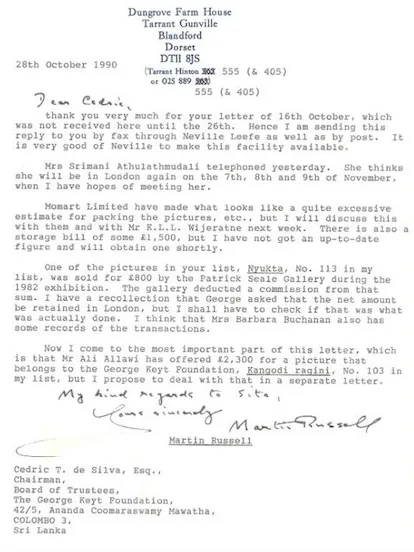
The fourteen paintings and six drawings arrived at the Katunayake International Airport in Sri Lanka on an Air Lanka flight, UL 504, from London Gatwick Airport on Monday 8 April 1991. Of the 21 works that were to be returned, one was sold at a gallery in London, and only 20 paintings returned to Sri Lanka. This could well have been 19 too, as one of the most important paintings from the collection, ‘Kangodi Ragini’ (1951), was under offer from a wealthy London-based Middle-Eastern banker who was an avid collector of Keyt’s work. A request to enhance the initial offer was also heeded by the banker, but fortunately for the foundation, it was finally decided that this painting should remain part of the trust’s collection.
‘Kangodi Ragini’ (a mode in Indian music) is the largest painting in the foundation’s collection, and arguably one of its finest, as its vivid colours and modernist figures brilliantly represent Keyt’s strokes of genius. All these paintings were displayed at the Lionel Wendt Gallery in Colombo at a retrospective exhibition honouring George Keyt’s 90th birthday from 17-21 April 1991. In 1992, the paintings were installed at the Walker Tours Building of the John Keells Group. Given that only 20 of the paintings that were originally bequeathed returned to Sri Lanka, Keyt donated another painting, aptly named ‘The Friends’ (1982), to fill this void.
As the foundation did not have a gallery or a space for its collection of George Keyt’s paintings at the time of its return to the island, Ken Balendra, the then Chairman, and the board of the John Keells Group generously agreed to maintain the paintings and later housed them at their Glennie Street premises.
Unfortunately, as the John Keells Group had to shift its premises from Glennie Street due to a planned large-scale development project, disaster struck on 13 July 2013 as two masterpieces by George Keyt, named ‘Mother and Child’ (1953) and ‘Vasanti’ (1950), went missing. To this day, an investigation led by the Criminal Investigation Department of the Sri Lanka Police Service has been unable to identify the perpetrators of this heinous crime. Due to this incident, the George Keyt Foundation’s collection has been reduced to 19 paintings.
Martin Russell was a connoisseur and art critic based in Dorset, England, who spent several post-Second World War years between Sri Lanka and India. Born in 1918, he served as private secretary to Duff Cooper during the Second World War, before embarking on a career as an investment banker, and he is remembered as the patron of the ’43 Group and George Keyt’s works.
After being sent from Singapore shortly before it fell to the Japanese in February 1942, Russell found himself in Ceylon. There he was posted as a sergeant in the British Army, before being transferred in 1944 to Headquarters Land Forces South East Asia at Kundasale, near Kandy. The hill country had become the nerve centre of the war in Asia that year, for in April 1944 Lord Louis Mountbatten moved the headquarters of his South East Asia Command to the botanical gardens at Peradeniya, a few miles from Kundasale. Since Russell’s parents had been in Ceylon in 1939 and knew people there, he was introduced to Colombo society without much effort. Here, he met Jerry Naidoo, a proctor, and Hilda Naidoo, a pianist. Through them, he met the pioneering modern photographic artist Lionel Wendt, who sought legal advice from Jerry and also taught music to Hilda.
Yashodhara Dalmia cites in her book an account by Martin Russell from Colombo in April 1998 on their meeting:
Hilda and Jerry took me to see Lionel Wendt at 18 Guildford Crescent, opposite the Museum, where the army employed me as cipher officer. … I was not entirely ignorant of modern art. My father’s family, the Russells, had made [a] collection of paintings for centuries, but regarded modern art as incomprehensible or absurd. … so when in Lionel Wendt’s glorious sitting room I saw two magnificent oil paintings, Nara Narayana by George Keyt, and Homage to El Greco by Ivan Peries, I was smitten.
The year 1943 was a seminal one for Sri Lankan art as well as for George Keyt. When Lionel Wendt presented the ’43 Group’s first exhibition in Colombo in November 1943, Martin Russell not only met Keyt at the exhibition’s opening but was captivated by Keyt’s work, a genius who had evolved his own stylistic vision, unlike anything Russell had previously encountered. Russell bought several of George Keyt’s works and he continued to collect Sri Lankan paintings throughout his lifetime.
From April 1995, in Martin Russell’s notes for Manel Fonseka about Lionel Wendt, referenced in Yashodhara Dalmia’s book, he writes:
At that time I did not quite understand Keyt’s work, because it was so non-European, but another member of the ’43 Group, George Claessen, now living in London, pointed out to me that Keyt’s work had a ‘poetic’ quality. The word ‘poetic’ used by Claessen has been embedded in my memory ever since. I bought all the Keyts in the show, except one, The Journey, which I was told Lionel Wendt himself wanted to buy.
In 1946, Russell returned briefly to England to begin writing his book The Art of George Keyt. This brilliantly illustrated monograph, which consisted largely of paintings from his own collection, was eventually published by Marg in Bombay in 1950. The book remains to this day the most comprehensive account of Keyt’s work.
Martin Russell would go on to acquire the finest and unsurpassed collections of George Keyt’s work, which accompanied him back to England for exhibitions and publicity. These remained with Russell for several years. He continued to promote Sri Lankan art in London and was involved in setting up many exhibitions at galleries in London, Oxford, Cambridge and Paris. He was helpful to George Claessen and Ivan Peries of the ’43 Group when they were working in London, offering patronage to the group and encouraging the exhibition of their work.
Keyt met Russell as a 42-year-old fully-fledged painter living in a village near Kandy, and would look upon Russell as his closest friend for over 40 years. Keyt held Russell in thrall as he continued to be a great friend, patron and frequent visitor to Keyt and Menike’s home at Sirimalwatta, meeting often in the years between 1943 and 1953. Their closeness can be gauged from the fact that Keyt wrote to him frequently from Sri Lanka and turned to him during difficult times, particularly in his later years.
Russell writes on the trajectory of Keyt’s art,
In the accounts that are offered to us of new scientific discoveries, we often find that an element of accident plays a great part. When Galileo first turned his telescope on the planet Jupiter, he did not do so with the expectation of finding it encircled by its own moons, and thus decisively refuting the option that the world is the centre of all. Nor did Keyt foresee that when the calligraphic freedom of his line was accentuated beyond a certain limit it would, like a rising river, burst all previous restraints and carry him away to new lands of imagination and sensibility.
As a long-time patron of Keyt’s work, Russell remained passionate and active in the promotion of Keyt’s works until the end. Russell’s devotion to the arts in Sri Lanka, in particular that of George Keyt’s, was intuitive and perceptive beyond his time, when it was unheard of to appreciate art beyond the Euro-American centre. Not only did Russell succeed in drawing attention to Keyt’s works but also to the art and culture of the Subcontinent.
These paintings of significant importance by George Keyt, which traversed an immense and arduous journey to and from Sri Lanka, will continue to draw admirers of Keyt worldwide to the island.
The net positive result of this odyssey is that some of George Keyt’s most brilliant and celebrated works have been returned home and will continue to be a source of study and inspiration to local and regional artists, scholars and the wider public. With time, the hope is that the paintings will energise the efforts of the foundation to form a catalogue raisonné of George Keyt’s artwork, enabling museums and collectors worldwide to establish the work done during Keyt’s lifetime. The foundation hopes that ongoing and new activities planned in turn will support and inspire emerging artists to reach new heights of artistic achievement that parallel George Keyt’s. A further wish of the foundation is to create a viewing space at the Gothami Viharaya temple to make Keyt’s frescoes accessible to a wider public, reaffirming the vision to perpetuate Keyt’s legacy and preserve his work as part of the country’s national heritage.
The journey of the paintings, like the ‘rising river’ of George Keyt’s works Russell describes, will continue to defy all restraints and carry forward the new possibilities of Keyt’s imagination and sensibility across Sri Lanka and beyond.
Sources
- Yashodhara Dalmia, Buddha to Krishna: Life and Times of George Keyt (2016).
- Martin Russell, The Art of George Keyt (Bombay: Marg, 1950).
How to cite this essay
Shwetha Srikanthan and Malaka Talwatte, “The Odyssey of 21 Paintings of George Keyt,” Malaka Talwatte: Sri Lankan Art and Ceylon Antiquaria, https://malakatalwatte.pages.dev/publications/odyssey-of-21-paintings-of-george-keyt/.
Quote and cite freely with attribution; please do not republish a whole essay, or a photograph, without permission.