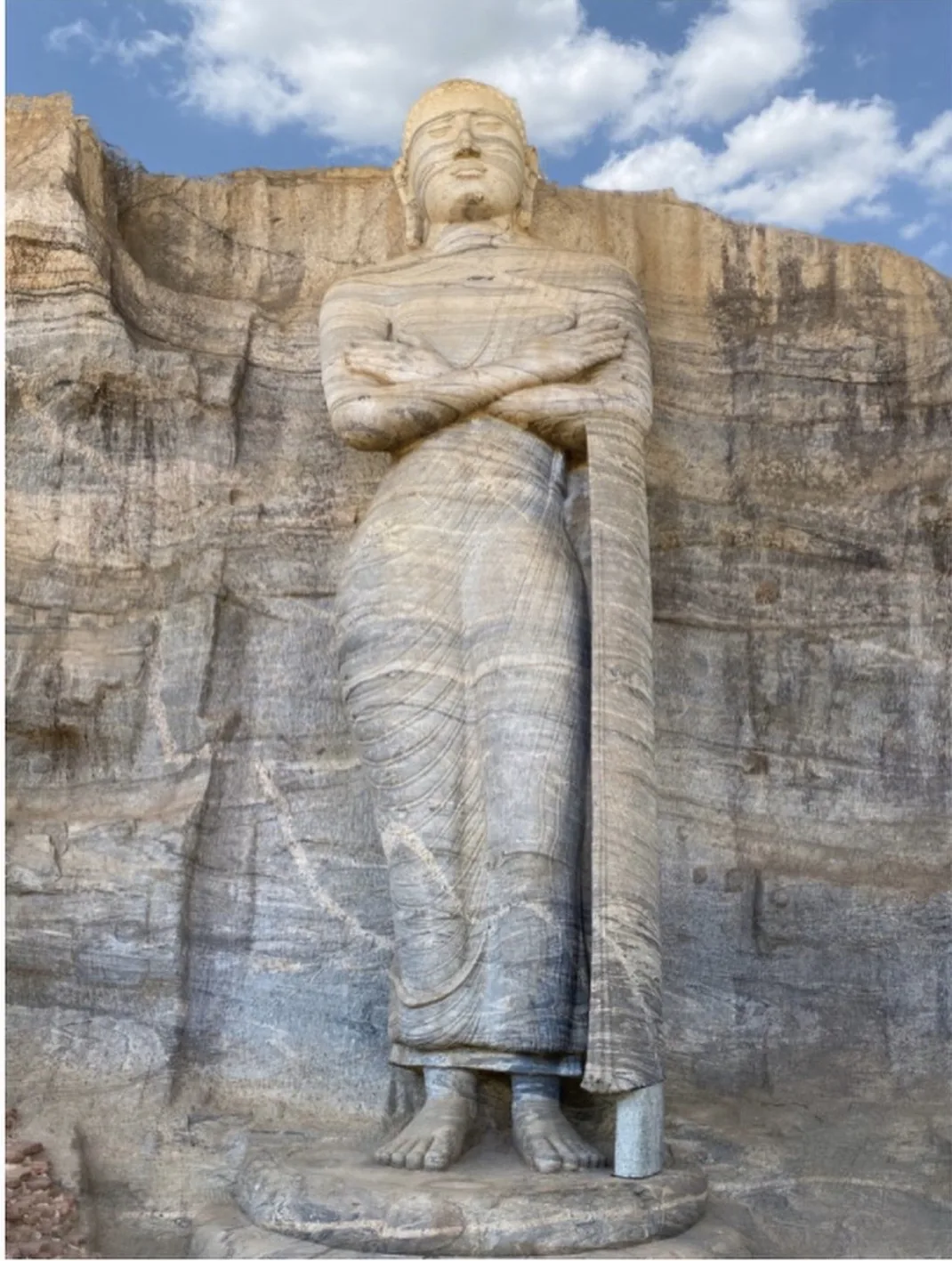
From a single large rock of granite at Polonnaruwa, Sinhalese carvers cut four figures of the Buddha and made of the whole outcrop one shrine. The Gal Vihara, as the place is now called, is the best-known work of the island’s second capital, and it stands for what Polonnaruwa was: the city that rose when Anuradhapura fell, and that in less than two centuries produced the finest sculpture the Sinhalese ever cut in stone, together with the last great flowering of their classical painting.
The city that followed Anuradhapura
For close to a millennium and a half the seat of Sinhalese kingship had stood at Anuradhapura, in the dry plain of the north. That long rule ended at the turn of the eleventh century, when the Chola empire of southern India invaded, defeated the reigning king Mahinda V and held him prisoner in India. The Chola then ruled the island from Polonnaruwa. The town lay lower down the Mahaweli river system, and it was the better base from which to hold the whole country: it commanded the river crossings and the road to the south, from which Sinhalese resistance came, and it stood clear of the exposed old capital. The Chola governed from it for something over half a century, until King Vijayabahu I drove them out in the later eleventh century; he kept the site rather than rebuild the ruined north, and Polonnaruwa became the capital of the restored kingdom.
The city owes its greatness to three kings. King Vijayabahu I won back the island and reunited it under one crown, and revived a Buddhist order so weakened under Chola rule that he sent to Burma for monks to restore a valid line of ordination. The kingdom fell into division again after his death, and it was King Parakramabahu I, who ruled through the middle of the twelfth century, who brought it back under a single rule; he built the vast irrigation lake, the Parakrama Samudra, the sea of Parakrama, and raised the monasteries, image-houses and palaces whose ruins fill the site today. King Nissankamalla, who came to the throne within a generation of Parakramabahu’s death, built and inscribed on the same scale, and had his name and his good deeds cut into stone across the city and at shrines far beyond it. Nearly all the art of Polonnaruwa was made under these three kings, in workshops that a rich and confident court could keep at work.
The image-houses built like vaults
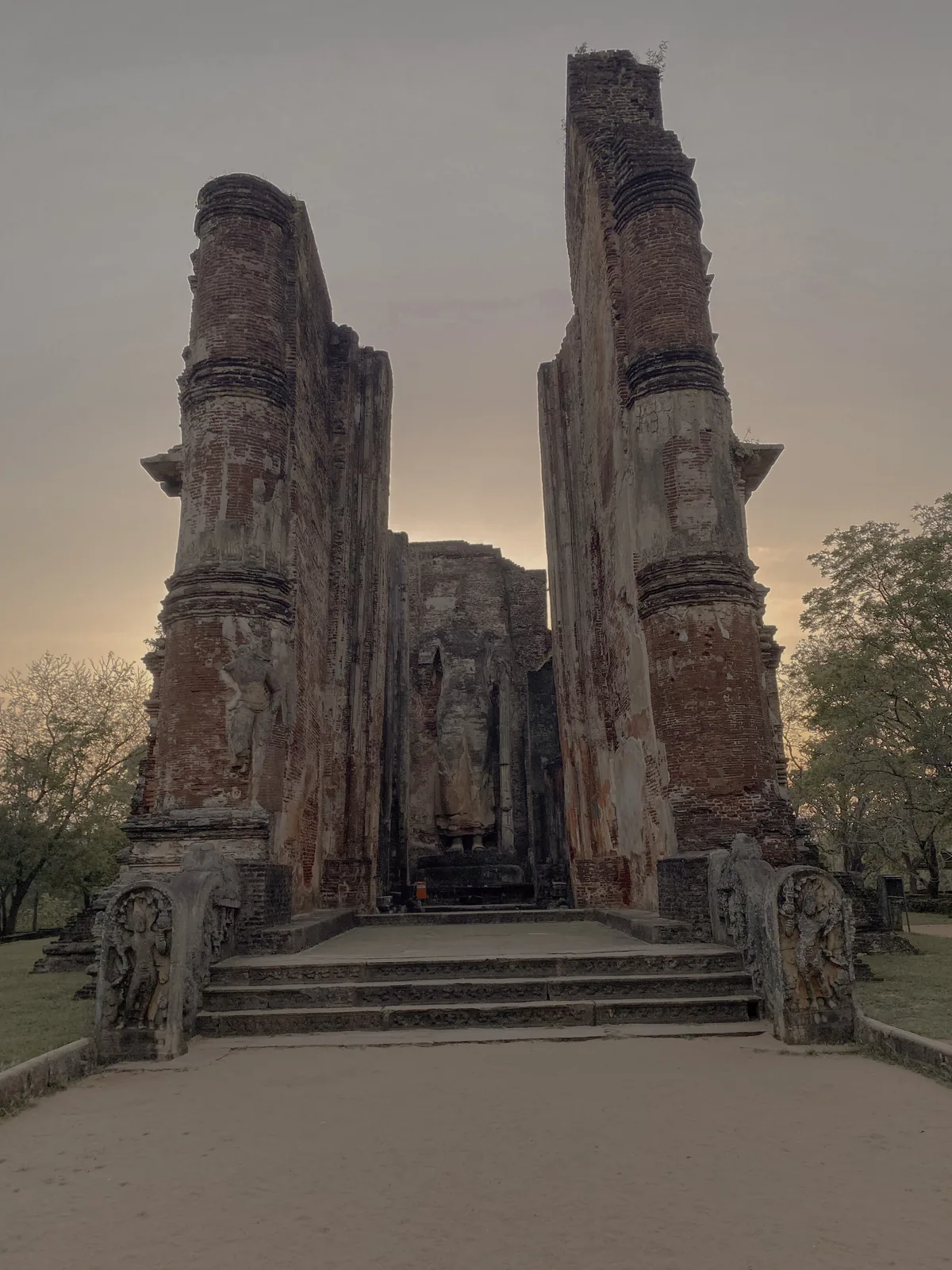
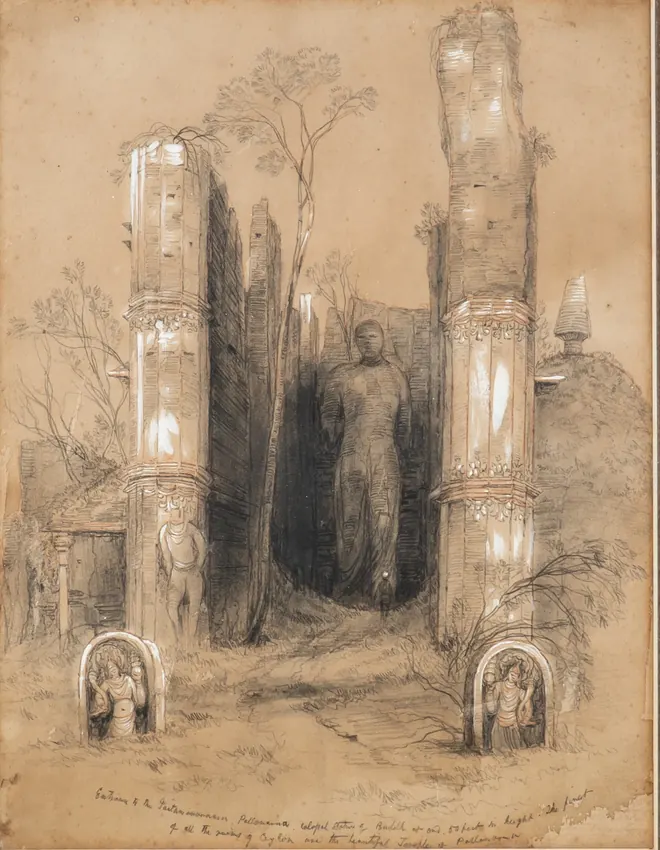
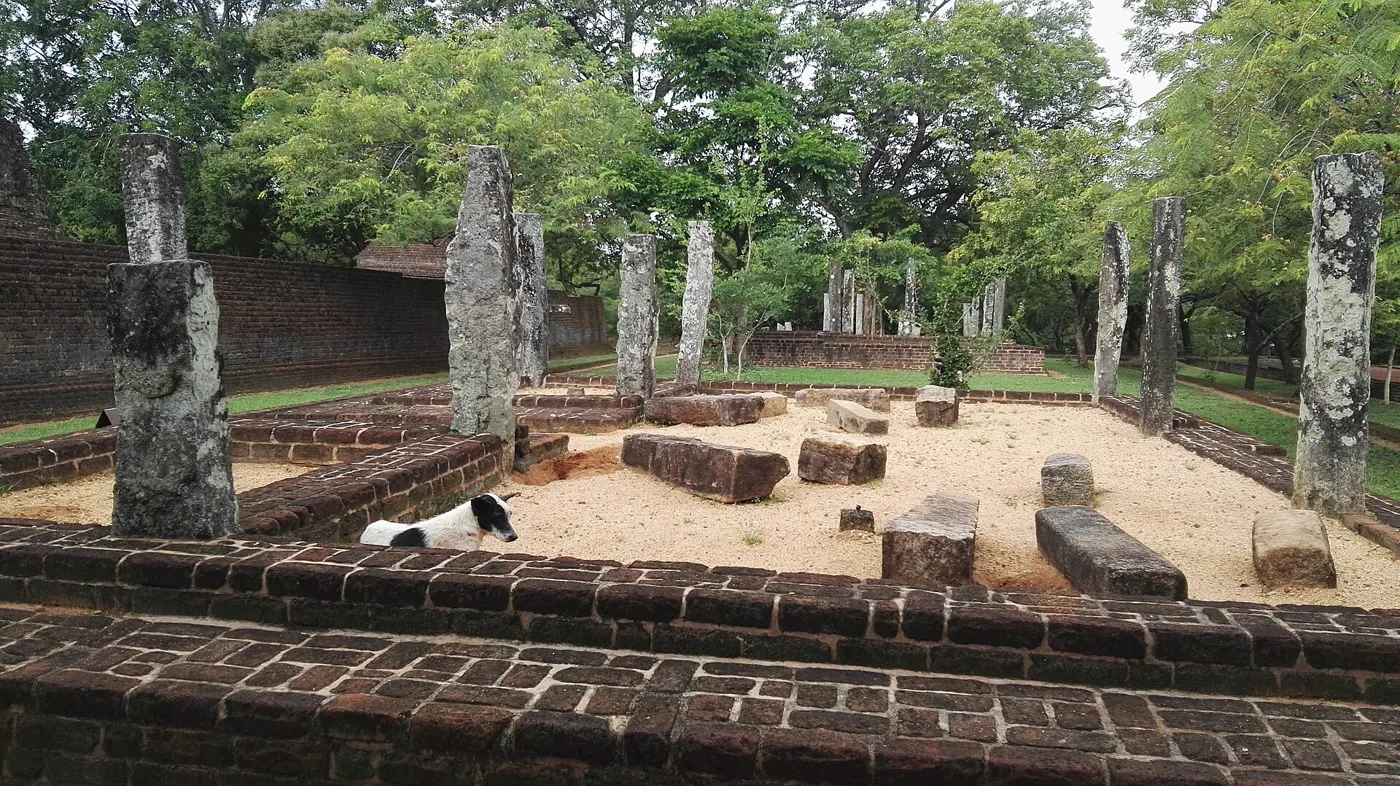
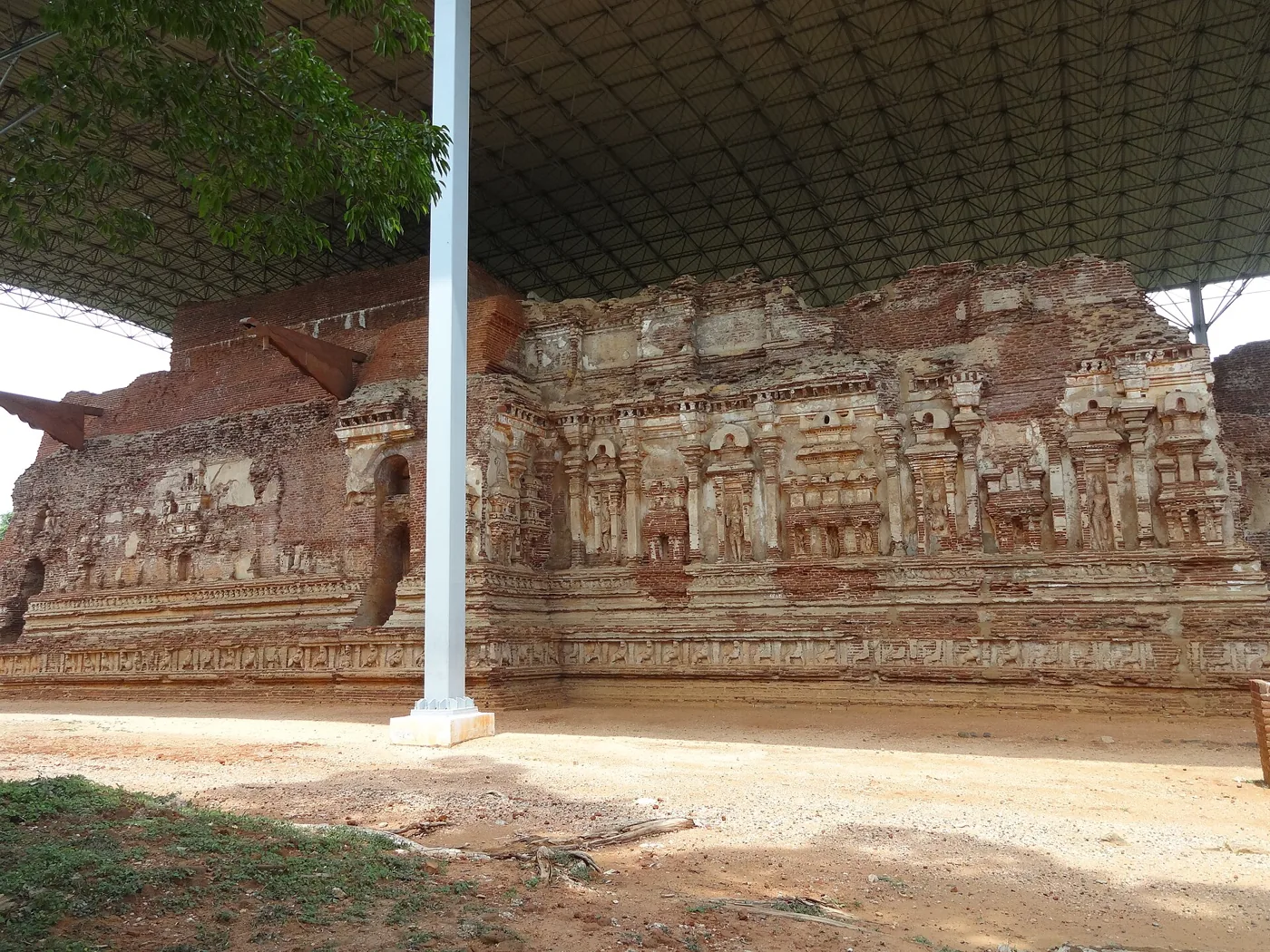
The most distinctive building of the period is the gedige, the Sinhala name for a Buddhist image-house raised wholly in brick and roofed with a great brick vault in place of the usual timber and tile. Its Pali name, ginjakavasatha, means simply the brick house. To bear so much weight overhead the walls were built massively thick, and the roof was turned in brick, each course stepped a little further inward than the one below until the two sides met over the shrine. Three of these buildings show the type at its height: the Thuparama, whose vault still stands and which is the best preserved image-house of the age; the Tivanka; and the Lankatilaka, the largest of the three.
The Lankatilaka, part of King Parakramabahu’s great monastic college the Alahana Pirivena, was built to stand about a hundred feet high, and even in ruin its two great brick pylons still rise some fifty-five feet, open to the sky now but once closed by a vault of carved and interlocking stone. Between them stands a brick-and-plaster Buddha about forty-two feet tall, the head now lost, the downcast gaze once set with gems that caught the light from the doorway. The walls inside and out were plastered and painted in the earth colours of the old craft, reds and yellows and a blue, ground from leaf and bark, resin and honey, coloured earth and stone. At the foot of the entrance steps lies the balustrade-end called the korawakgala, carved as a makara, the auspicious dragon of Sinhalese ornament that is drawn from many creatures at once: the trunk of an elephant, the jaws of a crocodile, the feet of a lion, the eye of a monkey, the ears of a mouse and the tail-feathers of a peacock. The worshipper is said to have venerated the Buddha first at the level of the head, from the upper storey, before descending to the feet and leaving the shrine walking backwards, so as never to turn the back on the Buddha.
The great stupas and monasteries
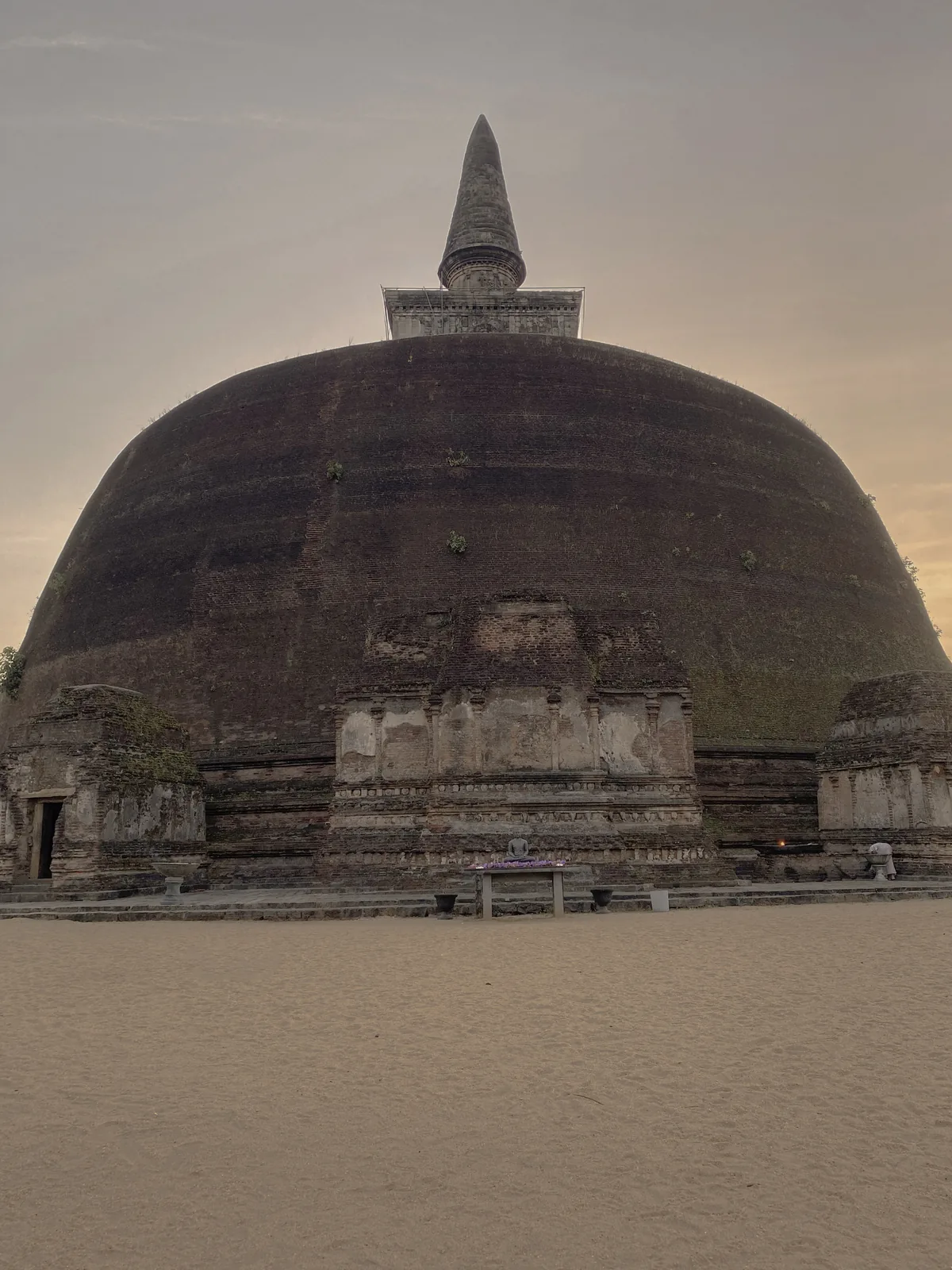
The city kept the old form of the dagaba, the solid brick dome raised over a relic, and built it once more on the grand scale. The largest is the Rankot Vehera, the Ratnamali stupa raised by King Nissankamalla in the manner of the great domes of Anuradhapura, more than a hundred feet high, with four ayaka frontispieces at the cardinal points and its dome carried, in the old Andhra manner of the mainland, on a solid cube of brick at the core. The Kiri Vehera nearby is smaller and so well preserved that much of its original white plaster still holds. Grandest in ambition was the Demala Maha Seya, begun by King Parakramabahu I on a scale that would have made it the largest stupa in the land and left unfinished; its vast brick mound stands in the forest still, a measure of the reach of the age as much as of what it completed.
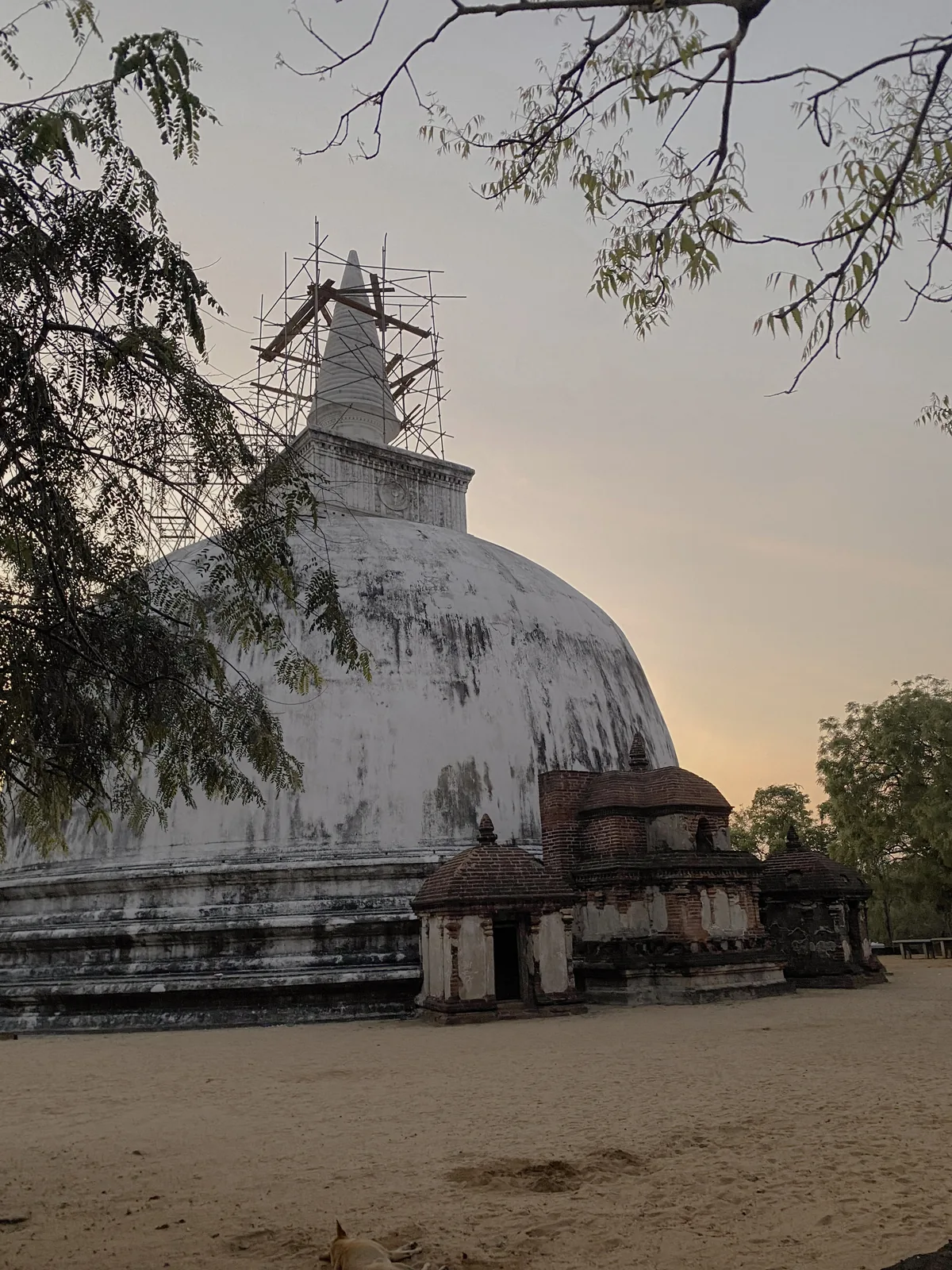
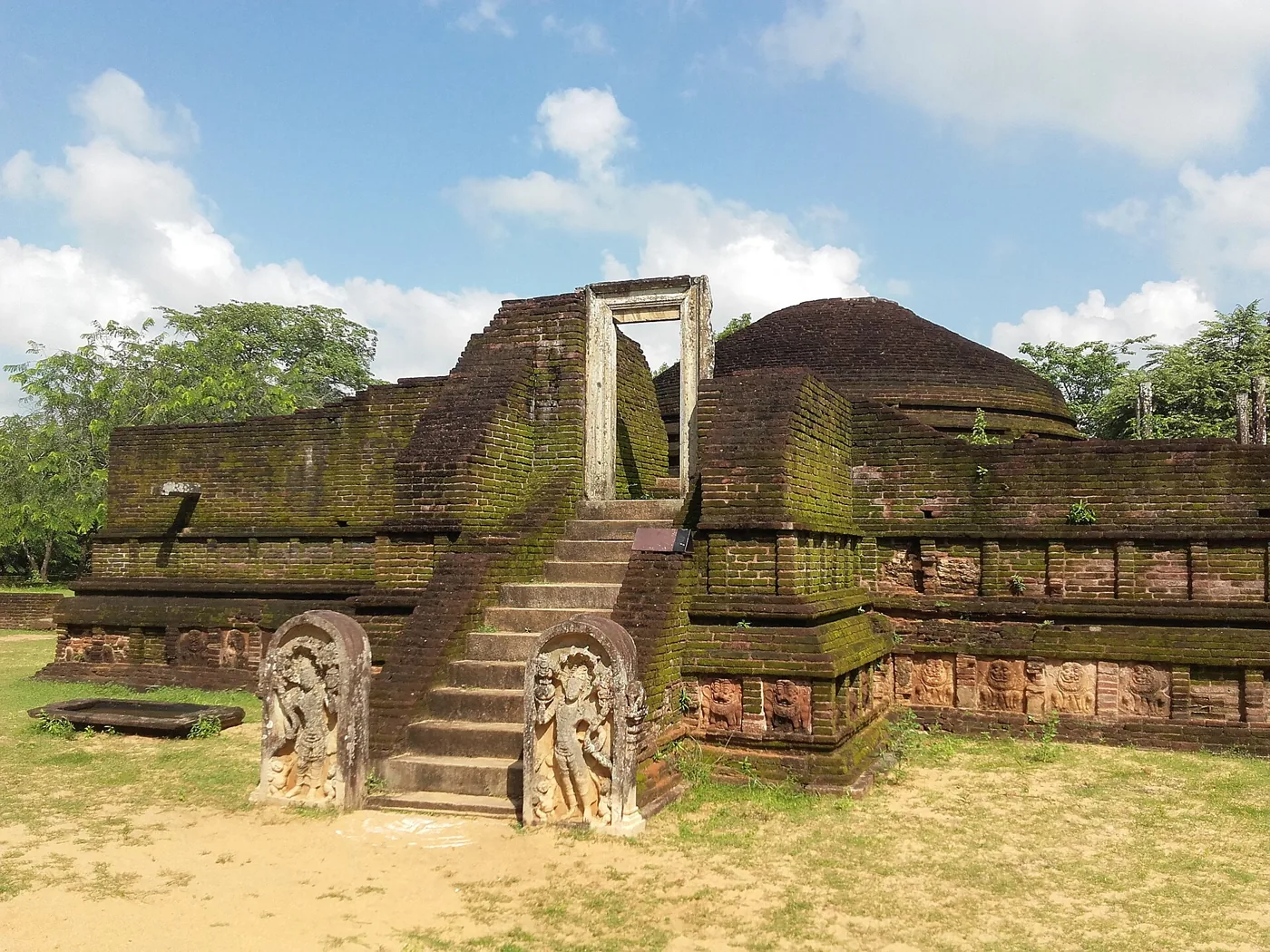
Two further complexes belong with these. The Pabalu Vehera, north-east of the Sacred Quadrangle, is a stupa of the rounded ‘bead’ shape that gives it its name, raised, tradition holds, by Rupavati, a queen of Parakramabahu, though the relics sealed in its chamber carry the foundation back to the last years of Anuradhapura; beneath the dome the builders set a yantragala, a stone of nine compartments holding the four guardian animals of the gods Indra, Yama, Varuna and Kuvera and an invocation to the bodhisattva Avalokitesvara, a small diagram of the ordered cosmos laid at the axis of the mound. The Manik Vehera, north of the rampart, is a terraced monastery of two ages, the eighth or ninth century and the twelfth; its image-house was guarded by squat terracotta lions, their heads still ringing the base, and once held three standing Buddhas, of the past, the present and the future, after the manner of the older shrine at Medirigiriya.
The king’s city
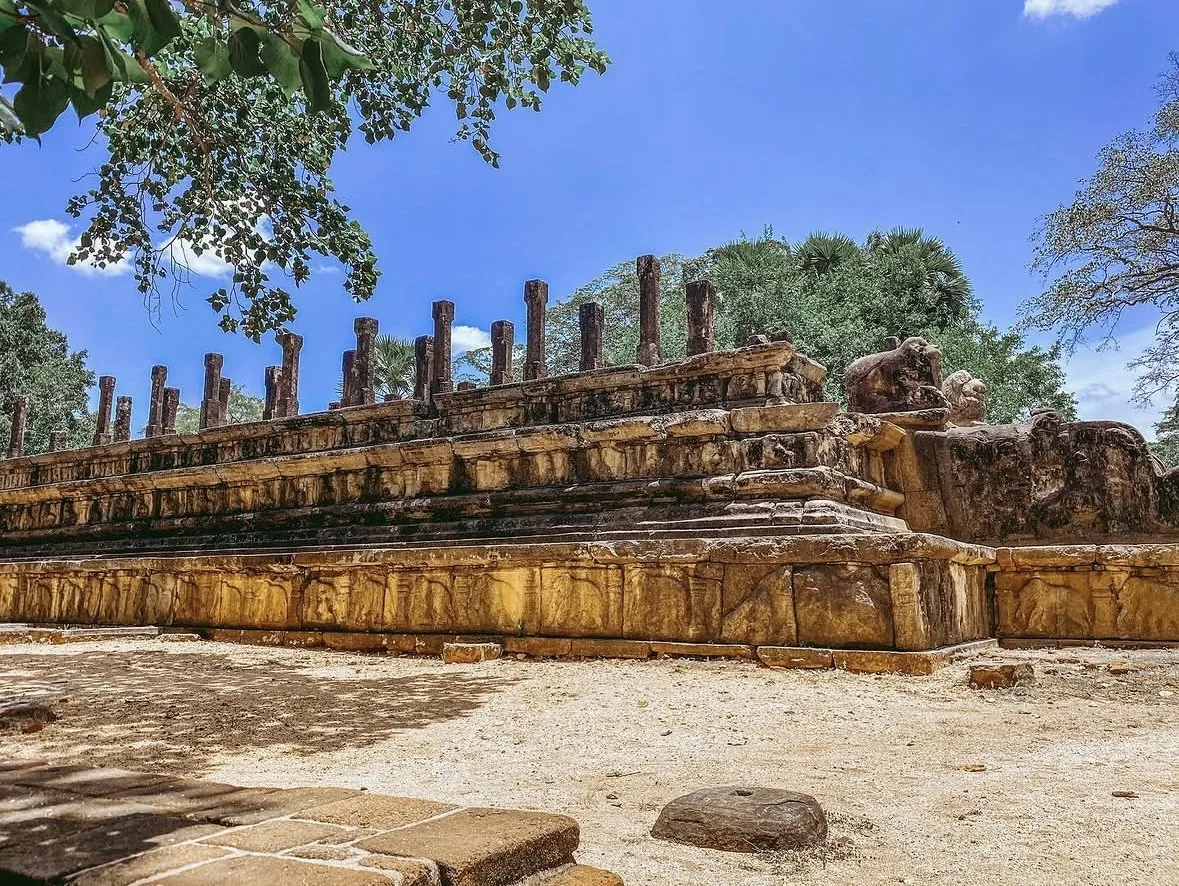
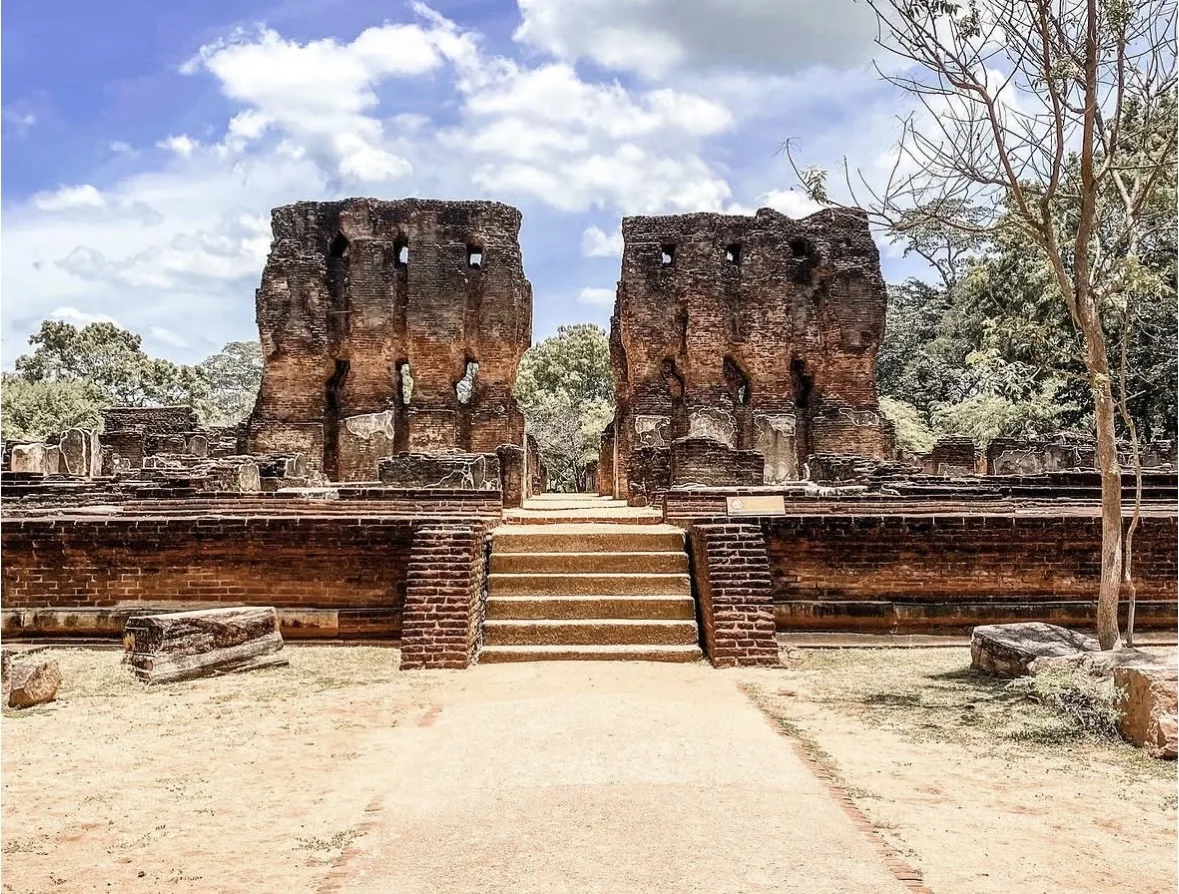
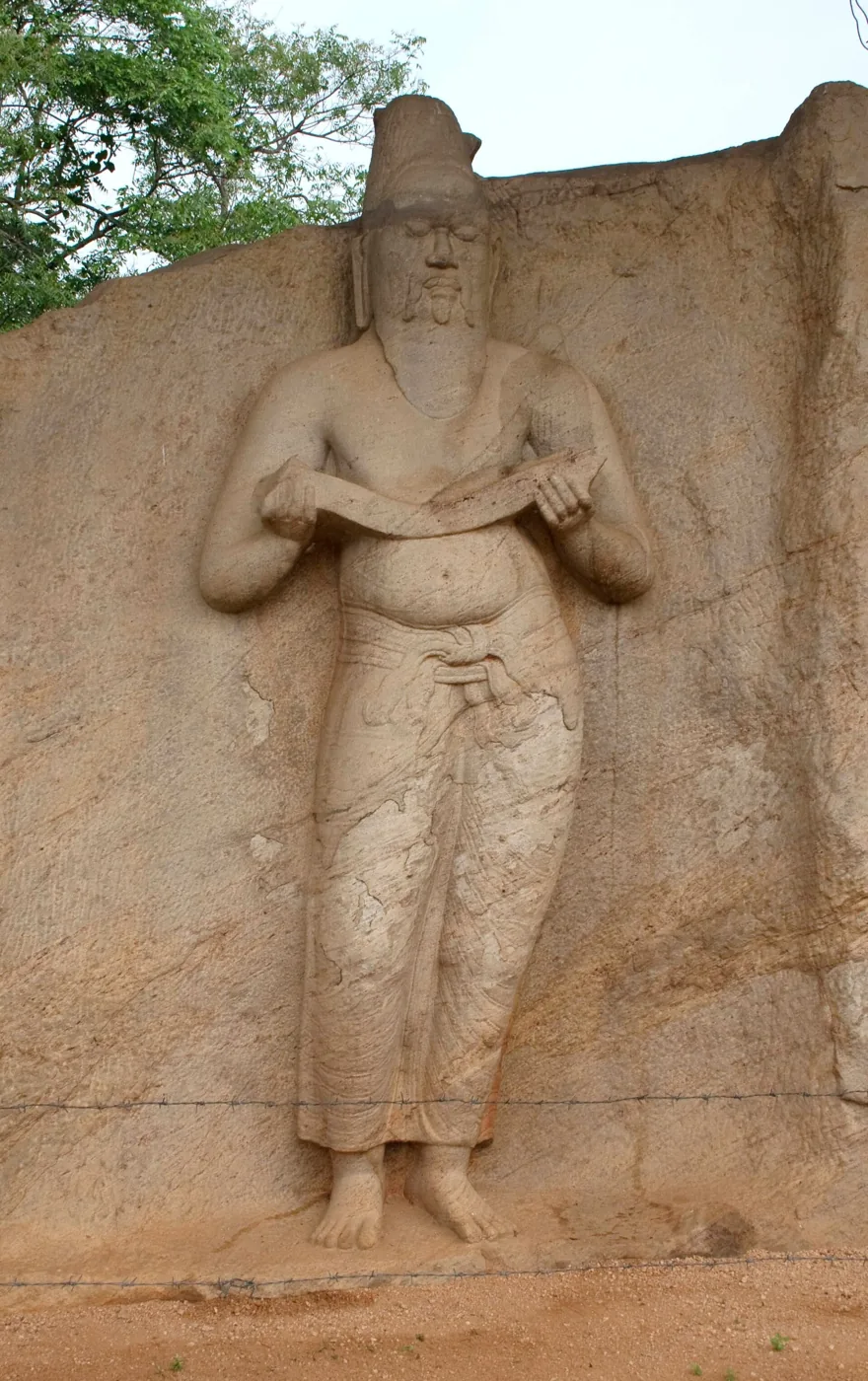
Two buildings speak for the secular city beside its shrines. The council chamber of King Parakramabahu I, its name fixed by an inscription on the slab at the head of its steps, was the Raja Vaishyabhujanga Mandapaya, the hall where the king sat in council. It rose in three receding tiers faced with carved stone, the topmost carrying a roof of timber and tile on stone pillars; the form that survives may owe something to a renovation of the thirteenth century, when the kings of Dambadeniya briefly tended the old capital. Grander still was the king’s own royal palace, the Vaijayantha Prasada, named after the heavenly hall of the god Sakra. It is said to have risen seven storeys of brick and timber and to have held the king’s queens within it; much of the timber is long gone, yet its great brick walls still stand, part of the ruin the Kalinga invader Magha left when he stormed and sacked the city early in the thirteenth century. At the southern edge of the city, by the round brick library-shrine called the Potgul Vehera, the Dharmadhatu or house of the doctrine, a tall figure is carved from the rock, a bearded man holding what seems to be a palm-leaf book, known by tradition as King Parakramabahu himself or as the sage Pulasti, and standing, either way, for a court that built in stone and thought in books.
The Gal Vihara: four Buddhas from a single rock
The masterpiece of the age is the Gal Vihara itself. In its own day the rock and its shrines were the Uttararama, the northern monastery of Parakramabahu’s city, and the four figures were divided among separate shrines cut and built along the one outcrop. Three of them are colossal, the standing and the reclining and the larger of the two seated Buddhas; the fourth, in its cave, is worked on a smaller scale. Together they are the summit of Sinhalese sculpture, the stone handled with a confidence the island never surpassed.
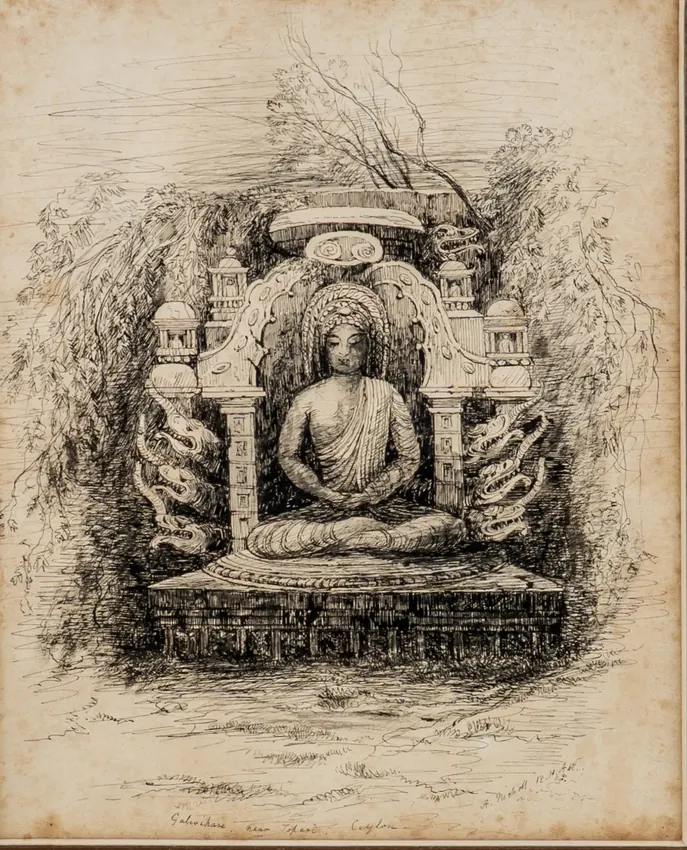
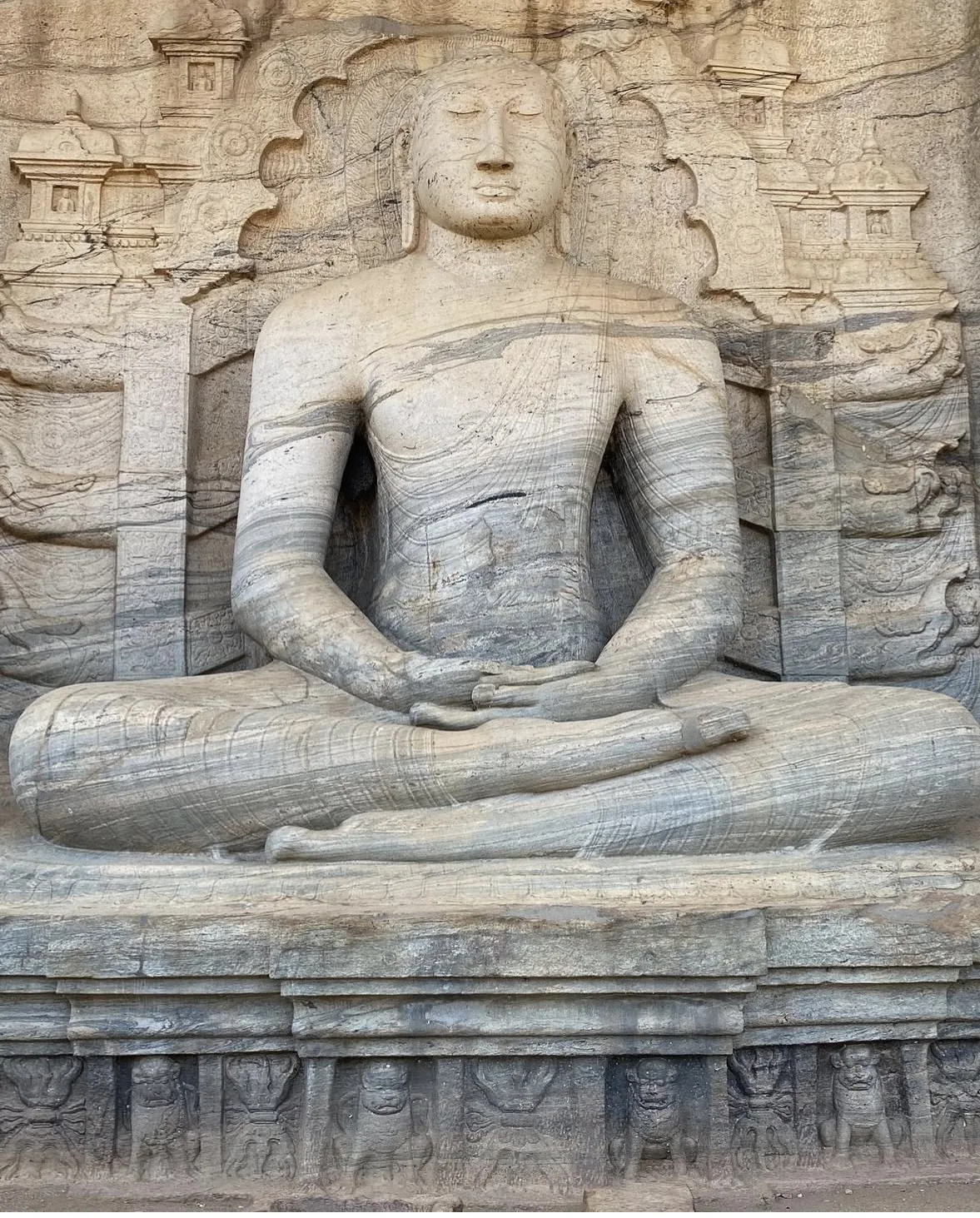
The larger seated figure rests in samadhi, the posture of deep meditation, the legs folded and one hand laid open upon the other in the lap. It sits on a carved throne whose plinth is cut with a frieze of lions, taken in the tradition as a sign of truth and courage, the image borne up by the brave rather than by the bhadra bearers that more often carry such a seat. Behind it the rock is worked into an ornate back-screen: a makara-torana arch rises over the head, six makara run down its sides, and ten lotuses ring the head for the dasa paramita, the ten perfections a Buddha fulfils on the road to enlightenment, among them generosity, virtue, patience, truthfulness and wisdom. The tiered and crowded carving above the head recalls the great gateways at Sanchi in India, and it is thought that the carvers, or at least their learning, came to the island from the mainland.
Beside it, cut some fifteen feet into the rock, is the shrine known as the Vijjadhara-guha, the cave of the knowledge-bearers, those who carry and pass on sacred learning. The seated Buddha within it rests on a throne whose front is carved with lions and with the vajra, the thunderbolt, emblem of an indestructible truth and a sign of the Tantric Mahayana Buddhism that had reached the island by this time. The carving around the figure shows the Buddha preaching the higher doctrine, the Abhidhamma, to his mother among the gods of the Tavatimsa heaven, the heaven of the thirty-three; the gods Brahma and Vishnu stand on either side, a host of deities fills the space above, and among them, cut from the same granite, is a parasol of pearls, the muthu kuda. The cave is said to have been gilded throughout, the gold mixed with copper. When Magha of Kalinga overran the city early in the thirteenth century the shrine was filled in and buried to hide it, and it lay so until the soil was cleared late in the nineteenth century; the gilding was lost when the earth came away, and the copper in it has since oxidised to a green film on the stone. On two of its walls the original twelfth-century painting still survives, among the few Polonnaruwa paintings that still survive.
The standing figure, close to seven metres tall, folds its arms across the chest in a posture found almost nowhere else in Buddhist sculpture, and its identity has been argued over for more than a century. Professor Senarath Paranavitana, the island’s foremost epigraphist and archaeologist, held that it is the Buddha himself, shown in the para-dukkha-dukkhita mudra, the attitude of one grieved at the suffering of others, a gesture of pure compassion, and on this reading it is thought to be the only image of its kind. An older and still common view is that the figure is not the Buddha but Ananda, his close disciple, standing in grief beside the master who lies dying to its right. A third reading takes it for the Buddha in the week after his enlightenment, gazing in gratitude at the tree that had sheltered him. The old chronicles, which record so much of the city, say nothing of a standing Buddha here, and that silence has kept the question open. Whichever it is, the folded arms and the long straight fall of the robe are among the most tender passages of stone on the island.
Much is told at the shrine that the archaeology cannot confirm, and it is worth setting down as the lore of the place. The reading that has the figure grieve beside the dying Buddha carries a train of detail with it. The Buddha, in his last days, is said to have walked to the city of Kusinara, and the left leg of the image is shown a little swollen, bound above the knee with a cloth that the disciple Ananda had wrapped for him, its fold just visible beneath the robe. Grief, in the same telling, ran beyond the human world: the great world-mountain Mahameru is said to have felt the pain of the passing, and the black granite on the far side of the figure, the side to which its gaze is turned, is split by two long fissures read as the mountain’s sorrow set in the stone. The carvers are held to have balanced the figure with great care, weighting the two sides evenly so that the mass of the robe, gathered to one side, should not seem to unbalance it; and the whole image, by the reckoning handed down at the site, took seven years, seven weeks and seven days to finish.
The last figure lies along the rock in the parinibbana, the passing away of the Buddha at Kusinara. It reads as death and not as sleep, and the carver marked the difference with great care: the pillow yields under the weight of the head, the upper hand lies forward rather than tucked beneath the cheek as a sleeper’s would be, the ears have settled along the line of the face, the raised arm has the slight give of a body from which life has gone, and the feet, which a sleeping Buddha holds exactly together, lie fractionally apart. The figure was buried and lost with the rest of the monastery, and it was H.C.P. Bell, the first Archaeological Commissioner of Ceylon, who cleared and recorded it at the close of the nineteenth century.
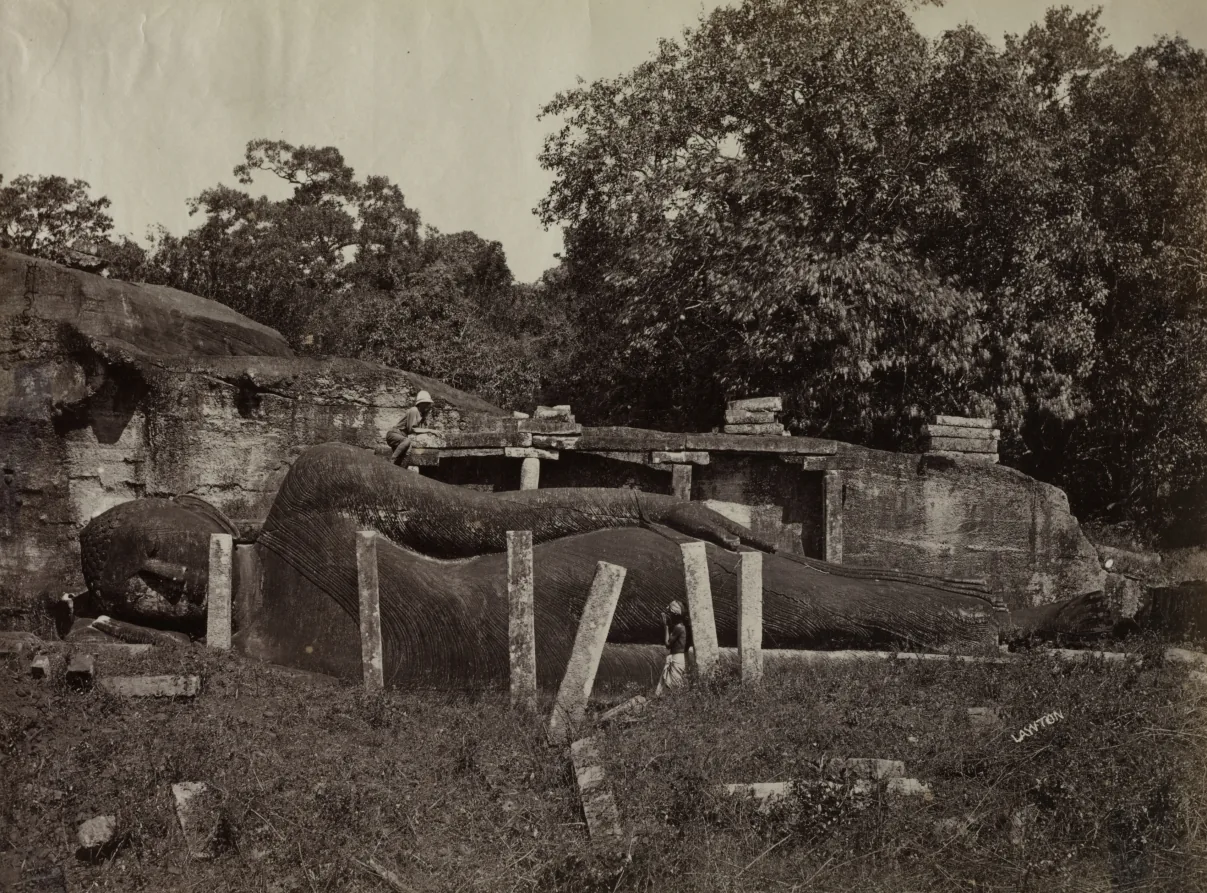
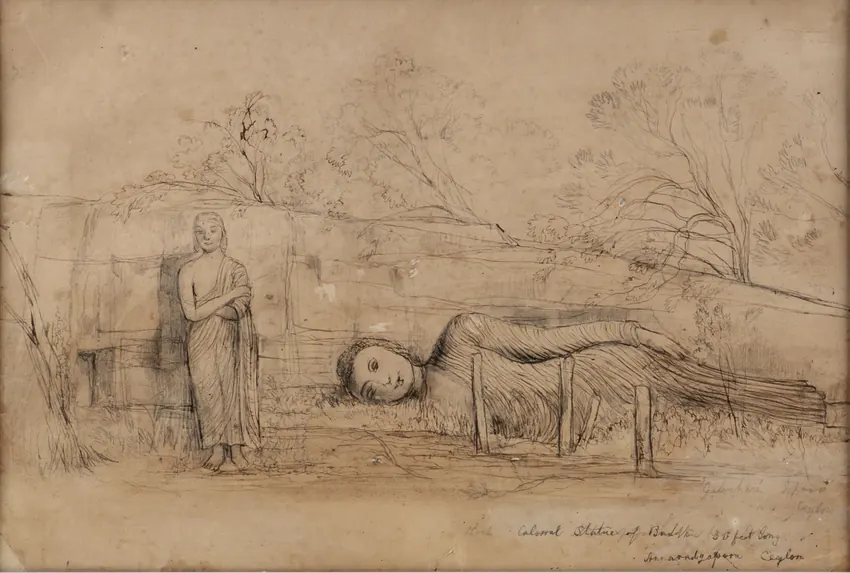
Between the cave and the standing figure the rock carries a long inscription, the Katikavata, the sel-lipiya or stone edict of King Parakramabahu I. It records the council the king called to end a long quarrel among the island’s three great monastic fraternities, the Mahavihara, the Abhayagiri and the Jetavana, and to bring them under a single agreed code of discipline. The stone is at once a work of the shrine and a document of a king reaching into the affairs of the Sangha, the community of monks, to reform and reunite it.
The Sacred Quadrangle and the Tooth Relic
At the heart of the city, on a raised terrace north of the palace, stands the cluster of shrines known as the Sacred Quadrangle, or Dalada Maluva, the terrace of the Tooth. The name recalls the two shrines that in turn housed the Tooth Relic of the Buddha, possession of which had become, since Anuradhapura, the very warrant of Sinhalese kingship. The first was the Atadage, raised by King Vijayabahu I; the second the Hatadage, by King Nissankamalla.
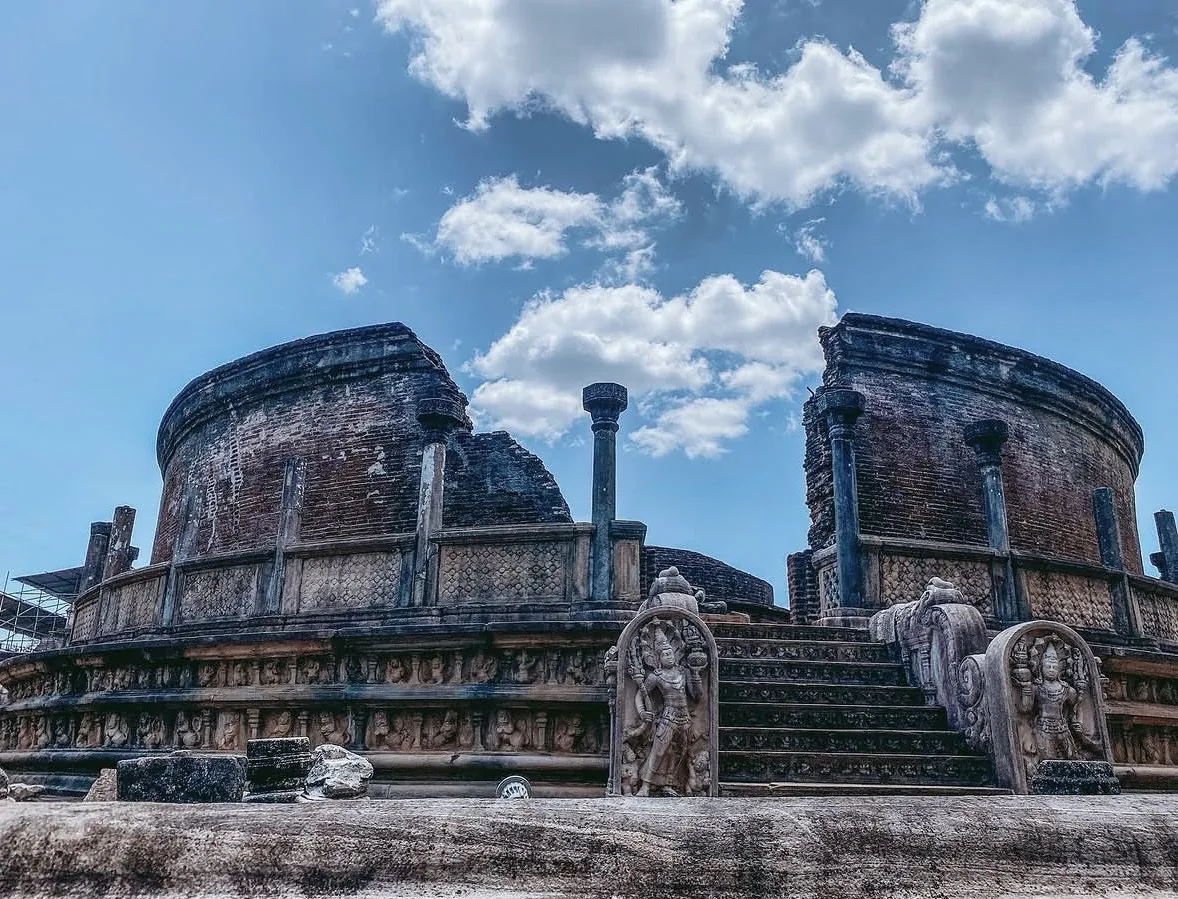
Around them stand some of the most refined buildings the island made. The Vatadage is a circular relic-house, a small stupa ringed by concentric terraces and a colonnade that once carried a conical roof, entered by four stairways each guarded by carved stones and a moonstone. The Nissankalata-mandapa is a stone pavilion whose slender pillars are cut in the form of a lotus stalk rising to an open flower, built so that monks might sit within it and chant pirith, the Pali paritta, the Buddhist blessing recited for protection and merit. The Satmahalprasada is a stepped pyramid of seven diminishing storeys, a form so unlike the island’s usual dome that it is compared to the Vat Kukut shrine at Lamphun in northern Thailand, a sign of the reach of the Buddhist world in which Polonnaruwa moved.
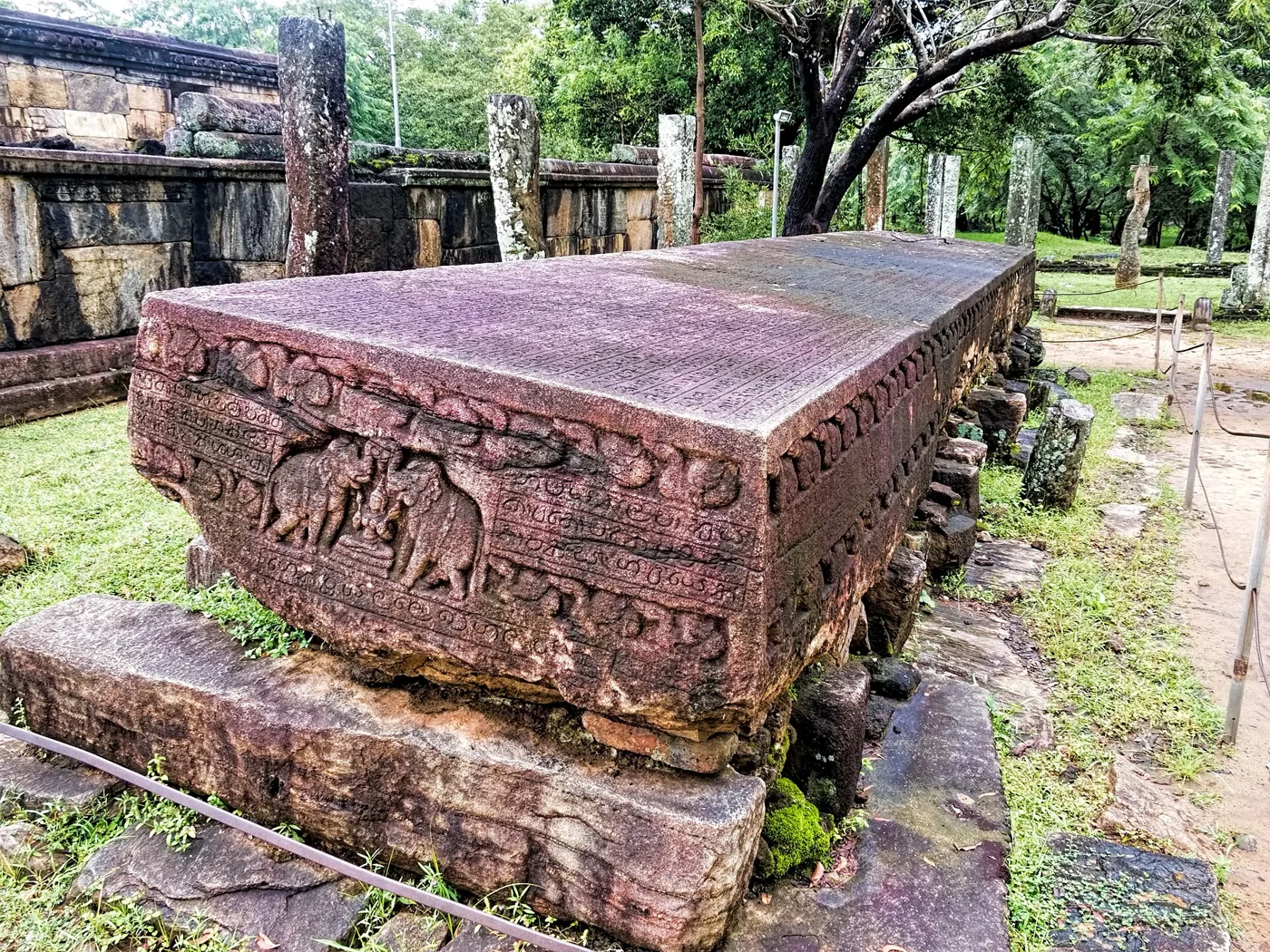
Nearby lies the Galpota, the stone book, an inscription of King Nissankamalla cut across a single slab shaped and lined like a giant palm-leaf manuscript. It is the longest inscription on the island, some seventy-two lines in three columns, and it sets out the king’s descent and his good works, the policies of his reign and the duties he laid on his subjects. The slab itself, the text records, was dragged the hundred-odd miles from Mihintale, and a goddess of plenty, Gajalakshmi, is carved on its side.
The Tivanka murals: the last classical painting
The Tivanka image-house takes its name from its standing Buddha, whose body is set in the tribhanga, the graceful triple bend at neck, waist and knee that Indian sculpture gave to its dancers and goddesses and that the Buddha image itself only rarely takes. Its lasting importance lies in the paintings on its inner walls, the last great body of classical mural the island produced after Sigiriya and the only Polonnaruwa image-house to keep much of its painting at all. Time has been hard on them: whole bands that H.C.P. Bell saw and drew in the eighteen-eighties have since faded to a stain, and the account that follows describes as much what was recorded then as what the eye still finds.
The scheme fell into three parts, in three different hands. In the sanctum, the innermost chamber, a single vast composition showed the Buddha’s descent from the Tavatimsa heaven to the city of Sankassa: three golden ladders, the Buddha on the central and largest, the god Sakra holding a parasol over him on one side and Brahma with a flower on the other, and, at the wall’s end, five figures rising from cloud, four of them haloed as the guardian deities of the quarters. In the chamber before it the painters set the Supplication of the Gods, the deities of the Tusita heaven entreating the Bodhisattva to take his final birth, a crowd of figures in fine jewellery and head-dresses beneath a divine mansion, the Buddha seated among them in the dharmachakra mudra, the gesture of teaching. Two of those figures fold their arms across the breast in the manner of the standing ‘Ananda’ at the Gal Vihara. In the outer vestibule the manner changed altogether: there the jataka stories, the tales of the Buddha’s former births, ran in horizontal bands one above another, drawn on dry plaster and filled with red, yellow and green, the outlines set in red and the modelling got by thickening the line, the old narrative art carried scene by scene along the wall.
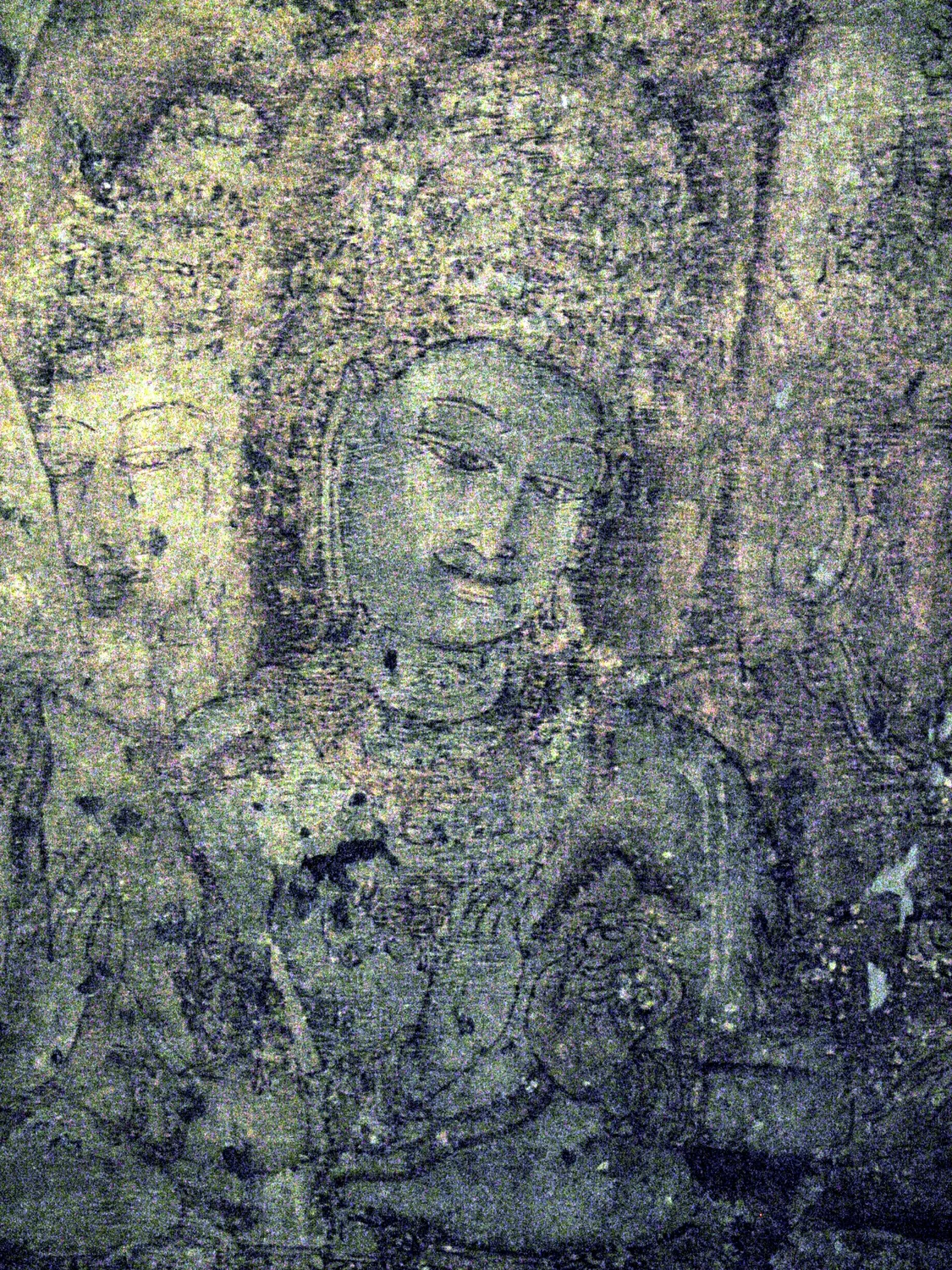
The difference between the chambers is the difference between two schools. The historian Siri Gunasinghe read the great panels of the sanctum as the work of accomplished court painters, their figures larger than life and their line delicate and controlled, and the jataka bands of the vestibule as a later and more popular hand, a resurgence of the oldest Buddhist narrative art, the art of the carved rails of Bharhut and Sanchi. Paranavitana set the whole in a longer view still: the painters of Polonnaruwa, he wrote, kept alive a tradition whose maturity is seen in the caves of Ajanta, long after that tradition had faded in India itself, and their line is subtle where the line of Sigiriya is swift and broad, made to be seen at a distance. The Tivanka wall is where that classical art of the island made its last great stand, before the long road that led to the Sittara painting of the later Kandyan temples.
The Hindu shrines and the Chola bronzes
The Chola century, and the Tamil presence that outlasted it, left within the Buddhist capital a cluster of Hindu shrines, the Siva Devale, of which H.C.P. Bell traced thirteen. They are small buildings of finely jointed stone in the southern manner, their sanctums once crowned by the pyramidal gandi tower of the Dravidian temple. The best preserved, Siva Devale No. 2, is a work of the Chola occupation itself, raised for a queen of the emperor Rajaraja; No. 1 is later, built in the Pandyan style after Magha’s invasion; the largest stood beside a shrine of Vishnu. One shrine, its doorway carved with a cobra’s hood, was for a time miscalled the Naipena Vihara, the snake temple, before it was understood for what it was.
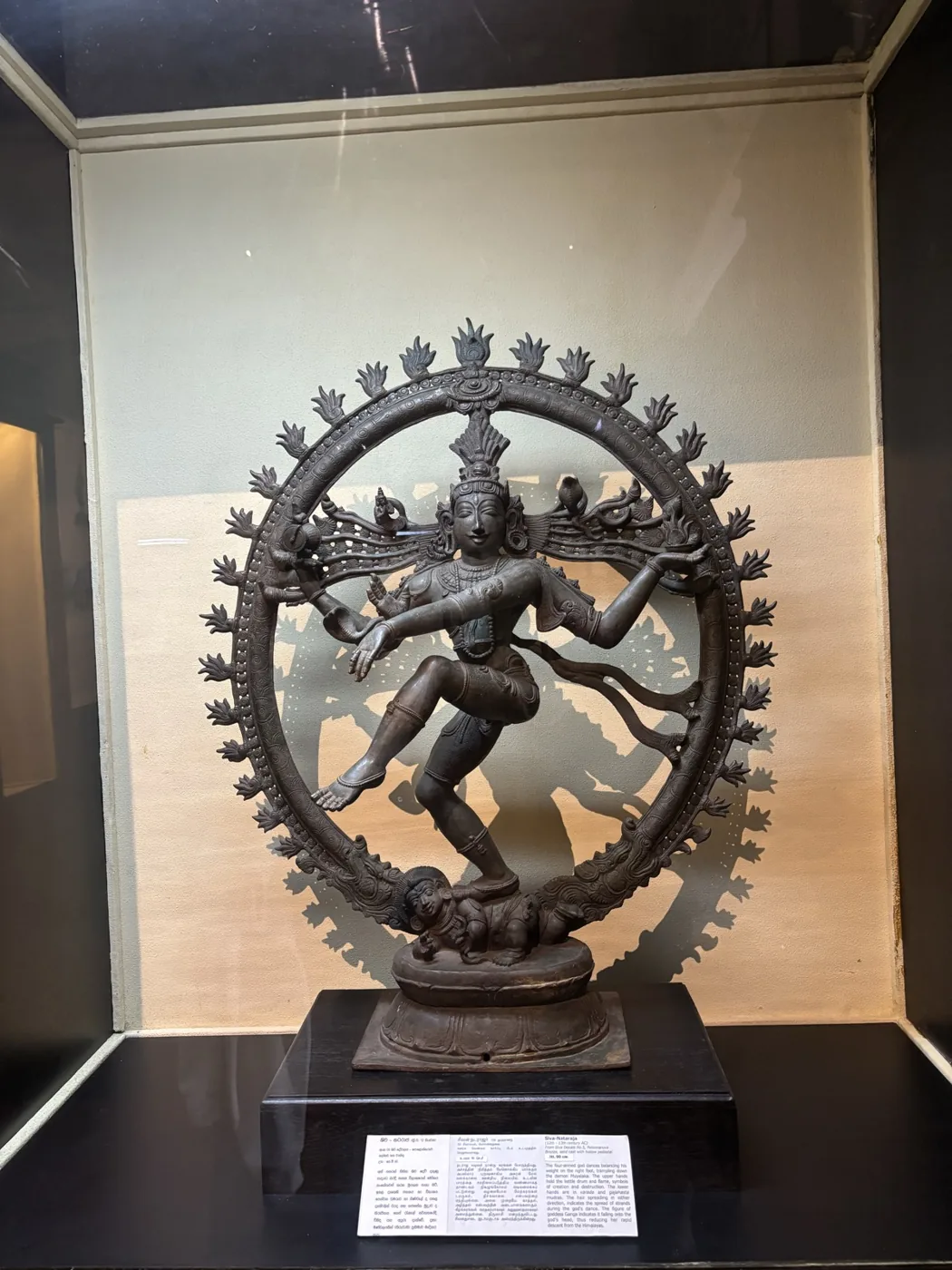
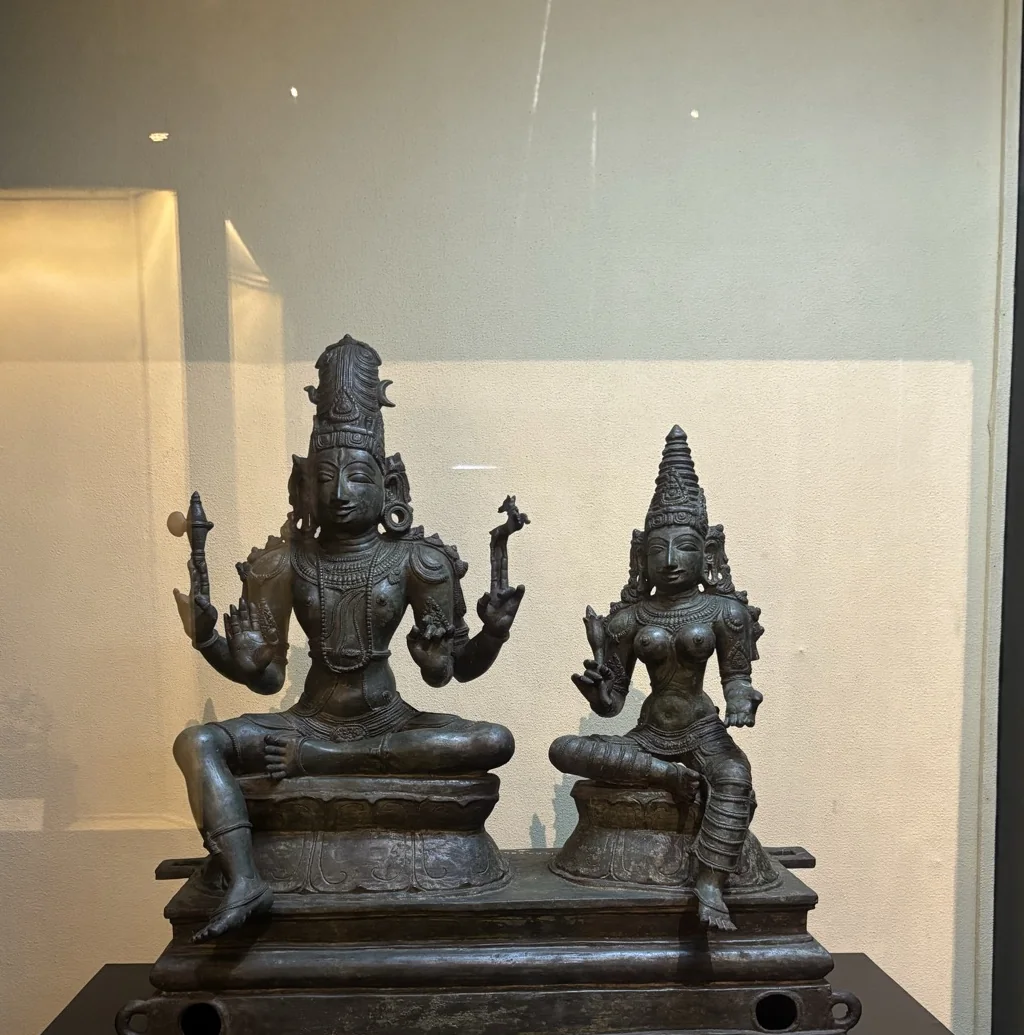
From these shrines, and above all from Siva Devale Nos. 1 and 5, came the bronzes for which Polonnaruwa is known across the world, dug from the buried city by Bell in 1907 and 1908. Chief among them is Shiva as Nataraja, lord of the dance, four-armed within a ring of flame and poised on one foot upon the crouching dwarf of ignorance, one hand holding the drum whose beat is creation and another the fire of dissolution, a third raised to say ‘have no fear’ and the fourth pointing down to the refuge of his feet. Beside the Nataraja are his consort, here named Sivakami, the boy-god Skanda, the sun-god Surya, the bull Nandi, and the four great saints of Shiva, the Tamil poet-devotees whose hymns carried his worship through the south. So fine is the casting that the images were long taken for imports from southern India, and Arunachalam, who first studied them, judged that they follow the southern convention closely; yet several carry marks of dress and stance that argue for a workshop on the island itself. That the shrines of Shiva stood among the monasteries of the Buddha, and their gods were cast with such care, is itself a record of the inclusiveness the Sinhalese court extended to the faith of its Tamil subjects and neighbours.
The bull that left the moonstone
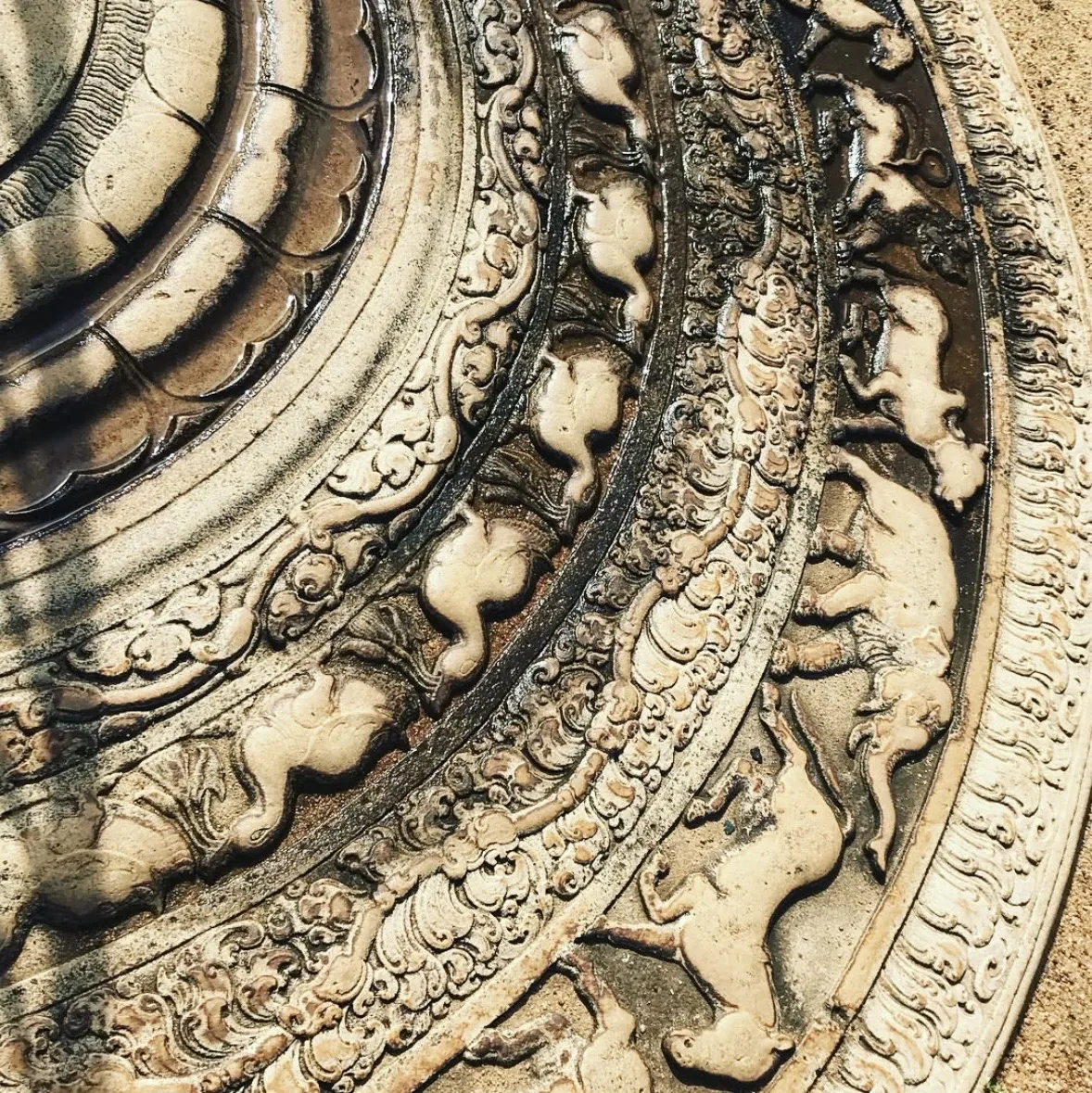
A small change in a carved threshold shows how close the two faiths lay, and how the one came to influence the other. At the foot of a flight of steps the Sinhalese laid a sandakada pahana, a moonstone, a half-circle of stone worked in concentric bands: an outer ring of flame, then a procession of animals, then a band of scrolling creeper, then a file of sacred geese, and at the centre a half-open lotus. At Anuradhapura the animals were four, the elephant, the horse, the lion and the bull, taken by some as the perils of birth, age, sickness and death that the worshipper stepped over on the way in. At Polonnaruwa the bull was quietly dropped from the ring. The bull is the mount of the Hindu god Shiva, and to tread upon it at a threshold had become, under the strong Hindu presence of the day, an offence to be avoided. A carved stone had followed a shift in belief.
The second golden age
Polonnaruwa was the last capital to rule the whole island from one hand and to build on the old colossal scale. Within a few generations of Nissankamalla the seat of kingship began its long retreat to the south and west, to Dambadeniya and Yapahuwa, Kurunegala and Gampola, and at last to Kotte, Sitawaka and Kandy, and no later court commanded either the unity or the wealth to work again on such a scale. What the second city left is a summit at either end of its art: in sculpture the four figures of the Gal Vihara, cut with a tenderness never matched in the island’s stone, and in painting the crowded, jewelled walls of the Tivanka, where the classical tradition of Buddhist Asia made its last great stand. Between the two lies everything the age was: a kingdom confident enough to gather the whole island under one king, devout enough to raise its shrines like vaults of brick, and open enough to cast the gods of another faith in its own bronze. For less than two centuries Polonnaruwa held all of that together, and the stone holds it still.
Sources
- Bandaranayake, Senake, and Gamini Jayasinghe. The Rock and Wall Paintings of Sri Lanka. Colombo: Lake House, 1986.
- Basnayaka, H.T. (Uda Hettige). Polonnaruwa: Civilisation of Sri Lanka. Colombo: Godage International Publishers, c. 2007.
- Arunachalam, Ponnambalam. Polonnaruwa Bronzes and Siva Worship and Symbolism. Colombo, 1916.
- Prematilleke, Leelananda, and Roland Silva. Polonnaruwa: The Art of the Second Kingdom. Colombo.
- Paranavitana, Senarath. Art of the Ancient Sinhalese. Colombo: Lake House, 1971.
- von Schroeder, Ulrich. Buddhist Sculptures of Sri Lanka. Hong Kong: Visual Dharma, 1990.
- Godakumbura, C.E. Murals at Tivanka Pilimage (Art Series No. 4). Colombo: Archaeological Department, 1969.
- Gunasinghe, Siri. ‘Buddhist Paintings in Sri Lanka: An Art of Enduring Simplicity.’ Spolia Zeylanica 35 (1980).
- UNESCO World Heritage Centre. ‘Ancient City of Polonnaruwa’ (inscribed 1982). https://whc.unesco.org/en/list/201/
- National Museum of Colombo, period galleries (Polonnaruwa panels).
How to cite this essay
Malaka Talwatte, “The Art and Architecture of Polonnaruwa,” Malaka Talwatte: Sri Lankan Art and Ceylon Antiquaria, https://malakatalwatte.pages.dev/publications/polonnaruwa/.
Quote and cite freely with attribution; please do not republish a whole essay, or a photograph, without permission.