Look up in the image house at the Dodanduwa Kumara Maha Vihara, a little north of Galle, and the ceiling that should be a field of lotuses is a field of roses. The flower is the wrong one, and it is wrong deliberately: where a Kandyan painter would have set rosette beside lotus rosette in a grid and bordered the whole in scrolling creeper, the southern hand of the later nineteenth century filled the same grid with the European rose, ring within ring. That single substitution, one flower quietly put in the place kept for another, is the clearest sign of a larger change. The ornamental vocabulary of the Kandyan shrine, the painted lotus and the liyavala creeper treated in the companion essay to this one, travelled down to the maritime south and there came apart, absorbing the roses, cherubs, grapevines and coats of arms of the coloniser until it was a different language wearing the old one’s grammar.
A tradition without its workshop
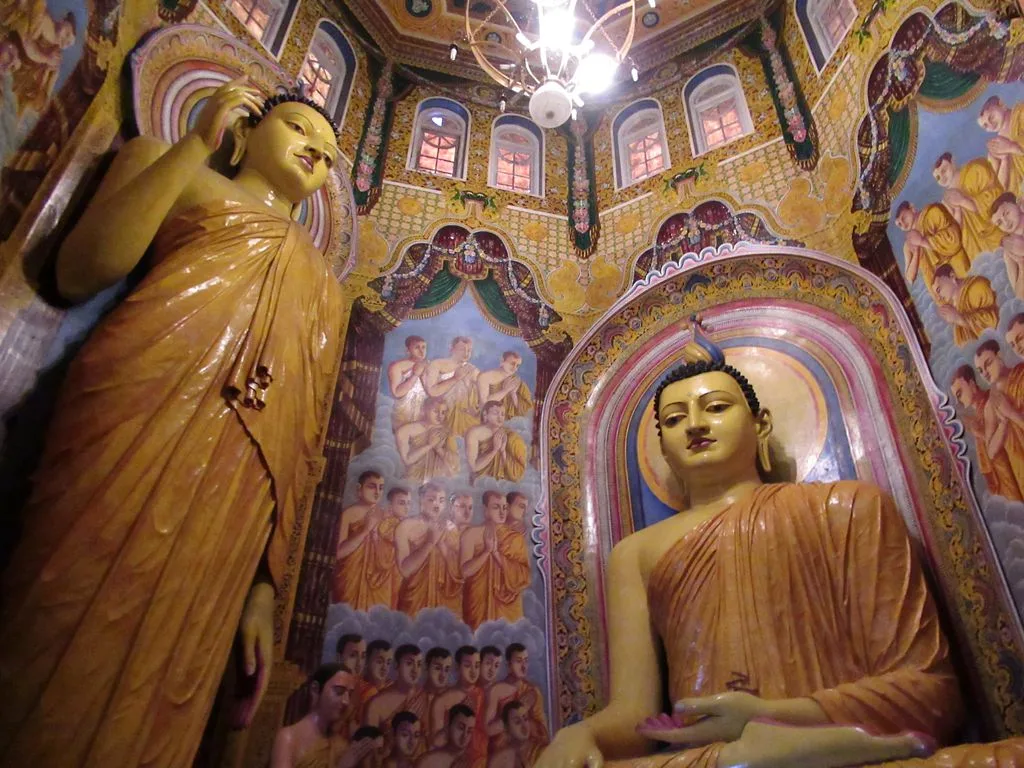
The ornament held together in the hill country because one body of craftsmen, trained in one royal department, drew on one repertory; take that structure away and the repertory loosens. The southern painters had neither the court nor the craft office behind them. The Kandyan kingdom fell in 1815, and with it went the patronage and the workshop discipline that had drilled a painter in proportion, in the grinding of colour and in the set line exercises before he was trusted near a wall. The men who painted the coastal temples were born instead in territories held for centuries by the Portuguese, the Dutch and then the British: Weligama, Ahangama, Katuwana, Mirissa and the villages around them, where a systematic grounding in the Kandyan forms was no longer to be had. What reached them instead was the printed and painted matter of colonial life, Christmas cards, newspaper engravings, illustrated books, commercial labels, painted ceramics and the perspective backdrops of the Colombo stage, and they took their motifs where they found them.
The very materials changed the look of the work. The old shrine had used a small palette of earth reds, yellow, white and gold; the southern painter reached for the new imported enamels and a vivid manufactured blue, and laid them on with an appetite that the tradition’s first serious historian found alarming. Ananda Coomaraswamy, writing in 1908 while the practice was still living, complained that the lesser painters would ‘run riot with the Aspinall’s enamel and Rickett’s blue’, and dismissed some of their borrowed designs as fitter for ‘second-hand Christmas cards’ than for temple walls. His scorn is itself evidence: it records exactly how far, and how fast, the ornament had moved from its Kandyan discipline. The painters knew what they were doing. Maligawage Sarlis, the most influential of them, said plainly, in an interview late in his life, that he and his fellows painted to the taste of ordinary people and to earn a living, at a time when neither the monks nor the wealthy patrons cared to revive the older manner.
Rose for lotus
The loss of the workshop became, on the wall, a freedom, and the first thing the southern painter did with it was to open the ornamental alphabet to the flora of the coloniser. The rose is the emblem of the change, and the Dodanduwa ceiling is its plainest case, but the rose rarely came alone: grapevines heavy with fruit, cherubs, flower vases and a crowd of European floral and foliage motifs entered the borders and the panels of temples along the coast, at the Dodanduwa Kumara Maha Vihara, at the Sapugoda Sri Maha Vihara near Beruwala, whose grapevine border of leaf and clustered fruit is a wholly European pattern turned to Sinhalese use, and at Kataluwa Purvaramaya, where roses and a grapevine run together in the ornament. The indigenous flowers were not driven out so much as made to keep company with the newcomers: the lotus and the Nari Lata, the creeper that opens into the figure of a woman, mingle on the same surfaces with roses, peonies and tulips.
The substitution reached even the sanctum, the most conservative space in the building. As the larger southern temples grew an ambulatory around the shrine, the sanctum ceiling that stood for the supramundane realm, the Lokottara, was worked in ringed and geometric patterns, and into those patterns, where the Kandyan scheme had held only the lotus, the southern painter set the rose. The frame kept its old cosmological job of marking sacred zones by pattern; the flower filling the frame was new. Here the breakdown is exact and legible: a European bloom doing the devotional work of the lotus, in the one place a tradition guards most jealously. Around it, the ceiling of the ambulatory took a subject of its own, worked with the painted patterns of woven cloth.
The coat of arms turned to Buddhist ends
The boldest borrowing was not a flower but a heraldic device, and the southern painters did to it something more pointed than decoration. The British royal coat of arms, the lion and the unicorn flanking the crowned shield, was a fixture of loyal colonial display; the coastal headmen who paid for these temples set the same arms over the doors of their houses. On the temple, though, the emblem was taken apart and reassembled to a Buddhist purpose. Over the entrance to the Satsati Ge, the house of the Seven Weeks after the Enlightenment, at Ambalangoda Sunandaramaya, the arms carry, at their summit and above the imperial crown, a small stupa, and the sovereign’s motto has been struck out and replaced with a line dating the work to the Buddhist year 2430, that is 1887; the crown of empire is thereby subordinated to the sign of the Buddha’s teaching. At the Alutgama Kande Vihara the reworking goes further: the imperial crown itself is gone, a stupa stands in its place, and the lion and unicorn are made to guard the Buddhist symbol, so that the coloniser’s arms come to stand for Buddhist authority rather than imperial rule.
The figure of the sovereign was handled with the same doubleness. At Polwatta Gangaramaya a row of small portraits of Queen Victoria is set into the Suvisi Vivarana, the ancient sequence of the twenty-four former Buddhas, the Christian empress placed among the Buddhas in the posture of a worshipper. At Totagamuwa Subhadraramaya the queen sits within an oval medallion ringed by the shield-bearers of the British arms, every mark of a Victorian portrait present, and yet a line of Sinhala beneath her names her ‘Queen Mahamaya’, the mother of Prince Siddhartha; the one image is left to carry two identities, the British monarch and the most honoured woman of the Buddhist story, according to who is looking. Scholars of these temples read such work not as a lapse of taste but as a strategy, the borrowed sign captured and turned, a way for a non-elite craft to speak back to power within the very grammar of power. Whether or not one follows that reading in full, the visible facts are striking enough: the arms of empire made to shelter a stupa, and the empress set to worship the Buddha.
The hybrid as record
The Kandyan ornament, considered on its own, is a closed and confident language, a small set of forms recombined by a hand that had drawn the same lotus ten thousand times. What happened on the southern coast was that this closed language was forced open, first by the loss of the court and the workshop that had kept it, then by the flood of colonial imagery and colonial paint, and finally by painters who had the freedom, and the wit, to make the intrusion mean something. The result is neither pure Kandyan nor properly European; it is a hybrid, and its very impurity is a document. To read the rose in the lotus’s place, the grapevine in the border and the reformatted arms over the door is to read, in the fabric of the shrine itself, the moment at which an old sacred vocabulary met a new political one and neither quite won. The companion tradition at Kandy shows the ornament at its height and its most sure of itself; these southern ceilings show the same ornament under pressure, and there is a case for saying that the pressure, not the purity, is where the period’s art is most alive.
Sources
- Asoka de Zoysa, Vajira Nalinda Jayathilaka and Ganga Rajinee Dissanayaka, Evolving Traditions of the Buddhist Image House, Part I, Samkathana Research Team, University of Kelaniya, essay VII (‘Temple Artists in Sri Lanka: Sittara Traditions of the Upcountry and Lowcountry’), for the Lowcountry substitution of Kandyan motifs and the reformatted British coats of arms.
- Asoka de Zoysa and Vajira Nalinda Jayathilaka, Buddhist Image Houses, Colombo, for the Dodanduwa and Kataluwa ornament, the Sapugoda grapevine border, and the rose-garland sanctum ceilings.
- Ananda K. Coomaraswamy, Mediaeval Sinhalese Art, Broad Campden, 1908, for the imported enamels and the criticism of the borrowed designs (full text, Internet Archive).
- Senake Bandaranayake, The Rock and Wall Paintings of Sri Lanka, Colombo, 1986, for the placing of the Southern school within the island’s mural tradition.
- Uditha Devapriya, essays on the Southern and Transitional temple traditions, for independent discussion of the coastal image houses.
How to cite this essay
Malaka Talwatte, “Rose for Lotus: the Remaking of the Kandyan Ornament in the Southern Temples,” Malaka Talwatte: Sri Lankan Art and Ceylon Antiquaria, https://malakatalwatte.pages.dev/publications/southern-decorative/.
Quote and cite freely with attribution; please do not republish a whole essay, or a photograph, without permission.