In a temple at Agalawatta, in a scene from one of the Buddha's former lives, a horse and an early motorcar share the same painted road. The anachronism is deliberate, or at least unembarrassed, and it is the signature of a whole moment in the island's art: the century and more in which temple painting, cut loose from the Kandyan court that had kept it, remade itself in the harbour towns of the south under the double pull of British Ceylon and a reimagined India. Senake Bandaranayake gave the moment its name, the 'Transitional Style', and set it between the last of the old mural schools and the modern art that came after. It is the bridge on which the island's painting crossed from the shrine wall into the twentieth century, and at its best, in a handful of temples around Panadura and Dehiwela, it produced work as original as anything in the Sri Lankan record.
The turn began in a loss of patronage. The Kandyan court had sustained the temple painter for three generations, and when the British deposed the last king in 1815 and broke the feudal landholding of the chiefs after the risings of 1818 and 1848, that support fell away in the hill country. Money and confidence were rising instead along the southwest coast, where the harbours of Galle, Matara, Panadura, Kalutara and at length Colombo had grown wealthy under Dutch and then British trade, and where a new elite of merchants, landowners and mission-schooled professionals was keen to be seen endowing the temple as the old aristocracy had been. Their patronage met a religious revival. From the 1860s the Buddhist reform movement, led by the scholar-monk Hikkaduwe Sri Sumangala and later by Anagarika Dharmapala, and quickened by the public debates with Christian missionaries and by the arrival of Colonel Olcott in 1880, set out to renew Buddhist learning and Buddhist confidence; the building and painting of image houses along the coast was part of that renewal. Olcott, the American who had co-founded the Theosophical Society in New York in 1875, landed at Galle in May 1880, took the Buddhist precepts in public, and went on to help design, in 1885, the Buddhist flag. The old tradition found, in the south, a second life.
Room to paint
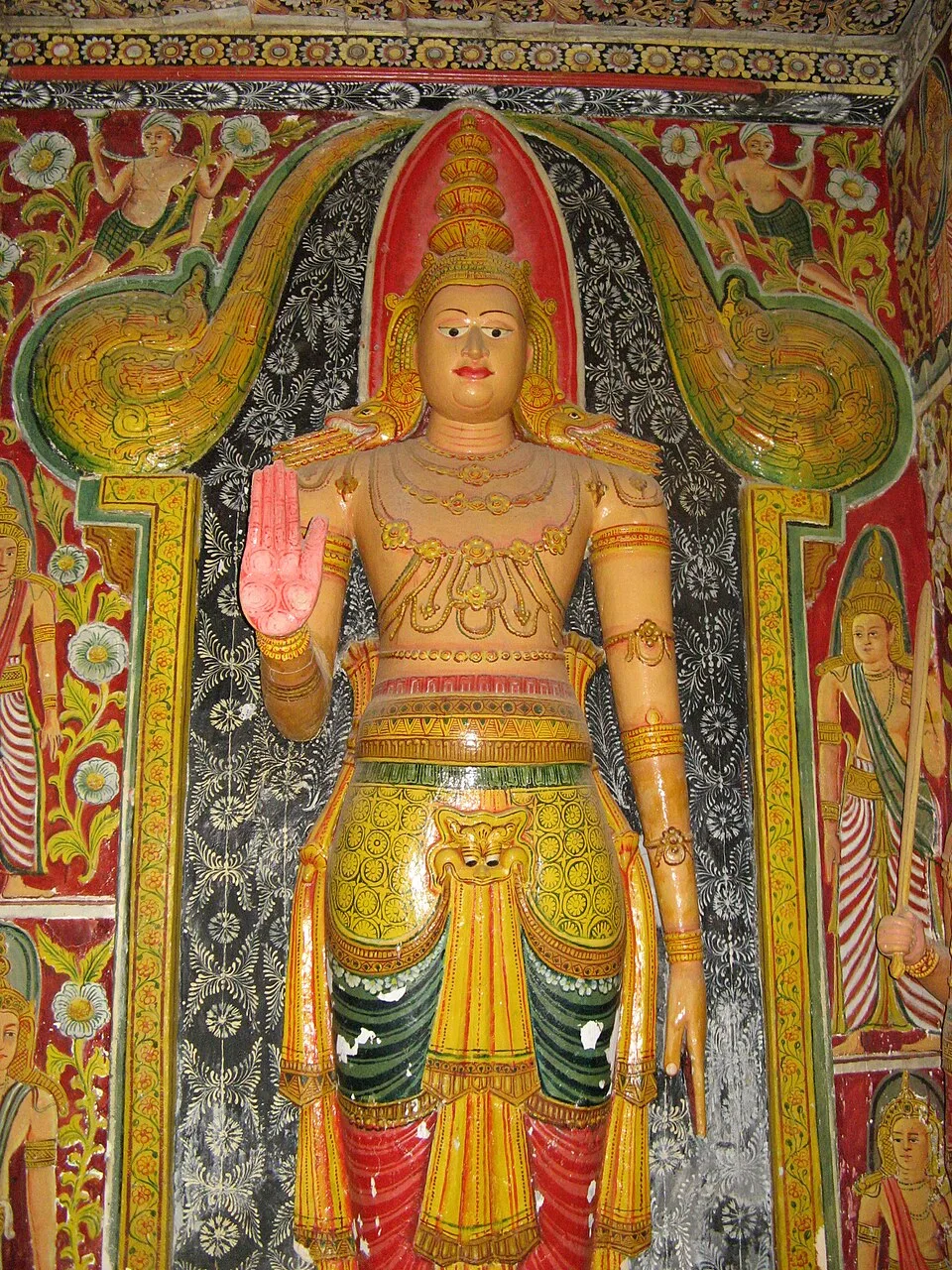
The change showed first in the buildings, and through them in the painting. The Kandyan sanctum had been a small dark room whose walls were soon filled; the temples raised in the south between about 1880 and 1920 opened that room outward, adding an ambulatory around the shrine, a vestibule before it and a pillared veranda beyond, and sometimes setting the whole on an octagonal plan behind a tall whitewashed entrance torana. The painter was given, for the first time, a wall long enough to carry a whole Jataka from beginning to end, and space besides for the cosmologies, the heavens and the many-chambered hells, that the older shrines had no room to hold. Abundance of surface changed the art upon it. The continuous horizontal register of the Kandyan school, in which scene ran into scene without a break, gave way to the single framed scene, self-contained and staged; perspective entered, and with it a painted architecture that receded to a vanishing point, a landscape that opened to a far horizon, and figures modelled with a roundness the flat older manner had never sought.
The whitewashed gateway
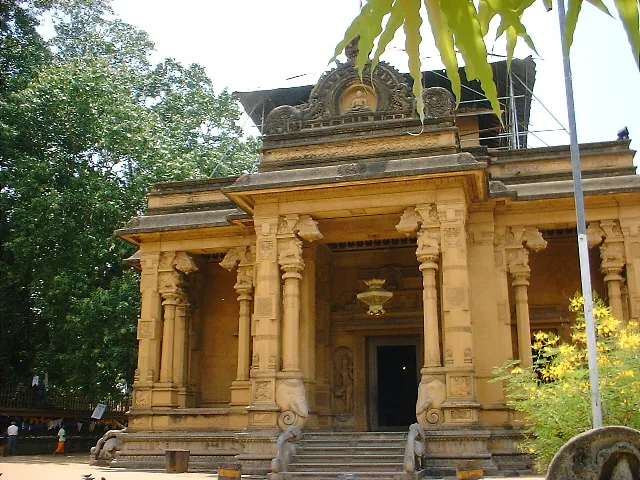
The torana at the threshold deserves a name of its own, the torana gateway, the tall whitewashed portal that fronts so many of the southern image houses, marked off from the makara torana, the vividly coloured arch named for the pair of mythical makara at its foot, by the plain fact that the gateway was left unpainted, its bare lime keeping to the austere lowland taste. Where the form came from is a question de Zoysa answers with what he is careful to call a working hypothesis, no more: the triangular massing, the three doorways opening as a nave and its aisles do, the round window set high to let light into the interior, and the square-plan bell tower beside it all recall, he argues, the façade of a Portuguese Catholic church. He concedes the weak point in his own case, that no Portuguese-period example survives on the island to serve as the model, so the churches he sets beside the gateway are those of Goa, Macau and Mozambique. The reading stays his, offered for testing rather than settled, and it suits a coast where temple and church had long stood within sight of one another.
The same years rearranged the shrine within. In the Kandyan sanctum the makara torana had arched directly over the seated Buddha; from about the 1880s, as the images were built larger than human size, the arch left that inner wall for the doorway and the vestibule, while a plain halo, the prabha mandala, took its place behind the figure. The move freed exactly the long unbroken surfaces the Transitional masters had begun to want, so that the opening of the building and the migration of the arch worked together to hand the painter his wall. Under the arch in its new position, at Kataluwa and a few other southern temples, the future Buddha Maitreya was for a time painted over with a likeness of Queen Victoria and the British arms and later covered again as the revival hardened, a substitution Jayathilaka reads as the colonial moment set into the very fabric of the shrine.
The patrons and the fraternities
A class of men gave many of these temples their names. Along the southern and western coast the word that recurs on the temple boards is Mudalindaramaya, and it carries a signature: the Mudaliyars, the colonial headmen who by the middle of the nineteenth century had become the wealthiest and highest-placed Sinhalese of the lowlands, their fortunes made in graphite, arrack, cinnamon, timber, shipping and the contracts and tax-gathering of the British administration. Vajira Nalinda Jayathilaka reads this new class as the dominant patrons of the coastal temple, most of them nominal Christians and missionary-schooled, who endowed and renamed image houses much as the Kandyan aristocracy had endowed the shrines of the hills, and who liked their patronage recorded where the devotee would see it. The Kandyan temple had seldom carried the name of its sponsor; the lowland temple announced his.
Behind the money lay a quarrel over ordination that decided where the tradition would take root. From the 1760s the Kandyan Siyam Nikaya, the senior fraternity of monks, withheld higher ordination from all but the Goyigama, the cultivator caste, and the coastal communities it shut out, the Salagama, the Karava and the Durava, answered by sending their own candidates abroad. From the missions to the Burmese ordination centres came the Amarapura fraternity, established in the first years of the nineteenth century, and after it the Kalyanivamsa and, in 1864, the Ramanna, each needing temples of its own along the coast where its authority ran. The Mudaliyars funded them, largely along their own caste lines, so that the raising of a southern image house was at once an act of piety, a claim of standing and a move in a contest over who might be ordained. This is the institutional reason the mural tradition, once loosed from the hill country, found its second home in the harbour towns and not elsewhere; and the very temples carrying the church-derived gateway belong, to this day, to these breakaway southern chapters, which had turned from Kandyan form along with Kandyan authority.
The masters of the four temples
The first and finest phase of the Transitional Style was the work of painters whose names are lost, as the names of the classical masters before them were lost. The Kandyan court had begun, in its last century, to keep the names of the painters it employed; the anonymous masters of the southern temples stood, in this at least, closer to the ancient tradition, and their finest work survives in four temples of the western and southern coast. The earliest is the vestibule of the Purvarama at Dikgala, Panadura, of about the 1880s, whose murals show the finest aesthetic sensibility of the group and appear to stand at the head of the line. A decade later comes the fullest achievement of all. The image house of the Rankot Vihara at Panadura, dated by an inscription to 1894, carries across its ceiling a cosmographic landscape more than ten metres long, a sacred geography of natural, stylised and imagined things, elephants and birds and lotus pools set among rocks and rivers, planned by a single master mind and painted by an atelier of hands; in its ambition and its quality it stands beside any panel painting the island produced in either century.
At the Subhodarama temple at Karagampitiya, in the Colombo suburb of Dehiwela, the long narrative of the Ummagga Jataka, completed and dated on the wall in 1897, unrolls as one of the most sustained painted stories of the period, and the temple offers a rare thing: alongside it, in the preaching hall, an earlier set of murals in the older traditional manner, so that the two, painted within a few years of each other, show the very steps by which the Transitional Style formed. The last of the four, the Purana Rajamaha Vihara at Botale in the Gampaha district, painted in the early 1930s, is the work of a master of theatrical and near-dreamlike invention, whose scenes of the hells verge on the surreal; the resemblance is a coincidence of vision rather than a borrowing, for the torments he painted come from the detailed underworlds of the Buddhist texts, not from any European source. By his day the tradition was already dispersing, and Botale is a late and brilliant fragment of it.
Across the four temples the new devices are the same: the three-dimensional stage set, the receding architecture, the modelled figure, and above all a costume that mingles worlds, the women dressed after a nineteenth-century European fashion with Indian additions, the men in the robes, dhotis and turbans of the contemporary Indian stage and of the immensely popular prints of the Indian painter Raja Ravi Varma (1848–1906). The Transitional master painted an ancient Indian scripture in the dress of a Victorian theatre's idea of the East, and did so with an inventiveness that redeemed the borrowing.
The theatre and the print: Henricus and Sarlis
The naming of the Transitional painter begins with the theatre. Richard Henricus, active from about the 1890s into the 1920s, is among the first professional painters of twentieth-century Ceylon whose name the record keeps, and the record keeps it partly because he worked where crowds could see him, painting the great scenic backdrops for the Tower Hall theatre in Maradana after it opened in 1911. One of the Henricus brothers was said to have trained in Italy, and the European scene-painter's craft came into the temple through them: the deep painted perspective, the atmospheric distance and, above all, the vanishing point, which the brothers are counted the first to work into a Sri Lankan temple wall; Richard had studied the murals of the Panadura and Dehiwela temples and carried their manner into a wider public art, into the shrine of the Jayatilakarama at Grandpass about 1909 and into the printed devotional pictures that were beginning to reach a mass audience. The approval of the leading revival monks helped turn a mixed Asian-European manner into the accepted look of popular Buddhist art.
His assistant at the Jayatilakarama was a young man who would carry the style further than anyone, and coarsen it in the carrying. Maligawage Sarlis (1880–1955) was born at Ambalangoda and learned his first painting from an uncle who made religious pictures for village homes; he studied at the Vidyodaya Pirivena at Maligakanda under Sri Sumangala, met Richard Henricus there, and served his apprenticeship at his side. Between 1911 and 1920 he painted and sculpted the image house at Maligakanda, his first temple, and went on to paint many more. His lasting influence, though, lay off the temple wall. Noticing that Buddhist homes hung imported prints of the British royal family and European scenes for want of anything of their own, Sarlis took his designs to the Buddhist entrepreneur William Pedris, who had them lithographed in Germany and sold across the island; a Buddhist household could at last hang the marriage of Prince Siddhartha or his feat at the archery contest, in Sarlis's warm, crowded, stage-lit manner, on its own walls.
The prints remade popular taste, and muralists everywhere copied them, often to the loss of their own invention, so that Sarlis's idiom spread across the island's temples in the second quarter of the century. Later scholarship has judged it severely. Albert Dharmasiri called it a dark chapter in the island's mural tradition, western art imitated without an understanding of its language, gaudy and derivative; and the criticism has force. Yet the reach was real, and it endures. Sarlis was the chief artist of the popular Sinhala newspaper Swadesha Mithraya and a sculptor of portrait statues of the revival's leaders, and his printed images passed from the wall of the home into the wider popular art of the Buddhist year, the festival panels and the devotional card. An art the connoisseur dismisses can be the art a whole people sees.
The turn to India, and the turn to the modern
Against the Sarlis manner a reaction gathered, and it looked to India for its cure. The decisive figure was Solias Mendis (1897–1975). Having begun in the popular style, Mendis studied the fifth-century Buddhist cave paintings of Ajanta, and when he came, over some two decades from the late 1920s, to paint the new wing of the Kelaniya Raja Maha Vihara for its patron Helena Wijewardene, he set the framed vignette aside and returned to the long unbroken wall, telling the early chapters of the chronicle Mahavamsa and the history of the temple in a continuous Ajanta-inspired flow. Two of his Kelaniya scenes, the arrival of the sacred Bodhi tree and the arrival of the Tooth Relic, have become so fixed in the island's imagination that they are copied in temples still. Where Sarlis had reached for a Victorian India of the stage, Mendis reached past it, to an older and grander India of the Buddhist caves, in a conscious search for a national manner.
The search took a further step when a modern painter entered the shrine. In 1939 and 1940 George Keyt, the foremost of the island's modernists, painted the newly built Gotami Vihara in Colombo, telling the life of the Buddha, the 'Buddha Carita', in a sequence of scenes that flow one into the next without division, in the cubist-influenced line he had made his own, guided on the story by the temple's resident scholar-monk, the Venerable Telwatte Amarawansa, and framed by border ornament from the hand of the monk-copyist L.T.P. Manjusri. Keyt brought the language of twentieth-century European modernism into the Buddhist image house, and set it on the same continuous wall that Mendis had recovered from Ajanta; the two together, working within a few years and a few miles of each other, carried the temple mural out of the popular idiom and into modern art. The turn they began ran on for the rest of the century: Somabandu Vidyapathi, who had studied under Nandalal Bose at Rabindranath Tagore's Shantiniketan, was still painting in that Indian-modern spirit at the Bellanvila temple in the 1990s, so that the argument these walls conduct, from Sarlis onward, about what a Sri Lankan Buddhist art should be, runs across the better part of a century.
The bridge
By about the turn of the twentieth century the Transitional Style had, in Bandaranayake's judgement, largely replaced the older Kandyan and Southern schools across the territories of the former kingdom, and the tradition it began runs on in two directions at once. It reaches back to the anonymous masters of Panadura and Dehiwela, who stand with the finest painters the island produced; and it reaches forward, through Sarlis to the popular devotional print and through Mendis and Keyt to the modern movement and the '43 Group. The motorcar in the Jataka at Agalawatta is not, after all, a lapse. It is the record of an art caught in the act of becoming modern, and painting the change onto its own walls.
Sources
- Senake Bandaranayake and Albert Dharmasiri, Sri Lankan Painting in the 20th Century, National Trust Sri Lanka, 2009.
- Senake Bandaranayake, The Rock and Wall Paintings of Sri Lanka, Colombo, 1986.
- Albert Dharmasiri, 'Painting: Modern period (1815–1955)', 1990.
- Asoka de Zoysa, on the Modern Transitional School (University of Kelaniya, 2012) and, with Vajira Nalinda Jayathilaka, Buddhist Image Houses, Samkathana Research Team.
- Sonal Khullar, on George Keyt and the Gotami Vihara murals, Marg, 2017.
- Anuradha Seneviratna, Gotama Buddha Murals by George Keyt, at the Gotami Vihara, Colombo, The George Keyt Foundation, 1993.
- Uditha Devapriya, essays on the Southern and Transitional temple traditions.
- Asoka de Zoysa, Vajira Nalinda Jayathilaka and Ganga Rajinee Dissanayaka, Evolving Traditions of the Buddhist Image House, Part I, Samkathana Research Team, University of Kelaniya.
How to cite this essay
Malaka Talwatte, “The Transitional Style: Temple Painting After the Kingdom,” Malaka Talwatte: Sri Lankan Art and Ceylon Antiquaria, https://malakatalwatte.pages.dev/publications/transitional-style/.
Quote and cite freely with attribution; please do not republish a whole essay, or a photograph, without permission.