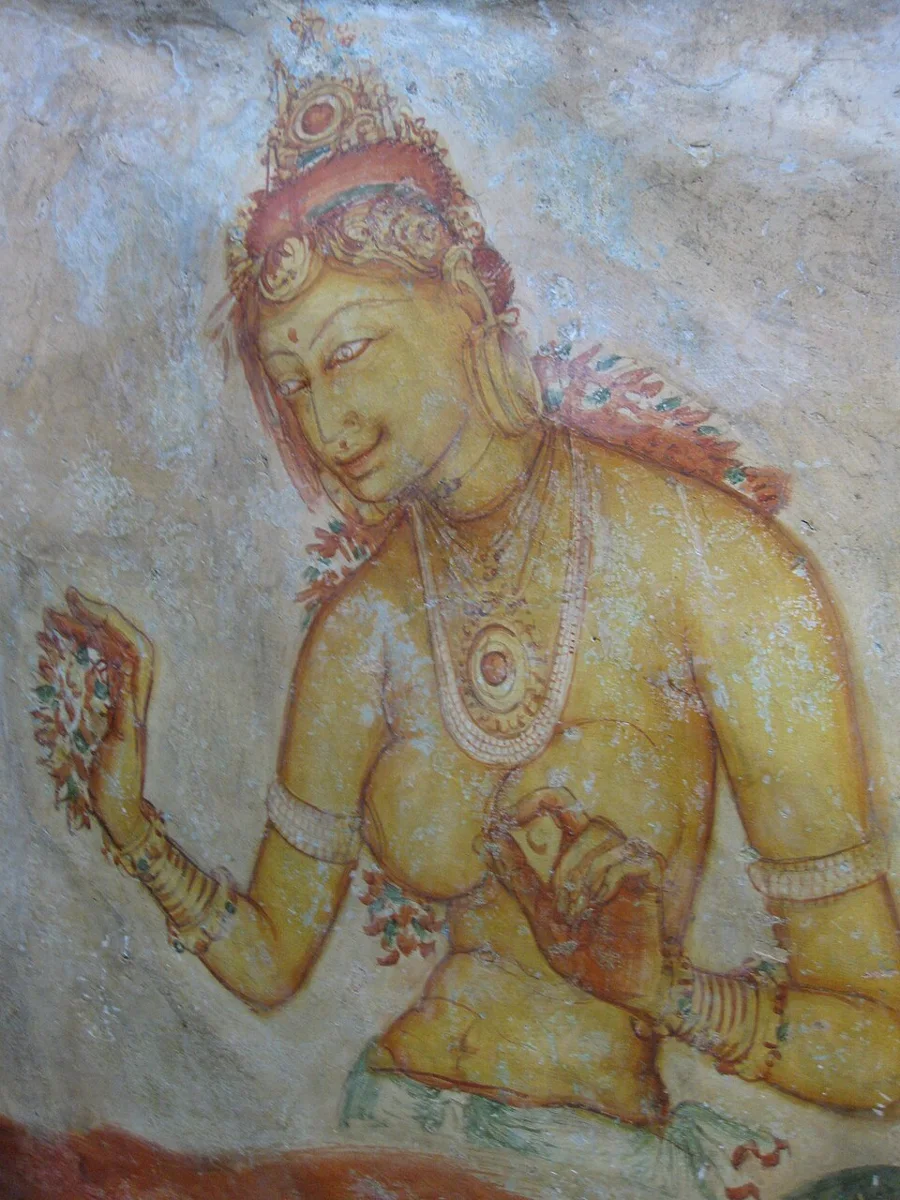
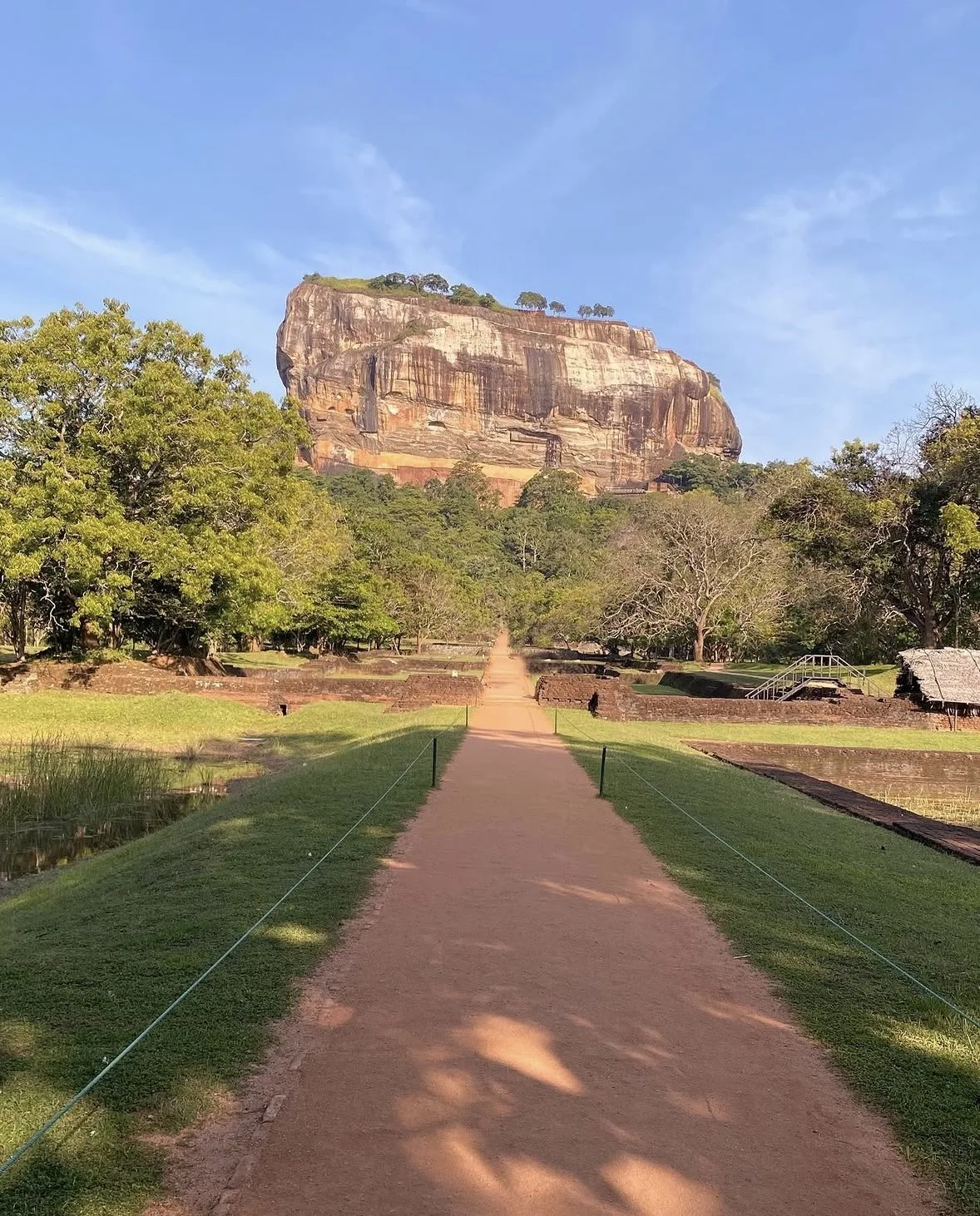
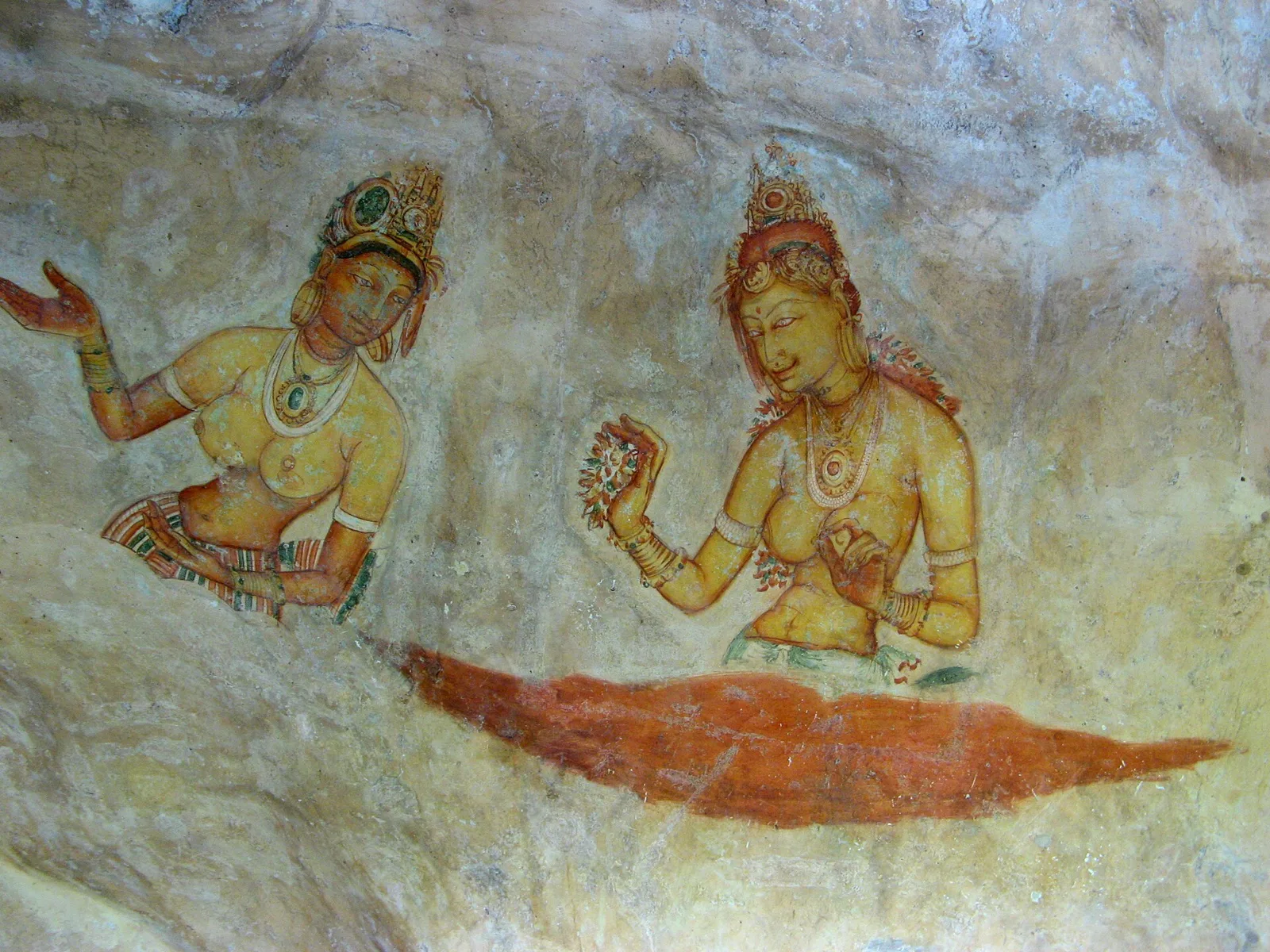
Halfway up the western face of a great column of rock in the dry northern plain, sheltered in a shallow pocket where the wind and the monsoon cannot reach, a company of women has survived for fifteen hundred years. They are painted life-size, drawn to the waist and rising from cloud or mist, bearing flowers and trays of offering, their gaze turned aside; and they are the oldest surviving painting on the island, among the oldest in all of South Asia. Sigiriya is the beginning of the story, and it is a story with no author. For the whole of its first thousand years the painting of the island was the work of hands that kept no names, so that the classical tradition is known, as it is gathered here, not by its masters but by its places.
The rock and the king
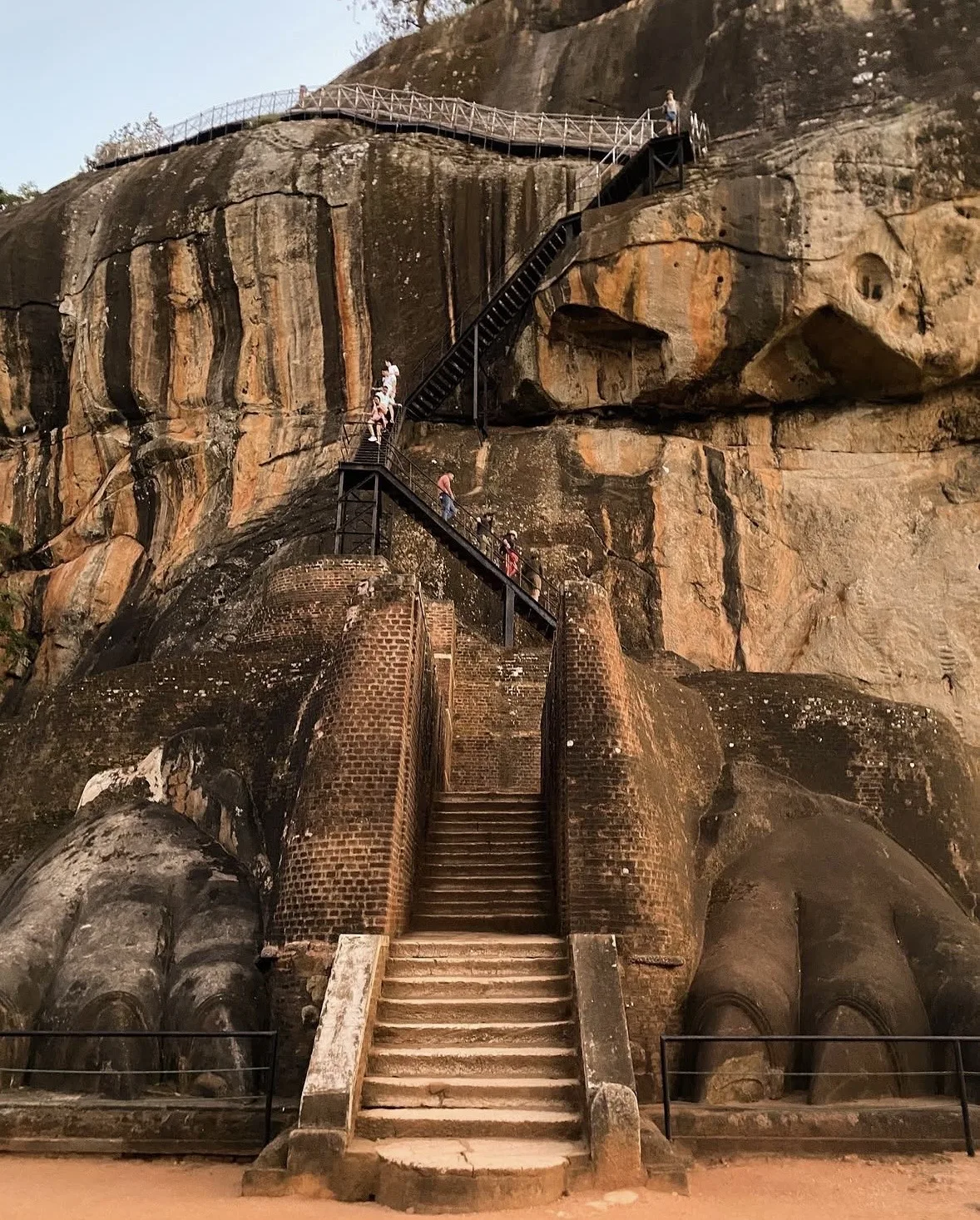
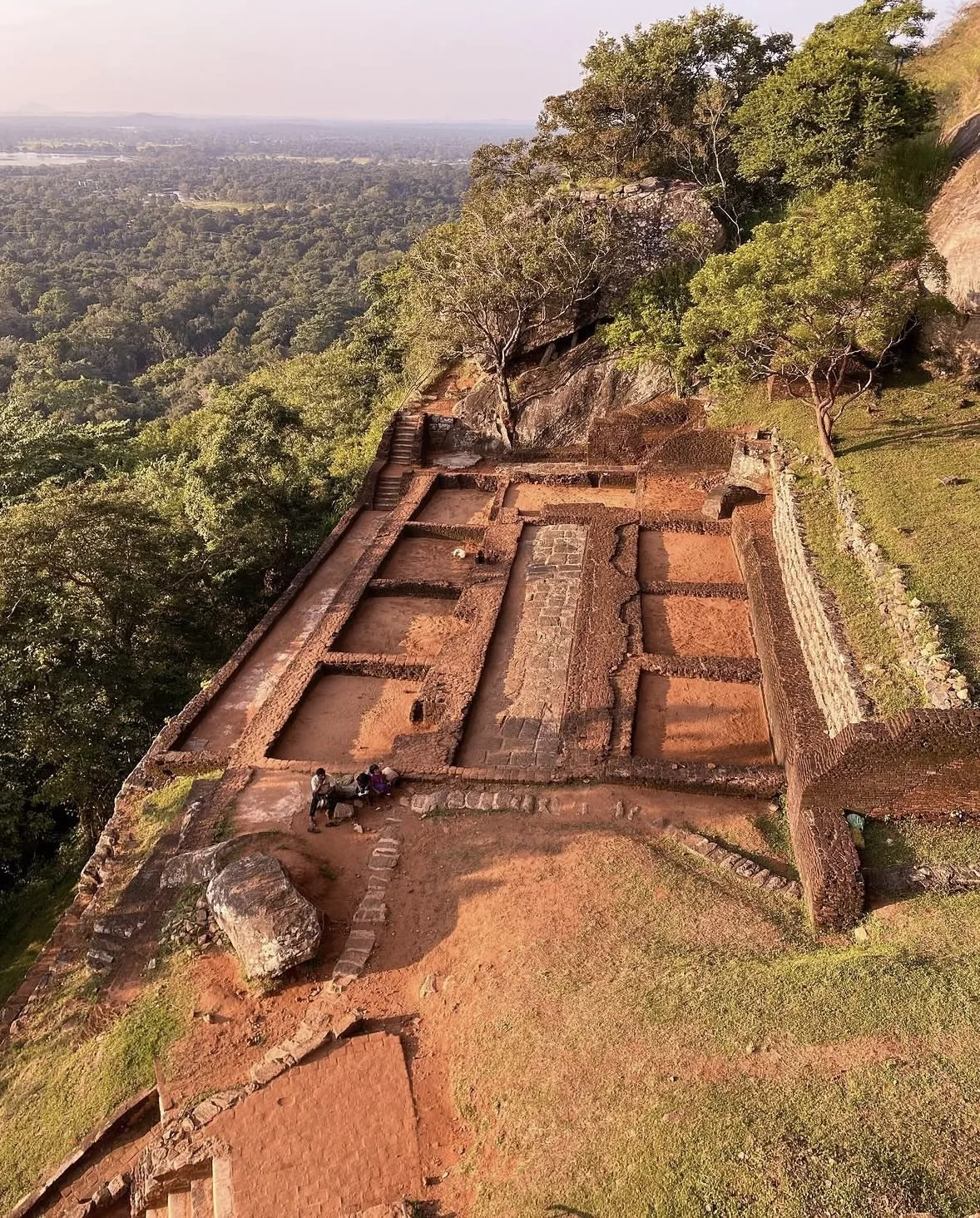
The paintings belong to a single reign, and a troubled one. Kashyapa I (r. 477–495) came to the throne of Anuradhapura by seizing it from his father Dhatusena and driving out his half-brother, and it is said that fear of that brother's return led him to abandon the old capital and raise a new one on the summit of the rock the Sinhala called Sihagiri, the lion mountain. In the eighteen years of his reign the rock became a fortress and a pleasure-palace, its summit built over, its base laid out in water gardens, its western flank given over to painting on a scale the island would not attempt again. The graffiti of a later age speak of five hundred figures upon that face; seventeen survive today, the rest lost to fifteen centuries of weather and the fall of the plaster that carried them. When Kashyapa was defeated by his brother Moggallana in 495 and the court returned to Anuradhapura, the rock passed to the Buddhist monks, and the painting was left to the elements and to the poets who came to look at it.
The women, and the argument over them
Who the women are has been debated for more than a century, and the debate is worth setting out, for each answer is really a theory of what Sigiriya was. Ananda Coomaraswamy took them for apsaras, the celestial nymphs of South Asian tradition, and that reading remains the popular one. H.C.P. Bell, the British archaeologist who first cleared the site, saw instead the ladies of Kashyapa's own court, a procession of the living carrying flowers to a shrine. Senarath Paranavitana, the great epigraphist who read the graffiti, proposed something stranger: that the figures rising from cloud are the lightning-princesses and cloud-damsels of the old Sanskrit poetry, the rock a version of Alakamanda, the cloud-city of the god of wealth. Senake Bandaranayake, who led the modern survey of the site, returned closer to Coomaraswamy while allowing that the figures may hold more than one meaning at once, celestial and courtly together, an evocation of royal splendour as much as of the heavens. The honest position is that the question is open, and that Paranavitana's more literary readings, unlike his patient transcription of the verses, are held today with some caution.
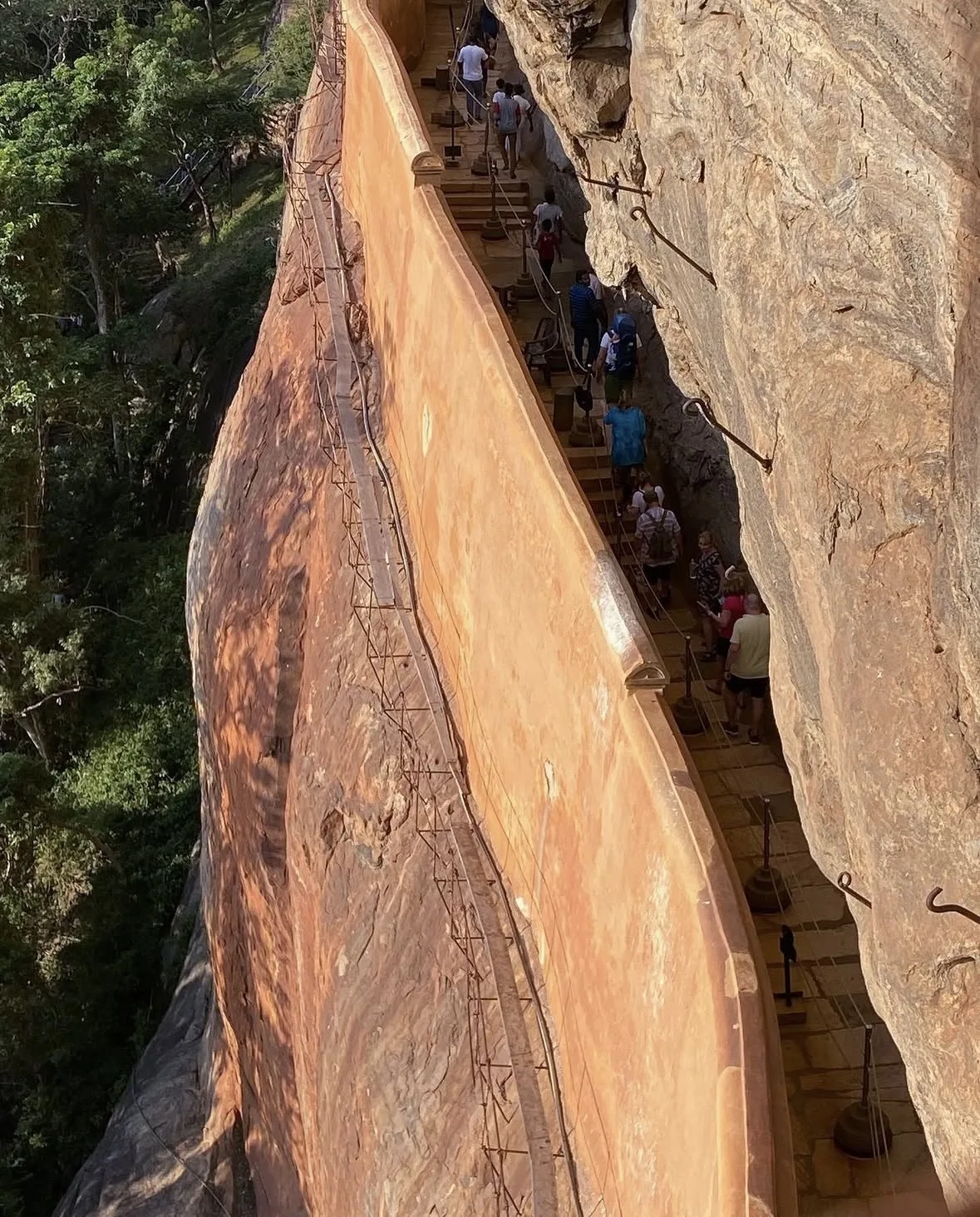
The verses are themselves a part of the work. Along the gallery beneath the paintings runs the Katapat Pavura, the Mirror Wall, a parapet finished in a lime plaster once burnished until it shone, and into that surface the visitors of the eighth, ninth and tenth centuries scratched their responses to the women above them: praise, longing, complaint, the occasional dry remark. Paranavitana deciphered and published six hundred and eighty-five of them in 1956; estimates of the whole run from twelve hundred to eighteen hundred, and the reading of them continues. They are among the oldest specimens of Sinhala verse, and they make Sigiriya something rare in the history of art, a body of painting whose earliest audience has left, scratched beside it, exactly what it felt. A few of those earliest viewers named the figures gods and goddesses, so the argument over what the women are is older than the scholars who now conduct it.
How they were made
The technique of the Sigiriya paintings is itself a matter of scholarly disagreement, and the disagreement is not trivial, for it bears on how the work has survived at all. The ground was laid in layers on the rock, clay strengthened with paddy husk and vegetable fibre, then clay mixed with lime and sand, then a finer lime coat towelled smooth to take the colour. Whether the colour was then laid into that surface while it was still wet, in the manner of true fresco, or onto it dry, has divided opinion for a century. The word 'fresco' stuck to the paintings as a label, and Bell used it, but the case for a true wet fresco was pressed rather by E.B. Havell and, later, D.B. Dhanapala, with some writers speaking of the polished 'fresco lustro'. Raja de Silva, who as Archaeological Commissioner had charge of the paintings and cleaned them with his own hands, put the question to the laboratory. His micro-chemical tests and paper chromatography found in the paint film both a vegetable gum and a drying oil, an oil-emulsion tempera laid on the dry ground; on that evidence he held that no true fresco exists anywhere in Sri Lanka, and that Sigiriya may carry among the earliest paintings in which a drying oil was used. The diagnostic details are his: the plaster shows none of the daily joins a fresco painter leaves as the wet lime is worked patch by patch, the paint sits as a discrete film that flakes clear of its ground, and the green paint thrown by a vandal in 1967 soaked only into the bare places where the old colour had already fallen and the raw lime lay open. The tempera reading now has the better of the argument, resting on the surface itself rather than on analogy, and a recent gas-chromatography analysis, finding wood-apple gum and dorana oil, has tended the same way; the older 'fresco' term clings on by long habit.
The line and the colour
What the eye takes first at Sigiriya is the drawing. The figures are built with almost no shadow, and their roundness is carried by the contour alone: the line is swept on with more pressure to one edge than the other, so that a single stroke deepens in tone as it turns and the limb it describes seems to swell into the round. It is this, the modelling of volume by one loaded stroke, that later writers have called the 'Sigiriya line'. The painter reached it by stages, and the stages are still visible: beneath the final contour run lighter trial lines in red, yellow and black, the first attempts at a shoulder or a wrist left standing on the plaster. Coomaraswamy long ago named the 'eight limbs of painting' of the old Indian canon, of which the outline and its correction are two, so those corrections are method rather than fault; at the height the pictures were meant to be seen the pale first lines fall away, and the sure dark contour alone reads. De Silva, who studied the figures closer than anyone, allowed himself the connoisseur's comparison, setting the drawing of one brow and nose beside Leonardo's 'Head of Leda' and the unforced naturalism of the flesh beside Caravaggio, high company the Sigiriya line does not disgrace.
The palette is as deliberate as the line and almost as small: the red and yellow of iron-earth ochres, a carbon black, and a green earth, laid in flat washes and then modelled. One colour is conspicuous by its absence, for there is no blue in the painted pocket. Bell thought the omission remarkable, the more so because at Ajanta in central India, the work the Sigiriya paintings are most often set beside, blue is used freely. The reason has never been settled, whether the painters wanted for the costly mineral or preferred the warmth of the earth colours; the comparison with Ajanta persists all the same, and the Sigiriya line is now generally judged the freer and looser of the two hands.
Defacement and rescue
What survives has survived narrowly. In October 1967 a vandal threw commercial green paint across the fresco pocket, and Raja de Silva, the Commissioner's officer sent up to the rock, found it daubed over fourteen of the nineteen figures then extant, the padlocked door opened with a key and two gates passed. Two of the maidens were past saving, the head hacked from one and the body above the waist from another, and a third had been stabbed. De Silva began the cleaning himself, lifting the green with the solvent trilene from every surface but the bare patches that had drunk it in. At the government's request the international centre for conservation at Rome sent Luciano Maranzi, and the Smithsonian Institution met the cost; Maranzi worked in the pocket beside de Silva and the Survey's staff from dawn to the failing light, and returned the following year to finish by the spring of 1968. Where the two ruined figures had stood he set reconstructions painted in true fresco on a sheet laid into the rock, so that the one authentic fresco at Sigiriya is the modern repair, while the ancient paintings around it, on de Silva's own reading, are not fresco at all. The paintings had been fading and flaking long before the vandal came, and are now watched and stabilised rather than restored; photography within the pocket is no longer permitted, so the images of the paintings gathered here are ones their photographers have placed under an open licence, while the pages that follow show the rock, the gallery and the ascent as they can still be seen.
Major Forbes had reached the painted gallery in the 1830s, and in June 1889 Alick Murray made the first climb into the fresco pocket, tracing six figures over a week spent on his back, though the gummed tissues he pressed to them tore away a skin of the ancient paint as they were lifted. The earliest full record came a few years after. In 1896, under the Archaeological Survey and its commissioner H.C.P. Bell, the head draughtsman D.A.L. Perera copied the paintings onto canvas over nineteen weeks on a platform slung from the cliff, five figures from one pocket and seventeen from the other. Bell judged the result almost perfect, with 'not a line, not a flaw or abrasion, not a shade of colour' left unreproduced, and Perera's copies hang today in the National Museum at Colombo, the oldest full record of the Sigiriya paintings to be seen anywhere and a witness to figures the rock has since let go. Later hands continued the work in another key: in 1985 the Archaeological Department made measured line drawings of every figure under de Silva's direction, and the Central Cultural Fund's Sigiriya Project, under Senake Bandaranayake, recorded each crack and lacuna as it stood. In 2004 the Fund found three more figures, smaller than life and unshaded, on the outer face of the gallery wall, proof that the painting once ran far beyond the sheltered pocket.
A reading against the grain: Raja de Silva
The account so far is the one most scholars hold, and it begins with Kashyapa and his palace. Raja de Silva spent a working life with the paintings and came to doubt almost all of it. In a monograph of 2002 he argued that Sigiriya was never a palace but a Buddhist monastery of the Mahayana persuasion, held from about the third century BC until after the twelfth, and that the summit long read as Kashyapa's pleasure-house shows none of the marks of an Anuradhapura royal building, wanting the pillar-bases, the door-jamb sockets, the cross-walls and drains, and carrying instead a small dagoba, a rock-cut seat of the kind a preaching monk would use, and terraces laid out for meditation. The chronicle that made Sigiriya a palace, he held, was set down some seven hundred years after the event by monks of a rival school, and had turned a Mahayanist's monastery into a usurper's fortress.
From that argument followed his boldest claim, that the women are neither court beauties nor even apsaras but the goddess Tara, the great compassionate deity of the Mahayana, painted again and again across the rock. The identification was first put to him in 1967 by the German-born ascetic Swami Gauribala, and de Silva spent thirty years assembling its evidence: the forward-bending posture and the ranked ornaments, the hand-gestures matched one by one to the canonical descriptions of Tara and to the Tara bronzes cast on the island at Trincomalee, Veragala and Buduruwagala, and above all the small line on the brow of several figures, which he read as the urna, the tuft between the brows that iconography reserves for a Buddha or a great being and withholds from a mere nymph. The style he tied closely to the Mahayana paintings at Ajanta, the work perhaps of an Indian master; and with the chronology recast he moved the paintings back from Kashyapa to an earlier and openly Buddhist king, most likely his father Dhatusena, whom he dated 604 to 626, placing the paintings themselves in the sixth century.
The argument has not carried the field. The state heritage authorities and the standard modern survey hold to Sigiriya as Kashyapa's royal city, and de Silva's later interpretations share the ground that scholars walk carefully, the same esoteric territory as Gauribala's revelation. The worth of the book lies less in the verdict than in the looking: few students of these paintings have examined the surfaces harder, and the technique, the palette, the drawing and the record of 1967 are his to a degree that even those who keep the palace and the apsaras must draw upon.
The wider classical record
Sigiriya is the summit of the classical tradition, and for a long time it seemed almost alone, but a handful of other sites carry the same ancient art, each anonymous, each known by its place. At Hindagala, in the hills near Kandy, a fragment of Anuradhapura-period painting survives on a rock ceiling, drawn perhaps a century or two after Sigiriya and long taken for a scene of the Buddha preaching in the Indrasala cave; it is one of the few classical survivals to show the Buddha himself, where Sigiriya shows only the celestial women. At Pulligoda, in a rock shelter near Dimbulagala in the Polonnaruwa country, five haloed figures sit in a row in adoration, one holding a garland, painted in white, yellow, red, a pale green and brown on a lime ground; their date has been argued over as hotly as Sigiriya's meaning, placed by Vincent Smith and Coomaraswamy around the seventh or eighth century, and by others later, into the Polonnaruwa age, so that the entry can only give the range and name the scholars who dispute it.
The fullest survival of all, after Sigiriya, is the Tivanka image house at Polonnaruwa, raised by Parakramabahu I (r. 1153–1186) in the Jetavanarama group of his new capital and named for the tivanka, the thrice-bent posture of the great brick Buddha within it. It is the only image house at Polonnaruwa to keep the greater part of its wall paintings, and its interior carries the Jataka stories of the Buddha's former lives and ranks of celestial beings across the plaster, the finest surviving narrative painting of the classical age; the surviving layer is now dated to the thirteenth century, a hundred years after the building, the mark of a later restoration in the city's second flowering. Beyond these, the relic chambers at Mihintale and Mahiyangana preserve fragments of early painting, and a scatter of remote rock shelters carries traces whose dating is still argued; but the great anonymous witnesses of the classical age are these, the rock at Sigiriya and the shrine walls of Hindagala, Pulligoda and the Tivanka.
The tradition and its silence
What binds these places is not a manner, for a thousand years and more separate the Sigiriya maidens from the Tivanka Jatakas, and the styles are not the same. What binds them is their anonymity, and the fact that the tradition ran on under it: through the whole classical age the painter worked as a craftsman in the service of the shrine and the crown, and left his work unsigned, as the sculptor and the mason left theirs. The line begins here, on the living rock, and it runs unbroken, through the medieval centuries and their decline, to the hill kingdom of Kandy, where at last, in the eighteenth century, a Sri Lankan painter is first set down by name. The classical age is the ground of all that follows, and the measure of how much the island had already made before it began to remember who had made it.
Sources
- Raja de Silva, Sigiriya Paintings, Colombo, 2002.
- Senake Bandaranayake, Sigiriya: City, Palace and Royal Gardens, Colombo, 2005; and The Rock and Wall Paintings of Sri Lanka, Colombo, 1986.
- Senarath Paranavitana, Sigiri Graffiti: Being Sinhalese Verses of the Eighth, Ninth and Tenth Centuries, Oxford University Press, 1956.
- Ananda K. Coomaraswamy, Mediaeval Sinhalese Art, 1908.
- R.H. De Silva, on the plaster and colour technology of Sri Lankan murals.
- H.C.P. Bell, Archaeological Survey of Ceylon, and the report on D.A.L. Perera's 1896 copies (Journal of the Royal Asiatic Society, Ceylon Branch, 1897).
- The Central Cultural Fund of Sri Lanka; UNESCO World Heritage listing (Ancient City of Sigiriya, inscribed 1982).
- 'An Analytical Review of Ancient Coating Technology Employed at Sigiriya, Sri Lanka'. npj Heritage Science, 2025.
How to cite this essay
Malaka Talwatte, “The Living Rock: Sigiriya and the Classical Painting of Sri Lanka,” Malaka Talwatte: Sri Lankan Art and Ceylon Antiquaria, https://malakatalwatte.pages.dev/publications/sigiriya-classical/.
Quote and cite freely with attribution; please do not republish a whole essay, or a photograph, without permission.