Belfast's finest in Ceylon: the story of Andrew Nicholl
Andrew Nicholl reached Ceylon in 1846 as the first teacher of landscape and scientific drawing at the Colombo Academy. A five week tour of the interior with Emerson Tennent gave him his sketches, and the rebellion of the following year came close to costing him his life.
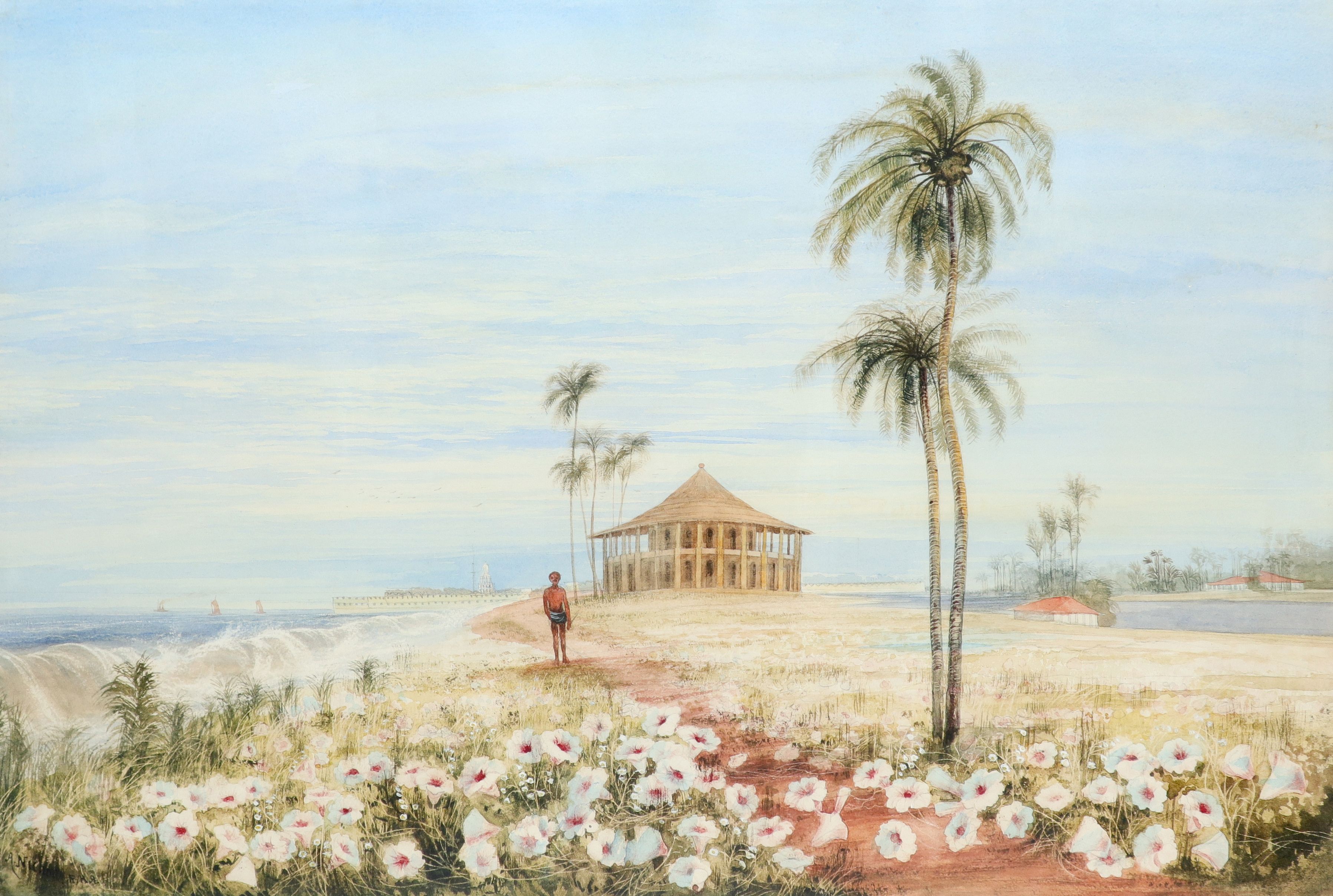
Andrew NichollWatercolour
Described in full
A watercolour in landscape orientation. Across the lower third a dense band of convolvulus spreads over sandy ground, white and pale pink with deep rose centres, painted down to the individual petals and buds. A path of red earth cuts up through the flowers from the bottom edge. A man walks away from us along it, bare above the waist and wearing a dark cloth at the hips, his skin a warm reddish brown. Behind him, on slightly raised ground, stands an octagonal pavilion of pale timber in two storeys, open on every side beneath a tall conical roof of thatch. Two very tall coconut palms rise at our right and cross near the top of the sheet, and thinner palms cluster to the left of the pavilion. On our far left the sea breaks in low white surf, with three small sailing craft on the water near the horizon and a low jetty running out from the shore, a slender white spire standing beyond it. To our right, red tiled roofs show among further palms, with still water behind them. The sky fills the upper half, pale blue with long horizontal bands of thin cloud. The artist has signed the lower left corner. The composition sets a wide prospect behind a close botanical foreground, which is the arrangement his Ceylon views are known for.
A view of Galle Face Green, Colombo. Watercolour with scratching out, 49 x 71.2 cm. Originally in the possession of Spink, London. Collection: The Talwatte Collection.
Andrew Nicholl was one of the greatest artists to visit and sketch in Colonial Ceylon. He was born in Church Lane, Belfast, on April 4, 1804, to Henry Nicholl, a boot and shoemaker. His elder brother William Nicholl, who was ten years senior to him had a business in town as a ships’ chandler and flax merchant. William was an amateur landscape painter whose work is in the possession of the Ulster Museum in Belfast, Northern Ireland. He encouraged Andrew to draw and when the Belfast Association of Artists was founded in 1836 with Hugh Fraser as its president, William and Andrew were among its earliest members. At fourteen, Andrew was giving lessons to the likes of Montague Talbot, the Manager of the Belfast theatre. At eighteen, Andrew Nicholl apprenticed as a compositor under printer Francis Dalzell Finlay, who later started the Belfast newspaper The Northern Whig, where Andrew Nicholl then worked for seven years in the letterpress department. At the time, a liberal young politician named James Emerson was also a contributor to The Northern Whig and it is believed that it is through this newspaper that Andrew Nicholl met James Emerson who would go on to be the force behind his journey to Ceylon.
James Emerson was also born in Belfast in 1804, the same year as Andrew Nicholl. Though he studied in Trinity College, Dublin he did not complete a degree there as his interests were more in politics and natural history. He went to Greece with Robert James Tennent in 1824 where he took part in the war of Greek independence as a lieutenant of the artillery. In 1830 he wrote History of Modern Greece. He was called to the English Bar at Lincolns Inn in 1831; though there is no evidence of him practising as a lawyer. He later married Letitia Tennent, the only daughter of William Tennent, a wealthy Belfast banker. Following the demise of his father-in-law, he adopted the name of James Emerson Tennent and inherited lands in Antrim, Fermanagh, and Sligo. He was elected M.P. for Belfast in 1832 under Prime Minister Lord Grey but later supported the new Tory administration of Prime Minister Peel as Lord Grey had been forced to resign after disagreements with his cabinet over Ireland.
Further evidence that Andrew Nicholl and Tennent were in contact is via a sonnet written by Tennent’s younger sister, Eliza in 1830 entitled ‘On my being presented with a beautiful, coloured drawing of flowers, executed by Mr. A Nicholl’. At this time both Andrew Nicholl and Emerson Tennent were in London. By this time Nicholl had already made a name for himself as a painter after a series of works on the Antrim Coast. In London, Nicholl spent a considerable time at the Dulwich College Gallery copying paintings in its collection. His style changed considerably at this time with the inspiration of the likes of Turner, which is evident in his later work including those he drew of Ceylon. He exhibited his paintings for the first time at the Royal Academy, in 1832. He moved in the same year to Dublin and exhibited at the ‘Royal Hibernian Academy’ and contributed works that were engraved for the Dublin Penny Journal. Over one hundred wood engravings based on his drawings were used to illustrate ‘Ireland: its scenery, character, etc.’ by Mr. and Mrs. S. C. Hall. This was published in three volumes from 1841-43. A letter by S. C. Hall dated 1840 to Andrew Nicholl requesting sketches of Wexford County gives an address in Belfast for Nicholl and refers to ‘Mrs. Nicholl’, indicating that he was married at the time. Nicholl moved back to London in the same year (1840) and continued supplying illustrations to publications. He also tried his hand at poetry, one of which, titled ‘Sunset’, was published in the Dublin University Magazine of 1844.
Each wilding flower that clothes the pathless wood
In a rich golden blaze of colour glows,
The distant landscape, now so heavenly bright,
Assumes the varied hues of Sunny even,
Steeped in a glorious burst of yellow light,
The last bright gleam of parting day from heaven.
Ceylon, the Lake of Minery, c.1870. Pencil, watercolour and body colour. Purchased by Queen Victoria in 1870. Collection: Royal Collection Trust.
Meanwhile, Emerson Tennant was appointed as Joint Secretary to the Board of Control by Prime Minister Peel. From 1841 to 1843 he was also made Secretary to the India board and was knighted by Queen Victoria in 1845. He then gave up his parliament seat in 1845 to take up the appointment as the Civil Secretary to the Colonial Government of Ceylon. After Tennant’s departure to Ceylon, Andrew Nicholl was appointed as the first teacher of landscape, painting, scientific drawing, and design at the Colombo Academy (later Royal College). To qualify for this post, Nicholl had to undergo training at the Ordinance Survey Department in Somerset House in mapping and engineering drawing. It is believed that Nicholl’s appointment was likely due to Tennent’s influence. Nicholl left for Ceylon in August 1846.
At the Colombo Academy, Nicholl would train teachers in producing professionals - such as draughtsmen rather than artists. An example of the work done by Nicholl during this time is available at the Ulster Museum and is a decorative floral pattern resembling a wallpaper design inscribed ‘Ceylon 1846’.
The falling of Prime Minister Peel’s government in Britain necessitated the change of the Governor of Ceylon, from Sir Colin Campbell to Lord Torrington, a cousin of the new Prime Minister, Lord John Russel. The new governor was ignorant of his job and disliked Tennant as he was considered a Tory and thus shunned a man with great ability and knowledge of Ceylon.
It is recorded that Tennant had invitedAndrew Nicholl for St. Patrick’s Day dinner at his residence Ellie House in Mutwal on March 17, 1847, indicating that the two men were on friendly terms in Ceylon. In July of the same year, Tennent took Nicholl as his draftsman. Together they went on an official tour through the interior of Ceylon, which lasted for five weeks. They initially travelled from Colombo to Kandy with Dr. Gardner, Director of the Peradeniya Gardens and Dr. Williams, a medical doctor. They were joined in Kandy by Captain Galway and Lieutenant Evatt. The party also included cooks, horse-keepers, and labourers. The landscape surrounding the Kandy Lake and the ‘Dalada’ or the sacred tooth of the Buddha, were of great interest to Nicholl. From Kandy, they continued their travel on a palanquin to Matale and then on to Dambulla, where the rock temple was examined in detail. From Dambulla, they moved through the jungles northwards where they visited the ruins of Topare (Polonnaruwa). From here they travelled to the mountain of Mihintale and subsequently to Anuradhapura. In Anuradhapura, Nicholl stayed two extra days with District Judge Tranchill and sketched the ruins found in the area. The rest of the group travelled without Nicholl to Arippu. On July 26, Nicholl was dropped off, back in Dambulla by Tranchill as he had planned to go to Kandy. From there he returned to Colombo by coach.
Nicholl who was travelling now from Dambulla with a guide, horse-keeper and two coolies, met with crowds of villagers fleeing into the jungle. It is from this crowd that Nicholl learned that a rebel king had been crowned in the Dambulla Temple and that his followers were killing Europeans. Nicholl then changed course back to Anuradhapura and on his way learnt that the new king had set his men out to capture him. He got back to the safety of Tranchill’s house in Anuradhapura and came back to Colombo via Arippu but ill with jungle fever, on August 10, 1848, with his sketches safely in hand.
“Thus, terminating my sketch tour through the forests of Ceylon, he writes, the most interesting I ever had in my life; and although attended with both danger and fatigue, yet the enjoyment which I derived from it far more than compensated for the hardship of the journey, and will ever be considered by me the most delightful of all my sketching excursions, either at home or in distant lands.” (Nicholl Scrapbook)
The Kandy revolt of 1848 was by two pretenders from the Southern provinces. The administration led by Lord Torrington declared martial law in Kandy and dealt with this revolt very severely which later caused criticism in Britain. Nicholl drew a Kandyan pretender and a rebel Buddhist monk who were imprisoned in the Welikada jail, and engravings of these drawings were published in the Illustrated London News of June 7, 1851.
Following his return to London, Nicholl exhibited three pictures at the Royal Academy in 1849 of which two were of Ceylon: ‘The Fort of Colombo, Ceylon, from the Galle face - Christmas Day’ and ‘Galle Harbour, Ceylon’. He further exhibited work related to Ceylon at the Royal Academy in 1850, 1852 and 1854.
Meanwhile, in 1850, Emerson Tennent was recalled from Ceylon but was soon appointed as Governor of St. Helena. Though he would turn down this appointment later on, he became a Member of Parliament for Lisburn in 1852 and was appointed as Secretary to the Poor Law Board and Secretary to the Board of Trade. It is during this period that Tennent worked on his two-volume account of Ceylon, which to date is considered one of the most important works on the island. On March 17, 1855, Tennent writes to Nicholl about the use of his illustrations in the book:
“My dear sir,
My work on Ceylon is at last gone to press, and will be published by Longman in 2 vols 8vo. With about 80 (of) your illustrations large & small which are now in the hands of the engraver.
But there is one matter in which I want your kind aid, if you can assist me. A scientific draftsman, Woolf, is employed by Longman’s to make 3 drawings of the attitudes of the elephants during their struggles in the Kraal.
The animals, he will do well, as he makes studies from living elephants in the Zoological Gardens, but he is at a loss for foliage. He has no sketches of Ceylon trees, and especially of creepers and climbing plants, and straggling roots above ground.
Now it occurs to me, that you may have some rough sketches of these that would enable Woolf to make the foregrounds in character with Ceylon vegetation. And if you would lend them to me, for that purpose, you see what an advantage it would be to me.
Here is the text from page 37 of the article, presented exactly as it appears in the source:
If you can oblige me in this matter, please would you put the sketches in a packet and send it by post, addressed to me, Board of Trade Whitehall London, marking it in the corner ‘private’.
With best regards to Mrs. Nicholl & Mary Anne.
*Faithfully yrs. *
*J. Em. Tennent. *
I will be responsible for the safe return of the sketches to you.”
It is not sure if Nicholl heeded Tennent’s request but the frontispiece of volume one of Tennent’s Ceylon contains an image of ‘Noosing wild elephants’ and contains foliage in it. The letter also is one of the earliest references to Mary Anne, Nicholl’s daughter. The latter part of Nicholl’s life was spent in London, Dublin, and Belfast. He continued to teach and paint. His later works are in the collection of the Ulster Museum.
Branch of the Cup Leaf Tree, October 29, 1847. Watercolour. Collection: The Talwatte Collection.
In 1850, Queen Victoria purchased two watercolours done by Nicholl of Ceylon for the Royal Collection for 30 guineas each, namely ‘Ceylon: the point de Galle’ and ‘Ceylon, Esplanade and fortification of Colombo. But as per records of the ‘Royal Collection Trust’, Nicholl presented a further twelve watercolours to Queen Victoria on March 15, 1870, of which ‘Ceylon: The lake of Minery (Minneriya)’ was purchased by Her Majesty for 20 guineas. A few more watercolours not related to Ceylon by Nicholl were also purchased for the Royal Collection by Queen Victoria. Nicholl also presented a volume of sketches done in Ceylon to the print room of the British Museum in 1883. Two of these sketches of ‘the Hindoo Temple, Maradana, near Colombo’, remain.
Ceylon: the Pont (point) de Galle, C.1848-9, watercolour, 48.6x69.5cm. Purchased by Queen Victoria in 1850. Collection: Royal Collection Trust
Andrew Nicholl died in London on April 16, 1886, at the age of 83, at his home at 7 Camberwell Grove. A month after his death a large exhibition of his work was held at 55, Donegall Place in Belfast. Over two hundred and eight works were exhibited. In February of 1889 fifty-six watercolour studies of trees and plants of Ceylon were presented to the Royal Hibernian Academy by Mary Anne Nicholl in memory of her late father.
The National Museum, Colombo has in its collection twenty-eight watercolour drawings by Andrew Nicholl which were presented by the late Dr. Paul E Pieris in July 1949. No records are available on how Dr. Pieris acquired them. The watercolours are mostly large and are of exceptional quality. Prominent landscapes of Colombo and its environs, Dambulla, Ruins of Polonnaruwa and Elephants Kraals are some of the subjects featured in these watercolours. Some are based on the sketches Nicholl did during his famous 5-week tour of the island.
Colossal Recumbent Figures of the Buddha and standing figure of Ananda, Galviharaya, Polonnaruwa, C. 1848.C originally in the collection of Sir Emerson Tennent. Collection: The Talwatte Collection
The watercolours were conserved at the British Museum in London with the generous patronage of the Jardine Fleming Group in 1997-8. The complexity of Nicholls’ technique became evident upon the examination of the watercolours by the restorers at the British Museum. He had used gum Arabic to highlight and intensify the dark browns and rich greens. This gum was sensitive to moisture. Nicholl had also mixed or glazed greens and browns with gamboge yellow or red lake colours which were also very unstable when in contact with water or bleach. With the pressure of time in hand, the team at the British Museum were able to complete the restoration and send the watercolours back to Colombo in time for its unveiling and exhibition at the Colombo Museum to mark 50 years of independence, an event which was graced by His Royal Highness the Prince of Wales on February 5, 1998.
References
Anglesea, Martyn, (1982), ‘Andrew Nicholl and His Patrons in Ireland and Ceylon’, Studies: An Irish Quarterly Review, Vol. 71, No. 282, pp. 130-151
De Silva, R. K., (1998), Newspaper Engravings of Ceylon, Serendib Publications
Millar, D., (1995), The Victorian Watercolours in the Collection of Her Majesty The Queen, 2 vols, London
Royal Collection Trust, www.rct.uk
Lakdusinghe, S. and de Silva R. K., (1998), Exhibition of Andrew Nicholl watercolours at the National Museum Colombo, Catalogue printed by the Department of National Museum
How to cite
Talwatte, Malaka, 'Belfast's finest in Ceylon: the story of Andrew Nicholl', The Talwatte Collection, 20 June 2026, https://malakatalwatte.com/publications/andrew-nicholl-in-ceylon/
- Author
- Malaka Talwatte
- Published